
|





|
|

Highlights of History from The Whitehorse Star, 1900-1909
Highlights of History from The Whitehorse Star
Explorer's Guides to Yukon Communities
1900
July
- July 8, 1900: Two newspapers are to be started before the middle of the month. One will be known as the Tribune with Mr. Burde, lately of Vancouver as the editor. The
other will be known as the Star and will be owned and operated by P. Scharschmidt of the Bennett Sun. (The Daily Alaskan, Skagway)
- July 18, 1900: The Northern Star, a weekly newspaper, will make its appearance this week at White Horse. P. F. Scharschmidt of the Bennett Sun is proprietor.
- July 24, 1900: R. J. Burde, editor of the White Horse Tribune, who was in the city yesterday, brought the information from White Horse that the Florence S was wrecked by a part of her cargo shifting. Three people died as a result. (The Daily Alaskan, Skagway)
August
- August 1, 1900: The White Horse Star says that an Atlin government official was accustomed to charge $2.50 for the privilege of layovers, records, etc., to such an extent that when a local miner was dying he requested the official to come and see him, when he informed the representative of the B.C. government that he could not pass away happily without paying the customary two and a half for that privilege. (The Douglas Island News)
- August 3, 1900: A. M. Rousseau, manager of the White Horse Star, is visiting his family in Skagway. (The Daily Alaskan, Skagway)
- August 8, 1900: C. Racine was on Monday awarded the contract for building Whitney & Pedlar's new store, corner of First avenue and Lambert street. The structure will be of wood and iron, 35x70 feet in dimensions, and two stories in height. The cost of the building will be in the neighborhood of $7,000. - White Horse Star. (The Daily Alaskan, Skagway)
- August 11, 1900: The White Horse Star of August 8 states that the body of Mrs. Stewart, one of the Florence S victims, was recovered eight miles below Hootalinqua. The Yukoner, says the Star, stopped there to lend the constable assistance in preparing the body for shipment to Dawson. The body of Miss Stewart had not been found.
- August 20, 1900: New quartz strikes along the shore of Lake Bennett are reported. P. Scharschmidt, the editor of the White Horse Star, and several others located some property down Lake Bennett five or six miles from Bennett a week or so ago, which appears to be the best I have seen from that district. Read the entire article here. (The Daily Ledger, Tacoma)
- August 22, 1900: The White Horse Star of August 15th, a copy of which was received by the steamer Tees this morning, says: "Passengers on the Gold Star, which
arrived on Monday morning, brought information that the body of Miss Stewart, the young lady drowned in the Florence S. accident on July 2lst, had been found four miles below the mouth of the Big Salmon. The body was in a badly decomposed condition and had been mutilated by dogs, one of her legs having been eaten off. It was the intention of the parties who had the body in charge to take it to Big Salmon for interment. (Victoria Daily Times)
- August 23, 1900: The White Horse Tribune pays its respects to Joe Martin in the following terse way: A report from Victoria says that Hon. Jos; Martin contemplates resigning the leadership of the opposition in British Columbia and moving to the Yukon where he will try to be elected as first representative at Ottawa. It would be just like the gall of him. (The Daily Alaskan, Skagway)
- August 23, 1900: There has been a good demand for horses in White Horse during the past few weeks and a large number of heavy work animals have been sold in the town. M. J. Heney placed in the hands of agents here about 150 of the horses which were used in the building of the White Pass & Yukon railway and every one of them has been sold. Robt. Lowe, the commission merchant, negotiated most of the sales, says the White Horse Tribune. (The Daily Alaskan, Skagway)
- August 29, 1900: Saturday night Corporals Johnson and O'Brien, of the N. W. M. P. force stationed at Tagish, crossed the river in a Peterboro canoe for the purpose of
bathing on the opposite shore, says the White Horse Star. Some time after they had gone cries for help were heard but although help was at once dispatched to aid them no trace could be discovered of men or canoe. It is supposed that on their return trip the canoe was capsized and both men drowned. (The Douglas Island News)
September
- September 1, 1900: News of important expansion of service on its river division and of the proposed establishment of large shipyards at White Horse by the White Pass & Yukon route is published by the White Horse Star. Read the entire article here. (The Daily Alaskan, Skagway)
- September 1, 1900: Although the Canadian officials are still maintaining a diligent guard against the introduction of smallpox from the coast to the Yukon basin by the Skagway gateway, the White Horse Star reports they no longer require people passing through or leaving this city to be vaccinated or present certificates. Read the entire article here. (The Daily Alaskan, Skagway)
- September 2, 1900: Major Primrose, of the N. W. M. P., will make his headquarters in White Horse as soon as the necessary buildings have been put up. In addition to the police barracks there will be a court house and a jail built just south of the town. — White Horse Star. (The Daily Alaskan, Skagway)
- September 5, 1900: Rome Hoyt, who has been in the employ of Miss Eversole ever since she started in business in White Horse, left on Bonanza King Sunday for Dawson. - White Horse Star. (The Daily Alaskan, Skagway)
- September 20, 1900: The first wedding in the town of White Horse took place last evening in the Episcopal church. The contracting parties were Mr. E. H. Bridgman, accountant for the Canadian Development company, and Miss Ruby May Kidd, of Vancouver, B. C. - White Horse Tribune. (The Daily Alaskan, Skagway)
- September 26, 1900: There are scows being run in to White Horse from the Atlin saw mills. The White Horse Tribune is authority for the statement that Arthur Copeland is agent for the Atlin scows coming in. The introduction of this new source of supply has a tendency to relieve the pressure. (The Daily Alaskan, Skagway)
- September 27, 1900: The White Horse Tribune hands this to the British American Corporation: "There seems to be an impression in some places on the outside that the B. A. C. have a cinch on every copper proposition in this district that is worth anything. The truth is that they amount to very little up here and now that the people are getting on to their moves they are likely to amount to much less." (The Daily Alaskan, Skagway)
- September 27, 1900: The White Horse Tribune is one of the best weekly papers published in the north. It is a credit to its enterprising publishers and the city for which it labors. Its news columns are brim full of interesting reading, and its editorial policy is strong. The good people of White Horse are to be congratulated on the fact that they have so able a champion. (The Daily Alaskan, Skagway)
- September 27, 1900: A wagon road from White Horse to the copper mines nine miles from that city will be commenced at once and rapidly pushed to a completion. Such is the result of the recent visit of Commissioner William Ogilvie to that city, says the White Horse Tribune. (The Daily Alaskan, Skagway)
- September 29, 1900: The Canadian and Bailey, both C. D. boats, had an exciting race on the up trip Tuesday, this side of Five Fingers, and one which might have ended seriously had not luck rather than good management stepped in to prevent an accident, says the White Horse Star. Read the entire article here. (The Daily Alaskan, Skagway)
- September 29, 1900: The support given Skagway in its efforts to secure the right to carry Canadian goods in bond for sale in the interior by the White Horse Star is appreciated. P. Scharschmidt, editor of the White Horse Star, is one of the best informed men in the north on all matters in connection with Canadian customs affairs and his suggestions may be followed with profit. Read the entire article here. (The Daily Alaskan, Skagway)
- September 29, 1900: There was something in the White Horse Tribune to the effect that the White Pass company was discriminating against Canadian freight and in favor of American. Traffic Manager Irwin sought out the editor and asked him for proof of his statement. All he could say was it came to him as a matter of current rumor. (The Daily Alaskan, Skagway)
October
- October 3, 1900: The White Horse Star reports that the Canadian government is
to undertake the important work of building a cut off for the winter trail to Dawson which will leave the Yukon near Selkirk and then run straight overland to the headwaters of the Bonanza and down the stream into Dawson. (The Douglas Island News)
- October 5, 1900: Miss Mary E. Glenn, for some time a reporter on the Dawson Sun, was united in the bonds of holy wedlock on Wednesday evening, in the Presbyterian church at White Horse, with Richard J. Burde, editor of the White Horse Tribune. (The Daily Alaskan, Skagway)
- October 5, 1900: I. C. Schermerhorn has closed out the entire stock of the J. A. Sayward Lumber Co., says the White Horse Star, and will leave for the outside about the 15th. (The Daily Alaskan, Skagway)
- October 14, 1900: Earlier in the season when there were about a thousand ugly mongrels yelping at nights, small feuds where men for spite killed each other's dogs might have been of some benefit to the country but just now when the opportunity for making those dogs pay in hard work on the trail for all the trouble they caused, is so near at hand it seems too bad to be killing them. - White Horse Tribune. (The Daily Alaskan, Skagway)
- October 30, 1900: Prospecting has developed wonderful richness in the Gleaner group of mines at Gleanerville, on Taku Arm, near Golden Gate. The fortunate owners of this immensely rich propusition have incorporated under the laws of British Columbia as the Gleaner Mining and Milling Company. The owners of the five claims and fractions in the group are the incorporators and board of directors. David Stevens, collector of Canadian customs at the summit, is president of the company, P. F. Scharschmidt, the newspaper and transportation man, is secretary, and D. Van Cramer of the Merchants Bank of Halifax treasurer. (The Daily Alaskan, Skagway)
- October 31, 1900: A coal mine has been discovered and is to be opened up right at the door of White Horse. There are three veins, the main one being thirteen feet and exposed on both sides of the canyon. A straight road from White Horse to the mines would be twele miles long, but the road by which it is now reached is twenty two miles, says the White Horse Tribune. (The Daily Alaskan, Skagway)
- October 31, 1900: The birth of the first white child in the White Horse district is chronicled by the White Horse Tribune, The baby is a girl and the daughter of Capt. and Mrs. Hoggan. (The Daily Alaskan, Skagway)
- October 31, 1900: The sensational charge has been made that the failure to complete the Dominion telegraph line from Quesnelle to Atlin failed on account of incompetence of the engineers. The White Horse Tribune says that a big fizzle has been made of the job and a serious reflection is cast on the competency of the responsible parties. Had they been working Intelligently the line would have been up and in operating order several weeks ago. (The Daily Alaskan, Skagway)
November
- November 1, 1900: Dr. Sipprell, the dentist, has a couple of peculiar looking birds which he bagged last Tuesday. They are a species of grouse, but peculiarly different in sume parts from the ordinary bird of that specie. The doctor intends sending them to Forest and Stream to allow the ornithological editor of that magazine to figure them out - White Horse Tribune. (The Daily Alaskan, Skagway)
- November 6, 1900: A. M. Rousseau and A. B. McEachen have purchased the White Horse Star from P. F. Scharschmidt, the former proprietor. Mr. Rousseau has been manager of the paper ever since its establishment at White Horse. Both of the new proprietors were formerly of Skagway, where they are favorably known. The paper should succeed. (The Daily Alaskan, Skagway)
- November 17, 1900: Work on the hospital building which was stopped for a while on account of a shortage in lumber has been resumed. - White Horse Tribune. (The Daily Alaskan, Skagway)
- November 24, 1900: C. Racine returned Sunday night from his cruise across country for the purpose of locating a road to directly connect White Horse with the Big Salmon mining district, says the White Horse Star. He made a thorough examination of the high range of mountains east of White Horse for a distance of twentv miles along the summit, but could find no way to cross at a lower elevation than 4000 feet, which he considered impracticable. (The Daily Alaskan, Skagway)
December
- December 7, 1900: French capitalists are becoming interested in White Horse property. M. Clere, who is in Skagway now, has secured an option on one of the promising copper properties near that place, says the White Horse Star. Read the entire article here. (The Daily Alaskan, Skagway)
- December 8, 1900: R. J. Burde, editor and manager of the White Horse
Tribune, broke his collar bone yesterday while practicing at the popular game of hockey. He will be laid up for some time. (The Daily Alaskan, Skagway)
1901
January
- January 2, 1901: The first issue in the online archives is Vol. 1, Number 25. Rousseau and McEachen, Publishers and Proprietors.
- January 2, 1901: The Board of Trade is investigating easy means of reaching the Big Salmon over land. A winter trail is proposed by Mr. Sullivan, but the editor does not believe he can build a good wagon road 55 miles in length for $400.
- January 2, 1901: The first secret society of Whitehorse is organized: the Independent Order of Foresters. The officers are: J.P. Whitney, H.M. Lay, E.Bray, W.L.Phelps, Dr. Paree, Rev. Wright, M.L. Strickland, D. MacR Minard, C.E. Strickland, Corporal Dyre, F.X. Laftsme.
- January 2, 1901: The North Star Athletic Club elects its officers December 25, 1900 for the ensuing year: J.C. Tache, M.J. Taylor, George A. Pringle, Kate Ryan, Rev. J.C. Wright, Robert Lowe (President), J.W. Nay, C.E. Strickland, W.L. Phelps, D. MacR. Minard, A.E. Dixon, Robert McIntosh, B.J. Burde
- January 2, 1901: The Board of Trade gives a banquet in honour of John McIntyre and W.P. Grainger and their discovery of the Copper King.
- January 9, 1901: "The Canadian Development Company is doing all it can to give the people of Dawson a good mail service from the outside. The company encountered some difficulty at the opening of the season, but has been pushing the mail along and endeavoring to get it to the people here in all reasonable time. Last year the company did not lose a sack of mail on the trail and did not intend to lose any this winter. Because of precaution against losing mail when the ice was in a dangerous condition we did not rush through hazardous places. Had we done so and been unsuccessful there would have been
another complaint."
- January 9, 1901: The excellent returns from Messrs Grainger's & McIntyre's properties has given a fresh impetus to copper mining in the White Horse district, and in the course of the next two or three weeks a force of men will be put to work on the Anaconda mine, which has already had sufficient development done to prove it equally rich as the Copper King.
- January 9, 1901: The White Horse Board of Trade meets every Friday night in the office of the Canadian Bank of Commerce. Information regarding White Horse and vicinity will be furnished on application to the Secretary-Treasurer. Robert Lowe, President; J. P. Whitney, 1st Vice-President; H. Chambers, 2d Vice-President.
- January 16, 1901: A new gold strike on Livingstone creek in the Big Salmon country is reported. The discoverers are the LaRose brothers. Read the entire article here.
- January 16, 1901: The photograph of the steamer Cutch as it was taken a year ago on one of her stormy voyages from the Sound, was brought to the minds of the people of
White Horse today when the train arrived from Skagway after six long days' battle in the snow. The engine was a mass of snow and ice and the entire train looked like some of the old time pictures of Santa Claus' Christmas time excursions. Read the entire article here.
- January 16, 1901: A good deal of speculation has been indulged in regarding the sale of lots owned by the Dominion government in White Horse, as to whether the sale would occur here or at some place to be designated later on. This matter although not generally known, was decided in the summer of 1898 by the government at Ottawa, at which time regulations governing the sale of Dominion lands in the Yukon district were adopted. Read the entire article here.
- January 23, 1901: Rich gold strikes have been made on the headwaters of Copper River, 5000 feet above sea level. It will be a comparatively easy matter to reach the new diggings next year. They are approximately 250 miles by trail from Prince William's sound and a military road for the greater part of the distance is being constructed under the direction of Captain W. R. Abercrombie, of the Second United States Infantry.
- January 23, 1901: A winter patrol for the Dawson- White Horse route is established by the N.W.M.P. The distance between the two points is 369 miles and "the longest of a police or military nature ever established in the latitude on the western hemisphere".
- January 23, 1901: Mr. Otto H. Partridge of the Mill Haven Lumber Co. is anxiously waiting for the railroad company to commence active operation again, as he has two cars loaded with lumber for the White Horse market somewhere on the line between here and Caribou.
February
- February 6, 1901: W. P. & Y. Route have purchased five steamers from the Canadian Pacific, used formerly on the Stickene river by the C. P. R. They will be brought to Skagway and taken down for shipment to White Horse where they will be rebuilt. The boats are the Ogilvie, Hamlin and McConnell, which are now at Wrangel, the Dawson, now on
the ways at Vancouver, which, though completed has never been launched, and the Walsh, which has been lying in the Fraser river since the failure of the route up the Stickene river to the Yukon.
- February 6, 1901: Mr. J. C. Tache, superintendent of construction in the public works department of the Yukon, says the trail between White Horse and Dawson is in fairly good condition and freight is coming through by teams in good time. Quite a number of the roadhouses along the line are not giving the service they should. Something should be done to see that they provide travelers with better accommodations.
- February 6, 1901: A petition is being circulated in White Horse to get signatures from residents with school age children. The government will be asked to start a public school. A number of families were obliged to leave White Horse to take advantage of winter schooling in other towns, thereby incurring heavy expense in transportation, etc., besides being detrimental to the prosperity of White Horse.
- February 13, 1901: It is announced that the premier of the Dominion of Canada will pass through White Horse during the summer enroute to Dawson.
- February 13, 1901: Ignorance of the law does not relieve one from the penalties which follow its infraction. For this reason we have made arrangements whereby we shall keep our readers posted on laws which have been enacted and are now in force
in this part of the Yukon Territory. Every week we shall endeavor to publish a part of them until the list is completed. We are enabled to do so through the courtesy of Major
Primrose, who has kindly consented to furnish us with the necessary documents. In this issue, amendments to Ordinance No. 43 of 1899, "An Ordinance Respecting Trespassing and Straying Animals," is printed.
- February 13, 1901: A Calico Ball held at the Jackson-McDonnell building by the ladies auxiliary of the White Horse General Hospital was well attended and raised $120 for the hospital. Late in the evening, one of White Horse's leading society young ladies induced a "noble red man of the forest," who had been an interested spectator the whole of the evening, to be her partner in a square dance, and he went through the performance with all the dignity of a modern Chesterfield.
- February 20, 1901: Coal is discovered on the C.D. cut-off, 105 miles north of White Horse. The coal was discovered by prospectors after Indians showed them samples of coal which had been taken from an old Indian trail.
- February 20, 1901: The Victoria-Yukon Company of Victoria has been absorbed by the Upper Yukon Consolidated company, also of Victoria. The manager of the consolidated companies is Mr. Mike King, who has been manager of the Upper Yukon Company and formerly occupied that position with the V. Y. T. Co., in which he held large interests even after his retirement from the management.
- February 20, 1901: Much of the front page consists of a letter from Mrs. A.E. Chantler, describing the ease of travel between White Horse and Dawson by Canadian Development Company stage, compared to "mushing in" in the old days.
- February 27, 1901: The White Pass & Yukon Route has purchased the Canadian Development Company and the John Irving Navigation Co., with a total of 17 steamboats and associated facilities. Read the entire article here.
- February 27, 1901: Offenders along the trail are being dealt with by the police force and last week a number of fines were imposed for interfering with the mail by obstructing the trail. One man by the name of Cohen refused to turn out for the stage near LaBarge and was arrested and fined $35 for the offense. A party with nine teams of oxen were fined $40 for obstructing the trail and for cruelty to animals, as all of their sleighs were overloaded.
- February 27, 1901: Twenty more of the North-west Mounted Police in Dawson have volunteered to go to South Africa and fight for King Edward VI. Seven from White Horse have also telegraphed their services, among whom is included Sergeant-Major Pennyfather.
March
- March 6, 1901: An order has been issued according to which as of March 16, gambling houses are closed and the sale of liquor in theatres is prohibited except at the bar.
- March 6, 1901: On March 1, Ottawa issued new mining regulations abolishing the six districts of the Klondike in which one was permitted to only stake one claim on every bench, river and creek in the territory.
- March 6, 1901: The White Horse Board of Trade at its regular meeting Friday night endorsed a contemplated illustrated edition of the White Horse Star.
- March 13, 1901: Supt. G. B. Pulham, of the Canadian Development Co., reports that heavy teams are cutting the trail up badly. "The greater number of freighters
are starting from White Horse with more of a load than they can haul, and as a consequence, tons of freight is cached all along the trail between Tahkeena and Chico. There is an immense lot of freight cached at Upper LaBarge."
- March 13, 1901: At Dawson as well as at White Horse much work is being done in the repairing and remodeling of boats. There are many lower river boats on the ways near that city, several being remodeled to operate on the upper river next summer. Read the entire article about the various companies and their boats here.
- March 13, 1901: The latest railroad scheme is that of a line from some Canadian point on Taku Inlet near Juneau to Atlin via the Little Salmon. Application for franchise will be presented at the next session of the B. C. legislative assembly. It is rumored that Atlin business men, assisted by outside capitalists, are behind the scheme
- March 20, 1901: Major Primrose, in command of the N.W.M.P. at White Horse has been transferred to Dawson.
- March 20, 1901: The Yukon Morning Journal is the Yukon's newest daily paper, making its initial appearance in Dawson on March 4.
- March 20, 1901: The Pacific Cold Storage Co. has completed the erection of a combination cold and warm storage plant in Dawson. The total capacity of the plant is about 600 tons.
April
[There are no issues online between March 20 (Vol. 1, No. 36) and April 24, 1901 (Vol. 1, No. 41).]
- April 24, 1901: On April 19, the Yukon Council is placed on a parliamentary basis by order of the new commissioner.
- April 24, 1901: Mr. H. G. Dickson, C. K., Dominion land surveyor, has just finished two elaborate blue print maps of White Horse and vicinity. One of the maps gives in detail the holdings of the W. P. & Y. Route which, including the townsite, extend along the river front a distance of three miles, with a width of from one-half to three-fourths of a mile, except one hundred feet along the water front reserved by the Government. The railroad lands comprise 17 forty acre tracts north of the townsite and one forty acre tract on the west, with 97.12 acres on the south for railway yards.
- April 24, 1901: Mr. A. Heathorn, traveling agent of the Canadian Pacific Navigation Co., Ltd., arrived on Tuesday's train and reported that by the first of May the company would have the large commodious and first class steamer Islander on the Skagway-Vancouver-Victoria run, supplemented about May 15th by the arrival of the Haytian,
which is now on the way from Hong Kong. The Haytian is a twin screw steamer and has an average speed of 14 knots per hour. In addition to the Islander and Haytian, which will only handle passengers and perishable goods, they will have the Amur and Danube and another American-bottom boat, name as yet unknown.
May
- May 1, 1901: Much of the front page consists of a report by the Star's special correspondent A. C. Macrae on the Pan-American Exposition in Buffalo.
- May 1, 1901: A man named Schultz was taken to the hospital Tuesday suffering from acute rheumatism. He had been living in a tent north of town for several weeks in an almost destitute condition, but it was not until Tuesday that people became aware of his sufferings. He died of a heart problem shortly after being admitted. His remains were shipped to Skagway by this morning's train, in care of the B. P. O. E.
- May 1, 1901: The fleet of steamers owned and operated by the White Pass & Yukon Route is rapidly being made ready to take to the water immediavely upon the opening of navigation. During the present year there will be no less than eighteen boats flying the W. P. & Y. pennant, fifteen of which will be on the White Horse and Dawson route and three on the lakes.
- May 15, 1901: On May 1st the formal transfer of all the belongings of the Canadian Development Co., Ltd., was made to the W. P. & Y. Route management, and although the old company will still retain its name until the next meeting of its stockholders in London and the final settlement of its business, it has to all practical purposes ceased to exist and its place has keen taken by what will henceforth be known as the British Yukon Navigation Co., Ltd. The new company is under the management of Mr. H. Darling, one of the ablest and best known transportation men in the Northwest.
- May 15, 1901: A petition is presented to the Yukon Council to incorporate the White Horse Electric Power and Water Works Co.
- May 15, 1901: Early Saturday morning a report was circulated around town that the body of a man had been found on the riverbank beneath the wharf of the W. P. & Y. Route, and crowds were soon flocking to the scene of the find. Read the entire article here.
[There are no issues online between May 15 (Vol. 1, No. 44) and November 29, 1901 (Vol. 2, No. 26).]
November
- November 29, 1901: It is announced that the bill for the incorporation of Dawson will pass at the next meeting of the council. R.P. McLennan will be elected the first mayor of the town.
- November 29, 1901: Work on the all-American trail from Valdes to the Yukon River has ceased for the winter, and there is some fear here that this work is liable to be suspended or abandoned if congress does not make an appropriation to complete it.
- November 29, 1901: J. Frey of the Trans-Alaskan Railway company has gone to Washington, to work in the interests of a bill granting to the company every alternate section of land on their right of way through the peninsula. It is claimed that the new railway will be of great benefit to the government in the transportation of troops, munitions of war and mail. It is the intention to connect the Trans-Alaskan road with
the Trans-Siberian road and to settle a majority of the lands of Alaska with immigrants from Russia, Sweden, Norway and other cold countries.
December
- December 9, 1901: H. M. Fowle, book-keeper in Tom Chisholm's saloon, attempted to commit suicide by poison on December 9th in the Empire hotel. On examination of his accounts it was discovered that he had appropriated $1600 of Chisholm's money. Fowle is now in jail, being discovered and arrested before the poison had time to take effect. This is not Fowle's first offence, he having at one time served two years of a seven years' sentence for forgery in a Massachusetts prison.
- December 9, 1901: The coal miners of Nanimo, Alexandria and Extension have thrown down the gauntlet to Dunsmuir by passing a resolution in mass meeting on Saturday in favor of affiliating their organizations. Dunsmuir has retaliated by declaring that he will close the mines sooner than recognize such a federation.
- December 9, 1901: On Saturday about five miles this side of Lower LaBarge, as the outbound mail team was coming over the lake the whole outfit went through the ice.
The driver managed to escape and saved the mail, but a span of $700. horses and the stage were lost. Last night a mail team was going down Fifty Mile river with a led horse in the rear, when about seven miles from White Horse the shore ice suddenly gave way and precipitated three of the horses and the stage into the water. As on the lake, the day before, the driver escaped and saved the mail and also managed to rescue two of the horses, but the stage and one horse went down.
- December 10, 1901: The Porcupine Nugget says that on Nov. lOth inst., Mr. Frank Altamont and partners came out from Quartz creek, Porcupine district, bringing with them $4000 in gold dust and nuggets. The gold is clean and of an excellent quality, being worth $19 per ounce. They report the creek very long and narrow and that the diggings are shallow, bedrock being reached from three to five feet and that the gravel pays from the top down.
- December 10, 1901: Mr. Carpenter of "The Best" lodging house is busily engaged in preparing the drawings for a fine new hotel which he purposes building in the Big Salmon district next spring. He will start into the Big Salmon in a few days to get
everything in readiness to rush things when he commences work.
- December 10, 1901: A curious find is reported from claim No. 1 below on Anvil creek, in the Nome district. Within four inches of bed rock what was once apparantly a neck chain was picked up. It is composed of small wooden balls, connected by an iron wire. Every fourth ball is carved with figures that look like Chinese characters. The chain is about fourteen inches long, and is in a good state of preservatton. The neck chain was
evidently a prized relic of some fair maiden of prehistoric race.
- December 11, 1901: Capt. Chas. A. T. Brauard who has spent 5 years in the Arctic, says that the northern shores of Kotzebue Sound to the Arctic ocean, a distance of 300 miles, is one immense bed of bituminous coal.
- December 11, 1901: When the news of the change of proprietorship of the Skagway Alaskan was received at White Horse the other day it was thought probable that that sheet would change its policy of villifying Canadians, but comments on the editorial page of last Tuesday show that the impression was erroneous.
- December 11, 1901: The continued failure of the telegraph line to give an effective service is decidedly disappointing. The prospect of having the news of the world sent in over the wire each day has been something very pleasant to contemplate. It must be said, however, to the credit of the public works department, that every possible effort has been made to keep the line in successful operation. No expense has been spared and no
labor has been too heavy for the men in the employ of the department to undertake in endeavoring to keep the line open. The simple fact of the matter is that the physical conditions necessary to be overcome are so many and varied that it is almost impossible to surmount them.
- December 12, 1901: It is only due to the superhuman efforts almost of the men in the employ of the B. Y. N. Co., that the safe arrival of the mail from Dawson Monday night was accomplished. Labering in water up to their waists with the thermometer from 20 to 25 degrees below zero and in the face of almost insurmountable obstacles the picked and tried men of the company, after tireless efforts, brought the mail safely to White Horse.
- December 12, 1901: An application will be made to the Parliament of Canada, at its next settings, to incorporate a railway company called the "Lake Bennett Railway Company," to_construct, equip, operate and maintain a railway from a point on or near the Dyea river, on the international boundary between British Columbia and Alaska, to a point at or near Lake Bennett, thence to a point on the Yukon river at or near Selkirk in Yukon Territory.
- December 12, 1901: Major Z. T. Wood, of Dawson, in command of the N. W. M. P. of Yukon Territory, has sent instructions to Major Snyder to close all the slot machines in operation in this part of the territory. Sergeant Brooke was around this morning notifying the various owners of machines that their use would have to be discontinued immediately.
- December 13, 1901: Seventy-five dollars and costs was the price a White Horse hotel keeper and former dance hall proprietor had to pay for being a ruffian. John Barrett was charged with assault against Edward Sheppard, who had gotten drunk in his hotel. It is sincerely to be hoped that this cheap lesson is the beginning of the end of this man in so far as his ruffianly conduct towards helpless and defenseless women and inebriated men, who are so unfortunate as to be within reach of his sticks, bottles and boots is concerned. Barrett refused to pay the fine, but one night in gaol changed his mind.
- December 13, 1901: Manager Jas. H. Russell of the White Horse hotel intends to fit up the bar in that building in a manner that would reflect credit on it were it located in one of the larger cities of the coast instead of at White Horse. As an initiatory step looking to this end he has just received a large invoice of the choicest and most expensive cut glassware, designed especially for bars, that has ever been shipped north. and which he will have in place in a short time.
- December 13, 1901: A glance at the weather report will show a still further moderation in temperature from that of yesterday, and the almost spring like weather of today has had a tendency to raise the water in the river still higher. The floor of the engine room of the fire company is now covered with about seven inches of water, which is slowly but surely rising, and which, if it continues, will in a short time flood the furnaces, thus depriving the town of its only means of protection in ease a fire shall occur. The Yukon Electrical company is also flooded and has turned off the power, and employees of the Whitehorse Steam Laundry are wearing rubber boots to do their duties.
- December 14, 1901: Mr. T. R. Carpenter is building a first class hotel at Commercial Center in the Big Salmon Country. Read the entire article here.
- December 14, 1901: An article about Skagway and its residents recently appeared in a Seattle paper called The Patriarch. The editor of The Star's response: "The person who could write such a slanderous article should be tried by a commission of lunacy and landed in the asylum at Steilacoom."
- December 14, 1901: Manager Porter of the Brixley Co., who had the contract
for laying the cable to Skagway, left Juneau on the Dolphin en route to New York. Mr.
Porter has been unsuccessful in his attempt to repair the cable, and owing to the severe weather on Lynn canal no change will be made in the present unfortunate condition until next spring.
- December 16, 1901: Henry Darling, superintendent ofthe river transportation department of the White Pass & Yukon Route, has handed in his resignation, to take effect the first of the year. He will be succeeded by Dr. P. F. Scharschmidt, who for the past two seasons has been agent at Bennett and Caribou for the John Irving Navigation Company, which was last summer absorbed by the W. P. & Y. Route.
- December 16, 1901: Signor Marconi, now experimenting at St. Johns, N. F., announced today that he has received wireless messages from Cromwall, England, solving the problem of signalling across the Atlantic without the aid of wires.
- December 16, 1901: Gov. Ross announced on November 29th that he will soon have Engineer Tribedeau go out to make a preliminary survey with the purpose of reporting on the feasibility and the probable cost of building a trail or road from Dawson to Selkirk. The work will be done, perhaps, within a few weeks. The purpose of such a road would be to furnish a means of communication between Dawson and the outside world at all seasors of the year.
- December 17, 1901: The Yukon mails arrived in Vancouver yesterday on the
Cottage City in a badly water-soaked condition, having gone through the ice in Lake LaBarge. The water, however, being shallow where broken through, the mails were fished out. This is a part of the first mail out from Dawson since the close of navigation on the Yukon.
- December 17, 1901: A party of expert packers and another of scouts is to be organized to go to South Africa with the 2nd Canadian Mounted Rifles. A large part of the former will be reeruited in British Columbia and the Northwest Territory.
- December 17, 1901: Application will be made to the Parliament of Canada for leave to incorporate the Lake Bennett Railway Company, to construct, equip, operate and maintain a railway from a point on or near the Dyea river, on the international boundary between British Columbia and Alaska, to a point at or near Lake Bennett, thence to a point on the Yukon river at or near Selkirk in Yukon Territory.
- December 18, 1901: The Munger quartz mill of two stamps and five tons daily capacity started up Saturday, Nov. 23rd, on the banks of the Klondike, near Dawson. It has been running steadily ever since on rock taken from the head of Victoria gulch.
- December 18, 1901: The Bank of Alaska at Skagway will pull up stakes and go in search of a new field. The business there is not of a sufficient volume to induce more than one bank to do business.
- December 18, 1901: Mr. Fred Holland, who left yesterday with a team load of supplies for his road house at Lower LaBarge, had his horse go through the ice twice between White Horse and Tahkeena, but managed to pull through all right.
- December 19, 1901: Two writs have been served on the Victoria representatives of the British Yukon company, otherwise the White Pass & Yukon route, each claiming $20,000 from the company on the grounds that their rates on the railway had not
been approved by the Dominion government, as required by the Dominion railway act.
- December 19, 1901: The Alaska Mail Steamship Company has been called off by the backers of the scheme and H. Stuart Brinley, the originator of the proposed fast mail and passenger service to Skagway, has gone to San Francisco. J. E. Chilberg, the well known steamboat man, was to have been local agent.
- December 19, 1901: Conductor Jerry Quinlain on his arrival from Skagway last night said the warm weather had caused a thaw on Lake Bennett and that the lake was open for about six miles near Pennington.
- December 20, 1901: Mr T. R. Carpenter and the two King brothers, who left here Wednesday morning en route to Commercial Center, Big Salmon district. returned last night, having only gone as far as Lake La Barge. High winds and mild weather made it impossible to make any headway.
- December 20, 1901: A party of six surveyors headed by H. L. Harper have arrived at Haines on the Dolphin, to conduct a preliminary route survey for an electric rail line from tide water to the border. Capt. John Irving has the first right to the charter on the Canadian side.
- December 20, 1901: The police at Dawson have notified in the neighborhood of one hundred people that their room was more desirable than their company and that they would have to leave as the trail to the outside was getting in good condition. The ones who were notified to leave are mostly hangers on around the saloons.
- December 21, 1901: Mr. Roderick Sprague, who for the past two years has been associate editor of the Skagway Daily News, has severed his connection with that paper and taken his departure for Olympia, Wash., where he will be engaged in the same capacity on the Daily Olympian. Mr. Elias Ruud has assumed the vacant position.
- December 21, 1901: Yesterday afternoon, Robbie, the 13-year-old son of Mr. R. Unsworth, was playing in the back yard with a handful of gunpowder, to which, after placing in a small box, he applied a lighted match. Result, a flash of flame, a burned face, the loss of a pair of eyebrows and a badly scared boy.
- December 21, 1901: The fines of the Nome steamers Valencia and Roanoke, imposed for overcrowding passengers, has been remitted.
- December 23, 1901: The Yukon council established the position of the Yukon commissioner. The commissioner is appointed by the Council and does not need to be a resident of the territory.
- December 23, 1901: H. J. Mignerey of Seattle, managing owner of the famous Yukon river steamer Clifford Sifton, announces that vessel is to be enlarged and remodeled so as to carry 30 additional first class passengers. Her present passenger capacity is 190, of which 70 are first class. Enlarged and remodeled she will be able to accommodate 100 first and about 150 second-class passengers. While the Sifton's regularly ran is from White Horse to Dawson, she will during the coming summer, make one round trip from Dawson to St. Michael, sailing from Dawson about July 10. Returning she will have in tow a 500 ton barge, which the Sifton's owners propose to build next spring at Dutch harbor.
- December 23, 1901: Messrs. Bob McIntosh, Dave Early and Leonard Machett arrived out from Livingston, Big Salmon district, Saturday night. They made the trip with
a two horse team and while on the way out cut 25 miles of trail; so that now there is a good plain road all the way to the Big Salmon. This trail on leaving White Horse follows the mail trail down the river until it reaches the Indian village about one mile below Upper LaBarge. At this point it branches off and goes across the country to Mason's Landing and from thereto the Big Salmon.
- December 24, 1901: Mr. I. Simmons, proprietor of the Golden Boot store on Front street near the postoffice, intends to close out his extensive stock of Dry Goods, Ladies and Gents' furnishings, boots, shoes, etc., and go into the grocery store exclusively. Mr. Simmons has been in White Horse for the past fifteen months, having previously moved from Main street to the present location.
- December 24, 1901: The latest at Hamacher's Picture Gallery, is a Flash Light Pistol for the amateur photographer. Simple and harmless.
- December 24, 1901: There will be an exhibition of Edison's new invention, the projectiscope, in the A. B. hall Saturday night, December 28th.
- December 27, 1901: During the first ten months of the year there was shipped to Klondike from Vancouver 302 horses, 3735 cattle, 3497 sheep and 1471 swine, or a total of 9005 animals. In 1898 the total number shipped from there was 2194.
- December 27, 1901: The A. B. hall was packed last night to witness the Christmas entertainment given by Rev. and Mrs. Bowen and the ladies of the town. The stage was beautifully decorated with evergreens and the tree was handsomely trimmed with tinsel and popcorn and lighted with electricity.
- December 27, 1901: Water is now delivered in White Horse by boys for five cents per bucketful.
- December 28, 1901: James Adair and Morte H. Craig of Dawson had a narrow escape from death below Selwyn on the 24th while en route to White Horse. Read the entire article here.
- December 28, 1901: Mat Tomerlin, who was held over on his preliminary hearing a few weeks ago on a charge of being one of the men that held up the Dominion gambling house here, on the 15th of last November, has made a full confession of his guilt, implicating William Brophy as the 'short man,' and his partner in the crime.
- December 28, 1901: Mr. Morte H. Craig says that Dawson quartz properties on Victoria Gulch are being worked right along and that the Munger two-stamp mill is being kept busy at work crushing ore from these mines which are proving may profitable to
their owners.
- December 30, 1901: The total population of the Yukon 21,000. 8,500 live in Dawson, 800 in White Horse. On the Klondike creeks, which are populated almost exclusively by miners, there are over 6,000 people. There are 1,000 Indians and 300 Eskimos.
- December 30, 1901: While it is perhaps a little early to guess at the prospects of the winter's trade, everything points at the present time to a prosperous business for White Horse during the present closed season. From reports we gather from reliable authorities we think that we are not far out when we state that in all probability four or five thousand people will make the trip to Dawson 'over the ice.'
- December 30, 1901: Winter work in the Dawson area is under way, with possibly a little more being done than last season. Wages are not high, but keep steady. A good man gets $4 day and board. Some owners find winter work necessary on account of the amount of
water in summer. They came out losers by not pushing the work harder last winter.
- December 31, 1901: The year 1901, which ends tonight at 12 o'clock, has witnessed many changes in the situation of affairs at White Horse. The uncertainty which characterized all business ventures at the beginning of the year has given way to a general belief in the permanency and stability of the town, and all feel that there is indeed a bright outlook for the future, although it may be slow in making its appearance.
- December 31, 1901: The trial at Juneau of Homer Bird for the murder of J. H. Hurlin on the Yukon River on September 27, 1898, has declared his life forfeited.
- December 31, 1901: The instruments of the Dominion Telegraph line have been moved and placed in position in the new headquarters building, and tomorrow the whole force of employes will shift their belongings to the same place.
1902
February
March
- March 1, 1902: A German man named Hauser decided to walk along the railroad tracks near Fraser, with snow five or six feet high on both sides. A north bound train came along and he was unable to scale the walls. He was killed, badly mangled. He leaves a wife and four children in Washington.
- March 1, 1902: The next public improvement to be inaugurated in White Horse will be a telephone system. Already the wires have been strung, the switch boards
placed in working order and the receiving instruments will be installed week. The system being put in is the Strowger Automatic Telephone, one of the latest and most up-to-date known.
- March 1, 1902: An order has been issued by the N. W. M. P. that hereafter all
dogs shall be tied up, or, if suffered to run at large, muzzled. The order went into effect at 6 o'clock last night. Owners of dogs neglecting to comply with its provisions are liable on conviction to fine and costs of court.
- March 5, 1902: On Friday night's train there arrived in White Horse three French prostitutes en route from Skagway to Dawson. R. E. West, well known Dawson news agent, and Ernest Levin, proprietor of, the Arctic restaurant, went up to the rooms which the women occupied in the White Horse hotel. The result of the visit was that the whole crowd got gloriously drunk. West and Levin stole a valise containing valuable jewelry, and in court yesterday, West was sentenced to three months in jail, and Levin one month.
- March 5, 1902: A Star representative paid a flying visit to the Grafter and Best Chance mines Monday. We the mine with a firm conviction that the Grafter is destined at no distant day to open the eyes of the mining world to a true realization of the immense wealth of the whole of the White Horse district.
- March 5, 1902: W. A. Anderson of Caribou writes: "Dawson freight contracted for at the lowest possible rate. Can take ten to twenty tons at once, without delay, as
our horses are in the finest of condition having worked all winter with sober, reliable men."
- March 8, 1902: The Treadgold concession is creating great uneasiness among the entire population of Dawson and the creeks. At a largely attended mass meeting recently held in Dawson four prominent men were appointed to go to Ottawa and lay the matter before the Governor General. They spent Thursday night in White Horse onn their way outside.
- March 8, 1902: The past few months had been of such exceptional mildness that the people of White Horse were hugging themselves in the delusion that they were to escape entirely from the extreme cold usually experienced in this part of the world during the winter. They were reminded, however, Wednesday night by a drop of the mercury to 48 degrees below zero, that hoary headed Old Winter was still around.
- March 8, 1902: A report on the Saint Louis Exposition by A. C. Macrae does not paint a positive picture.
- March 12, 1902: The construction of a road between Dawson and White Horse is being investigated. To that point, the Yukon River is used to access the two communities, leaving the city without mail after the end of the boating season and before the river is frozen.
- March 12, 1902: Chief DesBrisay, of the Provincial police, stationed at Bennett, B. C., has been here for several days looking after a sneak thief who it was supposed had come through this way after looting a cabin in Bennett of a lot of cooking utensils, sled, etc.
- March 12, 1902: The proprietors of the White Horse Star have made arrangements with the Commercial Center Townsite Co. of Big Salmon district to install a newspaper plant early in the summer as soon as navigation opens. The installation of this plant will not, however, affect the business of the Star which will continue to shed its rays on the
good people of White Horse for all time to come.
- March 15, 1902: Friday morning about 12:30 o'clock officers Joyce and Kelsey of the night patrol found John Sharmon on the sidewalk in front of the Hotel Grand in what appeared to be an unconscious condition, his face covered with blood from wounds which he afterward claimed had been inflicted by John Barrett. In court it was decided that Barrett had not used unnecessary force in ejecting the drunk and combative Sharmon.
proprietor of the Hotel Grand.
- March 15, 1902: Capt. J. J. Campbell, the Yukon river pilot, arrived on the train Wednesday enroute to Pelly river, where he has extensive timber interests, from which he expects to supply most of Dawson's demand in that line this year. Last season he was in command of the steamer Bailey, of the B. Y. N. Co., and saw that there was good money in the timber business.
- March 15, 1902: The match game of basket ball Thursday night in A. B. hall between teams composed of the B. Y. N. and citizens was won by the former with a score of
18 to 12. After the game a paper was circulated and numerously signed for the organization of a basket ball club.
- March 19, 1902: A lengthy report on the White Horse Mining District by William M. Brewer, originally published in the the New York Engineering and Mining Journal of Feburary 1, concludes in this issue.
- March 19, 1902: Mr. Henry Main, recently from the newly discovered placer mines on the Dalton trail 60 air miles west of White Horse, arrived in town Monday. He has located claims on Fraser creek and Gold Run and says the highly colored reports of the richness of the district that have come out are in nowise exaggerated.
- March 19, 1902: A Letter to the Editor by R. Unsworth begins: When the gong
sounded the alarm of fire on Monday morning three volunteer firemen responded to the call, and pulled, pushed and perspired in an endeavor to get the apparatus to the scene of the fire, while at least twenty property owners of White Horse stood on the street corner gaping, laughing and jesting at their efforts without offering to lend a helping hand."
- March 22, 1902: Friday morning Mr. Win. Perkins, instructor in the White Horse gymnasium, was placed in charge of the Hotel Grand as manager by the proprietor, Mr. John Barrett. Mr. Perkins is well known in Yukon Territory, having come in with the rush in the summer of '98.
- March 22, 1902: Mr. Jerry Doody, the photographer, left White Horse Thursday 18th inst. for Dawson. He has his photographing outfit with him and will take views of all points of interest enroute. He passed Isaac Bro's outfit between Lower LaBarge and Midway on the 16th. They appeared to be having a hard time and were making very slow progress.
- March 22, 1902: Work is progressing rapidly on the Grafter mine under the supervision of Mr. Haman and now at a depth of 45 feet the prospect is more encouraging than it has ever been. Another rich free milling gold quartz stringer has been cut through and the copper ore beneath has increased in richness, native copper being frequently encountered.
- March 26, 1902: Mr. E. A. Morck, fuel agent for the B. Y. N. Co., returned last week from a tour of inspection of the many wood camps of that company on the river between White Horse and Dawson. This year the company have 20 wood camps at about 23 miles apart. The company expects to use from 12,000 to 15,000 cords of wood this year. In the summer a test will be made with California oil, which, if successful will do away with the wood business.
- March 26, 1902: Mr. E. E. Samson, agent last year for the Klondike Corporation line of river boats, arrived by Saturday's train from Seattle, where he spent the winter
with his family. Mr. Samson will this season be the White Horse representative of Mr. R. W. Calderhead, who has bought the Klondike Corporation boats, and will, out of the three of which the present fleet is composed, construct two large, light draft boats, fit them up with new and powerful machinery, and furnish them in an elegant manner.
- March 26, 1902: A picturesque scene never to be forgotten by the sourdoughs and one to delight the eyes of a cheechaco was presented Tuesday morning on Front street
when fourteen stalwart drivers with arms at tension reined up twenty-eight fine big thoroughbred horses with glistening harness and silver bells hitched in pairs to fourteen sleds each carrying two tons of eggs belonging to Coleman & Carroll to make the trip
for Dawson.
- March 29, 1902: Mr. Nick Burley, the well known heavy weight boxer from Seattle, arrived on Thursday evening on his way to Dawson to fight F. P. Slavin for the championship of the Yukon. Burley is in splendid condition and keeps working faithfully whenever he gets a chance.
- March 29, 1902: By late advices from Seattle, we learn that a serious mishap befell Rev. Father Gendreau, bishop of the Yukon, in that city on March 15th. He was riding in a hack when a runaway fire department team crashed into the vehicle badly injuring the reverend gentleman.
- March 29, 1902: The White Horse Telephone Exchange has a man constantly employed in putting in phones in the various business houses of town.
April
- April 2, 1902: Mr. J. Tyrrell, the well known explorer and member of the Canadian geological survey, passed through town on his way to Dawson, leaving yesterday.
- April 2, 1902: Here was a large attendance last night at the annual general meeting of the congregation of Christ's Church. A great deal of necessary business was
transacted, the most important of which was the reorganization of the congregation from a missionary society into that of a church. Rev. R. J. Bowen occupied the chair.
- April 2, 1902: The Department of Agriculture at Ottawa seems bound to make a farmer of us. We have come to the conclusion after reading the advice from Ottawa, and from our observations around town, that the best cow to have is one that can live on colored posters, beer bottles, clothes on the line, soft coal, barbed wire, water barrels,etc. We would not care to have any other kind of cow. She would ruin us in this climate eating hay.
- April 5, 1902: The parade ground at the barracks, in which is located the police skating rink, presented a very animated appearance Wednesday night on the occasion of the grand masquerade carnival. The rink was lit up by an electric arc light, but the day proved to be very warm and the ice was found tom be unfit fore the purpose intended. The dance was moved to the orderly room.
- April 5, 1902: An attempt to raise the lost steamer Islander is to be made. The contract was let last week in Victoria by Capt. J. G. Cox, representative of Lloyd's, to Circus, Hope & Co., of Seattle. The work is to be commenced within 60 days.
- April 5, 1902: Felix Duclos, who passed through White Horse about six weeks ago with two French girls who he was taking to Dawson for immoral purposes, received
his just deserts the other day in Judge Macaulay's court in that city. He was convicted on the charge of being a "mac," sentenced to six months imprisonment and to pay a fine of $50, the extreme penalty in such case.
- April 9, 1902: Last fall Supt. Geo. E. Pulham made the assertion that before the winter was over he would break all previous records of fast travel between White Horse and Dawson and last night he arrived from the latter point in a W. P. & Y. Route stage that made the heretofore unprecedented time of 3 days and 10 hours.
- April 9, 1902: Word was sent down yesterday morning from Cowley, a station about 16 miles south of White Horse on the W. P. & Y. Route, that a section man named
Mathew Daley had committed suicide while temporarily insane. He had thrown himself into a hole that had been cut in the ice of the creek to draw water from. He was buried at Cowley.
- April 9, 1902: A sad case of destitution and want has been brought to light by the death of an Indian woman night before last. She died from paralysis, and during the long and bitterly cold weather of the past few weeks laid helpless in a miserable brush hut on the east side of the river in sight and hearing of hundreds of charitable people who, had they but known of her condition, would have spared neither money nor time in her
relief. Read the entire article here.
- April 12, 1902: Since his arrival in White Horse from Ottawa a few weeks ago Mr. P. E. Mercier, engineer in charge of road and river improvements in the Yukon for
the Department of Public Works of Canada, has done an immense amount of work at the head of LaBarge and expects to have the improvements at the head of the lake all completed by the opening of navigation.
- April 12, 1902: Mr. Chas. Anderson, manager of the Johansen properties in the Big Salon district, was in town Monday. He now has a sawmill in operation, and has a large number of men at work. He is getting everything in readiness to start up hydraulic machinery as soon as the frost is out of the ground.
- April 12, 1902: Geo. Henry McMillan, the man left by the owners in charge of the steamers Mona and Glenora at Dawson, was arrested and convicted of having set fire to the boats to conceal the theft of a large amount of gold that had been left in his care, and which he had carried away and sold.
- April 16, 1902: At the General Hospital in White Horse, Y.T. at 1:30 a. m. Tuesday, April 11th, William A. Perkins, a native of Sydney, New South Wales, Australia, died in his 30th year. He had recently assumed management of the Grand Hotel. Read the entire lengthy obituary here.
- April 16, 1902: A Star representative, in company with Port Captain I. B. Sanburn, made a tour of inspection through the B. Y. N. shipyards yesterday afternoon. With the 35 ship carpenters, 12 machinists and 20 laborers employed a scene of great activity is presented.
- April 16, 1902: From No. 28 below on Bonanza where several families reside, two of which have growing children, comes complaint that a female of the type now
conducting cigar stores all over Dawson, has located herself in a cabin which is directly in the group of dwellings and from which she refuses to move at the solicitation of her neighbors. The matter has been mentioned to the police on the creeks.
- April 19, 1902: To anyone desiring to go into a business that is already well established and on a good paying basis, the Hotel Grand offers one of the best opportunities in the north. The proprietor, Mr. John Barrett, wishes to dispose of this valuable property.
- April 19, 1902: The Upper Yukon is to have two more fast new steamers. Work has begun on them at Lower LaBarge, and they will be ready early in the season. The Merchants Transportation Company, with R. W. Calderhead as managing director, is building and will operate the craft on the river. The company recently purchased the Ora, Nora and Flora, Klondike Corporation fleet, and the new boats will be partly constructed from material and machinery taken from these boats. The steamers will be called the Thistle and La France.
- April 19, 1902: W. P. & Y. Route stage team went through the ice this morning at Lightning Slough, about eight miles north of Selkirk. The four horses comprising the team were lost, but the stage, passengers, baggage, etc., were saved.
- April 23, 1902: A new type of hydraulic machinery, an Adams hydraulic lift, arrived in the Yukon on April 12th, to be used on a test basis for mining. It is installed at No. 63 below on Bonanza, under the personal supervision of J. H. Adams, its inventor.
- April 23, 1902: Inspector Fitz Horrigan was appointed last week as deputy sheriff for the Yukon Territory. Read the entire article here.
- April 23, 1902: Yesterday Mr. and Mrs. E. S. Busby left their pleasant Skagway home and bided the night at the Golden North. They leave this morning for their new
home at White Horse, where Mr. Busby has built and equipped a handsome and thoroughly appointed cottage. They were delayed several months as Mrs. Busby has been too ill to undergo the move.
- April 26, 1902: Major Wood, former officer commanding the North West Mounted Police in the Yukon Territory, has been promoted to the position of assistant commissioner of the force and commanding within the Yukon Territory. This change severs the connection between the Yukon and the Northwest Territories for police purposes.
- April 26, 1902: To dry dredge the ancient bed of a river thought to have connected the Stewart river to the Klondike, is the project of a company which has been organized by J. M. Spinks of Vancouver. Concessions have been obtained from the government, and the deal to float the stock of the company is now being negotiated.
- April 26, 1902: The break of the ice jam below town which caused extensive flooding in town has caused a very material fall in the river. Owing to the light snow fall of the past winter it is feared that the earlier part of the open season will
witness an extremely low stage of water.
- April 30, 1902: Before the arrival of Gov. Ross in White Horse some steps should be taken looking toward the long delayed and much talked of incorporation of the town, It is absolutely necessary for our own protection that some measure be taken to regulate the sale of goods by transient dealers during the summer months, and this can only be done by having a municipal body with power to make and enforce restrictive
regulations.
- April 30, 1902: There are 1,100 men on the pay roll of the Treadwell company, on Douglas Island, Alaska, and as soon as the "700" mill starts up, which will be on the
first of next month, this number will be materially increased. The four mills of the Treadwell company, the "300," Treadwell, Mexican and Ready Bullion, have averaged so far this month the handling of 4,647½ tons of ore daily.
- April 30, 1902: The new and unique delivery wagon of the White Horse Steam Laundry, with its handsome team of well trained dogs, cause much comment whenever they make their appearance on the street.
May
- May 3, 1902: Engineer in charge P. E. Mercier is pushing the work of the Department of Public Works for the Yukon forward at a rapid rate and by the time boats are ready to run the river will be in better shape for navigation than ever before, although there will still remains much to be done toward its improvements.
- May 3, 1902: In White Horse at 3:15 a. m. this morning, George Miller Allan, a native of Edinburgh, Scotland, died, aged 42 years. Funeral from the family residence at 2 o'clock tomorrow. For the past six weeks he had been confined to his bed with an aggravated affection of the heart.
- May 3, 1902: The City of Lower LaBarge has assumed a business like air. Everywhere one turns can be noticed a bustle and hurry. Scow men and boat builders have their hands full making ready for the demand of down river passengers and freight; cattlemen are arriving every day with large bands of cattle and sheep, and altogether it looks like the good old days of 1898.
- May 7, 1902: Two scows left the B. Y. N. dock yesterday loaded with passengers, baggage and miscellaneous freight for the steamer Casca, which is moored at the mouth of the Hootalinqua, ready to start on her first voyage this year to Dawson.
- May 7, 1902: A freighter over Lake LaBarge named Henry Wade lost two horses
Saturday afternoon near the mouth of the river at Upper LaBarge. They
went through the ice and were drowned.
- May 7, 1902: The White Horse Masonic Lodge was installed on May 5, with upwards of 80 assembled at the Arctic Brotherhood hall to witness the ceremonies of institution.
- May 10, 1902: A new ledge of high grade ore has been found in the Corvette mine in the Whitehorse copper belt. If the ore carries anything like the values shown at present the Corvette promises to be one of the most valuable properties ever opened up in any section of the world.
- May 10, 1902: A special meeting of the White Horse Board of Trade was held at the court house last night to consider the propriety of sending a message to Ottawa asking that the work on the roads to the copper mines be not discontinued, in view of the fact that men had been hired, tools and provisions bought and taken on the ground and a great
part of the necessary expense already incurred.
- May 10, 1902: The building known as "The Best" lodging house, on Main Street, was moved Tuesday to Front Street, below the Regina Hotel.
- May 14, 1902: Traffic over Lake La Barge for this season is a thing of the past for the reason that it has become exceedingly dangerous, the rotten and treacherous ice not even affording safe passage to travelers on foot. All six of J. C. Shafer's horses went through the ice on Monday and he was only able to save one.
- May 14, 1902: With the rapid growth and spreading out of our town a more appropriate site needs to be selected for the public cemetery. Read the entire article here.
- May 14, 1902: An unnamed Chief Engineer on an unnamed B.Y.N. steamer should get a Royal Humane Society medal for saving the life of a woman who would have drowned in Henderson's pond.
- May 17, 1902: Today in White Horse a man is judged by the condition of bis backyard. A general crusade against dirt and disorderliness is on and our people are showing as much zeal in the work as the enthusiastic ping-ponger gives to his game.
- May 17, 1902: The first excursion of the season on the river will take place on Sunday, May 25th., when the steamer Wilbur Crimmins, Cap't. Walter Langley, Master, will make the trip to the head of Lake LaBarge and return. It will be conducted in a first class manner and no disreputable characters will be allowed on board. The price of tickets has been placed at $2 each.
- May 17, 1902: The boys in the railroad office at White Horse are jubilant over a report which has come from Cottoneva creek, in the Big Salmon District, and in which creeks they are largely interested, that a rich strike had been made.
- May 21, 1902: The first boat of the season to reach Dawson was the Sybil of the B. Y. N. fleet, which tied up at the dock in that place on the morning of the 19th at 5:30 o'clock. Within 40 minutes of this time the Bailey of the B. Y. N. fleet and the Prospector, an independent boat,had also reached Dawson.
- May 21, 1902: The Whitehorse Literary Society has raised almost $100 as the nucleus of a Public Library for Whitehorse. A room is soon to be obtained, a cabinet built and the public library will be an actual fact.
- May 21, 1902: Last Sunday, the body of a man named Ernest Williams, but commonly called the "Skagway Kid," was found on a sandbar four miles below town. Read the entire article here.
- May 24, 1902: The celebration today was a grand success in every particular. The heavy rain of Thursday laid the dust, and the day was ushered in with a bright warm sunshine. A light south wind rendered the atmosphere delightfully cool and
refreshing. An excursion train brought 309 people from Skagway to join the festivities.
- May 24, 1902: The Arctic Brotherhood hall was crowded, jammed, packed, last night with ladies and gentlemen. The occasion was the first annual ball of the Whitehorse Fire Department. It was one of the most successful and best conducted affairs that has ever taken place in Whitehorse.
- May 24, 1902: Inspector Fitz Horrigan will leave on Monday for the international boundary line above Ft. Wrangel on the Stickene river on a tour ofinspection of the N. W. M. P. stations in that section. He will likely be absent several weeks.
- May 28, 1902: Mr. Jas. H. Russell came out Monday from the new placer discoveries on Russel creek on the Big Salmon cut off. He has been hard at work for several weeks trying to reach bedrock, but has not succeeded so far, although he thinks he is now within a short distance of it.
- May 28, 1902: Reports from Lake LaBerge today indicate that it will be several days before the breakup, although it is thought the heavy rain that commenced early this morning and has continued at intervals all day will have a tendency to hasten that much desired event. A canoe load of Dawson mail, taken from the Bailey, arrived here this morning.
- May 28, 1902: Mr. Fred Walker arrived out from the Big Salmon Monday morning at 3 o'clock. He started Friday morning on foot and came by way of Russell creek, expecting to strike a shorter route than by way of the cutoff, but found the snow so deep on the mountain range between here and the Hootalinqua that he had to turn back and take to the trail again.
- May 31, 1902: Some time ago a yellow dispatch, dated Vancouver, was sent to Seattle to the effect that one Dick Fraser, a Canadian civil engineer, had destroyed a
Russian monument placed to mark the Alaskan boundary in the Chilcat district. Cap't. Richardson of the United States army was sent to investigate, with the result that the story was shown to have been a pure invention on the part of a whiskey seller who was arrested at Klukwan for selling whiskey to Indians.
- May 31, 1902: The steamer Elihu Thompson of the Pacific Cold Storage Co's fleet is expected to arrive in Skagway shortly with a load of frozen beef and mutton brought from Australia for the Dawson market. The Thompson will also have a consignment of frozen chickens and turkeys, valued at $30,000, which have been shipped from Omaha for the northern trade.
- May 31, 1902: Word comes from Wrangle that the body of Heathcote, one of the N. W. M. P. who were drowned by the upsetting of a canoe in the Stickeen last December, had been found at the mouth of the river and buried at Wrangle. See Yukon Peace Officer Honour Roll.
June
- June 4, 1902: Gov. J. H. Ross, accompanied by Messrs Barney Sagrue and Arthur Wilson, member of the Yukon Council, arrived in Whitehorse Saturday evening. He was a guest at the home of Major A. E. Snyder during his brief stay, during which time he met with the Board of Trade.
- June 4, 1902: The members of the Whitehorse Fire Department held a meeting Monday night at which a motion for the disorganization of that body was very seriously discussed due to the lack of interest in their work shown by townspeople.
- June 4, 1902: Three men in a small boat attempted Whitehorse rapids a few days ago, and were wrecked. There was no loss of life, but the boat was smashed into kindling wood.
- June 7, 1902: There appears to be a desire among the citizens of Whitehorse generally to pay a visit to Skagway on the fourth of July in acknowledgement of the handsome way in which the citizens of that place turned out here on the 24th of May. If 100 tickets are guaranteed at $5.00 each, the W. P. & Y. will furnish a special train.
- June 7, 1902: The steamer Canadian will go on an excursion to Lake Laberge tomorrow. A grand Ping-pong tournament will be one of the features ou board the boat. Tickets have been placed at $1.50 each. Mr. Spencer Coates assures us that everything will be conducted in a first class manner. Doubtful characters will be excluded.
- June 7, 1902: The story of the rush to the Yukon is ancient history; the story of the hardships of the Edmonton route has long lost its freshness, but the story told by Nelson Johnson of Winnipeg to the Tribune, of eighteen months spent on the trail, most of the time an invalid, abandoned by his companions and without food, has much that is interesting in it.
- June 11, 1902: The Semi-Weekly Star changes from spelling White Horse as two words, to one word, Whitehorse.
- June 11, 1902: There was a public meeting in the Court house Monday night for the purpose of reorganizing the Whitehorse fire company and selecting officers for the ensuing term. Although strenuous efforts had been made to interest the citizens and property owners of town in the matter there were only a very few present, and only four business houses on Front street had a representative in attendance.
- June 11, 1902: According to the Atlin Claim of May 31st., word has been received that Mr. J. Wash, part owner in the White Moose group on Taku Arm, has had instructions to commence work on the property at as early a date as possible, and he was expected to be on the ground last week.
- June 14, 1902: Capt. P. Martin has during the past two weeks made many improvements in his store on Front street. In place of the former box like front he has put in a handsome glass one the entire width of the building. In the back part of the main store he has fitted up a cozy office room with a large window opening out to the north and a glass partition separating it from the store.
- June 14, 1902: The steamer Koyukuk, just completed in the Whitehorse shipyards, was launched yesterday and will leave tonight on her long trip to the Koyukuk
gold fields. The Koyuknk was built by Capt. Jas. T. Gray and is the lightest draft boat ever launched_on the river. She will carry 5000 pounds of U.S. mail for lower river points.
- June 14, 1902: The little steamer Olive May, which sunk in Squaw rapids last fall while attempting to make her way down the river, has been raised and it is the intention to run the Whitehorse rapids at 4 o'clock this afternoon. Captain Hoggan will have charge of the boat during her perilous journey.
- June 18, 1902: The large crowd that went out Saturday afternoon to witness the passage of the little steamer Olive May through the turbulent waters of Whitehorse
rapids after waiting in vain for several hours had to return home disappointed. The boat was seriously damaged on her first attempt, but repairs were made and at 9.30 p.m. on Monday she successfully shot the rapids.
- June 18, 1902: A lively runway occured Monday afternoon when a two horse team belonging to the N. W. M. P., attached to a wagon, dashed up Main street at a break neck pace. The runaways turned into the barrack grounds and were brought to a stop without doing any damage.
- June 18, 1902: Engineer P. E. Mercier of the Public Works Department reports that some party, at present unknown, had cut a number of the piles in the dam at the
head of Lake LaBerge, causing a break in the dam and thereby endangering the whole structure. He went down yesterday to investigate the matter.
- June 21, 1902: The Yukon Gunboat was launched yesterday. This boat was designed and constructed by Capt. Jerry Doody and is expected to make 1 knot an hour. Capt. Doody expects to have his camera and other supplies aboard by Monday when he will start on his trip to Dawson taking pictures of the river, etc. as he goes.
- June 21, 1902: The Arctic Brotherhood already has well in hand the proper entertainment of the grand camp which is to convene in Dawson the first week in August.
Each of the sixteen camps of the brotherhood is to be represented according to the number of members. Nome has a camp as large and flourishing as the one in Dawson, while Skagway will be represented by nearly as many votes as Nome.
- June 21, 1902: Mr. S. Inukae, the Japanese mineralogist has opened an assay office in the building formerly oceupied by Mr. A. C. Muller's jewelery store (on Front
street. In order to familiarize himself with the mineral bearing ores of this section he will make no charge for assays.
- June 25, 1902: The party of three that left Whitehorse last week to locate a route for building of the trail to the Mush creek mines has not been heard from. The trail runs along the Ibex river in part, will be about 115 miles long, and Maj. Snyder says the country is filled with game and three lakes teem with fish. Read the entire article here.
- June 25, 1902: The steamer Thistle was launched at Lower Laberge on the 16th inst. and when in the water drew only four inches. A number of people from Whitehorse and Hootalingua were present to witness the launching. Miss G. Lindquist christened the vessel by breaking a bottle on the bow. After the launching was over dinner was given at the Hotel de Clark. Sergt.-Maj. Barker spoke very highly of Laberge City and said he hoped it
would be the shipbuilding center of the Yukon for all time to come.
- June 25, 1902: King Edward had to undergo an operation for appendicitis today, in consequence of which the coronation exercises have been indefinitely postponed.
- June 28, 1902: The headline states that no Chinese are wanted in the territory. The five Chinese people that arrived on the train from Skagway are warned by the Committee of Citizens to leave as soon as possible.
- June 28, 1902: The Eureka Landing Hotel is now open to the public. Situated on the Hootalinqua river, 25 miles above Hootalinqua Post, at the head of navigation, and 13 miles from the Big Salmon Mines. It is not a roadhouse, but a first-class hotel, with the best of accommodations for 80 people. A wide verandah faces on the river from which can be had an unobstructed view of the most magnificent scenery to be found within the broad expanse of the north.
- June 28, 1902: The labor problem in Yukon Territory is beginning to assume a serious aspect and considering the number of idle men in Dawson and vicinity it has been decided by the local labor council to warn kindred unions on the outside against the importation of any more men for labor or any other purpose which would react to force a greater stagnation of the labor market. This step has been taken partially because of reports that men are being advertised for and urged to come to Dawson to help build railways in every imaginable direction.
July
- July 2, 1902: The weather for the past few days has been extremely warm for this section and in consequence the festive mosquito flourishes like a green bay tree.
- July 2, 1902: The new channel at the head of Lake Laberge is 200 feet wide and in the shallowest part has a depth of 44 feet of water. The Clifford Sifton was the first boat to use the new channel and found no difficulty whatever in making her way up.
- July 2, 1902: Mr. Wm. Banfield has made arrangements with Dawson parties for the handling of his entire fish catch this season. Mr. Banfield holds the fishing permit for a small lake lying about 15 miles west of Whitehorse. This lake is fairly alive with trout and other varieties of fish and the gentleman has the prospect of doing a good season's work.
- July 5, 1902: At a session of the Dawson City Council last week it was decided to still retain the N. W. M. Police for the policing of the city. Alderman Macdonald was appointed commissioner of police and henceforth all orders for the town police will emanate from him.
- July 5, 1902: The special Fourth of July train left Whitehorse at 5:05 a. m., and and arrived at its destination at 10 o'clock, making the record trip over the road in four hours and fifty-five minutes. At Caribou quite a large delegation from Atlin was taken on board and by the time the train reached Skagway the excursionists numbered over 200.
- July 5, 1902: Today we are able to give a better idea of the probable location of the Mush creek trail than we did in our article of a couple weeks ago [June 25th]. Read the entire article here.
- July 9, 1902: The start of road construction works is announced. This includes the Dawson-Selkirk road and the Dawson-Whitehorse overland trail.
- July 9, 1902: A liquor ordinance was passed by the Yukon Council today. Fees will be retained for local revenue, and better accommodations will be required by hotels obtaining liquor permits.
- July 9, 1902: Edward Harris, the accomplice of Brophy and Tomerlin in the Dominion gambling house hold up at Dawson last winter was sentenced by Judge Dugas on the 4 inst to hard labor for ten years. It will be remembered by our readers that Tomerlin, who turned King's evidence, was allowed to go free while Brophy was sentenced to hard labor for life.
- July 12, 1902: Mr. Fred J. Holland has in hand the construction of a large gold dredge to be used on Stewart river. It is building at Mr. Holland's yards under supervision of Ex-Commissioner Ogilvie. The machinery is expected to arrive here from Montreal by the first of August, when it will be put in place and the dredge towed down the Yukon and up Stewart river to Mr. Ogilvie's concession,
- July 12, 1902: The liquor ordinance recently passed by the Yukon council contains 124 sections and covers all matters respecting the sale of intoxicants in the Yukon territory. The fee for a hotel license in Dawson is $1250 per anuum; Klondike City, Whitehorse or Bonanza, $1000; in any other part of the territory, $250. A saloon license in Dawson costs $1500 and a steamboat license is $250. These fees are in addition to the $50 fee which shall accompany each application. Hotels in cities and towns mus have not less than twelve bedrooms, and in other places, four bedrooms.
- July 12, 1902: Mr. G. Gervais, owner of the Valerie mine in the Whitehorse district, has been doing considerable work on the claim for the past few months. Sunday
he came to town, and wile he was away, a pack of supplies was stolen. The thief was spotted by neighbor Wm. Moorford and the pack was dropped on the trail. This is the first case that has been reported of any thieving being done at the mines and is a result of the country being overrun with broken men who are forced to steal in order to live.
- July 16, 1902: The first work on the Whitehorse-Dawson overland trail will begin Monday, when the steamer Prospector will take 115 men and several teams and complete camp outfits to the crossing on the Stewart river. The party will there split in two halfs, half working northward and half southward.
- July 16, 1902: In view of the number of births that have occurred in Whitehorse within the past few days we deem it our duty to call the attention of the happy parents to the law which states that while a man in the Yukon may propagate a family without first obtaining consent of the police, there is a statute which requires him to report progress.
- July 16, 1902: Tomorrow at 10 o'clock a. m. the fine and commodious steamer Victorian will leave the W. P. & Y. Route dock on the much talked of and eargerly looked for Sunday school excursion to the head of Lake Laberge. The various churches of Whitehorse have united in furnishing the means for the little folk of the town to have an outing free of expense.
- July 19, 1902: The steamer Columbian arrived in port at noon today from Dawson, having on board Governor Ross and a fairly numerous passenger list. The Governor, however, was confined to his berth in consequence of a paralytic stroke received yesterday afternoon.
- July 19, 1902: Peter Miller was arrested for being found in Jenny Kaskil's house with liquor in his possession. Sentence was suspended and he was allowed his freedom, his joy thereat being so great that he at once proceeded to cultivate a good sized jag and was later arrested for being drunk and disorderly and fined $5 and costs.
- July 19, 1902: Supt. P. F. Scharschmidt sent out the Closset last night under command of Capt. Gardner and with two extra crews of men, to investigate the feasibility of a steamer line up the Takhini river to Lake Arkell. Nothing is known of the river beyond a point 25 miles from its mouth.
- July 23, 1902: From Dr. J. F. Nicholson, one of the physicians in attendance on Gov. Ross, we learn this afternoon that the patient has taken a decided turn for the better and that his powers of speech are gradually returning. The attack was caused by hemorrhage in the pons varolii, at the base of the brain, resulting in paralysis of the left side of the face and the right arm, leaving his brain however, unimpaired.
- July 23, 1902: Mr. Harry de Windt, globe trotter, literateur and bon vivant, fresh from the frozen steppes of Siberia, arrived here this morning on the Whitehorse on his return to Paris after having successfully accomplished that which has never been done before, viz: the journey overland around the world travelling eastward, or rather will have done so upon his arrival at Paris, his starting point.
- July 23, 1902: On the last trip of the steamers Dawson and Yukoner, gold dust totaling $675,420 were shipped out. The total amount of gold dust shipped out from Dawson via Whitehorse since the opening of navigation has been $5,375,436.
- July 26, 1902: Manager Norman D. Macaulay of the Whitehorse hotel, at heavy expense, secured a lease of the outside wire to report the result of the Jeffries-Fitzsimmons fight at San Francisco. It did not take long to pack the spacious billiard room of the hotel to its capacity with people anxious to hear the result of the fight.
- July 26, 1902: A unique departure affecting Dawson has been made in the inland revenue department. It has issued a set of stamps especially designed for use in the Yukon. They are works of art which have not been equaled since the early days of Canadian history. There are six denominations, 10, 25 and 60 cents, $1, $2 and $3. On a red back-
ground are inscribed the words 'Dawson Mining Stamps,' used in payment of mining fees. The pictoria] representation is a prospector in the act of picking up a nugget. Then there is a law stamp to be used in the territorial court.
- July 26, 1902: Mr. A. D. McLennan has returned from his expedition to locate the Mush Creek trail. He was accompanied by Mr. A. A. Reardon and Chas. Stick, an
Indian guide. While his report is highly satisfactory to Major Snyder, no steps will be taken for the final location of the route until fully convinced that it is the best that can possibly be found.
- July 30, 1902: Work on the Copper King and Grafter roads will commence Friday and the Whitehorse-Dawson road will be started from this end immediately thereafter. Territorial Engineer McPherson, who is in charge of construction on this end of theline, states that about 150 men in andaround Whitehorse will be given employment.
- July 30, 1902: The steamer Thistle of the Merchants' Transportation line made its first appearance in Whitehorse Monday. The boat was five and one half days on the trip, but this was owing to a series of unavoidable accidents for which no one was to blame.
- July 30, 1902: Mr. F. Gardner, a Dawson man just returned from the Koyukuk
country, says the Koyukuk is a splendid place to stay away from. There is some good
ground there but there is a whole lot of claims staked that a man could not make his salt at. There is not a dollar in the camp and everybody who has any credit is in debt to the company store. Saloons and little stores are starving to death for want of some one to buy their goods who can pay cash for them.
August
- August 2, 1902: The north bound passenger train left Skagway yesterday with five coaches and several freight cars. While crossing a bridge one mile north of Clifton,
one of the middle coaches went off the track and bumped along over the ties for about forty feet, but owing to the prompt action of the engineer the train was brought to a stop before any serious damage was done.
- August 2, 1902: Yesterday, a company of which Mr. Jas. H. Russell is manager, purchased the Savoy Hotel property and will take possession early next week.
- August 2, 1902: Mr. F. August Heinze, the millionaire copper mine owner of Butte, Mont., is in Whitehorse en route to Dawson. He and his and party, accompanied by Messrs. Whitney, Granger and others interested in the Whitehorse district started out to
examine the Copper King, Anaconda, Carlisle, Rabbit's Foot and Pueblo. Tomorrow they will
take in the Grafter, Corvette and other properties. Much is expected of Mr. Heinze's visit to the mines.
- August 9, 1902: With this issue the SEMI- WEEKLY STAR bows itself out and we appear before the public as the Whitehorse WEEKLY STAR - a twenty-four column newspaper instead of the less pretentious sixteen column paper of the past two years.
- August 9, 1902: The Ibex River Mining District - On Saturday afternoon last Dr. H. J. Lindsay returned from Ibex river, where he had been for the past two weeks looking after the assessment work on the Indian group of mineral claims. Read the entire article here.
- August 9, 1902: Having decided to retire from business, I am now offering at a bargain the property known as the Hotel Grand, one of the most centrally located and finely fitted up hotels in Whitehorse. For full particulars and information, apply at hotel office to John Barrett, Proprietor.
- August 16, 1902: For some time past the School Board have been working earnestly to secure for Whitehorse educational facilities that would be an inducement for
families to settle here rather than go outside. Word has just been received that Mr. Fisher and an assistant teacher would report for duty at Whitehorse on September 1st. The principal's salary will be $200 per month.
- August 16, 1902: Last week Territorial Engineer Thibedeau completed the work of locating the new government road between Eureka Landing on the Hootalinqua and Livingstone creek. Saturday the steamer Bailey left Whitehorse with a large amount of supplies and men to begin construction, and the work is now well under way. The road extends from Eureka Landing on the Hootalinqua, 22 miles above its mouth, to Livingstone
village, which is located on 30 below, Livingstone creek. It will be 16 miles in length, graded for the use of wagons and first-class in eyery respect.
- August 16, 1902: Work on the Whitehorse-Dawson road is being pushed forward as rapidly as men and teams can accomplish it, and before there is any necessity for its
use it will be completed between the two points. At present it is only intended for use in the winter and hence will be impracticable as an overland route between Whitehorse and Dawson during the summer months for the reason that no bridges will be built over the many
large, deep and rapid streams that are encountered. In the winter, however, these can be easily crossed on the ice.
- August 23, 1902: Yesterday Peter Fournier, who left Whitehorse on June 16th in a small boat with Leon Bauthillette and Guy Joseph Beaudoin, whose bullet pierced bodies were found about a meonth ago in the Yukon river near Ogilvie, was arrested here. Four hundred dollars in Quebec bank notes were found on his person. The police are hot on the trail of a man named Labelle, Fournier's partner, and who is also known to have been one of the party when it left Whitehorse. It is believed by the police that there is still another body in the river.
- August 23, 1902: Manager Macaulay of the Whitehorse hotel has made arrangements to put in a gasoline furnace for heating purposes. These furnaces are in use in Dawson and it is said effect a great saving over the cost of wood in heating large buildings.
- August 23, 1902: The school board met Thursday and awarded the contract for the construction of the Whitehorse public school building to R. H. McDonald, for $2545. The specifications call for native lumber for all except doors, windows, casings and interior finish, which is to be of outside lumber. All the outside material was ordered last week by the school board, and its cost is not included in the contract price. Sixty single desks and two rubber cloth blackboards have also been ordered.
- August 30, 1902: The Northern Commercial Company at Dawson has cut the wages of its employees 40 per cent. All their old men are quitting. The other big companies still maintain former standard.
- August 30, 1902: Swan Harrison, who escaped from the Northwest Mounted police at Selkirk on the Yukon a year ago, has just been captured by members of the same efficient force at a point thousands of miles distant. Harrison has been taken a prisoner in the Northwest Territories. Read the entire article here.
- August 30, 1902: A second meeting was held regarding moving the cemetery to the plateau west of town, but a suitable site has not yet been found.
September
- September 6, 1902: At the regular meeting of the Whitehorse Board of Trade, there was a lengthy discussion ab out finding a new site for the cemetery, and a committee was struck to further explore the possibilities.
- September 6, 1902: On August 29th, WP&YR Vice-President Newell led a VIP tour from Whitehorse to Atlin. Read the entire article here.
- September 6, 1902: The senior department of the public school, with Mr. Fischer, the principal, as teacher, opened in the Presbyterian church Tuesday morning with 14 pupils. The junior department - Miss Middlemiss, teacher - opened at the same time in the N. S. A. C. building with 22 pupils. There are several children in town who have not yet put in an appearance; when they do, it is thought there will be a total of between 45 and 50 pupils in the two departments.
- September 13, 1902: Ed. LaBelle, the self-confessed accomplice of Peter Fournier in the cold-blooded murder of three men on the 23rd of last June on a small island below the mouth of Stewart river, passed through Thursday in charge of Detective
Welch on his way to Dawson to stand trial for his life.
- September 13, 1902: Isaac Simmons, who for almost two years ran a general merchandise store in Whitehorse and who, soon after the opening of navigation last summer,
closed out his business and went down the river to Dawson, lost his life on Sept. 1st by drowning in the Fortymile canyon.
- September 13, 1902: While the steamer Louise was going down the river on her
last trip Mrs. Durife, better known as vaudeville performer Miss Corinne Gray, gave birth to a son. The steamer was just passing Dahl river and no doctor being at hand Mining Expert DeSota was called upon to give medical aid. The child only lived two days.
- September 20, 1902: Governor J.H. Ross is re-elected as governor on September 18. He was the only one nominated. Fred McLennan is elected chairman.
- September 20, 1902: The Canadian Bank of Commerce of Skagway is blown up by a stick of dynamite thrown by an unknown man on September 15.
- September 20, 1902: Mr. E. C. Hawkins has arranged for considerable work to be done on the Klondike Mines Railroad over the winter, including grading of the yards and getting out more ties. It is hoped to get in the rails, an engine and other rolling stock before the close of navigation.
- September 27, 1902: The platform of the Yukon Liberals strongly favours a wholly elected Council, is squarely against Treadgold and other concessions, and is in favour of government aid for a smelter at Whitehorse.
- September 27, 1902: Peter Fournier confesses to his part in the murder of Gilbert Dufor, a Dominion Creek miner, and describes what occurred. Read the entire article here.
- September 27, 1902: The Yukon Directory on the front page begins with:
Commissioner - Hon. J. H. Ross; Territorial Secretary, Dr. J. N. E. Brown. Territorial Court - Hon. Justices Dugas, Craig, Macaulay; Clerk, Chas. McDonald, Dawson; Deputy Clerk, Sergt. Jno. A. McDonald, Whitehorse. Yukon Council - Appointed members: Hon. J. H. Ross, Hon. Justice Dugas, Major Wood, J. E. Girouard, E.C. Senkler, H. W. Newlands. Elected: A. J. Prudhomme, Arthur Wilson.
October
- October 4, 1902: Right Rev. Gabriel Breynat, the first bishop of the Yukon and Northwest Territories, reached Whitehorse on September 29, on his way to Dawson. Read the entire lengthy article here.
- October 4, 1902: The LaFrance, which arrived in Whitehorse Wednesday night, encountered rough weather at middle Laberge and had to run into shore. When near land the boat grazed a rock, which greatly alarmed some of the passengers and several of them got off when the boat got to shore and refused to return on board, preferring to sleep in the
woods to running a chance of the boat going down during the night.
- October 4, 1902: The steam drill recently shipped in by the owners of the Grafter mine in the Whitehorse district was started up Thursday of last week in the crosscut of the mine and is doing excellent work, making an average of four feet per day.
- October 11, 1902: Ten long term convicts, among whom
were Jas. Slorah, senteneed to life imprisonment for the murder of Pearl Mitchell, his paramour, and Wm. Brophy, also sentenced for life for participation in the Dominion saloon
hold-up at Dawson last winter, arrived in Whitehorse Wednesday in charge of Ins. Cosby, Corp. Egan and eight men. The prisoners are on the way to New Westminister, where they will serve the terms of their sentence.
- October 11, 1902: Mr. G. Gordon Biggs of San Francisco, arrived here Wednesday en route to visit his brother in Dawson. He had with him two handsome dogs brought from the Province of Pomerania, Germany. The animals are small and covered with a long and
heavy growth of white hair. They are extremely intelligent and perform a variety of tricks. They are of the pure Pomeranian breed, and are valuable on account of their pedigree.
- October 11, 1902: Ex-Commissioner J. H. Ross has gone Los Angeles, California.
He has almost entirely recovered from his recent illness and it is to be hoped that a few weeks spent in the land of orange blossoms and perennial summer will completely restore him to health.
- October 18, 1902: A Sulphur creek miner named Woodson on returning to his home last night after a short absence found a young man occupying the domestic couch. The
young fellow plunged through the window while Woodson seized a Winchester rifle and took a shot at the fleeing man, but missed. Woodson afterward shot at his wife with a revolver, but missed her also. He then gave her $500 and told her to skip. She left for the outside on the Canadian Wednesday. Woodson is a wealthy mine owner.
- October 18, 1902: The last B. Y. N. mail boat of the season, the Selkirk, left for Dawson yesterday. The Casca also left yesterday on what is expected to be her last voyage this season. The boat will be laid up for the winter at the mouth of the Hootalinqua.
- October 18, 1902: Mr. Cummings, of the firm of Cummings & Richardson, Atlin, who had been running a branch store here for the past year, shipped his stock of goods to Atlin Monday and left for the same place himself Tuesday.
- October 25, 1902: The postponed meeting of the new Athletic Club was held last Monday evening in the court chambers. The committee which was appointed to solicit membership names was very successful, forty-two names having been secured. It was purposed to rent the A. B. hall for athletic purposes, to fit it up for hand ball, basketball, and indoor baseball, and suitable fitness appliances.
- October 25, 1902: Stewart Crossing is building up very rapidly and there will be quite a little town there this winter. It is the point where the government road crosses the river, and it also believed to be at the terminus of the Klondike Mines Railway. The Prospector took up an immense load of hotel furniture and supplies from the Branner house at the mouth of Stewart.
- October 25, 1902: The arrival of the Dawson and Columbian makes the close of Yukon navigation as far as the B. Y. N. Co. is concerned. The boats are now being laid up for the winter at their various winter quarters. This year the company are wintering their boats at Hootlingua, Upper Laberge and Whitehorse.
November
- November 1, 1902: On Thursday Mr. Geo. W. Curtis, well and favorably known in Whitehorse, purchased the Imperial hotel property from Mr. J. H. Russell. The dining room of the hotel will be re-opened under the supervision of Mrs. Curtis, who has had years of experience in this branch of work.
- November 1, 1902: It is the intention of the W. P. & Y. R. company to
operate continually on the new overland trail from the close of_navigation, 1902, until the opening of navigation, 1903. To do this scows or boats have been placed at the river crossings which are unbridged, namely; The Tahkini, 20 miles from Whitehorse; the Yukon, at Mackay's; the Pelly, three miles up from the mouth; the Stewart, about 50 miles from the mouth. Stables have been erected on both sides of all crossings.
- November 1, 1902: Walter Jackson, a saffron hued gentleman who had for several days been making himself obnoxious to the police by a too free indulgence in "hootch" and the careless handling of a rifle on the streets, was ordered to leave town on Wednesday by Sergt. des Barres, the alternative being an indefinite term on the government woodpile. He left the next morning.
- November 8, 1902: The Engineer Mining Company are now installing machinery on their property on the east side of Taku Arm, nine miles south of Golden Gate. The company has purchased the latest make of machinery of the Joshua Hendy company. It consists of a 2-stamp, triple discharge mill, a boiler and engine of three times the power to run it, a steam hoist, a steam pump, a concentrator and all the contingent appliances.
- November 8, 1902: The steamers Thistle and Wilbur Crimmins, the last boats of the season to arrive from Dawson, got in Monday with quite a large number of passengers. When the Thistle reached the head of Lake Laberge a thick ice had already formed, and it was found necessary to sheath the bow of the boat with planks in order for her to force her way through without damage.
- November 8, 1902: Work on the new schoolhouse is nearly completed and it is expected that in the course of the next few days everything will be in readiness for the teachers and children to occupy their handsome, commodious and comfortable quarters.
- November 15, 1902: A young dog, about a year old, owned by Mr. B. L. Bissler, went mad and after attempting to bite several people and ripping holes in the canvas walls of the Bissler house, was taken out into the woods and shot. A dog belonging to the editor of the Star, which had been bit by that dog, was also shot as a precautionary measure.
- November 15, 1902: Over four hundred new citizens have been made within the
past month. The majority are Norwegians and Italians. The Clarke people are making a big roar because one Jap was naturalized. Among prominent Americans to take out papers are
E. S. Orr, of the firm of Orr & Tukey, and R. W. Calderhead, of the Merchants' Transportation Co.
- November 15, 1902: The crew of the steamer La France started out from Stewart River yesterday morning to try and reach Dawson, two in a boat and the rest on foot. Those
on foot arrived back at Stewart River that evening completely fagged out. They found the river jammed with ice about fifteen miles below and the water backing up fast, making it impossible for them to proceed.
- November 22, 1902: The official list of voters in Whitehorse is published - there are 216 men. See a high-resolution copy here. A Supplementary List was published the next week.
- November 22, 1902: Sergt. Lee, who is in charge of the hospital at the N. W. M. P. barracks, just reccived a new formaldehyde regenerator to be used in the disinfecting of houses and clothing from all kinds of contagious disease germs.
- November 22, 1902: Andy Dickson, ex-member of the N. W. M. P. and last summer Dominion telegraph operator at Lower Laberge, was drowned Wednesday of this week in Tagish lake by the swamping of a Peterboro canoe. The accident took place at a point about 15 miles below Caribou and near Woolridge's ranch.
- November 29, 1902: Mr. Fred Holland left Thursday morning for his roadhouse on the new government road near Hootchi. He will be joined by Mrs. Holland early next week.
- November 29, 1902: A list of about 230 eligible voters in Whitehorse is published.
- November 29, 1902: Joseph A. Clarke, Opposition candidate in the upcoming federal election, is publishing a newspaper, the Whitehorse Iconoclast. It is being condemned by the Star, and the N. W. M. P., for its lies.
December
- December 6, 1902: A St. Andrew's Day Banquet was held in the Windsor restaurant in Whitehorse by the Scottish residents.
- December 6, 1902: Governor Ross defeats Mr. Clark in the Yukon Elections.
- December 6, 1902: Mail carriers John McIntyre and Joseph Abbey are presumed to have gone through the ice and drowned between Atlin and Log Cabin - read the entire article here. Their sled and the bodies of the dog team were found December 11th, but the bodies of the two men were not found until the following Spring. On May 2, 1903, Abbey's body was reported to have been found. McIntyre's body was recovered on May 14th, 1903.
- December 13, 1902: On Monday afternoon the Rainier hotel on Front street and two adjoining buildings were completely destroyed by fire. The fire was started when an overheated stove in the hotel bunkroom set the canvas roof ablaze.
- December 13, 1902: Mr. D. Stevens arrived yesterday from the Big Salmon. He mushed from Eureka Landing on the Hootalinqua river down to Hootalinqua Post on the shore ice, which he found to be treacherous. From Hootalinqua he went to Carmack's where he caught a B. Y. N. stage and came on to Whitehores. Mr. Stevens says that during a part of his journey the thermometer dropped te 65 below.
- December 13, 1902: Mate Morgan of the steamer Yukoner, who had one of his legs amputated below the knee last fall in the General Hospital at this place, had to undergo
another operation this week, when the leg was again taken off above the knee.
- December 20, 1902: On Wednesday last people coming to town from down the river points reported thet there had been an Indian uprising in the Pelly river country. This rumor was freely circulated around the town and as is natural, has been added to until there is at present foundation enough for Henty to write an Indian story. Major Snyder, however, has investigated the reports and characterizes the whole thing as being a fake.
- December 20, 1902: The total enrollment in the public school for November was 50, of which 22 were in the senior department and 28 in the primary room. The average attendance for the month, however, was very low. The average in the primary room was 16 and that of the senior department 15.
- December 20, 1902: The executive committee of the Literary Society are doing all in their power to make the society popular and a means of pleasantly spending the
winter evenings. Last Saturday evening they kindly undertook to teach some of the young men and ladies of town the terpsichorean art. About a dozen were present. It is the intention of the committee to hold these "novice" practices every Saturday evening.
- December 27, 1902: At about 10 o'clock Sunday morning fire was discovered in the building used by Mr. C. A. Munro as a dry goods store, but the volunteer fire brigade did an amazing job of controlling it despite intense cold that caused many frostbites. Read the entire article here.
- December 27, 1902: On Xmas morning our citizens saw a sight that tended to upset the old traditional ideas of Santa Claus. His serene highness was conveyed from house to house not by the reindeers but by a Yukon dogteam. Mr. Taylor, of Taylor & Drury, wishing to gladden the hearts of the little ones of Whitehorse, had dressed up as Santa Claus and had gone from house to house distributing the presents to all the children.
- December 27, 1902: Mr. Harry Macdonald and Mr. Adam Dickson of the Dominion telegraph service arrived in town Monday evening from Tagish. The boys considered Whitehorse as a more genial place to spend the Xmas holidays than Tagish. They report that the Six Mile river is frozen over sufficiently to allow a team of horses to cross. This is the first time that this river has frozen over for many years.
1903
January
- January 3, 1903: Tasty decorations, a perfect floor, dainty refreshments, a good crowd and pretty costumes made the dance which was held on New Year's Eve in aid of
the Whitehorse general hospital a decided success in every way. It has often been said that Whitehorse people are truly loyal to their local institutions. The attendance at the dance certainly proved the correctness of this statement.
- January 3, 1903: On Tuesday last Mr. W. P. Grainger of the Copper King made a shipment of about thirty tons of copper ore to the Crofton smelter. This shipment consisted of the ordinary run of the mine and was not picked samples. Mr. Grainger intends making another shipment in a very short time. Mr. Brewer recently made an assay of the ore intended for shipment and found it ran 16 per cent copper, 9 ounces silver and $2.80 in gold.
- January 3, 1903: Fournier has become so savage he will not even talk to Alex Macfarlane, the solicitor who worked so hard to save his neck from the noose. He walks up and down the narrow confines of his cell like a caged lion, disdaining response to all queries. LaBelle, on the contrary, exhibits a meek and tractable nature and discourses on all subjects except the one with which the thread of his life is so intimately connected.
- January 10, 1903: Frederick Tennyson Congdon has been appointed Governor [Commissioner] of the Yukon, to succeed Hon. James H. Ross. Mr. Congdon was Crown Prosecutor for the Fournier/LaBelle trial.
- January 10, 1903: A number of N. W. M. policemen arrived in Whitehorse on Wednesday evening's train. They came north on the Amur and are waiting here to be sent ont to reinforce detachments. The party consisted of Constables Johnson, Hart, Gallesay, Smith, Robertson, Opsall, McLennan, Bass, McQushand, Buckley and Graves.
- January 10, 1903: A curling club has been organized at the N. W. M. P. barracks. Stones have been purchased aod are expected to arrive in the course of a few days. It is the intention to cut a seventeen foot strip off the north side of the skating
rink and this strip will be used as a curling rink.
- January 17, 1903: Robert Lowe is elected to the Yukon Council on January 15, defeating Mr. Dixon and Dr. Sugden. Joseph A. Clarke and Mr. Thompson represent Dawson and the Klondike district in the Yukon Council. Rev. John Pringle and Max Launderville are elected representatives for the creeks.
- January 17, 1903: Robert Purves McLennan wins the mayoral election in Dawson, defeating Donal Watson Davis, Thomas Adair, and Joseph H. Davison. Aldermen are F. N. Johnson, James Fraser Madonald, George Murphy, Michael Ryan, Abraham LaLande and A. F. Edwards.
- January 17, 1903: Mr. P. A Rook received an invitation from the Sheriff's Office this morning, to witness the execution of Victor Fournier and Edouard LaBelle in Dawson on January 20th. Mr. Rook was of great assistance to Detective Walsh in the hunt for LaBelle and was one of the most important witnesses for the Crown.
- January 24, 1903: Edouard LaBelle and Victor Fournier, who were convicted of murdering Bouthilette, Constantin and Beaudoin, paid the penalty of their infamous deed
on Tuesday last. The law took its course at 7:45 Tuesday morning. Both men walked to the scaffold unaided. Fournier maintained his self command to the last. LaBelle, on the other hand, was visibly affected although he at no time lost his nerve.
- January 24, 1903: A special meeting of the fire brigade was held on Tuesday evening last, the principal business being the making of arrangements for placing the
fire bell in position. Tenders will be called for erection of a bell tower, which should be raised higher than the Wind sor hotel. The alarm bell with fixtures weighs 875 lbs. the bell itself being 605 lbs. The cost of the whole outfit was $72.60.
- January 24, 1903: Mr. P. E. Ames of Dawson is busily engaged in organizing a company to be formed of Dawson merchants for the purpose of purchasing and operating a diamond core drill which will be used in prospecting quartz properties. They intend assisting the prospecting the quartz deposits which are to be found around Dawson.
- January 31, 1903: The popular sergeant of the town station and Const. Harbottle are making practical use of the experience obtained by them during the South
African campaign in chasing Boers This week no less than 14 dogs have fallen due to their unerring aim.
- January 31, 1903: Whitehorse has experienced some very cold weather during the past week. On January 26th and 27th Mr. T. W. Jackson's thermometer read 58 and 59 degrees below zero respectively. The thermometer at the barracks read even lower but Mr. Jackson's reading are taken as official.
- January 31, 1903: It is reported that placer diggings have been struck on the Ross river which is a tributary of the Pelly. These diggings are situated about 250 miles
from the mouth of the Pelly. Stampedes are on from Dawson, Selkirk and other down river points.
February
- February 7, 1903: One of the best shows ever given in Whitehorse was put on the boards last night by the N. W. M. Police minstrels. The A. B. hall, where the performance was given, was packed to the doors, even standing room being at a premium.
- February 7, 1903: The regular monthly meeting of the fire brigade was held on Monday evening last. There was a very small attendance which was a disappointment as Chief Dixon had some very important business to lay before the meeting.
- February 7, 1903: For the last few weeks teams have been engaged in hauling copper ore from the Grafter mine to the depot. Already 100 tons of ore have been sacked and is now at Skagway awaiting the arrival of the Amur which is to carry it to the Crofton, B. C., Smelter. The local syndicate had intended to ship 150 tons but the non-arrival of the ore sacks prevented them from having this amount of ore at the Skagway wharf.
- February 14, 1903: On last Sunday afternoon the Indians who live in the shanties across the river were having a "hi-yu" time. Skating, coasting and foot races were the favorite sports.
- February 14, 1903: It is with a feeling of deepest regret that we announce the death of Mrs. Margate "Maggie" McMillan, which occurred on Monday evening last. She succumbed to Bright's disease. Mrs. McMillan, who was 24 years of age, leaves a sorrowing husband and two children, a boy and a girl aged two and five years respectively. Mr. Jack McMillan, who is on the outside,, has wired that he will come north on the first steamer that sails. The body will be held till he arrives. Read the entire article here.
- February 14, 1903: Mr. J. Richardson, who has been working with Mr. Wiesdepp, freighting supplies to Livingston creek in the Big Salmon district, was kicked in the face by a horse. He was raced to Whitehorse in the remarkably short time of 28 hours, with fresh horses made available at the head of Lake Lebarge. Although the kick of the horse
fractured the skull and permitted a slight sloughing of brain-matter, the injured man retained consciousness throughout the terrible journey.
- February 21, 1903: The carnival held last night by the police boys on their rink was a decided
success in every way. The townspeople showed their appreciation of the police in throwing open their rink to the public during the winter by turning out in large numbers to the carnival, both as masqueraders and as spectators.
- February 21, 1903: On Saturday last a party of young people, chaperoned by Mesdames Armstrong, Edwards and McRea, visited the Tahkini roadhouse for the purpose of having a sleigh ride and a dance. A White Pass stage had been secured to take the young people down the trail.
- February 21, 1903: The express which left here on Tuesday morning did not arrive in Skagway until 11:30 p.m. A few miles this side of Fraser the engine was stalled in one of the cuts which was full of snow. It was found necessary to break in on the
telegraph line and wire to Skagway for the rotary which cleared the track.
- February 28, 1903: Last week Mr. Brewer, purchasing agent of the Crofton
Smelter Company, took a trip to the Brown and Black Cub mines which are owned by Mr. McNaughton. These claims are situated about two and one-half miles in a south easterly direction from Dugdale, about 15 miles from Whitehorse. These claims mark the extreme southern limit of the copper zone as far as has been prospected up to the present time.
- February 28, 1903: Last week there was on exhibition at P. Burn & Co. meat market a large white fish which had been netted in Marsh lake. When dressed it tipped
the scales at 37 pounds.
- February 28, 1903: On Friday evening a case of smuggling was tried in police court. It was alleged that the operator of Fraser station, on the W. P. & Y., had smuggled into the Yukon a typewriter, abetted in this act by the conductor of the rotary snow plow.
The operator was allowed to go on suspended sentence and the charge against Conductor Woodruff was dismissed. The typewriter was confiscated by the customs officials.
March
- March 7, 1903: Mr. K. B. McLennan, who has been the manager of the Vancouver Transfer company, has resigned his position and come north to Whitehorse, having leased the well known hostelry, the Whitehorse hotel.
- March 7, 1903: Mr. M. J. Heney who was the contractor having in charge the building of the White Pass & Yukon Ry., was in town Wednesday, having come south from Dawson with the party of officials of the Klondike Mines railway. According to report, he is making arrangements to bring in the old shovels and scrapers which are now stored at Skagway, which seems to prove that the road is going ahead.
- March 7, 1903: The outlook for the Yukon as being a vegetable producing country has been brightened this week by the arrival of some Swedes who have gone to Dawson.
- March 14, 1903: On Friday morning Drs. Sugden and Nicholson opened up their Central Drug Store in the store a few doors south of Taylor & Drury's. A new display ad appears on the front page of this issue, for McKeown's Drug Store.
- March 14, 1903: Mr. Hans Stark, who is a pioneer of the early Klondike days, passed through Whitehorse on Tuesday. He took Wednesday's White Pass stage for Dawson. Mr. Stark is a big mining operator and has interests in many claims on the Klondike creeks.
- March 14, 1903: Mr. Wm. Mersereau, who arrived in Whitehorse on Wednesday evening from Seattle, brought north with him ten horses and some sleighs. He will freight eggs to Dawson with a couple of the teams and, with the others, will haul several loads of meat consigned to Burns & Co.
- March 21, 1903: Our readers will remember the sad accident which befell John H. Richardson of Livingston creek a month or so ago, by which he was deprived of his
eye sight. He is now progressing as well as could be expected, and a subscription list is being circulated to secure funds to enable him to reach his home in Manitoba with proper care on the long journey.
- March 21, 1903: Skookum, Jim, the well known Todian who has accumulated quite a pile of this world's goods, was in town Thursday. Jim is going down to Dawson to look
after some of his claims and other investments.
- March 21, 1903: D. A. Shindler brought north with him a motor bicycle. This kind of machine is one that has not been seen by many of our citizens and, as a result,
during Thursday very many could be seen examining the novel cycle. It resembles an ordinary wheel but on the frame just below the seat there is a motor inserted which, propelled by gasoline, works the pedals.
- March 28, 1903: On Thursday our citizens had the pleasure of seeing an up-to-date automobile running on our streets. Mr. DeJournal, a leading lawyer and extensive mine operator of Dawson, brought one north with him and very kindly treated some of his friends to a speedy ride around the town. Mr. DeJournal used the auto during the past winter in California.
- March 28, 1903: Constable Greenlay, who has been attached to the town station for the past year, left this morning for New Westminister in charge of a lunatic who is being taken to the provincial asylum. From there he will go to Regina where he has been transferred.
- March 28, 1903: The B. Y. N. shipyard on the northern part of the river front has presented a very busy appearance during the past few weeks. Foreman Henderson and his men have been hard at work fitting and repairing the fleet for the coming season.
April
- April 4, 1903: On Wednesday evening the citizens of Whitehorse tendered a complimentary banquet in the White Horse cafe to the Hon. Fred. T. Congdon, the newly appointed commissioner of the Yukon. In no part of this territory does the appointment which has been made by the Governor-General-in-Council meet more with the approval of the people than in the southern end of the Yukon, and the large and representative assemblage
which met to do honor to the governor, fully attested to the popularity of the government's choice.
- April 4, 1903: Some time ago the Secretary of the fire brigade made application to the Minister of Customs asking for a refund of the $21.90 duty paid on the fire bell which was recently imported from Seattle. The request has been denied.
- April 4, 1903: Hon J. H. Ross, Yukon's first member, who returned a few days ago from the south where he was for the benefit of his health, has succeeded in having free miners' certificates reduced from $10 to $7.50, recording claims from $15 to $10, and renewal fees from $15 to $10. Payment in lieu of assessment has been abolished. A man has now got to do $200 worth of work on a claim each year before he can have it renewed.
- April 11, 1903: Late arrivals from the outside report that the flowers are in bloom down the coast. Quite a difference between there and Whitehorse. The passenger lists of the incoming steamers from the south were not as large as they have been. Evidently the spring rush is about over.
- April 11, 1903: Recause of being delayed in getting their tents from Haines, the Seventh Day Adventists are not able to begin their meetings as soon as expected. They feel safe, however, in setting next Thursday, April 16th, as the time to commence their lectures.
- April 11, 1903: Theodore M, Watson went to Caribou on Tuesday last to accept the position as manager of Dawson Charlie's hotel in that town. Mr. Lyttle of Caribou made a business trip to Whitehorse on Monday evening to put through a real estate deal which was being made by Dawson Charlie.
- April 18, 1903: The lecture given by the Rev. J. J. Wright on Napoleon Bonaparte on Thursday evening last was one of the most interesting and instructive lectures that it has been the pleasure of our citizens to listen to for many a day. The Rev. Mr. Wright by his able address on "The Story of the Flag" gained the reputation of being an excellent lecturer but Thursday evening's effort most decidedly eclipsed it.
- April 18, 1903: On Thursday evening two of our local bicyclists, Frank Bigger and Ransome Alguire, were taking advantage of the dry walks around the White Pass through freight shed and were engaging in some fast riding. They somehow collided, completely smashing Mr. Alguire's front wheel.
- April 18, 1903: The B. Y. N. steamer Sybil, which is in winter quarters at Hootalinqua, will be overhauled and putin readiness for the opening of navigation. The Sybil will be the first boat to go down the river. A party of men arrived on last night's train and on Tuesday next they will go down to Hootalinqua to make repairs to the boilers and machinery.
- April 25, 1903: The B. Y. N. Company have undertaken to blast out the rocks that are to be found in the steamboat channel at Five Fingers. On Tuesday last a party left for that point in order to commence operations at once. The work will be under the direction of Capt. Williams, of the steamer Dawson, and he will be assisted by Messrs. Wm. Woodney, Wm. Armstrong, G. B. Stewart and W. R. Dick.
- April 25, 1903: Two insane women came out from Dawson on the White Pass stage which arrived here on last Monday evening. One was Mrs. McKinnon, a cook and the other Miss Helen Jewell, a variety actress. They will leave on Monday morning's train in order to catch the Princess May which sails on the 27th inst. They will be taken to the Provincial asylum at New Westminster.
- April 25, 1903: The Leland hotel, Atlin, has announced a boon to the thirsty. Drinks are now two for a quarter.
May
- May 2, 1903: The body of Atlin mail carrier Joseph Abey has been recovered from the icy waters of Taku Arm. It was found near the Golden Gate, where the accident occurred by which he and John McIntyre lost their lives. Read a series of articles about the tragedy, including this one, here.
- May 2, 1903: Early in March the owners of the Grafter mine contracted with P. D. Burke of Ketchikan for the sinking of a 90 foot shaft and 30 foot drift on their property. However, the work was not completed, the men were not paid, and he has now skipped town.
- May 2, 1903: The excursion of the American Institute of Mining Engineers to British Columbia and the Yukon has been called off because none of the trans-continental railways can afford to give the required equipment. Between 15 and 20 cars were required for a period of six or seven weeks at the railways' busiest time of year.
- May 9, 1903: For a few days the early part of this week the northern meat market was exceptionally short. Skagway, Juneau and Whitehorse were in the same fix. Last Saturday afternoon P. Burns & Co., the locals meat dealers, were sold out of fresh meat. This was due to the fact that the last orders given by the northern dealers to the wholesalers were only half filled.
- May 9, 1903: A White Pass stage arrived at Whitehorse on Wednesday afternoon about five o'clock, having made the trip out in eight days. A wagon drawn by six horses was used all the way out. Considering the state of the road the time made was remarkable. Over a good part of the way the wheels were up to the axles in mud.
- May 9, 1903: The waterfront presented a very lively appearance on Sunday last as everybody in town could be seen at one time or another watching the ice moving out of the Fiftymile. About one hundred men are busily engaged in loading scows with consignments for Dawson and other points.
- May 16, 1903: The body of John McIntyre, the Atlin mail carrier, was recovered on May 14th. The burial service was held in Atlin Friday afternoon. Read a series of articles about the tragedy, including this one, here.
- May 16, 1903: Tuesday morning H. Rosenthal, who is shipping a cargo of liquors through to Dawson, had a narrow escape from drowning at the W. P. & Y. docks, when he slipped while trying to board the scow. One of the men on the scow jumped overboard, seized the drowning man and succeeded in reaching the shore.
- May 16, 1903: Last Saturday afternoon, Mr. Perry and Mr. LaRose took a trip through the Whitehorse rapids in a Peterboro canoe. Photographer Hamacher was on the spot and succeeded in getting some excellent views of them when shooting the rapids. Read the article and see one of E. J. Hamacher's photos here.
- May 16, 1903: The Seventh Day Adventist tent next to the bank, presented a lively appearance Thursday evening for a vegetarian dinner, held to illustrate the possibility of supplying the demands of the system without the use of flesh foods or animal fats, with the exception of cream, butter and eggs.
- May 23, 1903: On Saturday evening a sad drowning accident occurred by which Bud Harkin, the proprietor of the Windsor restaurant, and Lila Wallace, one of the waitresses there, lost their lives while making a pleasure trip through the celebrated Whitehorse rapids with river expert Eugene LaRose. Read the entire article here.
- May 23, 1903: The first steamer to be put into commission for the season of is the Joseph Closett, on May 17. That morning many interested spectators watched the little boat coming up to the slip fromm the upper ways.
- May 23, 1903: Whitehorse today has been celebrating Victoria Day in right royal style. There has been an exceptionally large crowd on the streets all day. The sports have been run off in good time by the committee and it is quite evident that the Whitehorse's celebration of 1903 has been an ungualified success in every sense of the word.

- May 30, 1903: An enthusiastic crowd gathered in Whitehorse to witness the balloon ascension by John Leonard, the "Prince of the Air." Read the entire article here.
- May 30, 1903: John Smart, a young Indian, was run over by W. P. & Y. Ry. engine 29 about half a mile the other side of Dugdale. His body was horribly mangled, and he died before the train reached Whitehorse. Read the entire article here.
- May 30, 1903: Since Victoria Day work on the Grafter has beea at a standstill. After Burke jumped the contract the syndicate hired men to continue the work but it is next thing to impossible to hold them now that the river has opened. The men will work for a few days at a stretch and then leave for Dawson. However, as soon as a responsible man comes along the sinking of the shaft will be continued.
June
- June 6, 1903: As soon as the ice on Lake Laberge begins to move out the palatial steamer White Horse will sail for Dawson. All the first class accommodations of this boat have been sold and she will go down the river with a full load. The next steamer to be sent out will be the Columbian. Already tickets are being sold for her trip and the first class list is rapidly filling up. The Dawson and Selkirk will leave Whitehorse in the order named after the sailing of the Columbian. First class tickets are being purchased by almost everyone. There is such a small difference between this and the second class rate that travelers down the river are taking the best that is going.
- June 6, 1903: The steamer Sybil, which was coming up the river from Dawson, got fast ona bar near Minto. Her passengers and mail were transferred to the steamer Clifford Sifton und were brought by that boat to the foot of the lake. The mail was packed around to the head of the lake where connection was made with the Clossett.
- June 6, 1903: Among the display ads is one for the Anderson Hotel in Caribou, Dawson Charley, Proprietor.
- June 13, 1903: In a lengthy interview with the Hon. Fred T. Congdon, commissioner of the Yukon, he told the of 28 above, Bonanza, where four men obtained a fifty per cent lay from the N. A. T. & T. Co., and as a result of this winter's work have
netted about $40,000 each, reminding one of the old days when it was a frequent occurrence for the penniless laborer of today to become a wealthy man tomorrow.
- June 13, 1903: Little Clarence McMillan, only three years old, was playing in one of the row boats which belong to Mr. Racine, and which are moored along the water
front near the lumber office. By some means or other the boat became untied and started to drift down the river with the little fellow aboard. One of the mates on a B. Y. N. steamer, which is tied up at the slip, noticed the little fellow and procuring a small boat, at once started out to rescue him.
- June 13, 1903: The first of that series of instructions and sermons known as a "mission," ever given in the Yukon Territory, has just been brought to a successful close in Whitehorse. Rev. Father Smith, of the Paulist Order and Superior of their San Francisco house, has been preaching to large and interested audiences every morning and night in the Sacred Heart church.
- June 20, 1903: The North Star Athletic Club in a good financial situation, it has been decided to incorporate and build a new club house. At a meeting last Tuesday, plans prepared by Mr. McAuley were presented. The plans show a building about the same size as the Arctic Brotherhood hall. The main hall will be utilized us a gymnasium and will be about 30 by 70 feet. There will be no ceiling, the hall extending to the roof. The front portion of the building will have a cozy reading room down stairs and one or two good rooms upstairs which will overlook the main hall. The cost of the building will be about three thousand dollars.
- June 20, 1903: The remains of Joseph M. Riley, the Dawson clothing dealer, were brought up on the Clifford Sifton and were taken to Seattle on Monday's train. Mrs. Riley, mother of the deceased, had charge of the body. Mr. Riley's death occurred about
four months ago and the inability to get the body outside preyed so heavily on the mind of his mother that a careful watch had to be kept over her on the trip from Dawson.
- June 20, 1903: The government telegraph line between here and Ashcroft has been down for the past week and there is no telling when it will be in working order again. Mr. Fleming, operator at this station, states that there are serious bush fires raging down the line which have caused the break in communication with the outside. With
the present excellent mail service the public will not be so inconvenienced as they were at the time of the break during last winter.
- June 27, 1903: The early part of the week a report was being circulated around town that a scow belonging to Dr. Hall of Skagway had been wrecked on Lake Laberge during a squall which blew up very suddenly last Saturday night. As there were quite a number of people on board the scow enroute to the Tanana country, considerable anxiety was
manifested. However, the party has been reported by wire to have passed Hootalingua on Tuesday afternoon. During the storm they had camped on the island in Lake Laberge.
- June 27, 1903: The largest single shipment of gold dust ever handled by the W. P. & Y. Route passed through to the outside on Monday of this week. The value of the precious metal was $721,249.60, the principal shipper being the N. A. T. & T. Co., of Dawson. Of this immense sum, only $1200 was consigned to Vancouver, the balance going to Seattle and San Francisco.
- June 27, 1903: Wednesday night Dawson Charlie and Skookum Jim were in the Arctic Trading company's store buying a large supply of provisions for a big hunt in the hills and valleys to the westward of Whitehorse. They left Thursday morning, accompanied by six other Indians, and expect to be absent for the remainder of the summer season.
July
- July 3, 1903: A special excursion train to the Fourth of July celebrations at Skagway will leave Whitehorse at 5 a.m. Saturday, and people can return that evening or the next morning.
- July 3, 1903: A report on the Whitehorse Public School lists top students and those promoted to the next Standard.
- July 3, 1903: J. H. Conrad, the Montana copper millionaire, returned from an inspection of the Whitehorse copper properties and the Engineer and Gleaner groups yesterday. He has spoken very highly of the Whitehorse prospects, and strongly advises the owners to develop their properties.
[There are no issues online between July 3, 1903 (Vol. 1, No. 52) and March 1, 1904 (Vol. 1, No. 1).]
1904
March
- March 1, 1904: For the second time during the history of Whitehorse the publishers of the Star are issuing a daily edition. Two years since when we took this action we were compelled to abandon the venture after about two months, principally because the telegraph line broke down, and the arrangements for repairing not being on as satisfactory and systematic basis as at present; the line was down for such long periods at each break that we were unable to obtain satisfactory telegraphic news, and without such a daily paper has practically no value to the subscribers.

- March 1, 1904: During the month of January the public schoot was opened for a period of 20 teaching days. In Principal Fisher's room the enrollment was 22 with an
average of 18.88. In Miss Middlemiss' room 14 were enrolled, the average being 15.5.
- March 1, 1904: The Star has to declined to support Mr. Wilson Foster of Dawson in his scheme to exhibit at the World's Fair in St. Louis. If for financial reasons we can not send a man with a creditable exhibit and armed with a technical report on our mineral resources and the mining industry in the Whitehorse district, we bad better, far better, not attempt to make any exhibit at all than to send one accompanied by Mr. Wilson Foster, or, for that matter, any man whose acquaintance with "hot air," judging from his communications, is so intimate and his practical knowledge of quartz mining so slight.
- March 2, 1904: A report on the new Whitehorse placer camp at Kluane includes information from the following creeks: Congdon and tributary Hardy, Kimberly, Twelfth of July, Telluride, Fourth of July, and Ruby.
- March 2, 1904: We are reliably informed that in several outside towns long lists of claims for sale in the Kluhane, Risek and Kaskuwalsh placer camps are being circulated by brokers. Of course this policy shows considerable enterprise on the part of the brokers, but we doubt very much if in the end it will prove either profitable to those gentlemen or for the best interests of the camps.
- March 2, 1904: J. E. Peters and Robt. Chesnut, two of the stand byes of Livingstone creek, arrived in town last evening. They report that the tunnel being run to intersect the ledge of copper ore situated about 15 miles from Livingstone creek, has accomplished its purpose, and expect samples from the ore body will be brought to town in a short time.
- March 3, 1904: So far as it is possible to do the Star will keep a record of the work being done in the new Whitehorse placers, and prospectors are earnestly requested to aid in this effort, for the outside world desires to keep posted thoroughly on the subject. The Star will do this if the prospectors will help by giving the desired information and confine themselves to cold-hearted facts. Fairy stories and "pipe dreams" do not go, but facts will be given the widest circulation.
- March 3, 1904: The Princess May left Vancouver yesterday with 65 passengers. Half are bound for Whitehorse and the new Alsek diggings, the remainder are for Port Simpson, Atlin and Dawson. One hundred tons of freight and 12 horses was shipped for Bullion creek.
- March 3, 1904: James Gibbons, proprietor of the Dominion hotel yesterday moved the frame building until recently been occupied as a government assay office, to the lot adjoining his hotel. Mr. Gibbons will have such repairs and alterations made as will render the building suitable for hotel purposes and thereby increase the capacity of the hotel very materially.
- March 4, 1904: The biildings for the accommodation of the police detachments on the trail to the new diggings, located at Champagne Landing and on Pine creek about five miles east from Bear creek, have been completed and are now occupied by the constables detailed to patrol the placer district. Other buildings of the same character will be erected on Ruby and Bullion creeks.
- March 4, 1904: John McLean, night bartender at the Commercial hotel for the past few months, has purchased the roadhouse on Ruby creek from Joe Knapp and will leave shortly to run it.
- March 4, 1904: Recently more than one prospector returning from the creeks has
complained to the Star that caches have been robbed on the trail, also that stakes have been removed from claims. We must remind those making complaints that it is their bounden duty to report to the police instead of circulating complaints on the streets.
- March 5, 1904: In 1901 placer gold was discovered in the Big Salmon country on Livingstone, Lake and other creeks. A small stampede followed, but although a good many
men went into the district, today there are only about 15 or 20 remaining. J. E. Peters and Robt. Chestnut are amongst those who stayed, and believe in the future, especially for hydraulic and quartz mining.
- March 5, 1904: A complete mastodon has been discovered on 5 below Amack's discovery on Quartz creek. The specimen was discovered at a depth of 38 feet, while miners were sinking a shaft.
- March 5, 1904: Puget Sound customs inspectors at Port Townsend have quietly inspected various craft plying on the sound and as a result of the inspections the department has assessed fines of between $500 and $750 against fifteen steamers.
- March 12, 1904: Application will be made to parliament for an act to incorporate the Boundary, Kamloops & Cariboo Central Railway Company, to start from a point near Midway, B. C., and build northerly to the confluence of the Hootalinqua with the Yukon river, with power to build a branch line from Kamloops to Princeton.
- March 12, 1904: Applications have heen made at the crown land and timber office in Dawson for four coal claims of 160 acres each on the left shore of Lake Laberge. The coal is of a bituminous nature. The lands, if granted, will be sold at the fixed price of $10 an acre. No anthracite coal is known to have been found in the territory.
- March 17, 1904: Despite cuts to the budget, Whitehorse will receive $5,000 from the federal government for public buildings, the Northwest Mounted Police have been granted an increase of $15,000 and $15,000 has been granted for work on the Lewes and Yukon rivers.
- March 17, 1904: Capt. John Irving arrived from Victoria on yesterday's train, having been a passenger to Skagway on the C. P. Co.'s liner Princess May. He was reticent about the rumoured deal for the Arctic Chief property. The object of his present visit is to arrange for work to begin on his Kluane placer properties.
- March 17, 1904: Much of page 3 consists of a promotion for Whitehorse, with a
"Description of the Mineral Resources of the District - Placer, Copper Gold Ores" and the statement that the town is "The Outfitting Point for Bullion, Ruby, Kimberly and Adjacent Placer Camps. A Modern Town, Four Years Old, Substantially Built and Up-to-Date. Heavy Stocks of Goods Carried by Our Merchants."
- March 28, 1904: Arrangements are made for marking the international Alaskan boundary line. The boundary will be marked with iron posts or stone cairns. Work will begin within one month.
- March 28, 1904: Peter Engler, who returned Saturday from the new diggings, reports that after passing Bear creek he began counting the men he met going out, and
continued doing so until he reached Puckett's roadhouse at Tahkini. The number aggregated 275.
- March 28, 1904: "Pat" Egan, formerly one of the best known of the Dawson town station police and who returned to the service after having taken his discharge, is again
gaining prominence in municipal police work. He has again been raised to corporal and is in charge of the town station at Whitehorse.
April
- April 2, 1904: Tom Doherty, who has been working on Gladstone creek, reports that he put down four holes in an endeavor to reach bedrock. The first two, 6 and 10
feet deep, had to be abandoned because of water. The third was sunk to a depth of 14 feet when it had to be abandoned because of a big boulder. In the fourth large boulders
were encountered at 18 feet, but by drifting this difficulty was overcome, and the men feel that bedrock will be immediately under the boulders. At avy rate quite coarse colors were obtained from around their neighborhood.
- April 2, 1904: Sundat services will be held tomorrow by J. J. Wright, Pastor at the Yukon Presbyterian church, the Rev. I. O. Stringer, Clergyman in Charge at Christ Church (Episcopal) and the Rev. Father Corbeil, Priest in Charge at the Roman Cathlic church.
- April 2, 1904: Interviewed Sunday as to the Alsek country, Con Short of Dawson said that many are returning and all said the same - gold has been found on two creeks, but on no others. Prospecting is difficult on account of water and but little will be known this season. There is no muck there and after sinking two feet quicksand is enconntered and then gravel and water, making sinking a very difficult task. In fact one could sink five feet here to one there.
- April 4, 1904: Since the train arrived on Saturday three stages loaded with passengers have left for Dawson. The first, E. Burwash, driver, left on Saturday at 7 p. m. with 9 passengers; the second, B. Williams, driver, left at 6 a. m. yesterday with 9 passengers; and the third left at 2 p. m. yesterday, A. McRae, driver, with 7 adults and two children. Two stages arvived from Dawson yesterday, with two passengers each.
- April 4, 1904: At Whitney & Pedlar's extensive establishment the members of the firm together with their staff of clerks have been exceptionally busy during the past month in putting up outfits of supplies for the road houses and prospectors in the new diggings.
- April 4, 1904: The C. P. R. liner, Princess May, arrived ih Skagway yesterday at 8 p. m. with 122 passengers. Of these about 20 are en route for Dawson, several are
steamboatmen and other employees of the W. P. & Y. Route, and the remainder are prospectors bound for the new Whitehorse placer camps.
- April 5, 1904: A lengthy report on progress at the Copper King mineral claim is published. Read the entire report here.
- April 5, 1904: R. D. Pinneo, assistant general freight and passenger Agent of the W. P. & Y. Route, advises the Star that after April 10th the passenger rates on stages will be advanced to $125 for passengers leaving Whitehorse for Dawson. This is brought about by the anticipated change in the condition of the trail after that date, which will necessitate the use of wagons over at least a portion of it.
- April 5, 1904: The White Pass route lost in the contest for the contract for transporting troops and supplies during the coming season to Fort Egbert. The White Pass
bid was the lowest, bat the point was raised by rivals that as it was a British company, it could not receive the contract, also that troops could not be transported across British territory without consent of the British government.
- April 6, 1904: Bob Henderson, the man who made the great strike on Bonanza creek, will leave today for Ottawa, to urge his claims for compensation, and thence will go to Nova Scotia to visit his family. Henderson has been in the Klondike for eighteen years.
- April 6, 1904: Tonight at the Yukon Presbyterian church the community will be given a treat which promises to be one of rare merit. At an entertainment which has
been arranged by the Rev. Mr. Wright, pastor ot the Yukon Presbyterian church, and is to be presided over by Rev. I. O. Stringer, clergyman in charge of the Church of England, those who attend, and we predict that the number will tax the capacity of the church building, will have an opportunity to hear T. W. Jackson deliver a lecture on the Hudson's Bay Co. Preceding the lecture the N. W. M. P. orchestra will give some selections, Mrs. Donnenworth will sing, Mr. W. J. Stoddart will recite and Messrs. Fisher, and McMillan give a banjo duet.
- April 6, 1904: Const. Elkins, of the N. W. M. P., left on today's train to take over the duties which have been so acceptably performed for the past three years by Const. Christensen, who will arrive here tomorrow to receive his discharge as his term of enlistment will shortly be completed.
- April 7, 1904: Two prospectors named Baxter and Haney reached town yesterday from the Canyon river, the former with his face seriously frozen. They had traveled from Haines Mission to Canyon river via the Dalton trail. The journey occupied 21 days, during which they experienced extremely cold weather and met with many obstacles and difficulties. On the return trip they took the trail to Whitehorse, having no desire to attempt the long overland journey back to Haines.
- April 7, 1904: Sir Wilfred Laurier has arranged to visit the Yukon early in June, arriving at Dawson probably about the 12th or 15th. The premier expects to spend three weeks visiting Dawson and vicinity. Although not definitely stated it is expected that Lady Laurier will accompany Sir Wilfred on his trip.
- April 7, 1904: At the present time those who are engaged io hauling passengers from Whitehorse to the new Alsek district are quoting a rate of $100 to Bullion creek, the center of the new strike, and $75 to Ruby creek. These rates do not include roadhbouse expenses while en route. The time required to make the trip by stage from Whitehorse to Bullion is about seven duys. Meals atthe various roadhouses along the route are $1.50
each, and beds $1.00 per night.
- April 8, 1904: This morning when James McDermott was brought up for sentence before Police Magistrate Taylor, marked the conclusion of the first trial for perjury held in Whitehorse based on an affidavit made before the mining recorder by an applicant for a grant to a placer claim in the Whitehorse placer camps.
- April 8, 1904: The Yukon Electrical Company is advertising telephone service - 75 cents each per week for residential, $1.25 each per week for business phones.
- April 8, 1904: E. J. Hamacher, Jerry Doody and Alfred DeQuoy will start for Marshall and other creeks on Sunday morning, expecting to remain for the summer. Mr.
Hamacher, though, will return at intervals. His photographic studio will be in charge of Miss Adams during his absence.
- April 9, 1904: A bill will shortly be introduced in the house giving the commissioner-in-council of the Yukon territory power to make ordinances for a division of the territory into electoral districts for the election of one or more representatives from each district to the Yukon council.
- April 9, 1904: The Pacific Cold Storage Company of Dawson has just closed a deal with Pat Burns for the purchase of 3,700 head of cattle for the Klondike market, to be shipped as required to meet the demand.
- April 9, 1904: There are now five constables attached to the town station, as the police force detailed from the N. W. M. P. to patrol the town is designated, instead
of four. It must not be imagined for a moment that this number of constables is necessary to preserve the peace in Whitehorse, because such is not the case.
- April 11, 1904: It is reported in Seattle on excellent authority that E. C. Hawkins' Klondike Mines railway will be built this summer.
- April 11, 1904: Two stages arrived from the north yesterday, one bringing two passengers and the other only one. Up to the present time this spring the travel into Dawson has not been more than 50 per cent. as great as that of last year.
- April 11, 1904: At Canyon river the company of which Mr. E. W. Gideon is a member have secured a permit for a roadhouse and another for building a toll bridge over the river, which is one of the most difficult streams on the trail to cross in going to or returning from the Whitehorse placer camps.
- April 12, 1904: W. T. Breese, from New York, arrived on yesterday's train and is stopping at the Whitehorse hotel. THe was on a hunting trip last fall at the time the stampede was on to Bullion. He and his partner joined in the rush and succeeded in staking claims on all of the discovered creeks at that time, and then, after recording the
same, returned to his home in New York to spend the winter. He is back to start work on Bullion creek.
- April 12, 1904: Geo. N. Sinclair, one of the principal sawmill men ot Atlin, has just returned from the new diggings, where he located a sawmill site and timber limits on Kluahne lake. He is going to Atlin to arrange to bring in a complete sawmill outfit which is idle there at present. He will not attempt, though, to take it through to the lake until the opening of navigation.
- April 12, 1904: The spring clean-up has certainly commenced and the Star sincerely hopes it will be a thorough cleaning out of the entire gang who have been recording claims without going through the necessary process of staking, as well as of
those rounders who have been attracted here because of the stampede into the Whitehorse placer district.
- April 13, 1904: A new crown bill empowers the Yukon Council to pass ordinances for the division of the Yukon Territory into electoral districts.
- April 13, 1904: The Atlin sawmill man, Baker, started yesterday with two teams loaded with machinery for a sawmill plant which he purposes installing somewhere on Kluahne lake, This is not connected with Geo. N. Sinclair's outfit so it is an assured fact that the new diggings will have two sawmills running during the present season, and there should be no lack of lumber.
- April 13, 1904: Since the thaw set in the streets of Whitehorse outside of those portions where sidewalks have been laid, are not things of beauty, but rather puddles of mud and water. In order to facilitate travel Rev. J. J. Wright, Police Magistrate Taylor and some others have constituted themselves into public benefactors by laying temporary board walks across particularly bad places.
- April 14, 1904: The editor takes to task the writer of an article in the Christian Herald of April 6th, calling it "an exhibition of the most inexcusable ignorance that has come under our observation for many a long day. 'Along the Great White Way' purports to be a description of the conditions and modes of travel into the heart of Alaska, but in realty is an inaccurate sketch of the Canadian Yukon.
- April 14, 1904: The Pacific Cold Storage Company are today shipping fifteen hundred head of beef steers from Vancouver to Whitehorse, from which point they will be driven over the government road to Dawson.
- April 14, 1904: Messrs. Johnston & Johnson at the the Windsor hotel have opened a guessing contest or sweepstakes to give our people the usual annual opportunity of guessing on the exact time the river will be open and ice running at a point selected opposite she W. P. & Y. R. wharf. Each entry will cost one dollar, and the winer will get the entire purse.
- April 15, 1904: Major Z. T. Wood returned from an extended trip to the new Alsek diggings yesterday. He believes the country is going to be a good producer. Colors can be obtained anywhere by panning, and in that respect the district is very similar to the Klondike.
- April 15, 1904: The machinery for the cold storage plant being installed by P. Burns & Co. will arrive here on today's train. When this plant is completed it will be
one of the most up-to-date and modern to be found anywhere.
- April 15, 1904: E. J. White, who has been connected with the Dawson press since the fall of 1899, and recently has been writing the Stroller's column in the Yukon Sun, arrived in Whitehorse on this morning's stage. Mr. White will assume editorial charge of the Daily Evening Star tomorrow and will make the Star prominent and influential in the ranks of journalism.
- April 16, 1904: It is rumored at Eagle today that a large vein of anthracite coal has been found fifty miles west of this place at a point easily accessible foam the Yukon river.
- April 16, 1904: W. M. Ogilvie, S. Maclaren, W. S. Gray and W. Begg will leave this evening by private conveyance for Stewart river, where they will all be employed on the Ogilvie dredge, which is located 70 miles up that stream from the mouth. In the outfit which they will take out with them is a large canoe with which to travel from the crossing up to the dredge, a distance of 30 miles. They take two horses and a wagon.
- April 16, 1904: The Royal restaurant has changed hands, the new proprietors being Mrs. J. E. Brighton aud Mrs. Annie Jacobson. The proprietors vave the experience necessary to make the business popular with the public and successful from a business standpoint. Regular meals are served for 50 cents.
- April 18, 1904: Dawson wholesalers are gathering in Whitehorse for the purpose of rushing early shipments through as soon as possible after the opening of navigation. Many of them will freight large consignments across Laberge, and thus gain an advantage ever those who will await the breaking up of the ice in the lake.
- April 18, 1904: Insp. Fitz Horrigan has been busy today getting off police teams with supplies sufficient to last the down river posts until the opening of navigation.
- April 18, 1904: Beginning with Saturday of the present week the Daily Star will contain a new feature in the "Stroller's Column," in which politics, religion and malice will have no part. Neither will any notice be taken of society events where the fine is less than $5 and costs.
- April 19, 1904: Robert Lowe, who has teams freighting on the river between Whitehorse and Lebarge, reports the ice as being in very bad condition, water at many
points almost completely covering the surface of the river. The opinion is ventured that, while freighting on the river is now dangerous work, it will be impossible after another
two or three days.
- April 19, 1904: Capt. Sid Barrington returned yesterday from Bullion creek,
where he owns and is operating 36 below discovery. He is greatly pleased with their prospects and he will work his Bullion creek property this year instead of dodging sandbars in the Yukon river.
- April 19, 1904: The Right Rev. William C. Bompas, bishop of Selkirk, with his wife, recently made the trip from Caribou Crossing to Winnipeg in eight days, it being the
former's first visit to the outside in thirty-eight years. Bishop Bompas never again expects to leave his diocese after his return.
- April 20, 1904: The Whitehorse, Kluahne and Northwestern Railway Company is seeking incorporation for the purpose of constructing a railroad from Whitehorse to Kluahne lake, with the necessary branches to tap the various creeks of the Whitehorse mining district.
- April 20, 1904: A force of men is now at work on the tennis and ball grounds, putting them in shape for the summer campaign of sport which will open in a short time.
Local fans are now doing considerable practice work, and by the time the season is regularly open Whitehorse will be in position to meet all comers.
- April 20, 1904: The U. S. war department has been ordered to double the strength of all the military garrisons in Alaska. The garrisons along the Yukon river will arive via St. Michaels and not through Whitehorse.
- April 21, 1904: This morning three walking arsenals, two Italians and a Hungarian, were arrested by the police on the charge of carrying concealed weapons, each of the three having a gun in his pocket as big as the hind leg of a mule. Being strangers in the country they probably thought they would need the weapons to shoot polar bears as they drifted down the Yukon on huge cakes of ice.
- April 21, 1904: The senate committee on appropriations compromised on the subject of aid to the Valdez-Eagle wagon road by granting money for surveys only.
- April 21, 1904: Police Magistrate Taylor now revels in the delights of home grown eggs, the product of three dozen as fine hens as ever scratched gravel in more southern climes. Nearly all the judicial hens are in commission, their yield being upwards of twenty eggs every day.
- April 22, 1904: Felix Estrada died last night at the Whitehorse General hospital, to which place he was taken less than 48 hours previously. Death resulted from tonsilitis. Read the entire story here.
- April 22, 1904: Wilson Foster has been instrumental in starting a small sized stampede to McIntyre creek, thirteen claims having been staked on that creek and recorded
today.
- April 22, 1904: Jack Phelps today sold his interest in the Whitehorse hotel to his partner, Barney McGee, who is now sole proprietor.
- April 23, 1904: Peter Hanson yesterday sold to Charles Burnes, Billy Rogers and James Hillis three Bullion creek claims, 71, 72 and 73 below discovery, the consideration being $2,250. Those whe are familar with Bullion creek assert that the investment is one of the best made in mining circles in the history of the camp.
- April 23, 1904: After this week Dawson may expect only one mail in and one out each week. From Whitehorse the will be sent down the Fiftymile river in canoes, then transferred across Lake Laberge by sleigh, then brought down the Thirtymile and the Yukon
proper to Dawson in canoes.
- April 23, 1904: Mrs. Margaret Morrison, known from Seattle to Dawson as "Marble Face," was before Magistrate Taylor this morning on the charge of peddling without a license, she having sold a number of fancy dress articles around town since her arrival several days ago.
- April 25, 1904: The Seattle Salvage Company, with Warden Smith's diving apparatus, will make an effort to raise the steamer Islander which went down with many passengers near Douglas Island in August 1901.
- April 25, 1904: Fred. Jansa, who had arranged to accompany Wilson Foster to St. Louis, changed his mind after staking No. 1 above discovery on McIntyre creek and
with O. Strigat, who staked No. 8 above, will delve for hidden wealth instead of taking in the fair.
- April 25, 1904: All that was mortal of W. H. Taylor, who died Saturday morning, was laid to rest in the cemetery yesterday afternoon. Read the entire article here.
- April 26, 1904: The ice has done went for the year 1904. Last night at 11:28 o'clock the ice holding the box to which were attached the flags, quietly severed its connection with the shore ice and started on its long journey toward Bering sea. The ice guessing contest was won by James Sullivan, an interloper from Dawson who blew into town only a few days ago, but the pot was only $43.
- April 26, 1904: The White Pass Athletic Club baseball team will be organized in Skagway tomorrow afternoon in a meeting at the club rooms. While the grounds are still in bad condition on account of the nightly rains, it is thought they will soon be all right.
- April 26, 1904: When the mail leaves for Dawson tomorrow there will be 700 pounds of lettermail. No second class matter will be taken. There are now one and a half tons of second class mail here for Dawson while two tons are being held at Seattle.
- April 27, 1904: William Dibble, a formerwood dealer who left Whitehorse a few days ago with upwards of $1000 in his pocket for the outside, is in Skagway. This is said to be the third time Dibble has started for the outside, dropping his entire roll at Skagway on both former occasions. Once again, he rounded up all the longshoremen in town and marched at their head from one saloon to another. With $260 left, a friend rescued him and will put him on the next steamer.
- April 27, 1904: For a man who but four years ago estimated his wealth at nearly one million dollars, it must be humiliating to be arrested on the charge of stealing a paltry $8,000. Yet such is the charge against Capt. John J. Healy, Alaska pioneer and trader, at Chicago.
- April 27, 1904: Passengers lately arrived from Skagway complain of the manner
in which the train is stopped by soldiers at White Pass City and searched for deserters. They state that when a train is stopped a soldier, armed with a gun, appears at each end of a coach, causing the situation to look very much like a holdup.
- April 28, 1904: From The Daily Alaskan: "The thieves and toughs must be driven out of Skagway. The determination of Marshal Burns to put every man in the city who has no visible means of support in jail is the proper course, and if he requires help in the landable work it must be given to him."
- April 28, 1904: George E. Riggins, who for the past six years has been connected with the press of Juneau, being at one time editor and publisher of the Weekly Truth of that place, has arrived to accept a position as printer on the Star's mechanical staff.
- April 28, 1904: If some enterprising Whitehorse property owner would erect a few neat houses for rent, he would realise readily on his investment and at the same time comply with an imperative demand.
- April 29, 1904: Jack Phelps will leave tomorrow for Skagway, where he will hereafter conduct the Totem saloon, corner State street and Sixth avenue, in which he has acquired an interest.
- April 29, 1904: There is not apparently a better satisfied or more contented man in Whitehorse today than W. Thibaudeau, the efficient engineer of Yukon Territory, who is patiently awaiting the opening of navigation. Mr. Thibaudeau is probably the best woodsman in Yukou today and has experienced as much of "roughing it" in the discharge of his official duties as any man in the district.
- April 29, 1904: The wreckage of the steamer Discovery has been found on Middleton island. The ship left Nome on the 16th of last October for Puget Sound with about forty passengers, some of whom left the steamer at Valdez. After leaving the latter port the Discovery was never again reported, everyone aboard being lost.
- April 30, 1904: That the railroad from Skagway to Whitehorse is of great assistance to people coming into the interior is attested by the fact that a conservative
estimate of those reaching this place over its track during the present week places the number at 150. In the above number are not included those who came over by train, for fully 150 men are said to have reached Whitehorse on foot since last Sunday.
- April 30, 1904: Mrs. Taylor, wife of Police Magistrate George L. Taylor, is giving a juvenile party this evening from 4 until 8 o'clock, the occasion being the seventh anniversary of their twin son and daughter, Wilfred and Helen.
- April 30, 1904: In any town where muslin enters largely into the construction of dwellings it is difficult to determine, when a man is seen in a dry goods store purchasing a few yards of that material, whether he is going to make himself a "nighty" or put a patch on his residence.
May
- May 2, 1904: Bullion creek is at present without doubt the scene of more activity than any other locality in Yukon. On every claim both above and below discovery owners of property are busily engaged in preparing for summer work.
- May 2, 1904: The Whitehorse & Alsek Railway Company has been incorporated, with head office in Vancouver and a capital of $1,000,000. Authority was given to use steam or electricity on a route from Whitehorse to Alsek. A request to also build from the international boundary va the White River valley to Dawson was rejected.
- May 2, 1904: Two train loads of stock reached here Saturday, consigned to the Pacific Cold Storage company of Dawson, and included 201 head of cattle and 480 head of sheep. The stock will be driven over the trail from here to Yukon crossing, and taken from there to Dawson on steamers or scows, probably the former.
- May 3, 1904: The first regular practice of the local baseball team will be held this evening at 6:30 o'clock. Most of the practice will consist of getting their batting eye on the ball. Nicholson, Barrager and Brightman will deliver some elusive twisters, while Hartigan and Murray will do the receiving.
- May 3, 1904: Two scows left today for the end of navigation, about seven miles
down the river. The object in starting this early, when there is no hope of getting through for some days to come, is no doubt for the reason that the scow crews can be kept aboard the scows cheaper than they can be boarded here.
- May 3, 1904: All the stock which arrived by trail Saturday, 201 head of cattle and 480 sheep, has been started toward Dawson overland. The sheep were started yesterday, and the cattle this morning.
- May 4, 1904: A lengthy article about the mineral resources of Whitehorse area (the Kluane placer creeks and the Whitehorse copper-gold belt) with some details about the town was published. It was then published every day for the next 3 weeks. You can read it here.
- May 4, 1904: The buildings for the accommodation of the police detachments on the trail to the new diggings, located at Champagne Landing and on Pine creek about five miles east from Bear creek, have been completed and are now occupied by the constables detailed to patrol the placer distriet. Other buildings of the same character will be erected on Ruby and Bullion creeks. There are about ten tons of supplies at Champapne Landing which will be relayed to the other posts.
- May 4, 1904: E. M. Sullivan, better known in the Yukon as "Black" Sullivan, who first crossed the Chilkoot summit in 1886 and knows the Yukon from the mouth to its head better probably than any other white man, arrived in Whitehorse on last night's train from the outside where has been spending the winter. He has come here for the purpose of investigating the new diggings.
- May 5, 1904: In 1901 placer gold was discovered in the Big Salmon country on Livingstone, Lake and other creeks. A small stampede followed, but although a good many
men went into the district at that time today there are only about 15 or 20 remaining. J. E. Peters and Robt. Chestnut, who are visiting Whitehorse this week, are amongst those who have stayed. Read the entire article here.
- May 5, 1904: Now that Wm. A. Temple, the diamond drill expert for the territorial government, has arrived in Whitehorse, and as Commissioner Congdon is still here, we presume consultations will be held with the owners of mineral claims on the copper-gold belt to the most feasible and desirable methods to adopt to aid the progress of the mining industry in this district. Read the entire article here.
- May 5, 1904: A complete mastodon has been discovered on 5 below Amack's discovery on Quartz creek, The specimen was discovered at a depth of 38 feet, while miners were sinking a shaft.
- May 7, 1904: Dr. Pare, who has been a resident of Whitehorse as surgeon for "H" division, N. W. M. P., since the fall of 1899, has been appointed Chief Surgeon for the Force.
- May 7, 1904: S. A. D. Bertrand, of the public works department in Dawson, states that while in Whitehorse he was told by the White Pass people that they had every reason to expect that fully 10,000 people would arrive from the south in the spring en route for the Alsek diggings.
- May 7, 1904: The B. Y. N. Co. purpose bringing in about 250,000 feet of dressed lumber at an early date, and thereby filling a long felt want in Whitehorse. This lumber will be on sale, so the Star is informed.
- May 8, 1904: On 11a on Kimberly creek a prospector pamed McKay is reported to have washed $1.80 from three pans of gravel, taken from the rimrock. A Dawson prospector named McCling, who was working on a claim about 19a on Kimberly, brought 1oz. of gold dust into Whitehorse a short time back.
- May 8, 1904: We r egret that Commissioner Congdon has been compelled to decide against furnishing government aid for a mineral exhibit from the Whitehorse district at the coming fair at St. Louis. The principal reason is that there are no funds available for the purpose.
- May 8, 1904: J. Sheldon has recently returned from the Tenakee hot springs, on Chicknoff island, where he has been to take treatment for rheumatism. He reports that his health is very much improved, also that "Shorty" Chambers is at the same springs and can now walk around without the aid of crutches.
- May 9, 1904: Complaints have been made to the STAR that the nurse in charge of the quarantined scarlet fever patient has been seen at the river dipping water from the hole generally used by the residents of Whitehorse. If by such action there is any danger of spreading infection which might result in an epidermic, the health officer most certainly ought fo put a stop to such practice. The quarantine regulations must be lived up to the letter.
- May 9, 1904: Yesterday evening about 5 o'clock a fire alarm sounded the call to the fire department, which was promptly responded to. In a few minutes from the time the alarm sounded the majority of the population of the town were en route to render any assistance possible. Fortunately, the fire was confined to a small tent house situated towards the northern outskirts of the town and remote from the business portion.
- May 9, 1904: March sun on the snow is bad for your eyes. We can remedy this, as our stock of Snow Glasses, Goggles, etc., is most complete, at prices to suit. Bennett News Co., Opposite Depot.
- May 10, 1904: Joe Brooks, the "old reliable" packer across the Chilkoot and White Pass summits, has brought to Whitehorse five heavy teams of freight horses and advertises in the columns of the Star for freight to the new diggings. Joe is a hustler from hustlerville and was never known to quit, no matter how bad the roads. When he starts with a load of freight, he always reaches his destination no matter what obstacles he has
to overcome.
- May 10, 1904: Last week the Sisters' school was visited by Commissioner Congdon, Robt. Lowe, M. Y. C., and Rev. Father Corbeil, where an entertainment had been
arranged to commemorate the event and to show to the commissioner and his companions a due appreciation of their visit.
- May 10, 1904: Conductor Charles Barnes is going to leave for Bullion creek in a few days where he is interested with W. J. Rogers in a roadhouse and hotel at Sheep Camp. While in Juneau the other day Mr. Rogers purchased a "cracker-jack" dog team for the use of Mr. Batnes and himself on the trail between Whitehorse and Sheep Camp. Barnes has been taking lessons in dog driving from Jerry Quinlan, who is the recognized expert in this science.
- May 11, 1904: At a meeting in Toronto of the home mission board of the Presbyterian church, Rev. John Pringle told of the work in the Yukon and spoke hopefully of the new gold fields in the vicinity of Whitehorse.
- May 11, 1904: On last evening's train there arrived in Whitehorse the following members of the crew of the sternwheeler Louise, which plies on the lower river from Dawson to St. Michael: S. E Lancaster, captain; Frank Grace, purser; and C. A. Boerner. B. D. Newcomb, George Turner, George Curry and Sig Hamen of the crew. It will be remembered that this steamer was frozen in last fall near Fortymile, consequently the crew
will have to go in over the ice to their vessel via Dawson.
- May 11, 1904: W. A. Clark, who is interested with Capt. John Irving in the Arctic Chief and Whitehorse mineral claims on the copper-gold belt, and also in the new
diggings, is today superintending the loading of supplies to be hauled to the new diggings by Wm. Wiesdepp in order that on the arrival of Capt. John Irving from Victoria he may be prepared to start for Bullion creek to commence work.
- May 12, 1904: Owing to the decomposed and dangerous condition of the ice on Laberge, all teams have been taken off and freighting suspended. Steamboat men who have crossed the lake express the belief that the ice will go to pieces and boats will go
through before the end of next week.
- May 12, 1904: J. H. Conrad, representing the syndicate that has bonded the Arctic Chief copper property, would leave Seattle today for Whitehorse and is expected to reach here next Monday. It is thought he will be accompanied by Capt. John Irving.
- May 12, 1904: Two surveying parties are now en route from Ottawa for the purpose of surveying the Canadian-Alaska boundary under the London award of last fall.
- May 13, 1904: The White Pass Athletic Club has completed arrangements with the W. P. & Y. Ry to run an excursion train to Whitehorse, Saturday, May 21, on which date Victoria Day will be celebrated at Whitehorse.
- May 13, 1904: Sitting around on a mining claim smoking, playing seven up and eating up grub while waiting for the fellow on the next claim to sink a hole to bedrock has never yet developed the resources of a creek. This is exactly what is being done on many claims in this district at present.
- May 13, 1904: The old Puckett roadhouse and stable at the head of Lake Laberge were totally destroyed by fire a few days ago. The roadhouse property was unoccupied and the crew of H. E. Gardner, who is taking a scow load of freight across the lake, had used the roadhouse as a camping place and within a short time after the party left it on Monday fire broke out.
- May 14, 1904: G. A. Hacking is not surprised that a lot of Kluane knockers have had considerable to say since returning from the creeks. He says they did nothing out there except loaf around and eat up what grub they had. Read the entire article and a related editorial here.
- May 14, 1904: F. L. Cochrane arrived from Ruby last night and left for Skagway this morning. His reason for coming out is that he and his partner cannot agree. The partner is still on the claim, Cochrane says he will return as soon as he can get their partnership adjusted.
- May 14, 1904: It is reported that a new dancing club, to be conducted on lines different from those heretofore in vogue, is to be organized by local worshippers at the shrine of "Old Terps."
- May 16, 1904: The police are rounding up all the loose dugs in town today on which the license tax has not been paid. If Fido, Nigger or Mary Ann fails to show up
for the dinner scraps this evening call up the town station, describe the missing canine and the chances are you will find out where he or she, as the case may be, is located.
- May 16, 1904: E. J. Hamacher writes from Champagne Landing that he and Doody.
who left here on the 25th of April with a wagon, had a hard trip and were about 10 days longer on the road than they expected to be. But on May 9th they landed on their claim on Marshall creek and the boys went to work mining, Hamacher coming back to the landing. He writes that the roads which were in a terrible condition when they weht in, are now drying up very rapidly.
- May 16, 1904: W. A. Rannie, managing owner of the popular steamer Casca, arrived on Saturday's train and will have his boat ready to start for Dawson as soon as
the ice is out of the lake. Rannie displaces as much atmosphere as of yore.
- May 17, 1904: The preliminary work looking to the erection of a grandstand on the athletic grounds was started today and will be pushed to completion in good time
for the Victoria Day celebrations on Saturday.
- May 17, 1904: J. H. Brooks, the packer and freighter, returned late last night with his teams from Lake Laberge, where for the past two or three weeks he has been
engaged in freighting. Brooks moved Gardner's big outfit about half way across the lake to a point where, owing to the bad condition of the ice, it was unsafe to go further.
- May 17, 1904: W. C. Sime, who is now here en route to Dawson, was in Arizona a few weeks ago and at Tombstone he met W. A. Semple, a newspaper man who had a meteoric career in the Yukon in 1898 and 1899. Semple was the editor of the Dawson Sunday Gleaner, which offended the majesty of the law, and to escape its wrath the editor fled, coming out
through this way concealed beneath mail sacks on a C. D. dog sled, about Christmas of 1899, when all there was of Whitehorse was the rapids and the Indians.
- May 18, 1904: If the Juneau band comes on Saturday it will be expected to discourse more music than it did last year, when its repertoire consisted two tunes. No encores were responded to. The band will be expected to use plenty of the wind on which we are long.
- May 18, 1904: A large and substantial grand stand\ has been erected on the grounds from which vantage point persons may sit in comfort and watch the ball game and
other sports. Tickets for seats, 50 cts.
- May 18, 1904: The committee on decoration began bringing in trees from the virgin forest this afternoon for decorative purposes. The work will be continued tomorrow. Trees will be left in front of the various properties and all the owners have to do is to put them up.
- May 19, 1904: Territorial Engineer W. Thibaudeau has returned from a 14-day inspection of the new mining creeks in the Kluane Lake area. He says that a government road will soon be built. Read the entire article here.
- May 19, 1904: The launching of a sternwheeler was an impressive show, and a small notice let readers know that there would be one sometime this day.
- May 19, 1904: The report from Lower Laberge today is that the ice is so far gone that it is impossible to go out to learn its exact condition. Occasionally a large piece of ice floats out of the lake and down Thirtymile, and this would indicate that the ice will all be gone in a few days.
- May 20, 1904: The steamer launching feature of the entertainment will take place immediately after the arrival of the train, which will be about 11:30 o'clock. The
big steamer Dawson will be the one that will scoot over the skids and into the water for the edification of the assembled multitude.
- May 20, 1904: As it is the desire of the proprietors of the Star to instill into its employes the spirit of patriotism, they will be given tomorrow in which to celebrate the glorious event. Consequently on that day there will be no issue of this paper.
- May 20, 1904: Isaac Burpee, who was lately arrested in Missouri on the charge of embezzling money from E. Schoff, of Dawson, and for whom extradition papers are being asked, is well known in the Yukon. Read the entire article here.
- May 23, 1904: News from Lake Labarge today is that it is open up to within ten miles of the upper end and the ice there is supposed to be very mushy. The steamer LaFrance went down today to reconnoiter about the lake and learn its exact condition. It is believed it will open before the end of the week.
- May 23, 1904: The return to Whitehorse of J. H. Conrad, who represents the
syndicate now developing the Arctic Chief copper property, and the businesslike, broadgauge methods which that gentleman employs in his work are very encouraging to the people of the town.
- May 23, 1904: Our annual celebration of Victoria day is now a thing of the
past and in bringing it about Whitehorse enshrouded herself in a halo of glory, her visitors returning to their homes well pleased with their reception and at the entertainment provided them during their stay.
- May 24, 1904: Late word from Ottawa is to the effect that there has been a wholesale reduction in the salaries of civil service employes in Yukon. Those who were formerly paid $2,400 per year are cut to $1,500, and the $2,000 class is cut to $1,400. Until the cost of living in Yukon is materially reduced by cheaper transportation those effected by the late order can not keep their heads above water.
- May 24, 1904: After June 1st, 1904, all flat rates of the Yukon Electrical Company will be abolished, and current thereafter furnished by meter only. Meters will not be installed for less than two 16-candle-power lamps. Read the entire notice here.
- May 24, 1904: Sour grapes. The Skagway Guide of Sunday morning, in its account of the Whitehorse celebration, among other things says that the ball game which resulted in favor off Whitehorse by a score of 10 to 9, in reality should have been given to the White Pass. A hired umpire by the name of Henderson was placed in the box for a purpose - to win the game at all hazards.
- May 25, 1904: The LaFrance which carried a party of masters and pilots down to view Laberge Monday returned yesterday evening, and those who viewed the condition of the lake give it as their opinion that fully a week and possibly ten days will elapse before it is open to navigation.
- May 25, 1904: Captain H. Bratnober, veteran prospector and miner, is in town on his way to Fairbanks. Last year he and Jack Dalton prospected the entire country between Valdez and the Yukon river, traveling the Tanana from its source to Fairbanks. The latter secured valuable interests near Fairbanks which he is now going in to develop.
- May 25, 1904: A letter from Edward McIntyre, captain of the Skagway baseball team, offering both thanks and apologies, was published: "...we seriously regret the occasions which caused so much wrangling during our last game."
- May 26, 1904: E. J. Proulx, the popular Bear creek roadhouse man who came in a week ago, is still here endeavoring to arrange a few business matters, the adjustment
of which would materially add to his financial strength. His fortunes are now cast with the new mining district and on the wealth of the creeks depends his future prosperity.
- May 26, 1904: A letter was brought to town yesterday from Allan McDonald, a well known Whitehorse man now on upper Ruby. He says that E. L. Wilson on
31 above on Ruby, and McKinnon and McIvor on 26 are getting good results. McDonald himself is working on what is known as Little Ruby. He is far up and was still waiting for the ice and ground to thaw.
- May 26, 1904: Manager R. B. Snowden, of the N. A. T. & T. Co., today received a wire to the effect that his company's steamer Cudahy, the first to leave Dawson this year for: down the river, has reached Rampart in safety. The Cudahy carries several hundred tons of supplies for Fairbanks.
- May 27, 1904: A private letter from Dawson by the last mail brought the news that the capacity of the new brewery was found to be inadequate to the demand the first week it was operated. Already arrangements had been made to double the output in
order to supply the demand.
- May 27, 1904: Jim Boss, the heavy weight chief of the Laberge tribe of Indians, has a grievance in that he claims some thief entered his cabin recently on the lake shore and robbed it of its contents. The chief was just preparing to leave for the mines at the time his premises were looted and he cannot go now for some time.
- May 27, 1904: At the present time the Whitehorse hospital is without a patient. This speaks well for the general health of the south end of the district.
- May 28, 1904: Monday evening the Northenders and Southenders, Main street being the dead line, will neet in battle array on the baseball grounds. The Northenders will be captained by the 'Pap' Anson of Whitehorse, J. P. Whitney, while Robert Lowe will lead the Southenders to victory or sacrifice every suspender button on his raiment in the attempt.
- May 28, 1904: The steamer Quick, which started across Lake Laberge yesterday, got as far as the island and turned back. She will make another attempt today to get
through. Large pieces of ice were running out of the lower end of the lake all day yesterday.
- May 28, 1904: The diamond drill bas not yet been put to work on the Arctic Chief copper property and Manager Conrad is not certain now that it will be, as to do so
would require two boilers and 2000 feet of hose through which to pump water. In case the aid of the drill is not invoked in developing the property a force of men will at once be put to work extending a crosscut tunnel.
- May 30, 1904: The police steamer Vidette is still in the hands of the ship carpenters but foreman Henderson assures Major Snyder that the craft will be able to put away down the river by a week from today. A new house is being put on, and new boilers are being installed.
- May 30, 1904: As soon as the water rises sufficiently to permit of the undertaking, the White Pass steamer Anglian will be taken up through the rapids and canyon to the upper lakes where she will ply during the season between Caribou and Atlin. A number of steamers have been brought down through the canyon and rapids but the Anglian will be if she succeeds the frst steamer to breast the current on the upper voyage.
- May 30, 1904: It is probable thet the N. S. A. A. hall will be moved within the rest few days, from its present location out toward Skagway, to the association's
grounds between Main and Steele streets. The ship department of the White Pass Company has been awarded the contract for moving the buliding.
- May 31, 1904: Frank Turner, who was at one time in the hote! business at Bennett and afterward in thie town, has struck it rich in Mexico. Mike King, also well
known in Whitehorse and vicinity and formerly in the sawmill business at Caribou Crossing, is operating with Turner.
- May 31, 1904: The City of Seattle and Amur arrived at Skagway yesterday, their passengers and mail reaching here this evening. The Cottage City will be due Thursday, the Princess May Friday, the Humboldt Saturday and the Alki sometime during the week.
- May 31, 1904: There is a territorial law, unknown perhaps to nine-tenths of
the people, making it an offence to kindle a fire for any purpose within 100 feet of a government road. It cost two returning prospectors $15 and costs each for kindling a small fire to fry some bacon a short distance this side of Tahkini a few days ago. In telling the story one of the unfortunately ignorant men said: "We were treated as common thieves
and locked up in jail pending trial."
June
- June 21, 1904: The little steamer Olive May sank in the Thirtymile river Saturday night or Sunday, after striking a rock 14 miles from Lower Laberge. Captain Raymond and his crew of three have succeeded in saving much of the cargo.
- June 21, 1904: The police at Dawson have handed out blue tickets very freely since navigation opened, upwards of 100 persons of the undesirable class, men and women, having been ordered to keep moving, and the majority of them have hiked on to Tanana.
- June 21, 1904: Charles Blondin, long the leader of the conservative party on Dominion creek, an agitator from away back, the man who brought out Kowakami, the Jap, as candidate for a seat on the Yukon council, and disturber generally, arrived in Whitehorse on the Victorian last night, and is now walking to Skagway.
- June 25, 1904: Major Snyder, officer commanding H division Northwest Mounted Police, has been notified that King Edward has seen proper, as a fitting reward for the valuable and faithful service of the police, to honor the service by bestowing on it the prefix "Royal," and hereafter that noble body will be the Royal Northwest Mounted police.
- June 25, 1904: The Stroller is just in receipt of a paper from Florida which informs him that his old time partner and friend, Senator H. H. McCreary, is compelled to carry a shot gun between his residence aud bis office. Come to the Yukon, Mac, where targets and bears are the only things ever shot at, and they are usually missed by the average civilian. Here we have no use for hip pockets except for handkerchiefs. Smith &
Wesson choruses are unkoown here and pocket artillery is rarely ever seen outside of hardware stores. If you come, do not part with your gun until the steamer pulls out of Seattle, then throw it overboard.
- June 25, 1904: Captain John Taylor is officiating as commodore of the flagship of the police fleet, the Vidette, on the cruise extending to the headwaters of the Stewart. The cruiser left Saturday afternoon at 2 o'clock and will probably be absent during the next week or ten days. The commodore is accompanied by his family and Mrs. W. E. Thompson, Upon the return of the Vidette to Dawson she will proceed to Fortymile.
- June 30, 1904: Thomas J. Kearney of Bonanza has been named the candidate of the Liberal association on June 29, for the upcoming territorial elections. Former governor J.H. Ross had previously declined his nomination.
- June 30, 1904: The last session of the Whitehorse school hefore the summer vacation was held this afternoon and at its close the children carried their books home and bid dull care begone until the latter part of August.
- June 30, 1904: A copy of the first issue of the Chena Herald, George L. Bellows, editor and publisher, has reached our exchange table. The Herald is a prosperous looking little paper and its object in life appears to be to boom the Tanana country in
general and Chena in particular, the latter being a rival to the town of Fairbanks. The Herald says: "Fairbanks is located on a slough twelve miles above Chena."
July
- July 1, 1904: A report on the Whitehorse Public School lists top students and those promoted to the next Standard. The school was open 124 teaching days, and attendance varied from 21 to 27 students in the Senior Room, and 14 to 21 students in the Primary Room.
- July 1, 1904: The police steamer Vidette reached here from Dawson today and
will remain in port two or three days. A patient named Bumgarten, having been adjudged insane, was brought on the steamer en route to the New Westminister asylum where it is believed his mind can be restored.
- July 9, 1904: H. B. Shadwell today received a telegram from sub-collector John Turner at Caribou, conveying the sad news of the death at that place at 10 o'clock this morning of the latter's daughter, Miss Bertha Turner. Read much more here.
- July 11, 1904: A special train of five coaches arrived last night with companies G and A of the United States infantry, third regiment, comprising eight officers and 135 men. The companies were direct from Columbus, Ohio, and were en route to Fort Egbert, at Eagle, Alaska.
- July 13, 1904: Isaac Burpee, who was arrested a short time ago at St. Louis on a charge of embezzlement, has been extradited and will be brought back to the Yukon
to stand trial. Burpee entered into copartnership with a Dawson merchant, took a stock of goods to Stewart river, sold it and skipped out with the proceeds.
- July 13, 1904: A peculiar consignment of freight arrived from Dawson this morning and was forwarded by rail on its way to Vancouver. It consisted of the head and one tusk of a mastodon unearthed in the Klondike. The box in which the head of the mammal was packed was so large that it could not be gotten through the door of the baggage car so it was shoved half way in and made fast with ropes.
- July 13, 1904: Mr. Rousseau reports from Sheep Camp, Kluane, that Hamacher and Doody went up Sheep this morning to take views. They will leave tomorrow for Kloo lake
where they haye a cache. From there Hamacher will go to Whitehorse while Doody goes to Dixie to represent.
- July 26, 1904: The richest single piece of gold ever picked up in the Klondike is a nugget found on the Mohr fraction. It weighs 84 ounces and is absolutely free of Quartz.
- July 29, 1904: Graham Menzies will leave in a day or two for San Francisco to undergo an operation to have his hip bone put back in its socket. He was badly jammed last spring while working on the steamer Lightning, which was caught by the ice and frozen in at the mouth of Washington creek the previous fall.
- July 29, 1904: Frank Ellis, a stranger who, lately arrived from the outside, while drunk yesterday made a gun play at the Rochester bar. This morning he was sentenced to 30 days hard labor.
- July 29, 1904: Bertie Davies, the 2-year-old son of Mr. and Mrs. L. B. Davies, was drowned in the Brackett ditch near Discovery, in the Atlin district, July 18.
August
- August 10, 1904: A clean-up action on No. 10 Eldorado creek yields $20,000 in 2,5 days. The claim had been worked on since 1897.
- August 18, 1904: It is announced that a railway will be built from Chena to Gilroy and Pedro creeks, in the Tanana country.
- August 18, 1904: Dawson's Carnegie Library was formally opened on August 16th by Commissioner Fred T. Congdon.
- August 26, 1904: The new light draft steamer Tanana, built by the Northern Commercial company expressly for service on shallow streams tributary to the Yukon arrives at Chena, the final point of her maiden voyage.
- August 31, 1904: The Pacific Cold Storage company's steamer Robert Kerr sails today for the Tanana with a double cargo, dressed meat and live stock, and will remain at Fairbanks or Chena as a cold storage warehouse for the winter. Several hundred head of cattle will be later driven overland from Circle City to Fairbanks.
- August 31, 1904: E. H. Clyne the well known citizen of this city who has been freighting on the Alsek trail and mining on Kimberly creek thinks the Alsek and Bullion districts will yet prove good producers of gold. As yet, however, the people have been too busy with stampedes to do anything like good work.
- August 31, 1904: The Dominion Hotel next to the post office, sets their table family style, with meals and beds 50c. each, single rooms $1.00. It has a fine two story log barn with stove and water, accommodation for 20 horses, and a log barn for dogs. Henry J. Arp, proprietor.
[There are no issues online between August 31, 1904 (Vol. 1, No. 154) and January 3, 1905 (Vol. 2, No. 104).]
1905
January
- January 3, 1905: The effort being put forth by the people of this end of the territory to secure for Robert Lowe appointment to the position of commissioner of Yukon, and the almost unanimous manner in which a petition in Mr. Lowe's behalf is being signed, regardless of party affiliation, shows the esteem in which that gentleman is beld by those who know him best.
- January 3, 1905: The Vancouver Cafe has re-opened under new management, with Mrs. McKenzie, formerly of the Regina, serving the best home cooking in Whitehorse, with service unexcelled.
- January 3, 1905: George E. Pulham, superintendent of the winter mail service, blew into Dawson Saturday evening as jolly and rotund as ever, his first trip to Dawson since the close of the stage service last season. He was accompanied by Dr. Coutts, veterinary of the White Pass, and traveled with a private rig, using the same team the
entire distance, making two stations every day. Whitehorse was left at 3 in the afternoon a week ago Saturday, arriving here the following Saturday at 6, seven days and three hours
enroute.
- January 4, 1905: All subscribers to the Daily Evening Star will please pay the boy 25 cents every Saturday. This is very necessary in order to avoid confusion and
errors. Do not pay in advance.
- January 4, 1905: The new barn recently completed in the north end of town for the Bullion Hydraulic company by Gould & Simpson is unquestionably the best appointed structure of the kind in the north. The building is 30x60 feet, two stories high with stall room for 21 head of horses, sleeping rooms for attendants, harness rooms and grain bins. While constructed of corrugated iron, the barn is ceiled with planed lumber, and is as warm and comfortable as any dwelling house.
- January 4, 1905: Cartoonist Buel left this morning on a visit to his parents at Tacoma. He says he is leaving the country for good, but as he has said the same thing half a dozen times in the past, his statement is not taken seriously. No one man has more friends in Yukon than Buel.
- January 5, 1905: Fred Brightman, who played third base last summer for the Whitehorse baseball team when it visited Dawson, has arrived in Dawson enroute for the
Tanana. Brightman and Si Pepper made the trip from Whitehorse with dogs. They were 12 days covering the run. Over a stretch of 75 to 100 miles they found it necessary to lighten the team as much as possible and the men had to walk that stretch. Otherwise the traveling was not bad.
- January 5, 1905: The government wire to the outside is again on its bad behavior. After being down for a week it came up yesterday afternoon for a short time but is again dead today, the Alaska-Seattle cable and White Pass line being our only connection with the outside world.
- January 5, 1905: A lady of Whitehorse complains bitterly to the Star that no provision is made here for the pleasure of her sex in the long, dull winter season. She points out that the men have very selfishly fitted up for themselves a curling rink, also the N. S. A. A. club, but that no provision is even thought of to furnish amusement and pastime for the ladies.
- January 6, 1905: The total trade of the Yukon terriry for the calendar year 1903, as shown by the customs returns at the ports of Dawson and Whitehorse, amounted to $12,509,894, the imports being valued at $1,698,883, and the exports at $10,811,211. All the exports, $10,324,720 represents gold dust, and but $486,491 merchandise.
- January 6, 1905: Haultain and Belyea of the Northwest Territories arrived in Ottawa yesterday afternoon to meet Sir Wilfrid Laurier in regard to provincial autonomy.
- January 6, 1905: The Japanese of Dawson gave a big smoker last night to celebrate the fall of Port Arthur. Fully 500 people of all nationalities were present and many speeches were made. Cigars and lunch were freely served. [An article on Page 1 of The Star the previous day began with the headline "Cost Was Enormous. Taking of Port Arthur Cost $100,000,000 and 50,000 Lives."]
- January 17, 1905: Ottawa discharges 30 members of the government service in the administration building and on the creeks. This is the most sweeping order that has ever come to the Yukon. The names of the concerned government employees are published in the January 18 issue.
- January 18, 1905: George Black, attorney of Whitehorse, is nominated by the independent party as candidate for the Yukon council.
- January 25, 1905: It is announced that the Klondike Creeks railroad running to Grand Forks will start from Dawson proper instead of from Klondike City as primarily intended.
- January 28, 1905: Rev. J. A. Sinclair, M.A., first presbyterian Minister at Whitehorse, dies January 15 in Regina. Sinclair built the Presbyterian church in Whitehorse in 1903, the Bennett Presbyterian church in 1899 and in 1898 he was pastor of the Presbyterian congregation in Skagway.
- January 30, 1905: The proposition to annex Yukon to British Columbia is looked upon in favour, as by that means the Yukon would escape from "present political turmoil" and cut heavy expenses. It is also argued that annexation would put the "very desirable" British Columbia laws in effect.
February
- February 1, 1905: The government will spend $11,500 this year to improve Five Fingers and Rink rapids. This will be done under the direction of engineers of the White
Pass company and the government.
- February 1, 1905: Three men are in Dawson from Fairbanks en route to the outside to buy cattle and sheep for the Fairbanks market. They will ship the stock to Whitehorse and drive it to Lower Laberge, scowing it from there to Circle and driving
it overland from there to Fairbanks.
- February 1, 1905: Sub-Chief Silas, of the Moosehides, contracted chicken pox on his late visit to Eagle and the town of Moosehide is now quarantined.
- February 8, 1905: The result of the official canvass yesterday by Returning Officer Pierre Ledieu shows Alfred Thompson to be elected to represent Yukon in the Dominion house by a majority of 618. A certificate of election will be issued at once to Dr. Thompson who will leave for Ottawa between now and the 20th of the present month.
- February 8, 1905: The lump found on Skookum gulch last week supposed to be platinum and worth $15,000, has turned out to be a worthless meteor.
- February 8, 1905: The mining country around Dawson appears to be in the throes of an epidemic of people falling into shafts. A week ago on No. 8, Gold Run, one man fell 50 feet and, though badly crushed, still lives. Monday of this week a man fell down the same shaft and was killed. Two similar accidents lately occurred on Bonanza, and yesterday a man had both his legs broken by falling down a shaft on Dominion. Can this tumbling
epidemic be due to the firing of all the mining inspectors?
- February 9, 1905: Joe Clarke has accepted the nomination at the hands of the nondescript convention, composed of neither liberals, conservatives nor independents, for candidate for the Yukon council from South Dawson, for which constituency Thomas O'Brien was sometime ago nominated by the independents.
- February 9, 1905: The Boyle and Williams concessions and other mining properties of the Detroit-Yukon Mining company have been formed into a new company and heavy operations on all the property will be conducted the coming summer. The American
branch of the Rothchild family is backing the Detroit-Yukon Mining company.
- February 9, 1905: Five women from the north end were before Police Magistrate Taylor yesterday, charged with violating the liquor ordinance. All were convicted and fined, Ida Williama and Violet De Vere $100 each and costs, and Lou St. Clair, Minnie Dale and Gypsy Moore $50 each and costs. It was the first conviction of the latter three.
March
- March 1, 1905: The Public School report for the month of February shows 33 students enrolled in Primary grades and 24 in Senior grades. Average attendance has been almost 96%.
- March 1, 1905: The North Star Athletic association is preparing to fix up
the front room down stairs for a reading room. The association already owns a good library. and other books, magazines, papers and periodicals will be added.
- March 1, 1905: The Syndicat de Lyonnais has ordered a large new dredge from San Francisco, which is contracted to be shipped soon after navigation opens. It will be operated on the company's Sixtsmile properties. Joe Segbers, of the Northern Lumber Company, has also bouglt a dredge. It is surmised that he is bringing this in on
speculation, heping to get good lays for it.
- March 14, 1905: C. W. McPherson has been appointed director of surveys for the Yukon. He succeeds C. C. Chattaway.
- March 14, 1905: The announcement has been made that the fare from Dawson to Whitehorse over the White Pass stage line will be advanced after April 1 from $75 to $100. This is on account of sledding getting more difficult. The trail is bare on hills having a southern exposure and from this date on there is no hope for the trail to improve.
- March 14, 1905: Joe Couture, a miner of 33 below on Sulphur, was killed yesterday by a portion of the roof of the drift falling on him. Geo. Archer, while going down the shaft to Couture's rescue, slipped and fell to the bottom, breaking both leges and fracturing his skull. Archer's recovery is doubtful.
- March 22, 1905: The steamer Casca is purchased by the White Pass company from William Rennie. The purchase gives White Pass control of all steamers regularly operated on the upper Yukon river, between Whitehorse and Dawson.
- March 22, 1905: Dawson is now putting up a howl over the fact that Russians are offering to work on the Dawson-Creeks railroad at $2.25 per day and board, which, by the way, is better money than the average laborer in the shaft has made for the past three years, working and loafing alternately. With Russians doing the outside manual labor, and Japs doing the cooking and chamberwork at Dawson, there is nothing left for "po' white
trash" but to pack up and move on.
- March 29, 1905: Robert Lowe is the unanimous choice of the Whitehorse district as candidate for the April 12th election to the Yukon council.
- March 30, 1905: John Turner, deputy collector of customs at Caribou, died in Whitehorse General Hospital 2 days before his 61st birthday. Read much more here.
April
- April 11, 1905: W.F. Thompson revives the temporarily defunct Yukon Sun which is now issued as a weekly paper.
- April 13, 1905: The members of the Yukon council are elected: In North Dawson Henry C. Macaulay defeats N.F. Hagel, in South Dawson T.W. O'Brien defeats Joseph A. Clarke. In Bonanza sub-district Richard Gillespie receives majority over C. Reid. George Black is elected by acclamation in the Dominion sub-district. The council holds its first meeting August 24.
- April 29, 1905: J. Francis Lee died at Detroit yesterday. He was traffic manager for the White Pass & Yukon Route from July, 1901, until the close of the open season of 1902. Previous to his connection with the White Pass company he was Chicago agent for the C. P. R.
[There are no issues online between April 29, 1905 (Vol. 3, No. 51) and July 3, 1905 (Vol. 3, No. 114), though the issue numbers indicate that they were printed.]
May
- On May 23, the town of Whitehorse was partially destroyed by fire. The damage is estimated at $300,000. We have no report about this significant event from The Star, but have posted two articles from Vancouver here.
July
- July 3, 1905: Ho for Willow Creek. S.S. Quick will make two round trips each week for Teslin Lake, stopping en route at New Discovery, portage for Willow Creek.
- July 3, 1905: EDITOR: Can you inform me by what right the owner of the Windsor hotel property is digging a ditch to carry the offal and sewerage from his property into the river, emptying it at a point above where seventy-five percent of the water used in Whitehorse for domestic purposes is taken? CITIZEN. (We pass - Ed.)
- July 3, 1905: One pint of Fresh Milk delivered at your door every morning or evening will cost only 90 cents a week. Whitehorse dairy.
- July 4, 1905: The Whitehorse ladies have kindly consented to assist in the entertainment of the ladies in the engineers' party during their stay here. As it is not probable that the visiting ladies will care for the trip to the copper mines, it is likely they will be taken by train to visit the canyon and rapids during the afternoon of the day devoted to Whitehorse.
- July 4, 1905: [t is cheering to learn that a force of men is now at work on the government telegraph line between here and Dawson. It is about time some attention is
being given that fragile affair. Why not slash out the right of way as should have been done several years ago?
- July 4, 1905: Jack McLennan and one of the Weisdeppe's will leave either this evening or early tomorrow morning with two heavily-laden freight teams for Kluane, the goods being for the Bullion Hydraulic company.
- July 5, 1905: Last night, before the D.A.A.A. in Dawson, Philadelphia, Jack O'Brien and Jack (Twin) Sullivan fought for the world's middleweight championship twenty rounds to a draw. Frank Slavin says it was one of the swiftest and most terrific battles he ever saw. There were 2000 people present.
- July 5, 1905: Dr. Alfred Thompson, member for Yukon, made a vigorous speech in Ottawa yesterday evening in favor of increasing the pay of the Royal N. W. M. P. in Yukon. He said the Yukon force consists of the highest class of men; that their lives are very arduous, and that as the result of their efforts Yukon is today as orderly and law-abiding as any portion of the Dominion.
- July 5, 1905: Yesterday W. C. Grainger visited all the copper properties in the north end of the belt and with a pack horse transported out to the government road,
where it can be picked up by a wagon, several hundred pounds of ore, which will be used by Government Assayer Robt. Smart in preparing exhibits for the benefit of the mining engineers.
- July 6, 1905: With a "message to Garcia," young Governor McInnes has been despatched to farthest north of Canada. On the tender side of forty, the mettle of McInnes is to be tested in the far away gold country where many reputations have been wrecked. Out into the West and towards the frozen North, he has gone, a goodly sample of strenuous Canadian and, if he fails to encompass golden prosperity with a contented and satisfied electorate we will be inclined to ask, not what is the matter with McInnes, but "What is the matter with the Yukon?" For McInnes - he's all right.
- July 6, 1905: No less than seven teachers employed in the Dawson public schools passed through here this morning arriving on the White Horse and taking the train for Skagway. They will return in time to resume their labors when school reopens which will be either the last week of August or first week in September.
- July 6, 1905: Mr. Justice Dugas is here on his way back to Dawson after an extended visit to various health resorts on the outside. He has been restored of his usual health and vigor and is returning to Dawson in excellent condition to again take up the arduovs duties of his honorable position. While here his lordship is the guest of Dr. and Mrs. Fraser at the barracks.
- July 8, 1905: One hundred and seventy-five people were present in Dawson last night at the banquet tendered to Governor W. W. B. McInnes in A. B. hall under the auspices of the Canadian club. In an address which consumed an hour and fifteen minutes the honored guest fully outlined the policy he proposes to pursue as commissioner of the territory.
- July 8, 1905: Under the able foremanship of Staff Sergeant Evans the police will begin on Monday the work of constructing a cable ferry across the river just above
town and where the former ferry was operated in the early days. While the new ferry will be sufficiently large and strong to transport a team of horses, its primary object is to permit of the police passing to and from the rifle range on the opposite side of the river.
- July 8, 1905: W. L. Breese, accompanied by Mining Engineer F. E. G. Berry, arrived from Bullion creek yesterday evening, and reports that next week the work of hydraulicking on a big scale will begin. Operations this year will be between claims 26 and 48 below discovery, in which length upward of 300,000 feet of lumber has been utilized in the construction of a mammoth flume. This ground was thoroughly tested during the winter and spring and is known to carry gold to the value of from three to fifteen cents to the pan.
- July 10, 1905: Captain John J. Healy, the pioneer Yukoner, is in Chicago securing indorsements of an Alaska-trans-Siberian railway scheme with Dawson as a terminus.
- July 10, 1905: Leo Simmons, oldest son of Mr. and Mrs. Stephen Simmons who operated the Tenmile roadbouse on the Dawson mail trail, died on June 28th at a hospital in Tacoma, Wash., to which place he was taken by his parents a short time before in the hope that his health might improve and his life be spared. The deceased boy was about twelve years of age.
- July 10, 1905: It was after 4:30 0'clock this afternoon when the White Pass train came in bringing a party of 97 people, members of the American Institute of Mining Engineers, their wives, daughters, sons and friends. This late afternoon and early evening
will be spent by about 30 of the male members of the party, accompanied by a number of citizens, in visiting the most accessible copper mines, where sandwiches aod beer will be served, while the ladies of the party and many of the gentlemen, accompanied by local ladies and gentlemen, will visit the canyon and rapids, a special train taking the large party to the nearest available point. A scow laden with lumber was held at the head of the canyon, and will be run through by Pilot E. A. Dixon for the benefit of the party.
- July 11, 1905: The members of the American Institute of Mining Engineers have visited Whitehorse, inspected her various copper properties and departed. What results will follow their visit remains to he seen, but we believe they will be beneficial to the community. Those of the party who visited and inspected the adjacent mining properties were profuse in their expressions of surprise that such vast bodies of rich mineral were not being worked on an extensive scale.
- July 11, 1905: Whitehorse entertained two distinguished guests last night in tbe persons of Captain E. K. Moore, commander of the United States warship Chicago and Captain Holmes of the warship Marblehead, both of which belong to the Pacific squadron and are now at Skagway with the fleet of Rear Admiral C. F. Goodrich, commander-in-chief of the Pacific squadron.
- July 11, 1905: John J. Black, having cultivated a red plush jag, raised a disturbance at the Canadian Bank of Commerce yesterday morning at 9 o'clock because the
bank was not open for business at that hour. In order that John J. will remember in future to conform with the customs of time-honored institutions, he was givea 30 days at hard labor.
- July 12, 1905: Dr. Alfred Thompson started for Dawson from Ottawa last night and expects to reach Whitehorse on his way in on the 22nd. The house yesterday voted $100,000 for repairs to Yukon roads, $15,000 for the transportation of lunatics to the outside and $2000 as compensation to Major Z. T. Wood for his services as acting commissioner.
- July 12, 1905: Yesterday Alphonse Morin had one of his thumbs caught in the gearing of a pump at Caribou on Dominion. The thumb, with eight inches of tendon, was torn out by the root.
- July 12, 1905: The steamer Quick arrived yesterday evening from a new gold discovery in the Teslin district. The creek had been called Willow, but the name has been changed to Iron creek, as there are already several Willow creeks in the Yukon.
- July 13, 1905: Dr. J. A. Varicle, the well known Dawson dentist, will, during the coming winter, make experiments in winter travel and exposure with the view of using the experience gained in a contemplated expedition to the North Pole. The headline "IS THIS MAN BUGHOUSE" makes the editor's opinion of the idea clear.
- July 13, 1905: News by wire from Cardiff, Wales - by an explosion in a coal mine yesterday 144 miners were entombed and all hope of recovering any of them alive has been abandoned.
- July 13, 1905: Reports from the gold bearing creeks recently discovered in the Teslin country continue good. It is evidently more of a hydraulic than pick and shovel
proposition.
- July 14, 1905: The government steamer Vidette will leave Selkirk for Upper Pelley on Monday. Major Wood has announced she would take up free of charge any bona fide prospectors with their supplies who are at Selkirk on Monday.
- July 14, 1905: S.S. Quick leaves Hootalinqua every Monday and Thursday for Teslin Lake, stopping en route at New Discovery, portage for Willow Creek, the newly discovered gold-bearing creek.
- July 14, 1905: E. J. Hamacher and A. M. Rousseau expect to leave this afternoon for the creeks, to be gone several weeks. In Mr. Hamacher's absence Miss Young will be in charge of the photographic studio.
- July 15, 1905: The train today is one hour late, and is bringing 103 sacks of mail and 16 passengers. Dr. C. H. Wharton and wife of Dawson were the only passengers from Skagway last evening. They will leave for Dawson on the Selkirk, Monday night.
- July 15, 1905: L. M. de Gex, W. L. Phelps and J. Phelps went up to Dugdale on this morning's train on a fishing jaunt.
- July 15, 1905: Canada has produced 200 millions in gold since 1862. More than one half of this has come from the Yukon since 1896. The Yukon produced in 1904 10 millions worth of gold. Canada ranks fourth among the the world's gold-producing countries, and Yukon placers have produced more gold than any other placer mines in the
world. The Yukon gold field is 125,000 square miles in area.
- July 17, 1905: An impression prevails to some extent that the goldfields of the Klondike have seen their best days, and that gold production likely to show a large falling off. But, according to a writer named Woodruff, in the Canadian Magazine, the Klondike is far from exhausted of its treasures.
- July 17, 1905: The Dolphin was at Skagway Saturday with 150 excursionists, the Seattle was there yesterday with 168 and the Cottage City is on the way up with 180. Nearly all these people are taken to the Summit on excursion trains.
- July 17, 1905: Barney J. McGee closed up his Vancouver bar Saturday evening, his license having expired. Since the burning of the Vancouver hotel the bar business has been conducted in a tent next to Capt. Martin's cigar store. It is said Mr. McGee will put up and operate a hotel at Windy Arm.
- July 18, 1905: Two hundred men have been discharged by the Klondike Mines railway pending settlement of injunction troubles. Five injunctions have been applied for to prevent the railroad from crossing mining claims.
- July 18, 1905: Word came by the Selkirk from Dawson yesterday that the mining engineers were still talking about Whitehorse, her wealth of mineral deposits and the treatment accorded them while here.
- July 18, 1905: The dog nuisance in Whitehorse is becoming so unbearable that staid, law-abiding citizens have been heard to express themselves in favor of taking
stringent measnres to abate it, among the remedies suggested being wholesale poisoning.
- July 19, 1905: Captain John Irving, one of the owners of the Arctic Chief copper mine, returned this morning from a trip to Dawson.
- July 19, 1905: Jas. O'Neil, formerly with Whitney & Pedlar, returned yesterday from a four month's visit to his old home, Napanee, Ontario. Jimmy went east to commit matrimony but was two weeks too late. His friends congratulate him on the manly fortitude with which ho bears his disappointment.
- July 19, 1905: Joe Nee who operates a roadhouse at 60 below on Bonanza, passed through to the outside this morning.
- July 20, 1905: Within another week fully three-fourths of the merchants of Whitehorse who lost their places of business by fire on May 23rd will be settled in their new stores, living examples of true northern industry and stick-to-it-iveness.
- July 20, 1905: Contracts have been let to Bob Lowe of Whitehorse and H. A.
Munn of Victoria to supply hay, oats and bran for the police stables in the Yukon for the year. Each contractor is to deliver 225 tons of hay, 200 of oats and 12 tons of bran. Lowe is to furnish the Whitehorse end and Munn the Dawson end.
- July 20, 1905: R. Unsworth is the first merchant on Front street to occupy his own new store, he having begun the work of moving in yesterday evening. His new store is 22 by 50 and would be a credit to any city on the ontside.
- July 21, 1905: Archie McLean and Charley Goodell arrived from the Kluane country at 4 o'clock this morning, having walked all night. When seen at his cabin by a
Star representative this afternoon, Mr. McLean spoke very encouragingly of the prospects for considerable gold being taken from Burwash creek this season. Read the entire article here.
- July 21, 1905: The new cable ferry constructed by the police across the river opposite the upper end of town is now in commission and is a great convenience in transporting the police to and from the rifle range on practice days.
- July 21, 1905: James Rosenburg, a well-known Dawson merchant who has just reached this place from a visit to Iron creek in the Teslin country, brings the most intelligent report yet made of the most recently discovered gold-bearing creek in Yukon, and the news brought by him is of the most encouraging nature. Read the entire article here.
- July 22, 1905: Dawson has a rifle association of no mean ability, and there is some talk of organizing a rifle club here to include civilians as well as police.
- July 22, 1905: There was a good attendance at last night's dance, fully thirty couples being present. Only the heat and mosquitos interfered with the pleasures of the occasion. Attracted by the light of the hall, it is said every mosquito within a radius of many miles came in to see what was going on.
- July 22, 1905: Dr. L. A. Pare, chief surgeon for the R.N.W.M.P., and daughter, Miss Blanche, returned yesterday evening from a seven month's visit to California, Montreal and various police posts and divisions in the Northwest where the doctor inspected the various police hospitals.
- July 24, 1905: By a fierce forest fire which swept down Nevada gulch, on Dominion creek, several hundred cords of wood, worth $10 per cord, were destroyed. Considerable other property was also burned, the loss to miners being very heavy.
- July 24, 1905: Postmaster I. N. Hartman is making strenuous efforts to arrange to have all mail, even of the third and fourth classes, brought to Dawson over the trail from Whitehorse next winter. Arrangements may be made to bring third and fourth class by freight.
- July 24, 1905: The Arctic Trading company, with Captain P. Martin on the bridge, is again in business at the old stand but in a bran new 20x50 store where the
long, deep shelves and varnished floor, walls and ceiling are in perfect harmony with the new, fresh and complete stock with which it is filled.
- July 25, 1905: Dr. Alfred Thompson, Yukon's member at Ottawa, passed through yesterday evening enroute to his home in Dawson after his first experience on the floor of the Dominion house. He returns to his constituency wearing the wreath of honor and with the feeling that he has done his duty on behalf of Yukon.
- July 25, 1905: People who passed through here a week ago enroute from the interior to the outside were still at Skagway yesterday, having been unable to secure
passage on any of the steamers plying between there and lower coast points. This condition of affairs is due to the fact that every steamer is loaded down with excursionists and there is no room left for the accommodation of the regular travel. This is a rank injustice and one for which the steamboat companies should be rigidly censured.
- July 25, 1905: The arrival of Inspector Fitz Horrigan of the Northwest mounted police at his old home, Picton, Ontario, on Wednesday afternoon was the signal for an outburst of enthusiasm which is seldom witnessed here. He had been gone for six years, serving in the Yukon.
- July 26, 1905: Forty members of the Royal N. W. M. P., with 40 horses, are engaged in cutting an all-Canadian trail northwestward from Peace river crossing to Lake
Teslin. They are now at Fort St. John, at the head waters of the Peace river.
- July 26, 1905: Major Walsh, first commissioner of the Yukon, died at Brockville, Ontario, yesterday evening from a paralytic stroke sustained by him a few days ago.
- July 26, 1905: The swimming hole, or small lake in the B. Y. N. pasture north of town, is proving & great attraction to the male population of Whitehorse, both old and
young, these bot days and evenings. As there is both an inlet and outlet to the pond, the water is fresh and clear at all times, while the temperature is all that can be desired.
- July 27, 1905: The railroad offices were all moved into the new depot today except the telegraph department, and it will be moved this evening or tomorrow.
- July 27, 1905: Mr. and Mrs. Isaac Taylor, Miss Middlemiss and Judge T. W. Jackson went to the head of the canyon on today's train and came back on one of Racine's lumber scow's piloted by E. A. Dixon.
- July 27, 1905: Mining swindles are common to all mining countries but this reflection is cold comfort to a number of Vancouver men who recently put their trust in tin mines in the Kluane district and in a man named J. J. Black and now believe that they have found both wanting. Read the entire article here.
- July 28, 1905: Bratnober's prospecting steamer, the Ella, has succeeded in reaching a point on the Tanana river 300 miles above Tanana Crossing. This is farther up than any steamer has ever previously gone.
- July 28, 1905: After an exciting man hunt, in which many civilians took part, the lone highwayman who has been terrorizing travelers and doing a thriving holdup
business on the road leading from Fairbanks to the creeks during the past eight months, was captured yesterday and is npw behind the bars. The name of the highwayman is Hendricks and he was convict No. 1 in the Dawson penitentiary. On June 13, 1898, he was arrested for a sluicebox robbery on Hunker creek and was sentenced to five years' imprisonment.
- July 28, 1905: All it needed was a little ayitation. A rifle club is now being organized in Whitehorse and many of the best men in town are putting their names to the
list. Only British subjects are eligible to membership and to the advantages offered by the government in the way of cheap ammunition and the free use of guns.
- July 29, 1905: Word has been received that W. R. Cuthbertson, a Yukon mining engineer, recently lost his life by drowning while bathing in the bay at Vancouver. He was manager on 80 below on Bonanza and of a Hunker hillside for an English syndicate.
- July 29, 1905: The White Pass employes will enjoy a big picnic tomorrow, the specia! train leaving for Dugdale about 9:30 or 10 o'clock in the forenoon.
- July 29, 1905: Mr. Vroohman, manager of a dredge operating near Mason's Landing on the Hootalinqua river, is in town today, having just arrived from the Nisultin
district.
- July 31, 1905: When Hendricks, the alleged lone robber, came to trial at Fairbanks, there was no evidence against him and he was acquitted. The hold-up work
may now go merrily on.
- July 31, 1905: Great encouragement was given Capt. Miller of the Tantalus coal mines by the visiting mining engineers. The steamers Selkirk and Dawson tied up at the
mines for an hour, and the engineers did not hesitate to explore all the tunnels on the property. Capt. Miiler was very obliging in showing them around, and answered all the many questions which were put to him. For much more information, see The Tantalus Butte Coal Mine.
- July 31, 1905: Jack McLennan and Geo. Heney, drivers for the B. H. company, arrived from Bullion Saturday afternoon, bringing as passengers Mrs. Grimes, Mrs. Dodson, Rupp, Nelson, Sparks and son. The latter two are from Virgin creek and speak very highly of the prospects there. McLennan says the B. H. company is no doubt sluicing by this time. He and Heney will start out tomorrow.
August
- August 1, 1905: The loss by the fire in the McDonald Ironworks at Dawson yesterday morning will reach $12,000. There was no insurance. The fire is believed to have been caused by defective electric light wires.
- August 1, 1905: Arrangements are almost complete for a delegation of five or six members of the Yukon Rifle team to go from Dawson to Ottawa and Toronto to take part in the Dominion contest. The government has appropriated $600 toward paying their expenses.
- August 1, 1905: The White Pass, notwithstanding it is burning coal in several steamers, has 32 wood camps along the river between Dawson and Whitehorse. An average of two men are engaged at each camp. This means the distribution of considerable money for fuel. Read the entire article here.
- August 2, 1905: An exciting game of ball was played Friday at Taku, B. C., between Discovery - Atlin's and Taku - Gleaners which resulted in a victory for the former team. An excursion was run by the B. Y. N. Co. and a number of Dicoveryites came over to see their team do the Gleaners up, and were not disappointed.
- August 2, 1905: M. H. Gilliam and M. L. Clark returned yesterday evening from Burwash creek where they have been operating on their claim, 94 above, all spring and summer. They are not pleased with their work and do not hesitate to say that 94 is practically a blank as they stripped and sluiced for 90 square feet and washed up only two and a half ounces.
- August 2, 1905: Supt. J P. Rogers of the White Pass railway, has very generonsly instructed the citizens of Whitehorse through Robt. Lowe to place the quartz exhibit now in the N. S. A. A. hall in the waiting room of the depot where it will be
allowed to remain as a permanent exhibit of and advertisement for the vast mineral resources of the Whitehorse district.
- August 3, 1905: A number of box cars for the Klondike Mines railway were brought over yesterday from Skagway and will be forwarded to their destination on a barge. As shipment of material for that road has been resumed, the inference is that money has been raised with which to pay freight and that the recent embargo has been lifted.
- August 3, 1905: A a large sum of money has been collected for the purpose of erecting a monument in honor of Fritz Miller at Atlin, but due to disagreement about the
kind of memorial and the place it should be erected, Mrs. Miller has decided to erect a monument herself.
- August 3, 1905: Early next week Mr. and Mra. Yamamoto, natives of Japan, will entertain the people of Whitehorse with an exhibition of moving pictures of the war and Russian and Japanese scenes. They have a choice collection of 70 different war scenes covering 12,000 feet of films. The pictures are to be described by Mrs. Yamamoto, who will
appear in Japanese costume and with her hair decorated with kanzashi.
- August 4, 1905: Twenty eight cases of typhoid fever are reported from Juneau. There must be something wrong with Juneau's water supply, and yet Juneauites were never much addicted to water.
- August 4, 1905: Bears are becoming numerous on the banks of the many streams that are tributary to the Klondike. Salmon are spawning at the present time and the streams are filled with them. Some Whitehorse boys claim to have seen an old bear and two cubs in the B Y. N. pasture just north of town a few days ago.
- August 4, 1905: Rev. Father Eichelbacher arrived from Dawson on the steamer Dawson and will take charge of the pastorate of the Church of the Sacred Heart at this
place. Father Eichelbacher is a young man of a very genial and social disposition and is destined to make many friends in Whitehorse as he did during his two years stay in Dawson.
- August 5, 1905: Notable among the passengers who left Dawson on the White Horse are Mr. and Mrs. C. H. Kruger, two industrious life partners from Lovett gulch, where they have hammered out a snug fortune for themselves the last few years. Read the entire article here.
- August 5, 1905: The Dolphin sailed from Skagway yesterday and the Seattle last night. Both were loaded with tourists.
- August 5, 1905: Another lumber laden scow belonging to C. Racine was brought through the canyon and rapids this morning by Pilot Ed. Dixon. A number of local people, men, women and children braved the dangers of the trip and made the journey through the raging waters as passengers.
- August 7, 1905: The Yukon telegraph service is about as poor an excuse of an institution as can well be imagined. So far as the Yukon World is concerned, it is now about three weeks since there has been any regularity in its telegraphic service.
- August 7, 1905: James Hume, Chas. Cousins and Billy Cameron returned last night from Marsh lake on the right limit of which what is believed to be a ledge of rich
gold ore has been discovered. The boys brought back a number of samples which they will have assayed.
- August 7, 1905: Fight Thursday night. Great interest is centering in the
second contest between Jack O'Brien and Twin Sullivan which will take place in Dawson before the D. A. A. A. Thursday night of this week. So far as bets are concerned, O'Brien
is the favorite.
- August 8, 1905: The fight between Philadelphia Jack O'Brien and Twin Sullivan, which was billed to take place on Thursday the 10th, has been called off because a minister here threatens to cause trouble. The lawyers all say that the fight is legal, but the preacher says he will carry the case to the superior court of Canada, if necessary.
- August 8, 1905: The proposed branch of the W. P. & Y. R. from Caribou to Wiody Arm will not be built this year. The season is too far advanced to begin the construction of 12 miles of road, a good deal of which will be rock work, and there is not a sufficient tonnage in sight at the present time to warrant the outlay that would he required.
- August 8, 1905: Dr. Pare, chief of the medical staff of the R.N.W.M.P., and Dr. Fraser, assistant physician of the police, are in Dawson on official business. Together with Dr. Thompson of the police, they comprise a board to examine several policemen who are candidates to be invalided.
- August 9, 1905: The immenseness of the rich ore body in the Conrad properties on Windy Arm has been established. The vein, richer than ever, has been pierced by a tunnel driven into the lode 400 feet down the mountain side from the point it was first discovered. That establishes that there is $50-a-ton ore all the way between and that there is a sufficient body of it now in sight to make it certain that one of the world's greatest mines is about to be opened up.
- August 9, 1905: Extensive work on the Yukon roads will be commenced in a few days. Already the work has been planned and the men who are to superintend it have been chosen. Nearly every road in the territory will be gone over and repairs made where needed, some being extended to reach new districts. Among the improvements mapped out by the department is a road from Carcross to the Conrad silver mines on Windy Arm.
- August 9, 1905: The big dredge for the Williams concessions has arrived at Dawson and as the water is very low will probably have to dig its own way up the Klondike to Ogilvie bridge. The Bear creek dredge and Moncrieff dredge on Bonanza will be running inside of two weeks.
- August 10, 1905: There was very little local news in this issue.
- August 10, 1905: Men who have recently arrived from Tantalus coal mines say that the prospects for getting a great deal of coal out of the mines are good, and at present there are a large number of men at work. The output of the mines is 50 tons a day. At present four of the White Pass boats are burning coal and in a short time all the boats will be using it.
- August 10, 1905: The engagement is announced of Miss Mary Mellish, daughter of John T. Mellish, D. C. L., of Charlottetown, P. E. I., Barrister, to the Rev. Christopher
Reed, of Bonanza, Y. T., now temporarily in charge of St. Paul's church, Dawson.
- August 11, 1905: Frank Johnson and Sam McGee have leased the Racine mill on Taku Arm from its owner, C. Racine, and will engage in the business of cutting lumber for the Whitehorse aud Caribou markets.
- August 11, 1905: L. N. Markle went to Bennett Tuesday morning and purchased the Palace hotel, a two story building that done good service in the days of 1900. Mr. Markle intends tearing down the structure and shipping it by water to Caribou where he
will reconstruct it and run a first class hotel.
- August 11, 1905: There are currently six railroads in operation in the North; the Nome & Arctic railroad, the Solomon River ad Council City railway, the Wild Goose railroad, the White Pass & Yukon railroad, the Alaska Central railway and the Tanana Mines railroad.
- August 12, 1905: Word reached here today to the effect that the steamer T. C. Power, owned by the North American Transportation and Trading company, with a barge in tow, was sunk this morning near the mouth of the Tanana river. Five lives were lost.
- August 12, 1905: Dan Campbeil is negotiating for the purchase of the lot on Main street where the Seattle hotel formerly stood. An offer has been accepted, and transfer papers have been forwarded to the owner, I. W. Garland, at Seattle, for his signature.
- August 12, 1905: Commander Peary has started on another attempt to reach the North Pole, with confidence that this time he will be successful. His vessel is as thoroughly equipped for the expedition as his former experiences and money could make it.
- August 14, 1905: Ground was broken today for the foundation of the new building of the Yukon Electrical company which will be located just south of the fire hall. The work of moving the plant will be rushed as speedily as possible.
- August 14, 1905: Yukon Councilman Robt. Lowe has been authorized by Commissioner McInnes to arrange for the construction of a wagon road from Caribou to the
Windy Arm mining locality, and for the purpose of viewing a feasible route for the road Mr. Lowe and H. G. Dickson, D. L. S., will go to Caribou tomorrow. The proposed new road will be from eight to ten miles in length.
- August 14, 1905: A lengthy article on activities and plans at Windy Arm was published - read it here.
- August 15, 1905: Last week Mathew Bridge, collector of customs at Skagway, came over to Caribou to angle for the white fish for which Tagish lake is famous. After several hours fishing without any success, not taking the precaution to spit on the bait, Bridge gave up in dispair and started along the lake shore for Caribou. On the way he came
across an Indian and his squaw who had three fish, which he bought for one dollar. They were suckers, as was Bridge.
- August 15, 1905: The electric light company of the city of Whitehorse has agreed to build adjacent to the present fire station a pumping station in which there shall be two steam pumps aud a boiler for fire protection purposes. The company agrees to keep up constant steam at all times. The service will cost the government the sum of $2000, which was the sum paid the former engineer.
- August 15, 1905: Prospectors continue to arrive at Caribou on every train. Mr. Simmons, collector of customs, who also acts as a notary public for British Columbia, has had his services required frequently for those staking on the other side of the line.
- August 16, 1905: While quarreling over a game of cards yesterday at Moosehide one Indian boy stabbed another in the back. The full extent of the injury is as yet unknown, but it is believed to be serious.
- August 16, 1905: The new Commercial hotel, Peter Richen and Barney J. McGee owners, they having recently purchased this valuable property from Jack West, is now occupied bp them and is open for business, the accomodiations being the best in the town. The building, which the new owners formally occupied for the first time today, is 22 by 80 feet, three stories and elegantly furnished throughout.
- August 16, 1905: A letter from H. B. Dunn, agent in Skagway for the Canadian Pacific line of steamers, was published. He states that will be may be true that American ships are so full of excursionists that there is no room for locals, that is not true of the Canadian ships.
- August 17, 1905: Hon. Frank Oliver, minister of the interior, is on the way to visit Yukon. He will be the first cabinet minister to tread Yukon soil. His predecessor in office was always coming "next year," but never reached us by two thousand miles or more.
- August 17, 1905: Nels Nelson was instantly killed yesterday by a cave-in while at work on claim No. 15 on Gold Run. The body was recovered shortly after the accident. Nelson was 35 years of age and a Norwegian.
- August 17, 1905: Mrs. R Kelsey is having a new sidewalk put down in front of her Royal restaurant which the property owners on the east will continue on to connect with that of P. Burns & Co. Whitney & Pedlar will continue the walk on to Front street as soon as their buildings are completed. The frontage of the old Vancouver hotel between Whitney & Pedlar and the Bon Ton cafe is yearning for a new walk.
- August 18, 1905: More steamers are needed at Vancouver. Sixteen hundred tons of Yukon freight are now lying on the wharf there, having accumulated under the special commodity rates.
- August 18, 1905: At Atlin a few days ago an untutored savage was fined $50 and costs for killing a moose out of season. Is it any wonder the dusky child of nature thinks
the cards are being stacked on him?
- August 18, 1905: The temporary tent house occupied by the Whitehorse Hardware store for the past nearly three months, has been removed from the street and placed behind the new store where it will be covered with iron and used as a warehouse. The firm is now doing business in its new store.
- August 19, 1905: Thos. Laird arrived yesterday from Virgin creek, of which he is the discoverer, in the Kluane district. He has taken out enough gold to pay good wages all summer.
- August 19, 1905: Frank P. Slavin, the pioneer hero of Yukon's "roped arena," arrived this morning en route to Portland, Oregon, where he and John L. Sullivan will
meet in an exhibition contest, after which he will go to San Francisco to train Jack O'Brien for his coming go with Gus Rublin. Frank is taking with him the manuscript for a book he has written on the Yukon.
- August 19, 1905: The police ferry scow broke away this afternoon and when last seen was making good time toward Bering sea. The accident was not due to the cable but to the rigging on the scow giving away. The police steamer Vidette was soon steamed up and giving chase.
- August 21, 1905: Eugene Larose returned yesterday from a ten week sojourn on Fourth of July creek where he has been engaged in doing representation work. He says considerable gold is being taken from that creek.
- August 21, 1905: School children recently promoted to the 6th grade, can obtain the literature for that grade by calling on Principal Fisher at hie residence.
- August 21, 1905: Mr. and Mrs. Yamamoto returned on the Selkirk from Dawson today and tonight they will give their famous cinematograph Russo-Jap war entertainment in the N. 8. A. A. hall, admission $1, children 50 cents.
- August 22, 1905: H. G. Dickson, D. L. S., returned yesterday from Caribou and Windy Arm where he laid out two different routes for government reads, one leading from Caribou to the Big Thing quartz group, and the other from Little Windy Arm to the Uranus mine. Each of the roads will be about five miles in length. Crews of men are now employed in their construction.
- August 22, 1905: W. A. Anderson, the old time Bennett and Caribou hotel proprietor, arrived at Caribou last week, made a trip to Windy Arm, returned Sunday and left for Whitehorse Monday afternoon.
- August 22, 1905: Chas Barnes, E. A. Murphy, F W. Fickardt returned Friday morning on the Gleaner from a prospecting trip. They all succeeded in staking good claims in the near vicinity of the big mines. Charley stood the trip well considering the extra weight of beef he carried.
- August 23, 1905: The big White Pass engine, No. 66, which went over the side of the mountain in the canyon below the track at 17D bridge week before last is at the shops in Skagway. It was dragged up and on to the track and towed into town behind the freight train on Sunday last.
- August 23, 1905: Captain J. J. Moog of the United States government boat Peterson which is a tender for Port William H. Seward, accompanied by his wife, came
over from Skagway on yesterday's train, retnroing today. Captain Moog was a skipper on the upper Yukon in the early days.
- August 23, 1905: Eddie Marcotte has moved his Windsor barber shop into the south half of the new Puckett building on Front street, where he has as fine apartments,
including baths, as can be found in any city.
- August 24, 1905: During the absence of the editor who will leave tonight on a hurried business trip to Dawson, Rev. C. O. Main will occupy the editorial and reportorial chair and any help given or courtesies extended to him by the people of Whitehorse will be highly appreciated by the editor.
- August 24, 1905: The honorable minister of the interior graced Whitehorse with his presence yesterday evening and last night, met and conversed with many of our people and was feted in that whole-soul and generous way so characteristic of Whitehorse and her people.
- August 24, 1905: A prettier church wedding was never celebrated than that at Christ's church yesterday evening at 7 o'clock when Miss Violette Terressa Bayntun of
Victoria, B. C., became the wife of William James Stoddart, the enterprising jeweler and successful young business man of this place.
- August 25, 1905: The Yukon Electrical Company, Ltd., wishes to advise its patrons that they will be unable on account of moving their plant to furnish current for four nights, commencing tomorrow, Saturday, August 26th, 1905.
- August 25, 1905: The first general session of the Yukon territorial council since the election of new members in March was convened yesterday. This is the first general meeting under the new commissioner. The lengthy docket includes the preservation of game throughout the territory, improved winter mail service for the interior, plans for an extensive water system for hydraulic mining, the Dawson ferry purchase, etc.
- August 25, 1905: Scott Bros. at Caribou have received a lurge shipment of lumber from Racine's mill and will at once start an addition 18x46 feet to their present large establishment. They will also build a plank walk from their hotel to the railway
station. Their house is popular and the addition is badly needed.
- August 26, 1905: What is declared to have been the dance of the season was enjoyed by a large number last night. The rain did its best to dampen the ardour of the
guests but failed entirely. The repaired roof was perfectly rainproof, the little
dampness which was experienced entering by an open window.
- August 26, 1905: The Yukon Electrical company will commence today to move their plant up town beside the fire hall. The building will be placed on flat cars hauled up by an engine.
- August 26, 1905: Mr. and Mrs. W. J. Stoddart will return from Skagway on today's train and will occupy the Turnbull house.
- August 28, 1905: Hendrickson, arrested, as a hold-up, managed to escape from jail at Fairbanks by sawing his way through the log wall. He made the saw out of an old barrel hoop. He has not yet been captured.
- August 28, 1905: What is a very sad incident happened on the Dawson shortly after leaving on her upward trip. Among the passengers were Solomon Manberg with his
wife and four children. One little girl two years old had been ill in Dawson, but with the doctor's consent they began their journey. The little one grew worse on the boat, however, and despite all attendance she passed quietly away when about 20 miles below Five Fingers.
- August 28, 1905: While speaking with the steamer Dawson near Tantalus the Columbian was forced against the shore and some damage was done her wheel. The passengers were transferred to the Dawson which returned to Dawson, and the Dawson's passengers and mail were brought up by the Canadian. The Columbian will be repaired at Tantalus.
- August 29, 1905: A big graft in a government wood contract has been unearthed. A contract with the timber department called for a certain number of cords. Later measurements show the pile to be 81 cords short. Commissioner McInnes is investigating the affair. Jefferson Davidson was the man who supplied the wood.
- August 29, 1905: H. K. Regal, of the Springfield Chronicle, who has been roughing it in our north since May, being employed with the Hootalinqua Dredging company, is in town looking bronzed and hardy. He leaves for home tomorrow.
- August 29, 1905: Everybody will be glad to see the competent job printer of the Star, Herman Mulack, around again. Under careful treatment he has recovered rapidly
from the rather serious operation.
- August 30, 1905: The Russia-Japan war, which The Star took a particular interest in, is ended. Terms of peace have been agreed upon. This afternoon the preliminary armistice for final arrangements was concluded. The work of framing the "Treaty of Portsmouth" was turned over to Dr. Marteens, Russia's international lawyer, and Mr. Dennison, who for 25 years has been legal adviser to the Japanese foreign office. (The treaty was signed on September 5, 1905)
- August 30, 1905: The removal from Front street today of the small building occupied for a time by the Bennett News Co. clears up the Front street so that the splendid terrace block is seen to good advantage. When the Windsor hotel and the Whitney & Pedlar building are completed and the refuse entirely cleaned up, Front street will present an appearance surpassing that of any frontier town.
- August 30, 1905: At Iron Creek, the Hootalinqua Dredging company have worked a length of 300 feet 11 feet deep and got good colors but no pay. A bench further up which was worked was encouraging. The creek requires machinery aod the prospects are encouraging.
- August 31, 1905: The inauguration of Alberta as a province of the Dominion will take place tomorrow at Edmonton. The lieutenant governor will be sworn in at noon, after which a salute of 21 guns will be fired.
- August 31, 1905: The banquet tendered the Hon. Frank Oliver at Dawson last night was a huge success. The minister of the interior said what appealed to him most while making a tour of the creeks was that where ground had been staked in the regular way plenty of work was going on, while the concessions were lying idle. He stated that he would see that these concessionaires get busy right away. "Concessions cannot be idle when all else are busy."
- August 31, 1905: Manager Wiley is unable to give us electric light tonight. The boiler is now in position and the engine and dynamo are being placed today and every endeavor is being made to furnish light tomorrow night.
September
- September 1, 1905: Edmund Bristol, M. P., of Toronto while on his way from Dawson visited the Windy Arm district and as a result a deal was recently closed by which he becomes interested in these rich silver-gold properties. Mr. Bristol's interest
consists of 14 claims in the Big Thing group, discovered about three weeks ago and purchased at once by J. H Conrad.
- September 1, 1905: This being the first of September the open season for game is on and already we hear of projected shooting parties, and our mouths are watering
for the succulent game.
- September 1, 1905: Morris Edgerton of Vancouver arrived at Caribou yesterday. He will leave for Mill Haven shortly on an extended hunting trip. Mr. Edgerton is a big game hunter of no little renown having hunted tigers in India and elephants in Africa. He comes here to hunt sheep and moose for which the country is famous.
- September 2, 1905: A new up to date furnace for the N. S. A. A. hall has arrived and will be put in place immediately. It will heat the main ball, the billiard room and the reading room. The pipe will be so arranged as to help to warm the dressing room as well.
- September 2, 1905: Principal A. E. Fisher and his assistant, Miss Middlemiss, will be glad to see all the school children on hand promptly at 9 o'clock next Tuesday
morning.
- September 2, 1905: Joe Salvatore, the popular fruit merchant, has purchased the vacant lot next Taylor & Drury's store. He has let the contract for a new building to
D McAulay who already has carpenters at work on it.
- September 4, 1905: The mammoth dredge installed on Bear creek and operated by the Detroit Yukon Mining company has proved an entire success. It is probable that another similar machioe will be placed by the same company next summer. Their steam plant was constructed sufficiently powerful to operate several such dredges.
- September 4, 1905: The Yukon World in Dawson says: "'Stroller' White, the man who made Whitehorse famous, author of the Book of Daniel and other works, is in the city after an absence of a year and four months. The 'Stroller' is looking hale and hearty. All day he was engaged in looking up old friends and making new ones."
- September 4, 1905: Three gentlemen miners who either did not strike it rich or who have some kick against the White Pass arrived on the Casca yesteraay and left for Skagway this worning via the Tie Route. The gentlemen were J. Walsh, Dawson "Scotty" and E. Newell.
- September 5, 1905: Hon. Frank Oliver minister of the interior, is again in Whitehorse on his way back to his seat in the Dominion cabinet after a visit to Dawson. Today he visited several of the copper properties near this place and they were as great revelations to him as anything he saw in the Dawson end of the territory.
- September 5, 1905: J. H. Conrad returned with Royal N. Riblet from the Bonanza mine and the Big Thing group today, where he has been with Mr. Riblet, the tramway manufacturer, laying ovt the two new trams to be built on the Bonanza group, and the tram for the Vault claim. The Vault claim is developed by nature 1800 feet deep and this promises to be the great mine of that camp.
- September 5, 1905: Ex-Sergeant Hilyard of the R. N. W. M. P., passed through this morning en route to California where he expects to make his future home.
- September 6, 1905: The agricultural and horticultural displays at the church fair last night went far toward refuting the impression that the broad white North is the home only of Arctic products such as polar bears and frozen noses.
- September 6, 1905: From a late arrival from Arch creek it is learned that a new creek has been discovered 12 miles to the right of Arch and that on it a miner named Gus Swanson, While prospecting, secured $12 from twenty pans of dirt, an average of 60
cents to the pan.
- September 6, 1905: On the last trip of the Selkirk up the river from Dawson she brought to Five Fingers Geo. J. Milton, manager of the Five Fingers Coal company, who was accompanied by a small force of men and one of the government diamond drills which it is proposed to operate in further prospecting for coal at that place.
- September 7, 1905: A good part of the time of yesterday afternoon's session of the Yukon council was taken up in the discussion of Councilman Black's resolution providing for a wholly elective council. Councilman Lowe, of Whitehorse, opposed the resolution. He strongly favoured the principle of a wholly elective council, but not until the conditions, population and finances of the territory justify it.
- September 7, 1905: Miss Blanche Davies, she of the golden tresses, cultivated a lurid red jag Tuesday evening and was warned to court on the charge of disorderly conduct, she having lifted up her voice and used language not recherche in Epworth League circles. Yesterday evening Blanche appeared before Police Magistrate Taylor, pleaded guilty and was fined $10 and trimmings, which were paid.
- September 7, 1905: Chas. Johnson of the Regina, and Gilbert Skelly left this morning for the Windy Arm country in quest of big game. If they get back without mistaking some quartz prospector for an old ram and filling him full of lead they will do well. They expect to be gone about a week.
- September 8, 1905: Councilman Robt. Lowe has secured a government appropriation for this end of the winter mail trail and two crews of men are now preparing for work between here and Tantalus. Ernie Burwash is in charge of the crew which will start out from this place.
- September 8, 1905: Governor W. W. B McInnes will take a trip through the southern partof the territory before the close of navigation. He will go to Whitehorse, take a run from there into the Whitehorse copper fields and the creeks in the Kluane district, then he will go to Windy Arm, and finally he will visit Atlin.
- September 8, 1905: E. J. Hamacher, the photographer, is back from a two months visit to the Kluane country where he secured a number of fine views.
- September 9, 1905: Jimmy O'Neil who for the past month has been in charge of affairs for B. Jerome MeGee at Windy Arm, arrived in town yesterday evening. He says that the position of night clerk in a hotel at a mining camp is allright - for some
people.
- September 9, 1905: The Hon. Frank Oliver returned yesterday with Major Snyder and Mr. Conrad, from a visit to the Conrad Bonanza mines on Windy Arm. He expressed himself as preatly pleased with the development and progress that has been made and the wonderful showing of the mines and ore. He told the miners and prospectors that the government would give them every assistance toward developing the country and its resources.
- September 9, 1905: A. M. Rousseau reports that Burwash creek this year (with possibly the exception of the Fourth of July) has had more real work done on it than any other in that section of country. In many instances the result has been highly satisfactory but in more it has been unproductive so far as a yield of gold was concerned.
- September 11, 1905: On Saturday the late order in council amending the placer regulations of Yukon were gazetted and became law. Miners' licenses will now be $5
and will expire on June 30th of each year. The size of creek claims will be 500 feet long and 2000 feet wide. One discoverer gets 1500 feet, and where there are two discoverers they get 1000 feet each.
- September 11, 1905: Alphonso Larose who left sometime ago on an extended visit through the east, arrived here Saturday evening with his bride, formerly Miss Clara Gosselin, of Buckingham, Quebec, where they were married two weeks ago.
- September 11, 1905: Vincent Hautier, the apprentice in the Star office, was taken to the General hospital this afternoon. He is showing symptoms of typhoid fever.
- September 12, 1905: Kazis Krauczunas, of the United States immigration service, will be at Skagway for the next month, during the rush from the interior. He will inspect the incoming passengers for the purpose of enforcing the immigration laws and preventing undesirable people from coming into the United States. He will goto the Summit from Skagway each day and return on the incoming train.
- September 12, 1905: L. N. Markle arrived at the head of the canyon yesterday evening with the barge Dan McDonald on which was loaded the Palace hotel which was operated in the town of Bennett during her halcyon days. Markle will float the barge through the canyon and rapids tomorrow but is not fully decided to what use he will put the Palace hotel.
- September 12, 1905: H. Waechter, former Dawson meat dealer, had six horses and 100 head of cattle on the Casca which sailed from here this morning. The stock will all
be taken to Fairbanks.
- September 13, 1905: All the men have been paid off and work on the Klondike Mines railway has been suspended until next summer. Another year or two won't make much
difference.
- September 13, 1905: Last night's fire was a reminder of the fact that, until the new hose arrives to replace that destroyed during the May fire, Whitehorse will be obliged to move all her fires into within a few yards of the fire hall before they can be
handled in a satisfactory manoer.
- September 13, 1905: Vincent Hautier, the boy printer who was taken to the hospital two days ago with strong symptoms of typhoid fever, is getting along as well as could be expected.
- September 14, 1905: All the Dawson merchants met yesterday and formed a combine to regulate prices. The new schedule will take effect on Monday the 18th. There
will be no more corners or slashing of prices.
- September 14, 1905: A survey for a railroad line from Toochi, connecting with the W. P. & Y. R. line at Log Cabin, to Conrad City, on Windy Arm, has begun. V. L. Hahn with a crew of men left on the train this morning and will begin operations at once. A line has been surveyed from Conrad City already. The work Mr. Hahn has in hand now will be to complete the loop from Caribou to Log Cabin via the Windy Arm mining district.
- September 14, 1905: Through the representations of Robert Lowe, a survey has been ordered by Governor McInnes and is now being made by H. G. Dickson, D. L. S., to mark the boundary line between Yukon and British Columbia in the Little Windy Arm country. This is being done in order that prospectors may know on which side of the boundary they are operating and where they will be required to record locations made.
- September 15, 1905: With its issue of last Sunday the Yukon Sun turned its toes to the daisies. The Sun, under the able editorship of W. F. Thompson, was ever a power to be reckoned with in Yukon politics, but somehow or other it got off on the wrong
leg and was never afterward able to catch the step. The Sun was the pioneer paper of Yukon.
- September 15, 1905: J. Bloomfield Smith who has been at Dawson representing the English capitalists interested in the Klondike Mines railway, arrived on the White Horse this morning and will be in town until tomorrow.
- September 15, 1905: Mrs. Joe W. Boyle, wife of the Klondike concessionaire, is sueing for divorce on the grounds of infidelity. Jessie Wyatt, the actress, is named as the correspondent.
- September 16, 1905: A. J. MacPherson, formerly Yukon government surveyor, has been appointed provincial engineer for Saskatchewan.
- September 16, 1905: A late issue of a Nome paper has the following to say of Harry Bratnober and the tub he built at this place last spring and named the Ella: 'Mr. Bratnober came down the Yukon and thence up the Tanana on the Ella, and proceeded two hundred and fifty miles up the Tanana from Fairbanks. On his return he sold the Ella
for $7,000, This is said to be the swiftest and best river steamer ever on the Yukon. She is in St. Michael to load for up river points.'
- September 16, 1905: Harry Gilchen of the Dominion telegraph, went to Caribou today to arrange for the construction of a line from that place to Conrad City. The beach will be followed from Caribou, the distance being about 11 miles. The new line will prove a great convenience to the Conrad mines operators.

- September 18, 1905: A fire at Nome last Thursday night [Sept. 14] destroyed the entire business district of the town before it could be controlled. The fire started on the waterfront and a strong wind from the sea carried it back into the business center, the frame buildings burning with such rapidity that the firemen were helpless. The loss is fully $500,000 with very iittle insurance. Many are bankrupt as a result of the fire.
- September 18, 1905: A sluicebox robbery was committed on Gold Run Friday night, when gold dust to the value of $100 waa stolen. A suspect has been arrested.
- September 18, 1905: G. A. Singer, manager of the Conrad Consolidated mines, who is spending two days in town, says the company is laying off a portion of its land into a townsite, seven blocks having been surveyed and subdivided into lots by H. G. Dickson, D. L. S. the latter part of last week. All the lots thus far surveyed have been spoken for.
- September 19, 1905: Nome advices say 75 business houses were burned in the late fire and that the loss is fully $500,000. As soon as the shortages are learned several steamers will leave Seattle for Nome with supplies.
- September 19, 1905: The case of Isaac Marks of San Francisco against "Swiftwater Bill" Gates has been decided in Fairbanks in favor of the latter. Marks claimed he grubstaked "Swiftwater" in San Francisco several years ago and was to have a half interest in all the property he acquired. The suit was for a half interest in property valued at $650,000.
- September 19, 1905: Jerry Doody left for Dawson today in a small boat on a picture taking trip. He expects to return to Whitehorse by dog team afer the close of navigation.
- September 20, 1905: The Polar society lately organized in Dawson is about to break into the lecture field on the outside for the purpose of enlisting aid to assist it in sending an expedition to the North Pole. The only way to reach the North Pole is
to follow the suggestion of Ben Downing: "Start north and keep going."
- September 20, 1905: From the sort of weather being experienced here it is feared the gubernatorial party en route to Kluane is having a disagreeable trip. Last night snow fell far down in the foothills and where the snow left off rain began and came down in torrents.
- September 20, 1905: A slide from the high bank just south of town occurred about 8 o'clock, covering the railroad track from 4 to 9 teet deep for a distance of 35 or 40 yards. A big force of men was put to work by 4 o'clock but it will be several hours
before the track is cleared.
- September 21, 1905: Eddie Dolan, the Irish Comedian who was here last spring with the Happy Hooligans, attempted to end his life at Fairbanks lately by jumping into the Tanana river. On reaching Fairbanks Dolan aitenipted to create a whisky famine by drinking all the stock on hand but new shipments kept coming in.
- September 21, 1905: The government wire is still down to the southward, it having become untied or unlaced or something Tuesday forenoon. All the business from Dawson and lower points to the outside is being transferred to the White Pass company
at this place and forwarded by way of Skagway and the Seattle cable.
- September 21, 1905: Mrs Kerruish left today to join her husband at Windy Arm for the winter. She will be the first female resident on the hill where the mines are located.
- September 22, 1905: Canada has been awarded eight grand prizes by the International exhibition. All the awards are for important exhibits. They include agriculture, forestry, fisheries, game, cereals, minerals and tobacco. The board of judges pronounced Canada's entire exhibit practically perfect, announcing that it was not
eclipsed by that of any other country which had taken part in the exhibition.
- September 22, 1905: The important combination made and entered into a week ago by Dawson merchants to maintain a uniform scale of prices, prevent corners and slaughters, which combine went into effect on Monday of this week, is already shattered owing to some of the merchants having broken faith.
- September 22, 1905: If the Dominion telegraph would clear its right of way and make some effort to operate the wire it already has stretched, it would be more commendable than to construct new branches to be down half or two-thirds of the time.
- September 23, 1905: At Tantalus yesterday an Indian boy attempted to murder Frank Mack, a woodchopper, by shooting. The bullet, a 22-calibre, struck Mack behind the ear but not seriously injuring him. The Indian, who is believed to be insane, was taken in charge by the police.
- September 23, 1905: As the season for mining is drawing to a close with the N. C. Co., for which company I have been employed the present summer, I wish to inform my
old patrons and the public in general, that I expect to be in Whitehorse the first of Octoher and resume the work of refining wood to please customers. James Richards.
- September 23, 1905: Frank Demontier and partner, after monkeying around nearly all summer up among the glaciers, finally got down to business on their claim, 71 above on Burwash, and in 17 days actual mining extracted from the bowels of the earth $400 in gold. They have their claim in good shape to begin work in the spring.
- September 25, 1905: Among today's pascengers on the Selkirk from Dawson were Charles and Frank Camsell who have been conducting a survey of the Peel river. Messrs. Camsell passed through Whitehorse in April witha party of seven men and ascended the Stewart river to Fraser falls, portaged across the divide to Wind river which they descended to the Peel. They surveyed back by way of the Rat river portage to Fort Yukon.
- September 25, 1905: Percy Reid, mining recorder in the Kluane district, who is on a leave of absence for his health, was in Toronto on Sept. 12th and would shortly leave for Ottawa.
- September 25, 1905: Mrs. Brown, who formerly conducted a restaurant business in Whitehorse and who was for some time in Kluane, came up from Dawson today and left
for the outside.
- September 26, 1905: Dr. Strong and John Grant have jumped Treadgold's claim No. 5 above Bonanza. They claimed the amount of representation work done on the property was insufficient. In the Gold court, however, Treadgold won out. Strong and Grant will appeal.
- September 26, 1905: Frank Downs, an electrician, had an electric current of 2300 volts pass through his system at Dawson last Saturday. His hands were badly burned but he will recover. Two thousand volts are supposed to be fatal.
- September 26, 1905: E. C. Senkler, gold commissioner, was married to Miss Emma McFarlane at 8 o'clock this morning at St. Paul's church in Dawson. They will leave for the outside on the White Horse tonight.
- September 27, 1905: It is stated that Mr. E. S. Busby, Inspector of Canadian Customs at Dawson, will develop his properties on Glacier creck in the Porcupine district. Mr. Busby is associated with Jack Dalton, of Dalton trail fame, in several claims upon which they have only done the assessment work since locating them several years ago.
- September 27, 1905: Mrs. E. J. White and daughter returned yesterday evening from ten week's visit to western Washington points and Portland. They greatly enjoyed the Lewis and Clark exposition at the latter place.
- September 27, 1905: H. M. Lay, accompanied by his bright little son and also by his mother, Mrs. E. E. Lay, who lately arrived from London, England, to visit him at his home in Skagway, arrived yesterday evening. They will remain for ten days or two weeks, this being Mr. Lay's annual vacation and rest from his duties as manager of the Skagway branch of the Canadian Bank of Commerce.
- September 28, 1905: The report that Commissioner McInnes would, while at Conrad Ciiy, select a site for the administration building is premature. While Conrad City
will no doubt have a large part of the territory's population with in the coming year, it is too far out on the edge to be chosen as the capital. Whitehorse is a better site for that purpose.
- September 28, 1905: Leo Simmons, deputy collector of customs at Caribou, came down yesterday evening, returning to his post this morning. It was his first visit here
since the town began to build up after the fire and he gave his opinion that, after all, the fire was a good thing.
- September 28, 1905: Mrs. Wm. Donnenwerth will close her millinery and fancy goods store Saturday evening after which date her stock of fine millinery, neckwear, ribbons, trimmings, blouses, etc., will be on sale at her residence.
- September 29, 1905: A whisky drinking contest took place at a roadhouse on Dominion creek a few days ago. Joe Nana won the prize. Joe also died the sume dav.
- September 29, 1905: In one day this week Skagway raised $1000 for the purpose of advertising that place as a summer resort. Ten people visiting Skagway will do Skagway more good than will 1000 people viewing Skagway exhibits at an Alaskan fair held in Seattle. A good motto would be "Alaskans for Alaska" instead of "Alaskans for Seattle" as it has been ever since Alaska, and particularly the Klondike, saved Seattle from going into the hands of a receiver the fall of 1897.
- September 29, 1905: The work of excavating for the new heating plant to be installed under the General hospital is almost completed and the furnace will be put in place next week.
- September 30, 1905: The Misses Madison have closed their dining room at the New Windsor hotel and will probably go outside for the winter.
- September 30, 1905: During the month ending today Government Assayer Robt. Smart has treated at his office in this place 92 samples of quartz.
- September 30, 1905: Dr. A. S. Grant, the pioneer Presbyterian minister of the Yukon, will arrive tonight with his family enroute to the outside and will preach in the Presbyterian church here tomorrow.
October
- October 2, 1905: On September 30th, Collector of Customs Busby seized a number of French novels which had lately been received at the Carnegie library in Dawson. They were seized and removed on the ground that they are immoral literature. Within the past 18 months over 800 volumes of French books have been added to the library and the French-speaking population have been constant patrons of the reading room.
- October 2, 1905: Jerome Chute will not attempt to complete the Klondike Mines railway. Jerome probably realizes that his bulldozing manner is just not the thing when it comes to obtaining permission from the owners to build a railroad over their claims.
- October 2, 1905: The governor's party returned from Atlin and Windy Arm yesterday. At the latter place they viewed the mines and Conrad City and expressed themselves as highly pleased with the amount of development work already done. In the evening Col Conrad entertained the party royally and in the best manner the well kept Caribou Hotel could command.
- October 3, 1905: Advices from Ottawa to Postmaster Hartman in Dawson gives the pleasing information that magazines and newspapers will be forwarded to Dawson by mail the coming winter.
- October 3, 1905: The new White Pass barber shop, in the big hotel of the same name, is now open to the public and the proprietors, Sharp & Grigwire, propose to make it THE tonsorial resort of the town. An elegant bathing department is a part of the new place and a bath in pure, soft river water is furnished for 50 cents.
- October 3, 1905: Rev. H. A. Cody who left ten weeks ago on a visit to his old home in New Brunswick, but primarily to forsake the ranks of single life, will arrive with a bride on this evening's train.
- October 4, 1905: Congressman and Mrs. John M. Reynolds and Dr. S. E. Furry returned from a visit to the Conrad-Consolidated company's properties on Windy Arm where they spent several days. The men are interested in this property and both are highly pleased with the results of their inspection and are also very appreciative of the manner in which the Yukon government has treated them in building roads to their properties and in extending the telegraph line to them.
- October 4, 1905: Atlin's latest claim to greatness is that she has lately entertained a body of prominent Yukon officials and had an up-to-date sluicebox robbery. The two features, however, are in no way linked together by the good people of that town.
- October 4, 1905: William Drury, of the firm of Taylor & Drury, who lately went loto the Teslin lake country on a "sizing up" trip, writes his partner, Mr. Taylor, that he has purchased for the firm the trading post and stock of Thomas Smith at Teslin.
- October 5, 1905: When the steamer White Horse, which is due to arrive here Sunday afternoon, leaves the next day for Dawson the last boat of the season will have
"done went" unless business of which the W. P. & Y. R. is not now aware should present itself.
- October 5, 1905: Judgment for $300 and costs was given Captain Peter H. Johnson yesterday in his suit against the steamer Prospector's owners for breach of contract.
- October 5, 1905: J. Todd, the Englishman who has shot big game on every continent discovered up to the hour of going to press, returned yesterday from the McMillan river country, to which place he went in the middle of the summer with a permit from Governor McInnes to take 11 forest monarchs for their heads. Mr. Todd played out his program to the last number and in doing so had a thoroughly enjoyable time.
- October 6, 1905: The sale of 80 per cent. of the Dail property to T. M. Daulton, who returned to this place yesterday morning from Seattle, was consummated last night, consideration $105,000. The owners of the two claims, George Dail and J. G. Fleming, who staked them a year ago, each received $2500 cash in hand to seal the contract. They also retain 20 per cent. of the stock in the new company.
- October 6, 1905: The steamer Tanana arrived here last night, having made the run from Chena in the remarkable short time of 113 hours. She brought 100 passengers and $175,000 in gold dust.
- October 6, 1905: Landlord Peter McMillan has the new White Pass hotel partially opened, a couple of dozen or more guests having been entertained there last night. The bar is doing business but it will be the fore part of next week before tLhe hotel will be formally opened to the public.
- October 7, 1905: Yesterday forenoon about 10:30 o'clock, and when the steamer White Horse was ten miles above Minto on her way from Dawson to this place, her crankpin broke and in the flurry that followed the cylinder head blew out of her starboard engine.
- October 7, 1905: The official acts of Alaska's Siwash missionary governor have again been investigated by a special agent of the treasury who has just rerurned to
Washington to report on what he learned. For the present peace of mind and future prosperity and welfare of our neighbers across the line we hope the narrow-minded old curmudgeon will "hit the ceiling" as a result of the investigation.
- October 7, 1905: As present indications are that Conrad City, the new town to which the famous Windy Arm mines are contiguous, will experience a rapid growth the coming spring, the proprietors of the Daily Evening Star have perfected all arrangements for establishing a printing and publishing house at that place.
- October 9, 1905: The new White Pass hotel, erected on the site of the late Windsor, is now completed and open for business, the largest and best appointed hotel in Yukon, there being nothing io Dawson in its class.
- October 9, 1905: A large crowd assembled at Christ church last night, the occasion being the last appearance of Rev. I O. Stringer as rector of that church. The
Presbyterians very courtecusly dispensed with their services in order that they might pay a parting tribute to Mr. Stringer by attending his church on the occasion of his farewell sermon.
- October 9, 1905: So far as known now, no further steamers will leave Dawson this year for the lower river country, as all the lower river boats are going into winter quarters as soon as they arrive.
- October 10, 1905: Headline: Conrad Sends Greeting. Great mining man rejoices over completion of telegraph line to his new town and predicts prosperity for Whitehorse.
- October 10, 1905: What appears to have been a carefully planned robbery was committed in that portion of town known as the "North End" this morning at about 2:30 o'clock, when the home of Chas. Suchy, a heavy property owner in that neighborhood, was entered and robbed of a box containing $100 in cash. Read the entire article here.
- October 10, 1905: Joseph B. Tyrrell is suing the Bronson & Ray concession people in the territorial court for $45,000 for his services as consulting engineer and for acting as their agent. Tyrrell has been the local representative of the concessionaires for a number of years.
- October 11, 1905: The Star was again required to go to the White Pass cable lines for its press service today, the Dominion wire having been out of commission since
yeaterday morning.
- October 11, 1905: Whitney & Pedlar, who already have a large cellar beneath their store, are further excavating with the view of installing a heating plant, by which their two stores will be heated in winter.
- October 11, 1905: Joho Bechtol, for six years poobah of the Regina hotel at Dawson but who has since made a fortune on No. 5 Cleary creek in the Fairbanks district,
is here on his way to visit his old home in Salt Lake City after an absence of eight years.
- October 12, 1905: A new lease of life has been given the season of navigation, the White Pass company having decided to dispatch the Casca, arriving this evening, on another trip to Dawsen and return. The Casca will sail at daylight tomorrow.
- October 12, 1905: A four-horse team hauling a wagon laden with 3500 pounds of provisions left here for Burwash creek this afternoon. The goods being taken out are the property of the French Syndicate and Dutch Development company, represented by Henry Collier, Fred Aten, Al Dare and Frank Altimore, who expect to push work all winter on their various properties.
- October 12, 1905: Albert Hymen, former mayor of Bonanza, who left with his family for the outside this morning, does not expect to return to Yukon. He goes to Montreal.
- October 13, 1905: A Daily Star man visited Caribou yesterday and returned wih enough mining news to fill a Sunday paper, but lack of space forbids other than brief reference to it. Read the entire article here.
- October 13, 1905: General Manager A. B. Newell of the W.P & Y.R. was here last night on his last visit of the season as he leaves for Chicage, New York and London on
his regular winter pilgrimage next week. Mr. Newell arrived in his private car from Skagway yesterday evening.
- October 13, 1905: Not a pound of freight remains in the White Pass sheds at this place, the Casca having taken the last item when she sailed for Dawson at daylight this morning, having arrived at 8 last night with 83 passengers.
- October 14, 1905: A fire at Caribou (a.k.a. Caribou Crossing, Carcross) at about noon today destroyed the Upper Yukon sawmill (formerly King's Mill), 3 buildings, the shipyard, and the WP&YR roundhouse. The estimated damage is $40,000.
- October 14, 1905: The Dawson arrived at Whitehorse an hour after midnight this morning with 135 passengers. The steamer was stripped and will be hauled out in a day or two. The Victorian is due to arrive this evening with a big crowd. The Colombian is due early Monday.
- October 14, 1905: Crown Land and Timber Agent H. M. Martin and Inspectors Sugrue and Sylvester of the same office, have all been suspended by order from Ottawa,
pending investigation of charges of alledged crooked work in measuring wood supplied to the government, it being claimed that there is a shortage of 81 cords.
- October 16, 1905: The coldest place on the Upper Yukon river this morning was at Stewart where the mercury registered 4 below zero. At both Dawson and Selkirk the
zero mark was reached. No ice was running in the river at Dawson. There was a little ice at Stewart and the Pelly was throwing out considerable.
- October 16, 1905: As usual this time of year, a high percentage of the comments in the "People Who Come And Go" section are about people going Outside for the winter.
- October 16, 1905: Attorney W. L. Phelps, who was at Caribou on business Saturday, reports that when the train arrived there en route to Skagway Mrs. Barbara Fern, the little washerwoman, left the train and started for Skagway on foot. Col. Conrad offered to pay the old lady's fare but she said she preferred walking as it would give her an opportunity to prospect for quartz along the route.
- October 17, 1905: Whitehorse merchants Whitney & Pedlar are running display ads in every issue, promoting a contest to guess when the river will freeze up. A male winner will get a suit of clothes, a female winner will get a dress pattern.
- October 17, 1905: Miss Fleming has moved from the tent recently oecupied by her in the rear of Lowe's wood yard to A. B. Raymond's house where she will continue her dress making business,
- October 17, 1905: G A. Singer, manager of the Windy Arm mining property, returned te Caribou today afer a short visit to his wife in this place. The present stormy weather is not favorable to work on the tramway now nearing completion.
- October 18, 1905: The Alaska Steamship company has purchased the steamships Watson and Buckman on the Atlantic coast to add to its Pacific fleet. Both the new steamers are steel. They are now on their way around the Horn. This will make six steamers which the company will operate between Seattle and Skagway, those operated at present being the Jefferson, Dolphin, Farallon and Dirigo.
- October 18, 1905: Louis Schultz, who with Tom Dixon will operate a atage line hetween Caribou and Atlin next winter, has been in Skagway several days. He is taking in a large shipment of livestock for his meat market at Atlin. The stock arrived on the Henrietta.
- October 18, 1905: Mrs. Paul Hogan and two little daughters returned Mouday evening from Caribou where they spent Sunday with Mr. Hogan who is engaged in constructing a telephone line from that place to the Windy Arm mines
- October 19, 1905: The fact that the Yukon and Atlin mail service last year cost the government $101,940 more than it produced is no reason why this particular service should not be as complete as though it paid a big profit. No mail service in a new country is ever self-sustaining.
- October 19, 1905: Yukon Councilman Robert Lowe returned yesterday evening from Caribou to which place he went to inspect the new road just built from that place to the Big Thing group of claims in the mountains in the Windy Arm district, the road being seven miles in length.
- October 19, 1905: Dr. G. W. Elliott, formerly of Grand Forks, near Dawson, has been appointed sanitary immigration inspector for Canada. He will be stationed at Ellis Island, New York.
- October 20, 1905: Windy Arm mine owners have recently been interviewed by Toronto and Seattle papers. Read the entire article here.
- October 20, 1905: T. A. Dickson and Ole Dixon left this morning for Caribou and Conrad City for the purpose of surveying the boundary base line between Yukon and British Columbia.
- October 20, 1905: The Rev. A. M. Ross left on the train from Skagway yesterday morning for Atlin where he will take the place of the Rev. W. J. Kidd, pastor of the Presbyterian church. The latter is in Skagway and will go south on the Dolphin.
- October 21, 1905: During the season just closed the White Pass fleet of steamers operating between Whitehorse and Dawson carried down stream a total of 25,385 tons of freight. Read the entire article here.
- October 21, 1905: There was a good crowd at the dance last night and, while the music was supplied by an orchestra of two, Pete McMillan atthe piano, and a man with a
tin whistle, is was good dance music. The evening was very much enjoyed by all present.
- October 21, 1905: Godfrey Chealander has returned to Seattle after an extended tour of Alaska and Yukon in behalf of the proposed Alaska fair - well, scarcely - to be
held in Seattle in 1907. Seattle is a good wide open town and a man can probably get action on his money there as quickly as any place on earth, but just why an Alaska-Yukon fair should be held there instead of in Alaska or Yukon is "beyond our ken."
- October 23, 1905: The Canadian club at Dawson held a big banquet at the Regina hotel Saturday night in commemoration of the 100th anniversary of the victory at Trafalgar. There were several enthusiastic speeches, the principal ones being made by Commissioner McInnes and Dr. Alfred Thompson, M. P. A large crowd was present.
- October 23, 1905: The police are constructing a skating rink at the barracks for the use of themselves and friends during the winter. It will be enclosed with canvas and will be supplied with well heated dressing rooms. A curling rink will also be one of the winter attractions at the barracks.
- October 23, 1905: The Casca, the last of the White Pass boats for this season, reached port this morning at 10:30, after an entirely eventless trip, bringing seventy-six passengers and considerable easy money.
- October 24, 1905: The Yukon gold output for the 1905 season was $7,758,904.80, with gold at $16 per ounce.
- October 24, 1905: The trail between here and Tahkini is in very bad condition on account of mud. The White Pass team which is taking R. A. McDonald's roadhouse supplies to Nordenskiold was three days in making the 22 miles which intervene between here and Tahkini.
- October 24, 1905: The Seattle-Skagway cable has been out of commission for several days as the cable ship is out on a testing cruise.
- October 25, 1905: Kate Kennedy's roadhouse on Lower Hunker, the Hillside, was burned to the ground last night. There were many narrow escapes but no one was injured. The fire was caused by an overheated stove in the bunkroom. The loss is $10,000. The Hillside atood near the mouth of Last Chance and was one of the oldest roadhouses on Hunker. It was also the postoffice for Lower Hunker.
- October 25, 1905: The steamer Prospector, five days out from Dawson, landed 35 passengers here today at 12:30 o'clock after an uneventful voyage. No other steamers will arrive from Dawson before next year. The Prospector left for Dawson at 3:15 this afternoon, her principal cargo being the mail. She carried only a few passengers.
- October 25, 1905: W. A. Puckett came from Tahkini on business yesterday, returning today. Mr. Puckett has purchased all the interest of his partner, G. I. C. Barton, in the Tahkini and Little River roadhouses and is now sole proprietor of those popular hosteleries.
- October 27, 1905: At the annual meeting of the Whitehorse General Hospital it was reported that during the preceeding year there have been admitted for treatment 57
patients, of whom twelve were women and 45 men. These represent a total days' stay of 572 days or about 10 days per patient. There have been of pay patients 29, of B. Y. N. N. employees 18, of W. P. & Y. Ry. employees 4 and of indigent patients 6. During the year there has been one death in the hospital, giving a mortality of 1.7 per cent.
- October 27, 1905: W. L. Breese, A. P. Hughes, Manager K. B. McLennan and Foreman M. W. Loveridge of the Bullion Hydraulic company, are all in town. Mr. Breese says he is so well pleased with the showing made during the season just closed that he will prepare for operations on a larger scale than ever next year.
- October 27, 1905: Capt. P. Martin and R. Unsworth are having the fronts of their stores covered with rough tin - imitation stone - which will add greatly to their appearance as will as affording protection in case of fire.
- October 28, 1905: E. J. Proux aud Joseph Beauchamp, owners of the popular Bear creek roadhouse on the Kluane trail, arrived in town on business yesterday evening and will be here for several days. It is Mr. Proux's first visit to town since early in June of last year.
- October 28, 1905: G. D. Reid, port stewart, ad H. B. Berdoe, fuel agent for the B. Y. N. Co., went to Caribou today and will go to Atlin tonight oo the steamer Gleaner. On the return of the steamer to Caribou next Tuesday she will be laid up until spring.
- October 28, 1905: A number of young men - well some of them are not so all fired young - who do not dance but who "rubber" through the library windows at the dancers below, complain that the windows aforesaid need cleaning.
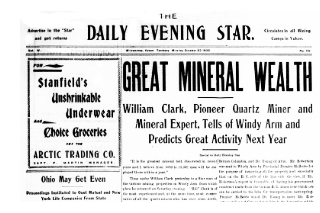
- October 30, 1905: "It is the greatest mineral belt discovered in recent years and I believe from 5000 to 10,000 men will be employed there within a year." Thus spoke William Clark yesterday to a Star man of the various mining properties on Windy Arm from which place he returned on Saturday evening. Read the entire article and another about Windy Arm in this issue here.
- October 30, 1905: Vincent Hautier, after having been in the hospital all this month as the result of a relapse of typhoid fever, was again discharged from the hospital today. He is thinking of going outside soon.
- October 30, 1905: Al and Eugene Larose, "Doc" Thompson and Mike Cyr brought a big pole raft through the rapids yesterday and will bring down another Thursday of this week. The quartette has been busy for the past month cutting piles on the river up toward Tagish lake. The piles will be used by the White Pass company in repairing the dock at this place. Over 300 piles will be used in the work.
- October 31, 1905: Since Saturday morning fully forty people, all summer residents of Whitehorse, have left for the outside for the winter. With very few exceptions they will all return in the early spring.
- October 31, 1905: E. O. Goebel, who enjoys a most enviable reputation as a baker, has opened up in what was formerly the Saddlerock restaurant on Front street, south of the postuffice, where he is conducting a first class bakery and where be invites the people of Whitehorse to give him a trial order.
- October 31, 1905: Joe Bingham, who conducts a roadhouse at Silver City in the Kluane country, is in town on business.
November
- November 11, 1905: Notices of incorporation are posted for Conrad City Electric & Power Company, Conrad City Water & Supply Company, Conrad City Telephone Syndicate, and Voepel Power, Light, Water and Telephone Company (the latter to operate at Carcross or within 50 miles.
- November 11, 1905: A ledge which assays show is rich in freemilling gold has been found a mile north of Conrad City and close to the lake.
- November 11, 1905: Notices of two roadhouse partnerships are posted: the Bear Creek roadhouse is now owned by J. Beauchamp, who bought out E. J. Proulx; and the Takhini and Little River roadhouses are now owned by W. A. Puckett, who bought out G. I. C. Barton.
- November 17, 1905: Rev. I.O. Stringer, lately rector of Christ church at Whitehorse, has been elected bishop of the diocese of Selkirk. He follows Bishop Bompas who resigned on account of the infirmities incident to old age.
- November 17, 1905: After a prolonged illness, Tagish Charley, an Indian well known throughout the Yukon and said to have been the most clever hunter of his tribe, died Sunday night [November 12th] from consumption. The funeral took place Monday afternoon,
- November 27, 1905: Dr. Antone Varicle, prime mover in the proposed Yukon-Polar expedition, will, as noon as he reaches Dawson, for which town he sails from Seattle tonight, take steps to organize an expedition for the relief of the whalers
imprisoned in the ice in the vicinity of Herschel island. Read the entire article here.
- November 27, 1905: The ice in the river at this place is very heavy and it is believed it will cease moving within the next 24 hours. A jam a few miles below town caused the water to rise several feet at this place this morning.
- November 27, 1905: A lengthy Letter to the Editor complains about the planned change of the name of Caribou to Carcross. Read the entire letter here.
- November 28, 1905: The bosom of the river at this place became still yesterday evening at 4:10 o'clock and from row until the latter part of next April no water will be seen - only a solid surface of ice. Early in the morning the ice jammed on the bar four miles below town and continued to back up until it stopped in front of the
depot at the hour above mentioned.
- November 28, 1905: Without having been nearer than 1000 miles of the camp, the editor of the Victoria Week gives the following learned dissertation on the booming of the Windy Arm country: Read the entire negative article here.
- November 28, 1905: Mark Gilliam went down to Conrad City yesterday with his dog team and a load of freight over the new trail. This is the first dog team to go from Caribou this year.
- November 29, 1905: The ballots in Whitney & Pedlar's ice guessing contest were canvassed yesterday evening by P. R. Peele and E. J. White who found that Mrs. G. S. Fleming was entitled to the dress pattern and L. B. Davis to the suit of clothes. In all there were 167 guesses deposited, with dates ranging from October 19th to December 8th.
- November 29, 1905: Staff Sergeant Fitzgerald and Constable Walker, Royal N. W.M.P., are here on the way from Regina to Dawson at which place they will form a part of the police patrol which will leave on December 15th for the mouth of the McKenzie river. Staff Sergeant Fitzgerald was formerly in charge of the police station on Herschel island.
- November 29, 1905: A middle aged respectably dressed woman who gave her name as Moore has just completed what most people would call an interesting trip out from Dawson. Read the entire article here.
December
- December 1, 1905: Two old-time Yukoners were lost back on October 26th when their scow was sucked under the ice below Coal Creek. Lost were James Sullivan, manager of the McDonald Trading Company at Dawson, and builder B. F. Sinclair from South Dawson.
- December 1, 1905: At a cost of more than $50,000 the Alaska Steamship Company is installing new boilers in the liner Dolphin, and converting her to an oil burner.
- December 6, 1905: Constable Vinail, secretary of the R. N. W. M. P. skating rink organization, announces that the skating rink at the barracks will be open for the first time tomorrow night to all persons holding invitations. The ice is in fine condition and an evening of rare entertainment is promised.
- December 6, 1905: A fire at the blacksmith shop at the police barracks was quickly contained, but considerable water damage was done to the adjoining tailor shop, and several firemen got frostbitten ears.
- December 6, 1905: John Pugh of Vancouver has opened a taxidermy shop at Carcross.
- December 15, 1905: Allen McDonald sold his lot and cabin situated on Front Street in Conrad to August Voelpel, formerly of the Whitehorse Steam Laundry. The price is said to be in the neighborhood of $800.
- December 16, 1905: R. W. Newsom who owns a roadhouse on 60 above on Burwash, arrived in town by dog team last night. He says that Burwash creek is very quiet this winter, only 15 or 20 men being on the creek at present, but as others are going in there will probably be as many as 30 men at work on the creek shortly after the beginning of the new year. The greatest drawback on Burwash, Newsom says, is lack of provisions.
- December 16, 1905: A letter from "The Stroller" (E. J. White) to William Paterson, Minister of Customs, is printed. It begins "A little matter has lately been borne to the Stroller's ears and he, having at heart the interests of the Dominion, feels that it is his duty to make you aware of the report. The story is that your customs inspector who mingles with the clouds and vapors on the summit of White Pass lately collected duty to the amount of 10 cents on a lunch which a wayfaring man had in his possession when he crossed the boundary line."
- December 16, 1905: Dr. Edwards seems to have been able to withstand all the allurements offered by Whitehorse to settle here, and to have followed out his original intention of going to Conrad City to establish a practice. He expects a population of 10,000 in the vicinity of Windy Arm by early spring.
- December 26, 1905: "The Daily Evening Star of Whitehorse bas been en-smalled, but still shines with as great brilliancy as before. It's good, what there is of it." (Douglas Island News). Yes, we decided to be friendly and move back so we would be in line with the town.
- December 26, 1905: The steamer Portland went ashore on Spire rock five
miles from Ketchikan on the night of December 21st and is breaking up. She will be a total loss. The passengers, crew and mail were taken off by the Alki Sunday. The captain and a
few others are staying with the ship.
- December 26, 1905: Billy Weisdeppe, the popular owner of the "Diamond W" outfit, drove a party of friends from Conrad over to Caribou on Christmas night in one of his four horse sleighs, returning the following day. The oldtimers at Caribou have not yet
recovered from the shock und novelty of seeing a four horse stage.
1906
January
- January 2, 1906: With every man keen and alert and dogs feeding on their mettle, the Royal Northwest Mounted Police patrol from Dawson for Herschel island - the longest and most difficult Arctic patrol in the world - got away at 8:30 o'clock today in the dark of the Arctic morning. Six long dark strings of figures drew away in the shadows of the police square, and rounded the corner into the highway with a snap.
- January 2, 1906: The White Pass Barber Shop in new White Pass Hotel, Sharp & Grigwire, proprietors, is advertising first class work guaranteed, and "River Water Baths Only Fifty Cents."
- January 2, 1906: J. P. McLennan arrived yesterday on the stage from Dawson on his way to the outside, having closed out his mercantile business in the Yukon metropolis.
- January 12, 1906: It is reported from Conrad that a rich body of high-grade, concentrating ore has been discovered on the Black Hawk mineral claim near the Montana mine and the indications are that it will surpass anything yet found on the hill. The Black Hawk is one of a group of three claims which was located last summer, the others being the Mabel S and the Timber Line.
- January 12, 1906: For first year residents the present weather is something of a revelation, but they may congratulate themselves that 45 below is very mild compared with what oldtimers have experienced. Blue snow may come yet and when it does everybody will know that the temperature is at least 74 below, for that is as warm as blue snow ever falls.
- January 12, 1906: As soon as the weather moderates sufficiently to permit of sacking ore, the Copper King mine owners will make a shipment to the Tyee smelter. A part of a carload was hauled in from the mine several days ago.
- January 17, 1906: The assay office at this place, in charge of Robert Smart, is the only government assay office in the territory, the one at Dawson having been discontinued by reverting to the owner from which it was leased, D. A. Matheson.
- January 17, 1906: Peter Richen, who made the round trip from Caribou to Conrad on Billy Weisdeppe's "Diamond W" stage line, says Weisdeppe made George W. Curtis a good offer to travel back and forth on his stage in the capacity of a wind break - a sort of
snow fence - for the protection of other passengers. George has the offer under
consideration.
- January 17, 1906: R. Ryder is advertising Pure River Water delivered at your door every morning at reasonable rates, and Garbage and Scavenger Work done on short notice.
- January 18, 1906: Robert Lowe, Yukon councilman and and progressive business man of Whitehorse, returned yesterday evening from an extended trip throughout the North-West country in which he visited Regina Edmventon, Calgary and other principal points. Mr. Lowe went outside in the interests of a number of local men who, with himself, had formed a company for the purpose of acquiring extensive real estate holdings in the great Northwest, the "granary of the empire."
- January 18, 1906: Miss Ellis of the Caribou mission school returned to that place today after spending two weeks here, the guest of Rev. and Mrs. Cody.
- January 18, 1906: Government Assayer Robert Smart, who returned last night from a month's visit in Seattle, says that much interest is being manifested there in the mining propositions of Windy Arm, also in the copper mines in this vicinity.
- January 19, 1906: Frank Kubel frozen to death; Ed Webster frozen so that his legs will have to be amputated, and a third man frozen to death. This is the summary of a report of disasters in the Fortymile and on the upper Tanana brought to Dawson by Charles Wetzler, a White river pioneer, now a freighter on the Fortymile river.
- January 19, 1906: Tom Kirkhouse, the well known miner, writes from Vancouver that he is enjoying life and taking full advantage of the vacation he gave himself after
several years in the north. He says he showed them how fast a Yukoner can go both in Vancouver and Seattle, but finally got a strangle hold on the demon, choked it into submission and left it lying senseless in the streets of Seattle. He is now an honored member of the Methodist church and is thinking of going to Conrad to assist in locating a Methodist church at the new camp.
- January 19, 1906: Sam McGee left with his family this morning for Toochi where he is operating Racine's sawmill. Frank N. Johnson is interested with Mr. McGee in the lumber industry which bids fair to be very prosperous the coming season.
- January 20, 1906: For the first time in the history of its operations, extending over several years, the White Pass company this morning suspended its regular stage schedule owing to the unprecedentedly cold weather. Read this and other articles on our page about this week of extreme cold.
- January 20, 1906: A. N. Bindy, a wellknown Juneau pioneer, committed suicide last week by hanging himself. The body was found hanging by the neck from a piece of clothes line four strands thick.
- January 20, 1906: Frank Spriggs, former corporal in charge of the town police station, left this morning for Goldfield, Nevada, where he hopes to carve out a fortune for himself.
- January 22, 1906: Old Boreas who, in Greek mythology, is said to be the personification of the north wind, has shown ample demonstration of his power within the
past few days, by driving the temperature down to 73 degrees below zero at this place last night, forcing the White Pass company to abandon all trains today. [The official temperature figure of -56.2°C / -69°F that night remains the coldest ever recorded in Whitehorse.] Read this and other articles on our page about this week of extreme cold.
- January 22, 1906: New-laid eggs are 60 cents per dozen at Capt. P. Martin's Arctic Trading Co.
- January 22, 1906: Every progressive man in the north will rejoice when John G. Brady is no longer governor of Alaska and when the position is filled by a man who is in
touch and accord with the spirit of progress that now prevails in the broad white north. There is still work for the missionary but it is elsewhere than in offices of state.
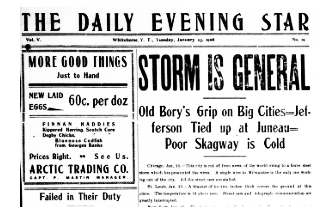
- January 23, 1906: The steamer Jefferson enroute from Seattle to Skagway, arrived at Juneau last night covered with ice several inches thick. A cablegram to her captain instructed him to tie up there and await better weather. A terriffic wind is blowing from the north at Skagway. The temperature is 18 below zero.
- January 23, 1906: Trouble has gone so far between the editors of the two Dawson papers that "honah, sah" cries aloud for satisfaction. If they will come to Whitehorse we will agree to employ a doctor and hold their coats and they can shoot it out on our preserves. There are a number of fine dueling grounds in this locality, but we warn our people to hunt their cyclone cellars when firing begins.
- January 23, 1906: No trains were operated by the White Pass company today, travel, trade and commerce being stilled on account of the weather, which it is hoped and believed will have sufficiently reformed by tomorrow morning to permit of the regular schedule resumed.
- January 24, 1906: The Pacific Coast Steamship company's steamer Valencia was wrecked off the west coast of Vancouver Island Monday night while on the way from San
Francisco to Seattle. A number of survivors were endeavoring to make a landing at Cape Beale lighthouse in a small ship's boat when it was swamped in view of the light keeper who hastened to the rescue, saving six people who say they are all who escaped alive of over 100 persons.
- January 24, 1906: Always ready to oblige its patrons, the White Pass company attempted to run a train from this place to Skagway today. The train started from here at 10:30 but had been gone less than five minutes before an order came from the train dispatcher at Skagway to abandon it for the day as the weather at that end of the route was too severe to send a rotary snowplow out to clear the track.
- January 24, 1906: The steamer Jefferson left Juneau 38 hours ago for Skagway and has not since been reported. It is possible, however, that she is lying in Berner's bay until the storm which is raging ou Lynn canal abates.
- January 25, 1906: Today all Yukon is shut off from telegraphic communication with the outside world. The Dominion wire is down between Atlin and Ashcroft; the government cable is disconnected at some point south of Haines, and the government wire from Eagle to Valdez, where it connects with another branch of the cable, is also down.
- January 25, 1906: A train having on board four issues of the Daily Star left for Caribou at noon today and its arrival would be hailed with delight by the residents of
that town. The train would also carry any passengers and care for all business that might be presented along the route. As the storm is still raging at and south of the summit the train will probably not attempt the through trip to Skagway.
- January 25, 1906: After being unreported for nearly 60 hours the steamer Jefferson arrived at Skagway with between 40 and 60 passengers at 12:30 o'clock today. During the recent heavy storm the Jefferson was "holing up" in a sheltered harbor on Lynn Canal.
- January 26, 1906: Godfrey Chealander, the hustling commissioner of the Alaska-Yukon exposition, states that plans for the exposition to be held in Seattle in 1909 are being pushed energeticaly and the outlook is promising.
- January 26, 1906: In the neighbourhood of Log Cabin, Fraser and the Summit 24 inches of snow fell last night and 22 inches fell the previous night. There were four
feet of snow at those places nearly a month ago.
- January 26, 1906: Henry Neubaumer, the man who murdered his former sweetheart, seriously wounded three other persons and then killed himself at Boise City, Idaho, on Tuesday of this week, occupied room 16 of the White Pass hotel at this place the night of the 4th of this month, having arrived from Dawson that day. He left a valice and bag of clothes to be picked up later.
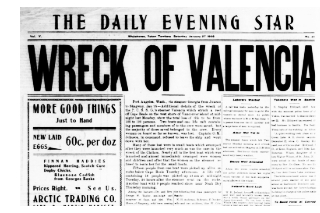
- January 27, 1906: Additional details of the wreck of the P. C. S. S. Co's steamer Valencia which struck a reef off Cape Beale on the west shore of Vancouver island at midnight last Monday, show the total loss of life to be from 108 to 123 persons. Two boats and one life raft containing passengers and members of the crew were saved. Several boatloads are said to be lost at sea from exposure. Captain O. M. Johnson, in command, refused to leave the ship and went down with her.
- January 27, 1906: A call was made yesterday by the railroad company for men to go to the Summit to shovel snow. At points where the snow is 30 or 40 feet deep it is passed from one tier to another and a large force of men is required.
- January 27, 1906: One of the most sudden changes of weather probably ever experienced occurred here yesterday evening when, from four degrees below zero at 5 o'clock, p.m., it rese to 30 degrees above, a change of 34 degrees, by 5:30, a change of more than one degree for each minute.
- January 29, 1906: Edward J. Thain, a prominent citizen of Atlin, died at that place recently after an illness of only a few hours. He arrived in Atlin on March 22nd, 1899, and for a year or so engaged in business, after which he mined on Boulder creek for some time. Read the entire obituary here.
- January 29, 1906: Wiliam Drury, merchant, mayor and hyas tyee of Little Salmon, will arrive in town by dog team this evening on a business and pleasure trip. He
left Little Salmon last Thursday.
- January 29, 1906: Mr. McDonald, a hotel man of Atlin, came in Saturday evening from Conrad where he contemplates engaging in business.
- January 30, 1906: After experiencing the pangs of hunger and suffering from exposure to the cold for twenty-one days on the trail from Fairbanks to Valdez, several people arrived in Seattle yesterday morning on the Santa Ana. Read the entire story here.
- January 30, 1906: A movement is on foot to establish a dancing school. Several young people in town who wish to learn the art, have engaged the N. S. A. A. hall for Wednesday night, when the first series of lessons will be given.
- January 30, 1906: Dr. H. A. Young, M.P.P. for Atlin, has arrived in Victoria to attend his duties in the legislature. He reports that while shortage of water last year
cut down the production in his district from what it would otherwise have been yet the indications are that the coming season will be a record one. The production during last year was about $660,000.
- January 31, 1906: Everything at Conrad points to great activity in the near future in the matter of the erection of buildings and the launching of business industries of every description. The greatest activity now displayed is in real estate circles, particularly in what is destined to be the business part of the town, although the demand for locations as far back from the waterfront as the third row of blocks is quite active.
- January 31, 1906: A White Pass stage with mail and passengers is due to arrive from Dawson this evening. An independent stage driven by a man named Adams arrived from Dawson last night with four passengers.
- January 31, 1906:
February
- February 1, 1906: Peter Richen, one of the most popular hotel men in the country, has all arrangements perfected for the erection of a hotel at Conrad. The building will be 30 by 80 feet, two and one half stories, with an annex 18 by 30 feet. It is his aim to make his new place of business first class in every particular.
- February 1, 1906: The election in Dawson yesterday resulted in a majority of six for a hydrant water system which will be put in by D. A. Matheson.
- February 1, 1906: The report that Sergeant Oliver is to be transferred from the town station, where he has been in charge for nearly a year, to some downriver post, is a distinct disappointment to every business man in Whitehorse as during Oliver's incumbency at the town station the peace interests of the town have been most closely guarded in a careful but unostentatious manner. As a level-headed peace officer, Sergeant
Oliver has few superiors.
- February 6, 1906: Capt. Roald Amundsen, who had planned to leave Eagle today for Herschel island, where he will rejoin his vessel and men, is taking with him a
number of articles, notably medicines, for the imprisoned whalers in the Arctic. Since a long, hard mush of 35 to 40 days is to be made over the ice and snow, particular care will have to be taken that the liquid drugs are not damaged.
- February 6, 1906: At Dawson the managers of the Carnegie library thought $10 per cord too much to pay for wood and cancelled that contract. In a few days a cold wave came along and put a crimp in the stock of wood on hand and wood was now $20 per cord. By the time Dawson supports her Carnegie library a few more years she will realize that a white elephant was unloaded on her once
upon a time and that to perpetuate the name of the old armour plate magnate comes high.
- February 6, 1906: Plans have been made for the resumption of upper Yukon
river improvement work next spring. Hell Gate is to be cleared and the channel made deeper there by the closing of several draws that now distribute the water over several channels.
- February 8, 1906: Hon. W. W. B. McInnes, commissioner of Yukon territory, arrived on yesterday evening's stage from Dawson en route to Ottawa on business for
the territory with the heads of the departments, principally with Hon. Frank Oliver, minister of the interior. Mr. McInnes is accompanied by his wife, two children, governess and maid.
- February 8, 1906: Martin Itjen and partner who own one of the best claims on Burwash creek, arrived from Skagway recently and have left with an outfit of five tons for that creek. Mrs. Itjen accompanies her busband. The men have two horses and figure that it will require at least six weeks for them to land their outfit on their claim. The two men are said to have taken about $4000 out of their claim Jast year,
- February 8, 1906: The Yukon curling club played in Winnipeg all Tuesday afternoon, evening and yesterday without defeat.
- February 13, 1906: Gilbert Hector Shaw Sproat, superintending engineer of the B.Y.N. fleet of steamers since 1901, died in Victoria this morning. It is believed that he died as the result of injuries sustained by a runaway on the hill west of Whitehorse the 23rd of last September when he was severely injured by being dragged some distance under an overturned wagon. He was about 39 years old, and not married.
- February 13, 1906: Otto Zitska, the well known pioneer jeweler of Dawson, is dead - probably of a broken heart. He was a native of Frankfort, Germany and came here during the rush of '97. In 1899 and for two or three years afterwards he was worth considerable money but luck had been against him the last few years. When he went out last year he practically broke. He arrived outside to find that his wife had a divorce from him. This last stroke induced a state of despondency from which he never recovered. His death took place in San Francisco a few days ago.
- February 13, 1906: After being out of business for two weeks the cable between Haines and Juneau was repaired yesterday afternoon and is once more in working order.
- February 15, 1906: The Whitehorse Carnival was a great success. At both the skating carnival on the police rink and at the dance which followed at the N.S.A.A.
hall last night, immense crowds were present.
- February 15, 1906: Norman E. Smith, a well known Tenakee hotel man, has sworn out a warrant for the arrest of Eva McDaniels on the charge of arson. It is alleged that the woman was stopping at the Smith hotel and in a fit of anger poured coal oil over one of the bed rooms and set it afire and only by prompt action was the building saved. Coal oil Eva is an old timer in the Yukon and the only thing suprising in connection with her latest escapade is that she would be permitted to occupy a room in s decent hotel.
- February 15, 1906: W. A. Beddoe, former Dawson newspaper man, is holding down a job in the parliamentary building in Ottawa. Beddoe stated that he was not coming back to Dawson, and volunteered the information that a good man is not appreciated in the Yukon. When he left here a year ago he looked fondly on the governor's residence as he waved a fond adieu and said, "I'll be back in seven weeks." He never came back.
- February 24, 1906: Dr. Alfred Thompson, M. P., accompanied by Mrs. Thompson, baby Alfreda and sister, Miss Louise Thompson, arrived on a White Pass stage from Dawson this forenoon after a pleasant trip. The party will be here until Monday morning when they will go to Skagway, taking the steamer Amur that evening for Vancouver, en route to Ottawa.
- February 24, 1906: The hard times dance given by the police orchestra at the N. S. A. A. hall last night was a howling success in every detail. Fully forty couples were on the floor and nearly as many more were present as spectators. Genteel poverty was apparent in many of the costumes worn both by ladies and gentlemen.
- February 24, 1906: James and Eli Hume and Len Cousins have returned from Conrad where the former is engaged in business and where the latter two have just completed a business house for August Voelpel and have also done other work in the building line. They report that the new town wiil be the most active place in the territory within a few weeks.
March
- March 2, 1906: J. P. Rogers has resigned from his job as superintendent of the White Pass railway as of April 1. He will be succeeded by Victor I. Hahn, who takes charge of the office duties March 15.
- March 2, 1906: A crew of men was attempting to remove the snow from the roof of the Macaulay warehouse in Dawson when the whole thing took a slide down the corrugated iron roof, and landed on Hutch's stables below. That roof collapsed, and over 20 cutters and carriages were damaged, at least two beyond repair.
- March 2, 1906: The police killed two dogs which were formerly owned by the late George Bauerman. As no one was able to catch the dogs and as they kept up a constant howling around the ruins of their former master's home, it was necessary to kill them before sleep was possible to residents of that part of town. [Bauerman died when his cabin burned onn February 18.]
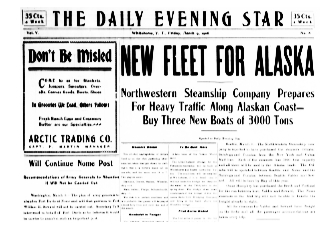
- March 9, 1906: In preparation for heavy traffic along the Alaskan Coast, the Northwestern Steamship Company has purchased three new steamers (Orizaba, Saratoga, Yucatan) of 3000 tons.
- March 9, 1906: The Allis-Chalmers dredge for the Fortymile concession will be built at Whitehorse and floated down the Yukon. The machinery will be installed at Whitehorse if it is found that it will not make the dredge too deep for the water in the Thirtymile in the spring time. The dredge is an exact counterpart of the dredge of the Bonanza Basin Gold Dredging Company now lying at the bank above the Klondike bridge at Dawson.
- March 9, 1906: Some years ago when the bicycle craze was at its zenith half the people on the continent wore what was called "the bycicle face." At present the outside papers are all talking about "the automobile expression." It is not yet worn or recognized in Whitehorse as we have none of the "Divil wagons" here. But we do have "the phonograph attitude," which consists in holding the head rather high and slightly pitched to one side, the result of persistent listening to various makes of machines and records.
- March 12, 1906: Word comes from Dawson that the Monte Carlo building on First avenue was destroyed by fire last Thursday night, the fire starting about 2 o'clock. The Monte Carlo was owned by George DeLoin, having been built by him after the big fire in 1900. It was the best building on First avenue. The down stairs was occupied by Murray Eads as a saloon and dancehall, the Arcade restaurant and one or two other small industries.
- March 12, 1906: A son of James B. Duke, the millionaire manufacturer of Duke's cigarettes, came up on the Oregon with an outfit intending to mush through to the Tanana but when he reached Valdez and was told that the first thing he would have to do after starting up the gulch from the town would be to skate across a glacier he stuck to the boat and came on to Seward, where he sold a $90 outfit of blankets and cold weather cloths for half cost at the first store. Then he went back on the same boat to get nearer to the old man's cigarette plant.
- March 12, 1906: The Sunday school sleighing party to the Tenmile roadbouse Saturday returned at 4 o'clock in the afternoon after a most enjoyable outing. Photographer Hamacher was along and everybody "looked pleasant" for a number of pictures.
- March 19, 1906: White Pass & Yukon Route has joined the Rosene company to build a railroad up the Copper river from Valdez.
- March 19, 1906: Every day's work done on the various quartz properties of the Windy Arm district attests more strongly to the high values of the ore bodies existing there. New claims are being opened up and within a few weeks miners will be burrowing into the mountain in scores of places. Already a number of small but comfortable fortunes have been made by Windy Arm miners, principally by staking rich claims and selling them to
syndicates who will extract millions for the few thousand invested.
- March 19, 1906: All reports from Fairbanks agree that there has never been a more orderly mining camp in the north. Two deputy United States marshals and one or two town officers preserve law and order throughout the entire Tanana country and have little or no difficulty in doing so.
- March 26, 1906: Ottawa has asked the White Pass company to lower prices for their freight charges into Dawson and the Klondike country.
- March 26, 1906: Wrangel, the oldest town in southeastern Alaska, burned to the ground on March 24. The loss is estimated at $1,000,000.
- March 26, 1906: Dr. P. F. Scharschmidt and Wynn Johnson were recent visitors to Conrad, and they also spent a day at the new townsite of Winton situated about 5 miles south of here. Big Bill Anderson has decided that the Yukon is not a suitable place for him, and he will erect a hotel at Winton, where life is not so strenous. Scharschmidt predicts there will be half a million people, more or less, at Winton this summer.
- March 29, 1906: By an arrangement made between the Bank of Commerce and the Bank of British North America, no more American silver will be put in circulation in Dawson, in conformity to an order issued by the Dominion government for the recall of all American silver.
- March 29, 1906: Rev. H. A. Cody returned last night from his trip to Conrad, where he went to assist in establishing a free reading room. While there he selected a lot
and erected a tent in which the library will be housed until a more suitable building can be built.
- March 29, 1906: Ed. Barton of the firm of Barton Bros., Dawson meat men, went to Skagway this morning to meet another shipment of cattle, which will arrive on the Cottage City due today.
April
- April 2, 1906: According to the Dawson News, there is no truth to be found in any statement that the government has decided to reduce the force of the R.N.W.M P. in the Yukon to fifty men.
- April 2, 1906: The Guggenheims took over all the Treadgold interests on Bonanza, on March 31.
- April 17, 1906: Captain Fitz Horrigan is authority for the statement that a meeting will be held at Caribou tomorrow night for the founding and organizing of a Ten Thousand club, the object being to work for a population for that place of 10,000 inhabitants by the year 1910.
- April 17, 1906: Iron Creek is promising according to Jack Blick, who has been
on the stream all winter in charge of a gang of half a dozen men for the Northern Commercial company.
- April 17, 1906: By an agreement made between the two banks, Mr. Gibbs, of the Canadian Bank of Commerce and Mr. Finlaison of the Bank of British North America, no more American silver will be put in circulation in Dawson, in conformity to an order issued by the Dominion government for the recall of all American silver.
- April 25, 1906: A lengthy report was made on the inaugural meeting of the 'Ten Thousand Club' at Carcross. The group will work towards getting 10,000 residents in the community by 1910. Read the entire article here.
- April 28, 1906: In San Francisco, the last sign of confusion caused by the terrible disaster of April 18th (the great earthquake), has disappeared, and order is at last restored. Active preparation for rebuilding the city are already well under way. Many improvements are to be made, such as wider streets and doing away with Chinatown. The chinks are now encamped at the Presidio, and it has not been decided as yet where they will be allowed to build. Capt. Ritter, of the marine guard, arrested a militiaman named Wilder for reckless shooting. Wilder is twenty years of age and it is said he would shoot at men like at mad dogs.
May
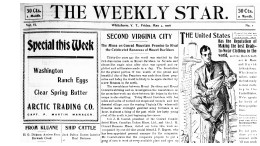
- May 4, 1906: "The Daily Evening Star" becomes the "The Weekly Star".
- May 4, 1906: The similarities between the ore bodies found on Conrad Mountain and those made at Mount Davidson 35 years ago are striking, and a new Virginia City may be about to be developed in the Yukon.
- May 4, 1906: Jack Dalton will give his personal attention to the interior meat trade this year, a business in the prosecution of which, in the early days, he built the
Dalton trail. He will ship great quantities of cattle to Fairbanks and other points on the American Yukon.
- May 11, 1906: Five hundred dollars will be given away in prizes at the Victoria day celebration which will take place in Whitehorse on Saturday, May 26th. Nearly $900 were raised by the active finance committee, more money than Whitehorse has ever before contributed for a like event.
- May 11, 1906: Herb Wheeler left Wednesday night in a well-manned vanoe with 700 pounds of mail for Dawson which will make the trip as far as possible by water and overland the remainder of the distance. No more stages will leave here for Dawson this spring. A stage with mail lefi Dawson for this place Wednesday.
- May 11, 1906: Last night a horse belonging to Robert Lowe was drowned on Lake Laberge while returning from Livingston creek. Three weeks ago a horse, harness, sled and a ton of feed, all belonging to Mr. Lowe, went through the ice on the river between here and the lake and were lost.
- May 18, 1906: T. M. Daulton, president and superintendent of the Anglo-American Mining company of the Windy Arm mining district, arrived on the City of Seattle and will leave tomorrow for the mines where they will begin the work of preparing for the season's activities. Ira Petty, the original owner of the Montana, the Venus, and many other choice Conrad properties, and who still owns property in the Windy Arm district, also arrived on the City of Seattle. He will spend several months at Caribou and Conrad.
- May 18, 1906: It was announced today that new timber regulations are being prepared
for the Yukon. No more timber berths are to be granted; all timber in the future must be acquired by permits. Owners of road houses and settlers will get their timber free.
- May 25, 1906: The business district of Fairbanks has been practically wiped out by fire. Losses are expected to reach $2,500,000. The Northern Commercial company is feeding the destitute from their warehouse stock, which was saved.
June
- June 1, 1906: Byron White, a Spokane capitalist, has been here for several days investigating the Pueblo and adjacent copper properties with the view of taking charge and working them on an extensive scale.
- June 1, 1906: The steamer Quick, Captain Thomas Smith owner, will be again operated this season on the Whitehorse-Iron creek route which includes Hootalinqua, Teslin and Nasutlin river posts.
- June 1, 1906: A. J. Baudette, territorial mining expert, arrived from Dawson on the mail stage Sunday evening by request of Governor McInnes that he meet him here. Mr. Baudette will accompany the governor on a visit to Conrad City from which place the Windy Arm mines will be visited next week.
- June 8, 1906: D. D. Cairnes and H. Matheson of the Geological Survey of Canada arrived from Ottawa on Saturday. They intend to spend a couple of weeks at Windy Arm looking over the mines and other places. They will then visit the coal mines this side of Whitehorse and also at Tantalus. On their return trip they will come by the way of the Wheaton river and explore that place thoroughly. They intend to remain in the country until the first of October.
- June 8, 1906: D. D, Cairnes and H. Matheson of the Geological Survey of Canada, arrived from Ottawa on Saturday, They intend to spend a couple of weeks at Windy Arm looking over the mines and other places. They will then visit the coal mines this side of Whitehorse and also at Tantulus. On their returp trip they will come by way of the Wheaton river and explore that place thoroughly. They intend to remain in the country until the first of October.
- June 8, 1906: Many miles road are being built to access the Windy Arm silver mines and the new townsite of Wynton. Read the entire article here.
- June 15, 1906: Right Rev. William Carpenter Bompas, D.D. died of heart failure at Carcross on June 9, at the age of 72.
- June 15, 1906: The Dominion Hotel in Whitehorse has been leased by Mrs. R. Kelsey. She is advertising beds for 50 cents and single rooms for $1.
- June 15, 1906: Construction of the launch Helen Gould at Whitehorse is nearly complete and she will soon be launched. Named after her sponsor, the launch will be used to support Y.M.C.A. work at Yukon and Alaska military bases.
- June 22, 1906: While at work on oné of the big
dredges being constructed at the B. Y. N. shipyards F. L Weaver, a carpenter, was instantly killed Tuesday forenoon by some heavy timbers falling upon him. He was between 60 and 65 years old.
- June 22, 1906: When driving across Tar Flats near Atlin shortly after 3 p.m. on Saturday last Malcolm Ross, driver for G. A. Kerr & Co., Discovery, discovered the lifeless body of Mrs. Charlotte Till lying on the road. She was 39 years old.
- June 22, 1906: An editorial from the Dawson News forecasts that dredges will have a great future in the Klondike.
- June 29, 1906: The steamer White Horse, flagship of the upper Yukon fleet, knocked all previous records into smithereens on her last round trip to Dawson which she made in five days. Since new machinery was installed in the White Horse she is certainly a hummer in the matter of speed.
- June 29, 1906: The excursion train which will leave here for Skagway tomorrow morning at 6 o'clock will carry a large crowd, it being the annual outing for many Whitehorse people. Returning, a train will leave Skagway at 8 o'clock tomorrow evening and another sometime Sunday.
- June 29, 1906: Captain P. H. Johnston left Tuesday for Carcross where he is putting the little steamer Mable F in shape to operate on Nares and Marsh lakes and on Windy Arm, the main run being between Carcross and Conrad City; also on to Winton when necessary. The Mable F is a staunch little craft and will carry from 15 to 20 passengers.
July
- July 6, 1906: The police steamer Vidette sailed from Dawson yesterday with f
Hindoos, four lunatics and four policemen. The Hindoos came here in May to look for work but no one would give them employment. They are Britishers, but because of their religious superstitions were under such restrictions that they would not handle meat in freight cargoes, nor eat meat killed by whites, nor eat what whites present, and therefore could be of little practical value here.
- July 6, 1906: The Lake Bennett-Gideon-Hainer-Beeman-Phelps Consolidated Gold Placer Mining company is about to be incorporated with $100,000,000 fully paid up capital. The company's property consists of a few recently staked placer claims on a small creek running into Lake Bennett near Pennington, two lengths of sluiceboxes, two second-hand shovels, a half dozen tins of canned beef and a plug of T & B tobacco. The company is starting work on a large scale.
- July 6, 1906: Preparations are being made under direction of Governor McInnes to have a school opened at Conrad next fall. Mr. McInnes says that many people are going to Conrad, and that unless the white channel experiments or something of the kind give the Klondike a new impetus, there will be more people around Conrad a year hence than there are near Dawson.
- July 13, 1906: Yukon police will aid in building the Peace River-Yukon trail, first begun in 1897.
- July 13, 1906: Byron White of Spokane, Wash., mining man and capitalist, has taken a working bond on a group of copper claims in this neighboorhood and already has a force of men at work at the Pueblo gettiog ready for active prospecting.
- July 13, 1906: A number of Carcross people, aided and abetted by a few from Whitehorse, lately stampeded the country in the neighborhood of the headwaters of the Watson river, where very rich "float" gold quartz had been discovered. The main ledge bas not yet been located.
- July 20, 1906: A rich vein of gold-bearing quartz is discovered near Robinson, at the headwaters of the Watson River, sparking a stampede.
- July 20, 1906: Dr. F.J. Nicholson will leave here tomorrow for Conrad City, where he will remain for two weeks before going to Victoria to rest and visit his family for a month. From there will will go to Vancouver, banner city of the Canadian west, to practice his profession.
- July 20, 1906: The shack of Lloyd Hicks, a longshoreman who resides in the northwestern part of town, was discovered to be on fire last night. It was put out but a pocketbook containing $200 was found to be missing.
- July 27, 1906: W.C. Grainger and H.W. Vance locate and file application for a townsite at the railroad siding known as Robinson, 21 miles south from Whitehorse.
- July 27, 1906: The body of E. B. Kissam, who was killed by losing his footing
and sliding down the mountain side while hunting mountain sheep on Canada creek early last December, has been found. As the two men who found it had no means of getting the body out of the deep canyon, it was buried where it was found.
- July 27, 1906: Billy Johns'-Son, a sub-chief of the Teslin band of Taku Indians, wishes to announce to his friends and the world at large that, in consequence of the death of the head chief of this band, he has assumed the name and office of the deceased and desires to be henceforth known as KOW'H-KHA, the head chief, with headquarters at Teslin lake.
August
- August 3, 1906: Governor W. W. B. McInnes, accompanied by the watch dog of the territorial treasury, Comptroller J. T. Lithgow, arrived in Whitehorse Monday night on the steamer White Horse and since that time they have been busy at the various points which are destined to make Southern Yukon famous as the greatest quartz mining field of the North American continent.
- August 3, 1906: The steamer which carried rainmaker Hatfield out of the country had scarcely rounded the point above Lousetown before the windows of heaven were opened and the rain fell in torrents on the very territory which he had been working in vain for nearly two months to dampen. Chief Isaac came to town and said he had three medicinemen at work making rain and that the government must pay him $5000.
- August 3, 1906: The commodious steamer Casca has been secured by the ladies of the Catholic church for a moonlight excursion on Lake Laberge tomorrow, Saturday night, the proceeds to go toward putting a furnace in the church. Fare $1.
- August 10, 1906: Captain John Irving of Victoria is
hene for the purpose of installing a force of men at work on the Arctic Chief copper claim which is owned by himself and William Clark.
- August 10, 1906: A wagon road is being built to the Pueblo copper mine, and another 22-mile one from Robinson to Gold Hill is 3/4 complete.
- August 10, 1906: Major Wood, assistant commissioner of the R. N. W. M. P., returned Sunday from a short tour of inspection of the posts in the southern end of the territory, his itinerary including Whitehorse, Carcross, Conrad and the old police post at Tagish, now occupied only by the telegrapher and lineman.
- August 17, 1906: Work is going right along on the Windy Arm properties. Tbe ore will begin coming over the summit next week and continue for the remainder of the season. Three tramways are now working and three more have been ordered.
- August 17, 1906: Count Von Bernstorff, a wealthy German, arrived here last Friday and left on the Selkirk Monday evening for Dawson. He will return on the same steamer and will leave early next week on a hunting trip into the Kluane and Donjek districts. The count has shot big game in all parts of the world.
- August 17, 1906: Yesterday's train from Skagway did not arrive until 11 o'clock last night owing to slides on the track, occasioned by the late heavy rain. There was a big slide from the mud bank just south of town and another in the neighborhood of Bennett.
- August 24, 1906: Steamboat captains on the upper river are now blessing the government for the work that has been donein the neighborhood of Hellgate, formerly the terror of navigation between Dawson and Whitehorse. The masters arriving report sliding through the straits of the sulphurous name on four and a half feet of water, touching nothing and with room to spare.
- August 24, 1906: Ernest Burwash and Harry Painter, two clever six-horse drivers lately with the White Pass Company and the Orr & Turkey Company, left yesterday on a long overland trip which will occupy the biggest part of a month. They are headed for Valdez and are traveling horseback witb two extra pack animals to carry provisions, their blankets and camp equippage.
- August 24, 1906: Although the season has not been particularly favorable, the B. Y. N. gardens, under the able care of William Hulbert, have yielded very heavily of the very choicest of fresh and tender vegetables.
- August 31, 1906: E. Stewart, scientist, arrived in Dawson on the 19th, completing a trip from Edmonton, making the three thousand miles in only seventy days. The Klondike Argonauts of several years ago spent two years in getting over the same route
with supplies. Mr. Stewart voyaged down the lakes and the Mackenzie, two thousand miles
by canoe, then portaged a few miles to the Porcupine, thence by canoe to Fort Yukon, from which he took a steamer to Dawson.
- August 31, 1906: The steamer Gleaner took a record shipment of ore from Conrad to Carcross Monday morning. The shipment included over 100 tons which were from the Venus and Vault, including sone very rich ore from the Big Thing. The Montana people report that the ore is becoming richer with every shot put in.
- August 31, 1906: Tom Dewar, pie artist and philosopher, is now employed at the Lorne section house where the appetizing odors from his well kept kitchen reach to and permeate the passing trains.
September
- September 7, 1906: Changes to the Quartz Mining Act remove the requirement to obtain a Free Miner's Certificate, and states the requirement for partners in a property to do equal work.
- September 7, 1906: Positive reports from the Venus, Vault, and Big Thing mines on Windy are published in the "Conrad News" section.
- September 7, 1906: A Letter to the Editor complained about five women being forced to ride in a car with 21 men, many of them drunk. Read that letter here.
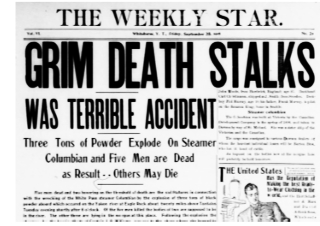
- September 28, 1906: The White Pass steamer Columbian is wrecked by the explosion of three tons of black powder aboard. The accident occurred on the Yukon River at Eagle Rock on September 25. Five people died in the accident, more were injured. Read the entire article here.
- September 28, 1906: The lack of the usual amount of reading matter in this issue of the Star is due to the illness of the head man of our mechanical force, A. B. 'Sam' McEacheran, who has been confined to his bed since last Sunday afternoon with an attack of appendicitis.
- September 28, 1906: Of the 235 persons who arrived here Monday morning, 76 on the White Pass steamer Columbian, the balance on the independent steamer Prospector, nearly 100 hit the ties for Skagway to save the $20 each they would have been held up for by the White Pass company had they taken the train for the city by the sea.
October
- October 5, 1906: Angus Bernard McEacheran was born in Chatham, New Brunswick, July 6th, 1876, and died in Whitehorse this morning. Read his story here.
- October 5, 1906: While the steamer Prospector was on her last trip up from Dawson one of her passengers, Oscar Rastad, disappeared and it is not yet known whether he fell overboard or was left behind at a wood pile, but as his hat and shotgun were left aboard the former is the generally accepted theory of his disappearance.
- October 5, 1906: The steamer Quick returned Tuesday night from a trip to Teslin lake, bringing back with her the hind quarters of fourteen moose, the result of five days' hunting by the boat's crew. In addition to the moose killed a large amount of
smaller game and lake fish were also obtained. The Teslin country is very properly
termed 'hunter's paradise.'
- October 5, 1906: The new government road to the Pueblo mine is practically completed and the work of hauling out ore may be begun any day. It is probable that ore will be shipped from the mine all winter as there are 1500 tons of ore on the dump ready for shipment.
- October 12, 1906: E. E. Winstanley, the only survivor among seven victims of the explosion and fire on the steamer Columbian on the 25th of September, is still at the General hospital at this place where, under the skillful treatment of J. P. Cade and careful nursing of the hospital corps, it is believed he will recover.
- October 12, 1906: The new Roman Catholic church at Conrad City was dedicated on Sunday, Sept. 16th by the Rev. Father Allard. The ceremony of blessing the new edifice was witnessed by fully fifty people. The new church is a frame building 20x30 feet in dimension with two living roons in the rear.
- October 12, 1906: By some means, probably a tip from an outside source, it was learned by the railroad people this morning that a sealed box car in the train ready to
start for Skay way cootained a number of stowaways. Corporal Cole and two of his men opened the car when no less than sixteen men, everyone of whom had a roll of bedding, were found within. The entire bunch was taken off and marched to the barracks where they are now confined,
- October 19, 1906: Thanksgiving in Whitehorse Slightly Insipid. Yesterday was Thankegiving and as such was observed by the school, bank and all the public officers. The fact that there were no turkeys to be had tended to detract from interest in the day.
- October 19, 1906: Every steamer arriving from Dawson for the past three or four weeks has been loaded to the guards with passengers, but none have been crowded equal to those arriving during the past week. The Dawson, Canadian, Selkirk and White Horse, the latter arriving in this afternoon, were all crowded to their full capacity.
- October 19, 1906: Margaret Flemming was married to Joseph Wellington Clifton at Christ Church, Whitehorse, by the Rev. H. A. Cody on October 17.
- October 26, 1906: Captain John Irving, who, with William Clark, owns the Arctic Chief copper mine, completed a deal on Tuesday with Angus McKinnon by which the latter's claim, the Best Chance and Irving and Clark's claim, the Arctic Chief, pass into the hands of a syndicate of which W. J. Elmandorf of Spokane, Wash., is the general representative, but whose interests in the deal just completed were represented by Capt. Irving.
- October 26, 1906: The police made a trip through that portion of town known as the 'North End' Wednesday night and as a result five women were before Magistrate Taylor yesterday charged with violating the liquor ordinance by selling without license. All pleaded guilty and were fined in various amounts, according to past records and previous
convictions. His honor stated from the bench that it is the intention of the authorities to stamp out the practice of liquor selling by women.
- October 26, 1906: A fine young moose arrived from Dawson on the steamer Whitehorse last Friday en route to the 'zoo' at Victoria. The moose is the property of
Governor W. W. B. McInnes and he is loaning it to his former home town as an attraction for its 'zoo'. The animal was captured by a steamers's crew near the mouth of the Twelve-
mile river and brought to Dawson where it was presented to the governor.
November
- November 2, 1906: Winter mail service from Whitehorse northward was inaugurated October 29th.
- November 16, 1906: All operations of the Conrad silver mines have been suspended for the time being. It is believed that concentrators will be installed and a smelter will be erected the coming summer.
- November 16, 1906: A sprouting hyacinthe bulb was stolen from the lavatory of the White Pass hotel early this morning. A reward is offered for information. These bulbs cost 30 cents each.
- November 16, 1906: A lot of mining machinery arrived on Wednesday's train for Byron White. A portion of it will be operated on the Carlisie and a portion on the Pueblo.
It is proposed to sink the Carlisle shaft 100 feet deeper this winter.
December
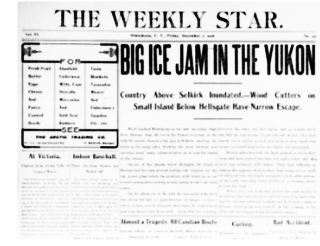
- December 7, 1906: Word reached Whitehorse on the last incoming stage from Dawson that the ice in the Yukon river had, on the 24th. November, formed a big jam at Selkirk, backing the water up for many miles, flooding the river bottoms and carrying away many cabins situated on or near the banks of the stream.
- December 7, 1906: A White Pass stage left yesterday afternoon for Dawson with 2100 pounds of mail but no passengers. The incoming stage which reached here Tuesday night had three passengers from Dawsen en route to the outside.
- December 7, 1906: The sequel to a case of domestic infelicity was enacted at Carcross on Monday afternoon, and had it not been for the prompt interference of the police and the nimbleness of foot of one of the parties interested a bloody tragedy would doubiless have taken place.
- December 14, 1906: A railroad project has been incorporated under the laws of the state of Washington November 27. The incorporaters are headed by Jack Dalton. The route of the line commences at Haines Mission. The railroad renders accessible important and established placer camps along the Lynn canal, the Chilkat river, the Klenihi river and the Porcupine river.
- December 14, 1906: Ernie Jordan left on Sunday's stage for Tantalus where he will engage in getting out timber for the B. Y. N. coal mine near that place.
- December 14, 1906: Dr. Thompson, Tom O'Brien and others who arrived on the stage Sunday night are authority for the statement that in coming down the long hill
between Wounded Moore and Stewart crossing Driver Billy McAdams took off his gloves and rolled a cigarette when the thermometor registered 69 degrees below zero.
- December 21, 1906: Colonel John Howard Conrad never rides a losing race. When he left for the outside a month ago he said work on the Windy Arm mines which was suspended about November 10th would be resumed at an early date. He has made good.
- December 21, 1906: There have been doings in local copper circles during the past week. No less than seventeen options have been given and taken on as many different properties, including the Anaconda, Rabbits Foot, Grafter, and Copper King.
- December 21, 1906: Arrangements are all completed for the union Christmas tree which will be held in the N. S. A. A. hall Monday night, December 24th. Immediately after the completion of the program the presents will be distributed when every child in town will be remembered.
- December 28, 1906: Government House in Dawson was totally destroyed by a fire at about noon on Christmas Day. It was erected in the spring and early summer of 1901 at the cost of about $40,000 since which time nearly as much more has been spent in improving the house and beautifying the grounds. The furniture cost $15,000, being the very finest to be had. Governor McInnes is at present in Ottawa while Mrs. McInnes and children are in Honolulu.
- December 28, 1906: Many mines in the southern Yukon have promising reports. Among them, a quintette of Wheaton river miners is hauling ore out to Robinson from which place it is being shipped to an outside smelter. The ore from Wheaton goes $200 per ton, principally in silver.
- December 28, 1906: During the month of November there were seven marriages in Yukon. Of these five couples were whites and two couples were Indians. Luke Charles, a Twelvemile son of the forest of the tender age of 19 led to the altar Miss Laura, a native daughter who has withstood the tempests of 38 winters. During the month there were 11 deaths, eight of white people and three of Indians. Fourteen births were recorded for the same period, all white.
1907
January
- January 11, 1907: Ivor Wollan and Nick Hanson, who were convicted here two years ago of wholesale robbery of cabins on the hills back of Dawson, have been pardoned
by the secretary of state of Canada, and will be relieved from custody Saturday.
- January 11, 1907: A list is published of 18 missing people who the police have had inquiries about.
- January 11, 1907: Ketchikan's first murder was enacted on January 5th and the cause of it was jealousy between two friends over a woman of the under world who showed
partiality in the distribution of her affections.
- January 18, 1907: A petition is filed to prime minister Wilfrid Laurier for the appointment of Mr. Lithgow as commissioner of the territory, but others are also said to be under consideration by Ottawa.
- January 18, 1907: All this week reports have been current that the White Pass & Yukon Route company has sold its holdings to the Guggenheims. If it is true, as reported, that $42,000 freight was paid on the Bear creek dredge, it certainly stands the Guggenheims in hand to own their own transportation lines before attempting to establish several dozen dredges in the country.
- January 18, 1907: A. Goss and Dent Miller, two Skagway longshoremen, met on a street of that town at midnight Sunday night and had a spirited set-to with knives. As Skagway is a nice quiet town, especially at midnight on Sunday, there were none to molest or make the fighters afraid and when the bout closed Goss was literally cut into strips. He was taken to the hospital where 52 stitches were required to hold him together.
- January 25, 1907: An article in the Atlin Claim says word was brought down Friday afternoon by Charley Baker, of Spruce creek, of a cave-in on the ground worked by Mat McEwan and Dan Burnyeat. Both men were caught in the drift and crushed to death. They were dug out during Thursday night and Friday morning. Read more about the accident and subsequent funerals here.
- January 25, 1907: Dangerous wiring is being used in the Yukon. "Old code cord," or old style wire used for suspending electric bulbs, has been sold to this territory to a large extent. It is a style that was condemned by the United States electricians and underwriters because of being dangerous. It is inflammable, and likely to carry and distribute fire from a defective wire. To sell old stock it was shipped to distant points.
- January 25, 1907: Half the front page is taken up by a promotion asking Atlin voters to cast their votes for Captain John Irving in the election next Saturday. See the entire ad here.
February
- February 1, 1907: One or more dog poisoners have been busy in Dawson and some fine dogs have been lost. The penalty for poisoning dogs is severe, and includes long imprisonment.
- February 1, 1907: A letter received by merchants Taylor & Drury Wednesday evening contained the discouraging news of the total destruction by fire on New Year's
morning of their store building and warehouse at Lake Teslin.
- February 1, 1907: George Martin, a resident of Skagway, has been adjudged insane for the reason that he showed a tendency to hug every woman he met on the street, even the ones who are not so pretty.
- February 8, 1907: The Guggenheims secure control of the railroad and steamer lines of the White Pass & Yukon Route company. The Star admits however that the "report has not been verified and is not credited at White Pass headquarters in Skagway".
- February 8, 1907: Although the desired appropriation for the A.-Y.-P. fair at Seattle developed into a bugaboo of no small proportions, the bill allowing $1,000,000 was finally passed.
- February 8, 1907: Captain John Irving was defeated in the Atlin district but he will be a winner in the district comprising the Arctic Chief and Best Chance. We are rather pleased that Captain John was not elected as we need him here.
- February 15, 1907: A masquerade skating carnival was held with great success in Whitehorse. The celebrations were followed by a grand ball.
- February 15, 1907: All the spare teams in town are busy hauling ore from the Pueblo copper mine to the depot from which place it is shipped to an outside smelter. Almost 600 tons of ore have already been hauled in.
- February 15, 1907: On his recent trip to the outside Robert Lowe purchased a fine large safe which has arrived and is now installed in his office. It is of the Hall make and weighs 1700 pounds. Robert decided that the signs of the times justified the
outlay involved.
- February 22, 1907: The first train to reach Whitehorse for just one week came in Tuesday evening. The train that left here a week ago Wednesday morning lay at Pennington until some time Monday when it proceeded on to Skagway. The track was covered from Glacier to Pennington by a succession of slides due to recent mild weather. The snow in places was 30 feet deep.
- February 22, 1907: Sergeant Aclen, who was last fall transferred from Conrad City to Dawson where he was placed in charge of the town police station, has been relieved of that post. He may be sent to Whitehorse to join Captain McDonnel on the long trip which the captain is to make between Telegraph creek aod Hazleton the coming summer, to cut the new all-Canadian military highway from midland Canada to the Yukon territory.
- February 22, 1907: James H. Rogers, traffic manager of the White Pass, during a recent trip to California, visited the little watering place called Venice, on the ocean beach, and took in the Klondike exhibit which was started by Geo. Ames and R. P. Richtie. They reproduce a very realistic mining scene on Eldorado creek, and have a cleanup, taking from the sluice boxes right before the Cheechacos' eyes, a pan of gold with perhaps $2,000.
March
- March 15, 1907: The Weekly Star prints "an excellent review" of Robert Service's recently published book "Songs of a Sourdough". For the paying teller of the Whitehorse branch of the Canadian Bank of Commerce this is the next step on the ladder to fame.
- March 22, 1907: Fifteen or more survey parties, said to be in the pay of the Northern Pacific, are now running trail lines for a railroad to connect Winnipeg and Dawson City. It is expected the charter for the line will be applied for this summer, but
the Northern Pacific, connection with it will be kept secret as long as possible.
- March 22, 1907: Word comes from the South that W. W. B. McInnes, late governor of the Yukon territory, has been designated head counsel for the Guggenheims in Canada. While his headquarters will be at Vancouver, his duties will take him over the country not a little, and might involve a trip each year to Atlin and the Klondike.
- March 22, 1907: Through the tireless efforts of R. Unsworth money to the amount of $323 has been raised for the purpose of purchasing band instruments. Already
the money has been sent away and the instruments will be here very soon.
April
- April 5, 1907: A lengthy description of the Whitehorse copper zone is presented on the front page. Read it here.
- April 5, 1907: News brought up by men who had just come up the Tanana river is to the effect that the strange malady with which so many of the Nenana Indians have recently become affected is proving a deadly epidemic. The extermination of the whole tribe is threatened, unless the epidemic is stamped out. It is considered remarkable that no whites have as yet been attacked by the disease.
- April 5, 1907: Dr. P. F Scharschmidt, superintendent of the White Pass & Yukon Route river and lakes fleets of steamers, says the coming season will be a fairly busy one for his steamers but the inability of the foundries aod factories to furnish dredges in compliance with the Yukon demand will somewhat lessen the freight shipments of the season.
- April 12, 1907: One of the happiest events in the social life of Whitehorse took place last Friday afternoon and night at the Copper King mine four and a half miles
northwest of town, the occasion being a sort of celebration of the sale of that property by W. P. Grainger and others to the eastern syndicate by which it has lately been acquired.
- April 12, 1907: The weather during the past week has been such as to justify the assertion that the backbone of winter is broken. The snow has melted rapidly during
the past few days and in another week the ground will be bare, revealing countless tin cans and other debris with possibly a dead dog at irregular intervals.
- April 12, 1907: Fistic Combat. A treat is in store fur all local lovers of the manly art next Thursday night at the N. S. A. A. hall when Harry Agee and Chas. Bush will go ten rounds for a decision.
May
- May 10, 1907: William P. Grainger and Gilbert Joyce died in a shaft at the Copper King mine on May 9th when they were overcome by gas from a fire lit to thaw ice. It was Whitehorse's first mine disaster. Read the article here.
- May 10, 1907: The White Pass Hotel has undergone & wonderful transformation in the recent past due to the enterprise of Manager P. D. McMillan and the highly artistic skill of woodworkers, paperhangers, painters and decorators, traces of the delicate hands of artistic workmen being apparent in every room of the house.
- May 10, 1907: A big ice jam a short distance below Yukon Crossing early Tuesday morning caused the water to back up and overflow the banks of the river until it was nine feet deep in the roadhouse at that place. Three horses were drowned in the stable at the crossing, two of them being owned by the White Pass company and the other by Reynolds, the roadhouse keeper.
- May 24, 1907: A strike that places the Copper King mine in the top row of the list of local mining property was made Monday this week when a well defined ledge of copper in place, four feet wide and of unknown depth, was uncovered a short distance below the shaft in which Grainger and Joyce lost their lives two weeks ago yesterday.
- May 24, 1907: Police Magistrate Taylor appeared before a full house last Friday morning when no fewer than ten women residents of the restricted district were before him charged either with selling whisky without license or with being inmates of disorderly houses.
- May 24, 1907: The body of Martin Rock was found in the driftwood on the beach in front of Dawson by some of the men who were taking wood from the river. Rock was drowned in the Klondike river last September while attempting to come down the stream on a raft.
June
- June 7, 1907: With the opening of Lake Laberge there is a direct waterway connection between Whitehorse and Dawson and the navigation season starts.
- June 7, 1907: Joe Hutton, one of the most popular business men in Dawson, died Monday, May 27th, of heart failure. He was one of the pioneers, proprietor of the celebrated Mug restaurant in Skagway during the Klondike rush, and later of the town's Mondamin hotel. He went to Dawson in 1901, and had been in business there ever since.
- June 21, 1907: Vancouver jurist Alexander Henderson is named Governor/commissioner of the Yukon Territory on June 17.
July
- July 5, 1907: There is a premium on boy babies, because they grow into voters and voters build empires and nations. Besides, girl babies never make baseball players. For the above reasons the Star is pleased to announce that at the General hospital at an early hour Tuesday morning a fine boy was born to Mr. and Mrs. H. W. Betts. The father is one of the pioneer postoffice employes of the Yukon.
- July 5, 1907: The group of rich quartz claims on Lake Marsh lately sold by Robt. McKenzie et al to Messrs. Caldwell and Lucas, the former of Kaslo, B. C., the latter of Spokane, is soon to be the scene of considerable activity as it is the intention of the new owners to begin work at once.
- July 5, 1907: The Pennsylvania Syndicate which some weeks ago acquired the valuable Copper King mining property and which for the past several weeks has been
carrying on operations there on a large scale, is having three new buildings constructed, a messhouse, bunkhouse and office, the old quarters being inadequate to accommodate the force now employed. The new buildings will all be constructed of logs but will be finished inside with lumber.
- July 12, 1907: The world's biggest placer merger is perfected in Dawson June 25, whereby the Guggenheim interests takes over properties from A.N.C. Treadgold, Northwest Hydraulic company, and Yukon Consolidated Goldfields company, and other smaller companies. By the deal the Guggenheims absorbs all the placer properties in Klondike watershed. Hundreds of claims - Eldorado, Bonanza, Hunker, Bear - are included in the deal. It is estimated that the claims costs the company ten million dollars.
- July 12, 1907: Hon. Alexander Henderson, newly appointed commissioner of Yukon Territory, arrived Wednesday evening en route from ¥ancouver to Dawson to assume the duties of his office. On the trip over from Skagway he was the guest of General Manager Berdoe in the latter's private car. Wednesday night a banquet was tendered the new governor at the White Pass Hotel Dining Rooms by the citizens of Whitehorse, about sixty of whom were present.
- July 12, 1907: The mutilated body of Hugh Hamiltion was found last night at the bottom of Pooley Canven opposite the messhouse on the Vault Claim. The body which had fallen over a precipice and down a rough declivity fully 200 feet was found by Fred Whiteman.
- July 19, 1907: Statistics show that there are 104 licensed saloons and bars in the Yukon, down from 120 last year. In Dawson there are 31, the upper limit imposed by regulations, while Whitehorse has 4.
- July 19, 1907: "Since the last issue of this paper the editor has visited a number of the mining properties of the local district," and he reports on the Grafter, Pueblo, Arctic Chief, and Copper King, as well as others not visited, including the War Eagle, Valerie, Nelson, Anaconda, Rabbits Foot, and Corvette.
- July 19, 1907: An automobile built for carrying passengers passed through for Dawson this week. It is for Captain J. P. Hubrick, proprietor of the Tower hotel on Hunker creek. Capt. Hubrick probably got the automobile idea while operating the cable ferry at Dawson.
- July 26, 1907: Meagre news of a disastrous conflagration of Victoria has been received here but as the Dominion wire is working badly, details cannot be obtained. A high wind caused the fire to spread rapidly and before it could be controlled many blocks on lower Chatham, Herald, Government and Blanchard streets bad been wiped out.
- July 26, 1907: As there has been no rain to speak of for nearly three weeks the entire country is very dry. The roads and streets traversed by the heavy ore wagons are badly cut up and in many places the fine dust ie several inches deep with the result that a vast cloud arises with every passing team.
- July 26, 1907: The elegant new C.P.R. steamer Princess Royal was at Skagway this week, sailing Wednesday evening, on her maiden trip between B.C. points and the northern terminus. The Princess Royal has 74 large state rooms all the same size, and six suites of rooms on the saloon deck.
August
- August 2, 1907: The fact that about 20 people camped at Ear Lake from Saturday until Monday evening has nothing to do with a big fire which started there Monday night and raged all day Tuesday when it came within but a few feet of a number of tents left there by their owners and which were saved only by the heroic efforts of Section Foreman Chris' gang and Al Larose's road gang.
- August 2, 1907: A boiler weighing. 13,000 pounds arrived trom Dawson on the steamer Casca last Saturday for the Copper King mine and a hoist commensurate with the size of the boiler arrived from the outside about the same time. Twelve horses were required to move the boiler to the mine where it is now being installed.
- August 2, 1907: Oscar Brown, who was here recently taking subscriptions for the San Francisco Examiner, became violently insane at Dawson a week ago. He is now confined at the insane ward of the Dawson hospital where it is said he is a raving maniac.
- August 9, 1907: George Williams, a young man who has lost both feet and one arm, arrived here Saturday and at once began a systematic canvass of the town as a professional beggar, notwithstanding the fact that be had been told by Major Snyder at Carcross that he could not beg in the Yukon. After making a cleanup of probably $50 in an hour, he was instructed to take the train for the outside from whence he came, which he did.
- August 9, 1907: Mr and Mrs. W. A. Reid, the former being army secretary of the Y.M.C.A. for Alaska and Yukon, got away yesterday in their little launch Helen Gould for lower river points on their annual tour. They expect to follow the Yukon to St. Michael and return from there to the outside by steamer.
- August 9, 1907: A mail sack containing 80 pounds of Tanana gold dust was accidentally dropped overboard from a truck in being transferred to the wharf from the steamer White Horse Tuesday morning. Luckily the water at that place is only about eight feet deep and as the weight of the sack prevented it from drifting, little difficulty was experienced in bring it to the surface on a hook in the end of a fishing pole.
- August 16, 1907: Sam McGee has a force of twenty men at work building a road for the government from a point on the Whitehorse-Dawson road a short distance north of McIntyre creek to the War Eagle mine, a distance of a little over a mile.
- August 16, 1907: Hamacher used his gasoline launch to convey a party to the life-giving, health-preserving hot springs lately discovered in the wilds which are contiguous to the Tahkini river about 15 miles from its confluence with the Yukon. A minor mechanical problem forced them to stay overnight at the springs.
- August 16, 1907: Every steamer from Dawson is now coming laden with passengers. They are coming from Dawson and from all lower river points, especially from Fairbanks, all heading for the outside, some for good and others for the winter. Indications are that there will be fewer people by one-half in the country the coming winter than at any time for the past nine years.
- August 23, 1907: Two new roads leading to mines in this locality are now nearing completion, the one leading straight to the railroad from the Arctic Chief and Grafter, and one leading from the Government road near McIntyre creek to the War Eagle mine. Read the entire article here.
- August 23, 1907: An investigation of a possible railway route to the Whitehorse copper mines has made by White Pass Superintendent V. I. Hahn and railroad surveyor P. F. Wright of Seattle. Read the entire article here.
- August 23, 1907: The largest single order for general groceries ever placed on the West coast is received by a Vancouver firm from the Guggenheims. The order calls for the supplying of 500 tons of general provisions for immediate shipment to Dawson.
- August 30, 1907: Jack Dalton came in Wednesday from the head of the White river where he has had a party of prospectors nearly all summer. Mr. Dalton contirms the
report of McGlathlan published in last week's paper of the great mineral wealth of the country, but says that until transportation facilities are provided there can be little done in the matter of developing the country.
- August 30, 1907: The new steamer Pauline, which arrived in Dawson yesterday from Whitehorse, was fined $400 here by the customs department for failing to get a certificate for her hull, boiler and engines. The steamer was rushed to completion, the
owners explain, with the hopes of getting some supplies up the Stewart river and saving that country from starvation this winter, and when they got ready they found the steamer inspector, Mr. Richardson, was unavailable for a month.
- August 30, 1907: The Indian children at the Mission school at Carcross who were reported in last week's paper as being quite sick, are now on the road to recovery. Only one death occurred during the epidemic, that of little Mollie Dixon.
September
- September 6, 1907: Inspector Fitz Horrigan, R.N.W.M.P., is transferred from Whitehorse to Dawson.
- September 27, 1907: Boronite City is the name of a new town at the mouth of Williams Creek, on the Yukon River between Dawson and Whitehorse. An extensive copper ore body has been located in the area. The new town has between 15 and 20 inhabitants.
October
- October 4, 1907: The Yukon Council urged the building of a railway spur at Whitehorse to tap certain copper mines. Read the entire article here.
- October 25, 1907: The actual work of constructing the spur of the White Pass railroad from a point near the head of the canyon to the chain of copper mines lying southwest, west and northwest of this place began Mcnday morning of this week. Read the entire article here.
- October 25, 1907: The closedown of the Venus mine on Windy Arm will be only temporary. The machinery for a concentrator will be hauled over the ice from Carcross this winter and the work of construction will begin about the first of April.
- October 25, 1907: When copper dropped to 13 cents per pound last week the Grafter mine was closed down and the War Eagle stopped shipping. Read both brief articles here.
November
- November 1, 1907: Captain M. B. Raymond's steamer, the Pauline, arrived Wednesday forenoon from Dawson after a brief but very successful season. She is the last steamer of the season, and has tied up here for the winter. The Pauline made
four trips up the Stewart river with full cargoes, also two trips to Fortymile.
- November 1, 1907: Two fine young bull moose arrived on the Casca from Dawson from which place they were shipped by G. I. C. Barton to Vancouver where they will be kept in the zoo until the A. Y. P. fair opens at Seattle in 1909 when they will be taken there and placed on exhibition in the Yukon department.
- November 1, 1907:Al. Dart, one of the teamsters for the White Pass company on its railroad construction, had the misfortune to have his left leg broken Tuesday morning, sustaining a compound fracture. Dart was plowing at the time of the accident which was caused by the breaking of a singletree, a portion of which hit him in the rebound, breaking his leg.
- November 8, 1907: A book about "Soapy" Smith and the history of his tragic death at Skagway in 1898 has been published. Star editor E. J. White verifies the truth of the account, saying that he was the only newspaper man actively working in Skagway when the event occurred.
- November 8, 1907: A letter from L. N. Markle at Robinson tells of many wolves in that locality. Last Sunday wolves ate up two mountain sheep within a few yards of the Robinson hotel The sheep had been killed and brought to that place for shipment.
- November 8, 1907: Mr. and Mrs. J. M. Pooley and Mr. and Mrs. J. M Stewart of Carcross left Wednesday for the outside where they will spend the winter.
- November 15, 1907: Work on the railroad spur to the mines is progressing rapidly and in the course of three or four more days the first mile and a half of the new road will be ready to accommodate a train, the grade for that distance being now completed and the work of laying ties and rails being under way. This will complete the road to the point where a large bridge will be required.
- November 15, 1907: Joe Lamb, who has been in the White river country for the past five years, arrived in town Tuesday night accompanied by Bruce Fisher, a Kluane
pioneer of many years experience. Lamb has about two fair sized counties of copper staked in the White river locality and some of these days when that country is penetrated by a railroad he will find himself a millionaire.
- November 15, 1907: K. Kojimoto, a young Japanese about 25 years of age, died yesterday morning at the General hospital from kidney trouble [Bright's disease]. Read two brief articles here.
- November 29, 1907: The thunderous vibrations and deep intonations felt and heard these days
are not of volcanic origin, but they come from the line of the proposed spur of the White Pass & Yukon railroad to the many copper mines near town to the westward on which rock
work is now being carried on. Read the entire article here.
December
- December 6, 1907: Monday evening Mrs. P. R. Peele and little daughter Vivian were both attacked and quite severely bitten by dogs in their own yard and without the slightest provocation. The little girl stepped outside the door when the two big work dogs owned by Richard Hill attacked her, throwing her down and imbedding their teeth in her flesh, one of her shoulders being quite severely bitten.
- December 6, 1907: Where Are Tho Hunters? There has been no moose or mountain sheep on the market here for some time and as there are no ptarmigan, grouse or rabbits, it is beef, mutton, pork or the earlyday standbys, beans and bacon. There appears to be more money in hunting for heads than for meat.
- December 6, 1907: Up to yesterday evening the weather had not been colder than 16 degrees above zero in the preceding week and from all points along the Yukon come reports of mild weather, the mildest ever known at this season of the year. The river at this place is still almost clear of ice.
- December 13, 1907: A. G. O'Brien, who has well and ably filled the editorial chair in the offices of the Skagway Daily Alaskan for the past five months, has resigned that position to accept the editorship of the Juneau Daily Record. The vacant chair on the Alaskan staff has been filled by Sam W. Wall, one of the best and most able writers in the West.
- December 13, 1907: J. R. Alguire has purebased the interest of Henry Arp in the Club Cigar store and will continue the business alone. Arp has gone into the wood
business, having acquired the interest of Joe Sheldon who has been operating with C. W. Young about three miles south of town.
- December 13, 1907: When chechacos come to the country and start for the hills and mountains with dog teams it is not to be wondered at that they insist on being photographed by Hamacher before leaving. But when oldtimers like Dave Early and George Waltenbaugh, men who have been here for ten years and who are as hoary as the hills and mountains themselves, insist on being "tooken" before starting out on a litle prospecting trip, it is a safe bet that they will locate little more than a place to pitch their tent.
- December 20, 1907: The many runners in Whitehorse will get a chance to display their skills on the 28th, when 3 races will be held: a flatfooted, heel and toe walking race; a white men's running race; and an Indian running race.
- December 20, 1907: W.P.&Y.R. General Manager A. L. Berdoe spoke in Vancouver about what the completion of their copper belt spur will mean to the mines. At present the charges for transporting ore from Whitehorse to coast smelters is $6 per ton, added to which the mine-owners have to pay wagon haul charges which run from $3 to $4.50 per ton, according to the location of the property from the White Pass terminus.
- December 20, 1907: Dawsonites passing through to the outside inform us that a long felt want of that city - a firstclass hotel - has at last been supplied by John Borland of the Occidental. With 57 elegant sleeping rooms, it is located on Third avenue in the central part of town and which is very justly the most popular hotel in the Klondike metropolis.
- December 27, 1907: From a business standpoint the larger merchants of this place have enjoyed a much better Christmas trade this year than last according to information given the Star - a prosperous closing of an all-around prosperous year.
- December 27, 1907: On their way home from an official visit to Champagne Landing recently, Major E A. Snyder and Dr. L. A. Pare visited the Tahkins [sic] hot springs and both were highly elated as well as very much surprised at what they saw. Major Snyder is enthusiastic over the springs as a future health resort.
- December 27, 1907: Work Wanted. Japanese boy wants to do house work by day or hour, please inquire at Japanese Club, near Barracks.
1908
January
- January 3, 1908: Merchant Isaac Taylor celebrated the last day of the old year by moving his family into their new home which has just been completed by him at the corner of Elliott street and Second avenue, and which is among the most attractive homes in Whitehorse.
- January 3, 1908: Corporal Andreason and Constable Brewster arrived Monday evening from Livingstone where they are stationed at the R.N.W.M.P. post. They came in with a team and report the trail in fairly good condition. They say more people are employed on Livingstone and adjoining creeks this winter than during any previous year at the same season.
- January 17, 1908: Assistant Gold Commissioner RC. Miller and Ole Dixon walked all the way to Takhini hot springs. They both express the belief that the springs will, when accommodations are supplied, be very popular as a resort for people with feet, rheumatics and all complaints of like nature.
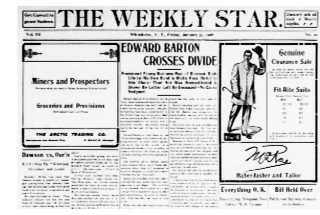
- January 31, 1908: Edward Barton of the firm of Barton Bros., meat dealers and stock importers of Dawson, ended his life at the White Pass hotel in this place Wednesday morning by shooting himself in the mouth with a 38 calibre revolver. Read the entire article here.
- January 31, 1908: The contract for freighting the machinery for the Conrad concentrator from Carcross to the mill site on Windy Arm, a distance of about 15 miles, has been awarded to the firm of Dixon & Schultz of Atlin. The outfit will comprise about 150 tons and it will all be hauled over the ice between now and the breaking up of the
lakes.
- January 31, 1908: The first business meeting of the railway committee was
held in Ottawa on January 14. The British Yukon Railway company asked power to extend its
line to Tahkini river, a distance of about 35 miles, to reach the mires. This is a branch line.
February
- February 7, 1908: The body of Edward Barton, whose death occurred at this place on January 29th while he was en route from Dawson to the outside, was buried in
the local cemetery Tuesday afternoon after appropriate services which were conducted in the Presbyterian church by Rev. Turkington. Considering that the weather was nearly 40 degrees below zero, the funeral was one of the most largely attended in the history of
the town.
- February 7, 1908: Last week two young men arrived here on the way to Dawson where they will be in the employ of the Guggenheims as surveyors. As the young men had just escaped from some eastern college, it was, of course, their first appearance in the
land of the "white silence" and they showed that such was the case by their actions, each
od them donning a brand new pair of white moleskin pants.
- February 7, 1908: Beginning about April 1st, the White Pass company will put some five hundred men at work on rushing extensions of the road. The principal extension is that of the twelve mile spur out of Whitehorse to the copper mines. The company has also ordered two ten-ton locomotives.
- February 14, 1908: A. Olsen and Ben Peterson, two sons of the Norseland, were here a few days ago on their way to the Koyukuk country where they own valuable mining property and where they have been operating for the past several years. They left Sunday with a dog team on their thousand mile journey, nearly two-thirds of which will be over a practically unbroken trail.
- February 14, 1908: Harry "Snowslide" Esquigge, a former Kluane miner, is now an inmate of the asylum for insane at New Westminster to which place he was taken from
Victoria two weeks ago. Esquigge insisted io prospecting on the streets of Victoria for gold and in setting traps in the city for game. He placed several traps on the streets, tying them to telephone and electric light poles.
- February 14, 1908: This week three French, one German, one Italian and one American automobiles left New York for Paris by way of Bering straits. They propose to run across the continent to San Francisco, go by water to Valdez and thence across the country to Nome. They will do well if they ever get ten miles after they leave the Valdez-Fairbanks trail, and it is even doubtful if that highway can be passed over with the machines.
- February 21, 1908: While War Eagle copper mine Manager Kessler is working
but a small crew this winter, only three men being at present employed, good and substantial progress is being made and the property is showing up among the very best in the district. A tunnel penetrates the mine a distance of 125 feet which has revealed vast ore deposits of high grade.
- February 21, 1908: While here from Dawson D. A. Matheson arranged with the B.Y.N. company for the construction at their shipyards of a dredge barge for use on the mining company's concession on the Stewart river where they own a tract 105 miles in length, the largest dredging concession in the Yukon.
- February 21, 1908: A gang of eight men under Foreman Archie Pike left Monday for the purpose of improving the channel of the Yukon river in the neighborhoods of Five Fingers and Rink Rapids. The work is being done by the government and the B. Y. N. company acting in conjunction. The sum of $6,000 will be expended, the principal part of the improvement being the blasting out of rocks.
- February 28, 1908: The local dog market has heen brisk the past few days, the demand being due to contemplated trips down the river. Ed Allen and Angus Seaton paid $90 for three dogs the other day and within an hour one of the animals lay down in the snow and kicked the bucket, thus escaping the long and arduous trip to the headwaters of the Stewart river.
- February 28, 1908: G. A. Singer, manager of the Seattle-Livingstone Mining Syndicate, arrived in town Saturday to meet his wife who came in from the outside. Mr. Singer has been operating on Livingstone creek since last fall and now has a shaft down to a depth of 144 feet with bedrock not yet revealed. He believes, however, that they are near the bottom and that probably a few more feet will reveal that for which they are looking.
- February 28, 1908: The railroad eating house at Bennett was reopened for the season this week by the former manager, A. R. Graves. All trains now pause there 20 minutes for lunch.
March
- March 6, 1908: The masquerade skating carnival followed by a grand ball on February 28th attracted a big crowd.
- March 6, 1908: Four men left Skagway Saturday morning to mush to Dawson. One of them, William Joseph Cotter, dropped behind his companions while walking up the he did not show up at the Summit roadhouse, his companions returned to look for him and found him unconscious near the south end of the big cantilever bridge. A train came along about the time the man was found but be died in a few minutes after being taken aboard.
- March 6, 1908: Twenty-three head of horses were received by the winter mail service department of the White Pass company Friday evening from the ranges of Eastern Oregon to which place Dr. H. B. Coutts went on a horsebuying mission for the company about six weeks ago. Another shipment of about the same number of horses will be received
in a couple or three more weeks.
- March 13, 1908: A large delegation of shipyard men arrived this week from the outside, principally from Victoria and Vancouver where they wintered, and the cheering whistle of the shipyards mill will awaken the snoozing populace after next Monday morning. Geo. Askew will be acting foreman until the arrival of A H. Henderson who will be here in about a week.
- March 13, 1908: Howard Carey, the young man known as "Missouri" who was sent from this place to the Tenakee, Alaska, hot springs for treatment by the people of Whitehorse three weeks ago, was most liberally treated by parties at Skagway to whom he carried letters of introduction.
- March 13, 1908: The Davidson Brothers, who are heavy dredge operators on Fortymile, arrived from the outside Monday evening with a party of men, twenty-three
horses and fifty tons of machinery. The outfit will get away in a day or two.
April
- April 3, 1908: Captain D'Arcy Edward Strickland, commanding the Royal N.W.M.P. at Fort Saskatchewan, died March 24th after a short illness. He was stationed at Tagish and other points in this end of the territory in the early days. He left Yukon in 1900.
- April 3, 1908: Supplied Booze to Reds. George Matheson pleaded guilty on Monday to the charge of furnishing whisky to Indians and was fined §50 and costs by Police Magistrate Taylor. He came through with the "ready John Davis."
- April 3, 1908: William Drury, of the firm of Taylor & Drury, proprietors of the Quality Stores of this place and of trading posts at both Little Salmon and Teslin, returned Monday evening from a three months visit to his old bome in England looking as though he had spent some time at the famed fount of perpetual youth. It was hinted that William might not return alone but he did, and some people are wondering if his calculations miscarried. On his way back he devoted considerable time to buying goods for their stores.
- April 10, 1908: Foreman Herman W. Vance, of the Conrad Consolidated Mines, accompanied by his wife and little daughter, is now at Conrad. Mr. Vance purchased a concentrator for his company while on the outside and will proceed to have it freighted to a point on the upper end of Windy Arm and near the Venus mine where it will be erected and made ready for operating.
- April 10, 1908: Electrician Harvey Jordan arrived from Skagway Monday evening and is now engaged in constructing a telephone system along the route of the railroad spur by which it will be possible to communicate with both Whitehorse and Skagway from the scene of construction, thus greatly facilitating the work of reporting and of ordering needed supplies.
- April 10, 1908: W. S. Jones and partner, Parton, and Jack Pringle arrived Monday from Champagne Landing. Jones and Parton own a dozen or more horses which they purchased from the international boundary surveyors last fall and which they are now offering for sale. H. C. Chambers, vulgarly known as "Shorty," merchant, roadhouse keeper
and freighter at Champagoe, was also in town this week.
- April 17, 1908: The telephone line along the railroad spur was completed the latter part of last week and Electrician Harvey Jorday, who constructed it, has gone to Dawson to take a position with the Guggs.
- April 17, 1908: Thomas Bee, an ex-policeman, was brought to the hospital at this place the latter part of last week suffering from frozen feet, his misfortune having
overtaken him while he was prospecting in the neighborhood of Carmacks. Both his big toes were amputated.
- April 17, 1908: H. W. Vance, manager of the Yukon District Gold Mining company, the new name since the Conrad company was reorganized, arrived Saturday evening with his wife and little daughter. While outside he purchased material for a 70-ton-per-day concentrator and that material has already begun to arrive.
- April 24, 1908: New men are being put to work as rapidly as they can be secured on the railroad spur, but the work of laying track is held back until a number of
bridges are completed in order that supplies and general material can be delivered by the construction train.
- April 24, 1908: With the market for copper now improved, work is going to soon be resumed at the Arctic Chief, Pueblo, and Copper King mines.
- April 24, 1908: Governor Alexander Henderson with his wife and little daughter arrived from Dawson Wedmesday evening on their way to Vancouver. The trip from Dawson to Pelly was made in a sleigh and from that point to Whitehorse on wheels. Although tired and very much sunburned, they arrived in good health and spirits.
May
- May 15, 1908: Ex Commissioner of Yukon William Ogilvie arrived here Saturday evening and wiil be here for some weeks and until dredge No. 1 for operation on the Stewart river is completed which will be about July 1st. Mr. Ogilvie is the organizer and head man of the Yukon Basin Gold Dredging Company, Ltd., which owns a dredging concession of 110 miles on the Stewart river.
- May 15, 1908: Except for an ice jam at Five Fingers the river is believed to be open all the way from Lower Lebarge to Dawson. The water, however, is too low for even scow navigation and up to yesterday evening there had been no rise of the water. If the weather continues as it has been for the past two days it is thought the water will soon come up.
- May 15, 1908: At a meeting of the directors of the N. S. A. A. held Monday night it was decided to go ahead with the work of adding to the building an annex for the
purpose of putting in a bowling alley. The addition will be 100 feet long and will be 20 feet wide about half that distance and 16 feet wide the remainder of the length. It will be two stories high and the equipment will be modern and up to date.
- May 22, 1908: There is a glaring possibility that Whitehorse will entertain more visitors tomorrow than on any one day in her history. Word from Skagway is to the effect that nearly 400 people will avail themselves of the excursion and the opportunity of visiting a live town, the centre of the greatest mining camp in the Broad White North.
June
- June 5, 1908: A big mining deal was consummated here the latter part of last week when the Grafter copper mine, one of the most valuable mining properties of the district, passed into the hands of the Tyee Copper company, one of the biggest mining and smelting companies of the Pacific coast. The deal was engineered by Robert Lowe, the heaviest individual owner of the property.
- June 5, 1908: Corporal Cole, stationed at Carcross, reports the finding of a human skeleton at or near Tenmile Point, ten miles down the lake from Carcross. The discovery was made by one of the Shermer boys. The corporal went to the scene and found not only the remains of a human being, but also the bones of a dog and the rusted barrel of what he believes to have been a flintlock rifle. It is possible the remains had lain there for more than half a century.
- June 5, 1908: Up to Tuesday of this week 186 small boats had left this place this spring for down river points according to the record kept by the police. So far the boats have averaged four and one fifth passengers each which makea the total 780.
- June 26, 1908: All Whitehorse was plunged into mourning last Saturday evening by the startling news that both Alphonse and Eugene Larose had lost their lives in the historic Whitehorse Rapids a mile above town. Read the entire article here.
- June 26, 1908: The last mail dispatched by Supt. Wheeler to Dawson by canoe from this place was taken down in the remarkably short time of 76 hours. This is the best time ever made between this place and Dawson by canoe.
- June 26, 1908: Mr. Brabazon, of the Dominion survey department and head of the International survey corps of Canada, was here this week on the way down the river to join the U. S. surveyors who passed through last week. The two parties work in conjunction in the matter of establishing the international boundary.
July
- July 3, 1908: The grading of the first 6 miles of the railway spur to the copper mines has been completed, and a dozen bridges have been built. Read the entire article here.
- July 3, 1908: The water in the river at this place is slowly but surely rising and from now on trouble on the bars at the head of Lake Lebarge is not anticipated. However, the Selkirk which left here the forenoon of last Friday spent 48 hours on the bar near the head of the lake.
- July 3, 1908: The excursion to Skagway to the annual Fourth of July celebration will be well patronized. It will take place tomorrow and will be the first time Skagway has celebrated on the Fourth for some years, they always having it on the Saturday nearest the Fourth to accommodate the people of Whitehorse who can get away better on Saturday than on any other day of the week.
- July 10, 1908: Ned Elfors, whose trial for the murder ef Emil Bergman near Selkirk on about the 23rd of May began at Dawson on Mouday of this week, was convicted by a jury on Tuesday and sentenced by Judge Craig to be hanged by the neck uniil dead on Tuesday, the 6th day of October. But little is known of the condemned man further than that he is a Russian Finn and quite old, being upward of sixty years.
- July 10, 1908: The Dawson fire department has been reduced from seventeen to eight members. Dawson's fire department cost $61,000 last year while that of Fairbanks, cost $29,000, the latter being the larger of the two towns. This year but $33,000 has been appropriated for maintaining the Dawson department.
- July 10, 1908: On Gold Hill in the Wheaton district, where H. W. Vance and
others own property, ore has lately been found which assays as high as $2,500 to the ton but the extent of the ledge has not as yet been determined.
- July 17, 1908: At present fierce fires are raging in all directions from Whitehorse. A week ago a fire was by some unknown means started in the woods just north
of town and near the bluff. Steamboat men say one of the worst fires they have ever seen along the river is now in progress on the shore of Lake Lebarge while fires are burning
at various other points along the river between this place and Dawson.
- July 17, 1908: The whooping cough which was quite prevalent here a few weeks ago, has almost died out, no new cases having been reported for some time. However, some of the children still give an occasional "whoop."
- July 17, 1908: While the steamer Selkirk was lying at the wharf at Dawson on her last trip a soldier of the Tenth U. S. Infantry who was en route from Fort Egbert,
Alaska, to the outside, fell overboard and was drowned. The unfortunate man was in an advanced stage of "boozeication."
- July 24, 1908: Two Indian Department officials are in the territory, investigating the condition of Indians and selecting sites for Indian schools, the government having decided to further aid the missionaries in their goal of educating the natives.
- July 24, 1908: A Japanese prostitute whose name sounds like "Canned Yams" was assaulted and robbed in the "Shadyville" suburb just north of town. Read the entire article here.
- July 24, 1908: The Skagway Alaskan complains that some vandal has robbed the grave of "Soapy" Smith of its headboard.
August
- August 7, 1908: That Leon Sochia, the man who claimed he was held up by masked men and robbed of $450 on the railroad track gear Pennington while mushing to the outside about June 20th, was a liar of the first magnitude, the police are now firmly convinced.
In talking to the chief of police at his home in Everett, Wash., the story appears to have been concocted to allow him to get away with several hundred dollars he had been entrusted with.
- August 7, 1908: Regardless of the precautions taken for the protection of game, two different parties bent on slaughter left here this week for the Pelly and McMillan countries. They are H. Von Bergen of Berlin, and Count Hoyos of Vienna, Austria.
- August 14, 1908: To dispel the rumours about why construction on the railway spur into the Whitehorse copper belt has been halted, W. P. & Y. R. President Samuel H. Graves has made a statment, part of which is: "The real and only cause of the suspension of work on the spur is this: The owners of mining property lying north of the Best Chance claim have declined to give ue any guarantee that they will ship ore from their properties
even after the track is laid to them and for us to put down our ties and rails to rot and rust from disuse would not be business."
- August 14, 1908: William Drury, lately returned from the Teslin store of Taylor & Drury, brought with him 10 grizzly pelts, most of them around 9 feet in length. With one exception, they were killed while in hibernation, by Indians.
- August 28, 1908: Mining Recorder L. T. Burwash and Mrs. Burwash will leave in the next few days to start an investigation into the best route for a highway into the White River country - from Whitehorse via Kluane, or from Dawson.
September
- September 4, 1908: Mrs. W. Robison has received and has now on display the finest consignment of Ladies Hats and Millinery ever brought to Whitehorse. Everything direct from Paris and is of the very latest styles.
- September 4, 1908: Four articles report on the activities of Colonel John Howard Conrad. He has purchased the Sunrise Group in the Wheaton country; his property at Porcupine, with a work force of 150 men, is doing very well; the new concentrator at the Venus mine will be completed within two weeks; and he, with a sister and her husband, have left Carcross to visit his Porcupine properties.
- September 4, 1908: the new gold dredge being operated on the Stewart River by the Yukon Basin Gold Dredging Company is doing very well, averaging a dollar per bucket, with 2,200 buckets per day being processed.
- September 11, 1908: It is a well known fact that Yukon has been the dumping grounds for undesirables ever since the first rush to the country the fall of 1897, but the law respecting undesirable immigrants is now being rigidly enforced at the Summit. Read the entire article here.
- September 18, 1908: A rich strike of high grade ore is made in the Wheaton country, on the property of Col. J.H. Conrad and known as "Sunrise Group".
October
- October 2, 1908: The pipe for the local water system arrived from Vancouver on Wednesday's train and within the next 24 hours it had been distributed along the streets
on which it will be laid - Front street from the Pioneer hotel to the BYN stables and Main street from Front to the NSAA hall.
- October 2, 1908: The editor visited Carcross last Saturday and found that place, not hilariously booming, but fully as lively as the town he left in the morning. Colonel Conrad is still there and wherever he is there are usually doings.
- October 2, 1908: C. Wynn-Johnson returned to Skagway today, taking with him the police launch, Jessie, which he bought and will ship to Vancouver for overhaul. The present machinery will be replaced by a 30-hp engine and its furnishings will be of the very finest. Mr. Wynn-Johnson will use it as a private launch.
- October 9, 1908: Work at the Arctic Chief mine is being steadily carried on. A new tunnel on a level 65 feet lower than the old tunnel is now in a distance of 323 feet and reveals a gigantic body of rich ore, the extent of which is practically incalculable.
- October 9, 1908: Colonel Conrad and associates contemplate the erection of an aerial tramway over the Chilcoot summit from salt water to a point on Lake Linderman for the purpose of doing a general freighting business, and in this connection Royal N. Riblet of Spokane has been at Dyea taking elevations and a general survey.
- October 9, 1908: A Letter to the Editor states that the first white child born in Whitehorse was Nellie Yukon O'Connor, who was born on January 18, 1900. Previous Letters have stated it to have been Jessie Chapman or the child of Mr. and Mrs. Shaw in November 1900.
- October 16, 1908: Sam McGee's road gang returned Wednesday evening from Carcross to which place the government wagon road leading from this place has been completed. The old Red Line wagon road was utilized a portion of the way but much of the highway is new and all of it is substantial.
- October 16, 1908: Herman W. Vance reports the concentrator near the Venus mine as being completed, and work will be inaugurated at once. The concentrator will handle 100
tons of ore per day and the intention now is to keep it going night and day all winter. Work is being resumed, after two years idleness, at the Big Thing group and from forty to fifty men will be employed.
- October 16, 1908: The work of laying water mains in the streets was practically finished Saturday, nothing but a little cleaning up remaining to be done on Monday. The system is a substantial one but the standing pipes on the corners are not the prettiest things in that line in existence.
- October 23, 1908: Just after the train pulled out for Skagway Friday morning two steamers, the Dawson and Casca, arrived from Dawson with a total of 209 passengers and the sleeping capacity of the town was all utilized in their accommodation that night. The bunch neariy all left for Skagway next day.
- October 23, 1908: The PCSS company's steamer Cottage City collided with a lumber schooner when a short distance out from Seattle bound for Skagway last Saturday and the result was that a large portion of her house was torn away. No one was injured and no freight was damaged.
- October 23, 1908: After a party of three men involved in the Alaska boundary survey were marooned on an island in the swift-running Alsek river after their boat escaped from her moorings, Archie Runnals of this city made a heroic four day journey to get help. He arrived back at the island with help and food on the tenth day.
- October 30, 1908: Monday was election day throughout the Dominion and the result is a complete and mighty endorsement of the policy of that great liberal leader, Sir Wilfrid Laurier, one of the most eminent statesmen of his day and generation.
- October 30, 1908: In the New Era, the official missionary magazine of the Church of England in Canada, Mrs. Bompas, widow of the late bishop of the Yukon, has an interesting and instructive article on the Yukon territory. Its past history, minerals, natives and general characteristics are well described.
- October 30, 1908: The Yukon river closed at Dawson last Sunday, October 25th, the earliest since 1899. The river at this place was running almost full of what is called "slush" ice yesterday afternoon and as it was running slowly and the water appeared to be backing up, there was supposed to be a jam somewhere between here and the lake.
November
- November 6, 1908: Phil Ashmun, for two years past foreman of the Star office, and professional musician, having played "slide" in the U. S. Navy for four years previous
to coming north, has hied himself to Fourth of July creek in the Kluane district, where he will search in the auriferious gravels for the elusive paystreak. Phil has a boiler and several pairs of moccasins and is otherwise well equipped for the work which will be a departure from his former pursuits in this vale of tears.
- November 6, 1908: The roads are in fine condition now or will be when the snow becomes packed. Several inches of snow have fallen in the past few days and wheels have been discarded for runners by all teamsters.
- November 6, 1908: Owing to the heavy ice in the lakes the steamer Gleaner was unable to make her trip to Atlin last week, and the result was that thirty people who expected to get out and go south on the May, were disappointed.
- November 13, 1908: H. E. Porter returned ten days ago from Seattle, bringing with him a general outfit of miners supplies which he is now having freighted
from Robinson station to his property in the Wheaton district where he and his partner, Chas. Eisenhauer, expect to sink two shafts to a depth of 300 feet each the coming season.
- November 13, 1908: The White Pass Company inaugurated a semi weekly stage service between this place and Dawson this week. A stage went out Tuesday afternoon and another will be dispatched tomorrow. Stages now leave Dawson for this place on Wednesdays and Saturdays. A stage will leave here today but will have no passengers. It is not expected there will be much travel to the inside until towards spring.
- November 13, 1908: Banker Donald Ross who has been enjoying a month's vacation, returned Sunday from a ten days hunting trip south westward of town in the Ibex valley. Neither Mr. Ross or any member of his party saw any big game on the trip but they hiyu snow which, in many places, was waist deep and somewhat cold.
- November 20, 1908: A.D. Mullin, electrician for the local electric light and power company, returned Monday evening from Conrad to which place he went to install an electric light plant in the new concentrator of the Conrad mining company. The
installation was successfully accomplished and twenty five lights now illuminate the mill, making it as light as day and greatly facilitating its operations.
- November 20, 1908: Supt. Herb Wheeler of the B. Y. N. company has rigged up a hoist of derricks on the railroad siding in front of his company's stables that is a wonder in the work of unloading ore sleds. The sled containing five tons of ore is driven alongside the track where the car stands and the hoist lifts up the entire box of ore and dumps it into the car in two minutes time where three hours or more would be required
to transfer the ore by the old fashioned and primitive shovel process.
- November 20, 1908: Matthew Watson returned Monday from Carcross to which place he went the middie of the previous week for the purpose of installing a heating plant in
the Caribou hotel of which K. W. Gideon is manager. The building is now heated throughout with a system of pipes, the furnace being located in the pool room.
- November 27, 1908: The hardy miners of the Big Salmon district are nothing if not active. At present fully a dozen of them, after a successful seasons operations on ground proven to be productive, are now prospecting on new creeks in quest of the elusive paystreak.
- November 27, 1908: There is no more healthful or enjoyable sport than ice skating and the people of Whitehorse can bave a rink, under cover and kept in good condition, if they desire it and at small cost. The barracks skating rink has been turned over to the canteen and the boys are ready and willing to put it in good condition and keep it so if the people are willing to pay the actual expense.
- November 27, 1908: Major Snyder returned Monday evening from Skagway to which place he went on Saturday for the purpose of meeting ten new recruits for the police force of this division. The new boys came up on the May and are a husky appearing and fine looking lot of young men. They came from the headquarters of the Royal N. W. M. P. at Regina.
December
- December 4, 1908: The Commercial Hotel was badly damaged by fire and water on December 2. Chief Hume and his men did heroic work but the fire was one of the ugliest in local history owing to the fact that it was practically inaccessable until holes were cut through the iron with which the entire building is encased, and not until thousands of gallons of water had been thrown into the building was the vital spot reached.
- December 4, 1908: Of all the mining operations now being carried on in the Windy Arm country, the workings of the concentrator recently installed are of the greatest. It is situated on the west side of the arm about three miles south of Conrad and immediately below the tunnel whieh enters the Venus mine, probably the most valuable single mine in the entire North, its values consisting of gold, silver and lead, silver predominating.
- December 25, 1908: Staff Sargeant O. W. Evans, accompanied by "Shorty" Austin, arrived in town Saturday evening, having driven over the new government road from Carcross where the former has charge of the Royal N. W. M. P. station. They returned Wednesday morning.
- December 25, 1908: Word has reached here from Conrad that a four horse team belonging to the Yukon District Gold Mining Company was on the way over the lake to Carcross with 70 sacks of concentrates when the ice gave way and everything went to the bottom of the lake except the driver. Read the entire article here.
- December 25, 1908: That triple hanging at New Westminster was pulled off on schedule last Friday when two negroes and a Chinese were launched into eternity by Hangman Radcliffe. It was the first triple hanging to ever take place in Canada.
1909
January
- January 1, 1909: Charley Henderson, an Indian known all over the Yukon and Southeastern Alaska as "Dawson Charley" was drowned at his home at Carcross early Saturday morning by falling from the railroad bridge into the water beneath while endeavoring to cross from the town to his home, he being very much intoxicated at the time.
- January 1, 1909: Letters received here from Colonel J. H. Conrad who is now at the Hotel Belmont in New York, state that the financial conditions generally are very much
improved and that he is meeting with no difficulty in financing several large mine propositions for the Conrad and Wheaton districts. Colonel Conrad expects to remain in New York until Spring.
- January 1, 1909: Dr. L. S. Keller of Skagway will arrive next week on a visit of uncertain duration. While here he will study climatic conditions and tell us what he
saw on his late trip to the outside. He lately suffered a great bereavement in the "departure" of his beloved dog, Sultan.
- January 8, 1909: The Weekly Star is very strongly supporting Robert Lowe in the upcoming election, and strongly bashing other candidates, in particular George Black.
- January 8, 1909: On Dec. 23rd an excellent tea and Christmas tree was provided for the Indians of Carcross at St. Saviors mission. The tea was held in the school room,
plum cake, doughnuts, cookies and other dainties to please tbe palates of the invited guests were plentifully provided by the matron of the school, Miss Collins.
- January 8, 1909: A 600 ton shipment of hay for Robert Lowe was received here on the train of last Saturday. The same train brought a fifteen ton dynamo for the Guggenheims at Dawson. The big machine will be freighted in over the winter trail.
- January 15, 1909: Alex McDonald, "Big Alex" who for many years to the early history of the country bore the name "Klondike King," dropped dead while at work on Clear cleek last Friday (January 8th), presumably from heart disease.
- January 15, 1909: Notwithstanding the fact that fully two thirds of the voters to the Kluane district are located on Burwash creek, the opposition insisted on having the
polling place at Silver, to the great inconvenience, probable disfranchisement, of the greates number of voters in the district.
- January 15, 1909: George Noot, deputy collector of customs at the Summit, took quite sick two weeks ago and has since gone below, having left on the steamer Jefferson
this week. Mr. Noot is well along in years and hiss friends fear he will not again be able to resume his official duties at the Summit, but possibly in some more congenial climate.
- January 22, 1909: Frederick Tennyson Congdon was solidly elected as the Member of Parliament for the Yukon Teritory. George Black was in second place, Robert
Lowe third, and Joseph Andrew Clarke fourth.
- January 22, 1909: Major Snyder has been instructed to enforce the Sunday Act at this place, his instructions being to see that all shops, stores, booths etcetera be closed to the public on Sunday. This act does not include restaurants or drug stores but the latter must confine their sales strictly to medicines. The law will be enforced at once.
- January 22, 1909: In drifting straight ahead in the main shaft of the Big Thing mine a few days ago the workings cut into a large body of high grade gold and silver. The concentrator worked right along during the cold weather until recently when a break necessitated it shutting down for a short time until repairs can be made.
- January 29, 1909: Deputy Collector of Customs George Noot of the Summit, of whose serious illness mention has been made in this paper of the two previous issues,
breathed his last at the White Pass hospital in Skagway Monday afternoon at 2 o'clock. Less than four weeks ago Mr. Noot sustained a partial stroke of paralysis which gradually extended until it encompassed both his body and mind. He was unconscious for a week before his death.
- January 29, 1909: While on his way to his home at Champagne Landing from Whitehorse on Monday "Shorty" Chambers had the misfortune to have his right leg broken
about four inches below the knee by his horse falling on him. H was brought back to the hospital on a White Pass stage.
- January 29, 1909: On January 6th, Willard L. Phelps married Hana Livingstone at St. George's Church in Harriston, Ontario. Following a honeymoon trip to New York and California, they will return to the Yukon about the 1st of February.
February
- February 5, 1909: In response to a letter from George Black threatening to sue, The Star publishes an apology, ending with this: "Anyhow, the editor of the Star apologizes and retracts and hereby requests his readers to expunge, wipe out from
the blackboards or their think tanks, the 'Libelous and Criminal' statements contained in the issue of 'Said Newspaper' of the 15th of January. Angels could do no more. Repentantly but Lovingly yours, E. J. WHITE, Editor Weekly Star. Subscription $5 per year in advance."
- February 5, 1909: William MacDonald, known more familiarly as "Black Bill," foreman of the "big Thing" mine, has become the fortunate possessor of a fine black fox. It is said to be a beautiful specimen, jet black and without a flaw.
- February 5, 1909: Just as he was boarding the Jefferson to depart for Skagway via Dawson, Percy Overton, a wealthy mine owner at Dawson, was placed under arrest by the Seattle police last night on a warrant sworn to by his wife, charging him with desertion. Mrs. Overton accompanied the officers when they made the arrest.
March
- March 26, 1909: A party of four who will prospect the Hootalinqua river with a view of installing dredges, is here and will leave for the scene of future operations soon. The same company had men on the river last season and the work done was very encouraging. Whitehorse is yet destined to become the greatest dredge building point in the North.
April
- April 16, 1909: A season of extraordinary heavy travel from the Yukon and Alaska is expected by transportation men to start early in the summer, the attraction being the Alaska-Yukon-Pacific fair at Seattle, and the cheap round trip rates which are to be put into effect by the White Pass & Yukon route and connecting steamship lines. From Dawson to Seattle and return the excursion rate will be $140, which is a reduction of $40 on the regular fare; the return rate from Atlin and Whitehorse to Seattle will be $80, a reduction of $20.
May
- May 7, 1909: Herman W. Vance, the well known mining man of Conrad, has resigned the position of general manager of the Venus mine and concentrator and will devote his time to the management of operations at the Big Thing mine in which he is an owner.
- May 7, 1909: J. P. Rogers, formerly superintendent of the White Pass and Yukon railroad, has been appointed superintendent of the Spokane, Portland & Seattle branch of the O. R. & N. railroad, with headquarters at Vancouver, Wash.
- May 21, 1909: Previous to leaving with his family for Saskatchewan, W. S. "Sam" McGee was invited to the vacant room over Robert Lowe's warehouse last Friday evening at 5 o'clock where thirty or more of his friends were assembled.
- May 21, 1909: Bishop Stringer will be a busy man the coming summer and fall, the present being the last week in which he will not be continuously on the move. He will leave Carcross tomorrow for Edmonton, Alberta, from which place he will penetrate the vast northland interior by canoe and portage route to Fort Macpherson, a distance of 2000 miles, visiting the isolated church missions enroute.
- May 21, 1909: That tall, graceful delivery horse of the Arctic Trading company is very mild tmannered until he becomes frighteneD and then he can certainly go some. One day this week he took fright at a bicycle aod broke away from his mooring in front of the store. When recovered the wagon was overturned and squarely on top of him. Neither horse nor wagon were injured in any way.
- May 28, 1909: The independent steamer Pauline, Captain N. B. Raymond owner and master, which left the foot of the lake on the 22nd for Dawson with three scows in charge, had very bad luck in the Thirtymile river where for three days she buffeted adverse winds and contended with shallow water, grounding on numerous bars and finally
foundering a scow carrying 312 head of sheep of which 105 were lost by being drowned.
- May 28, 1909: Thus far this spring the police at this place have registered 130 small boats and, as the boats average four passengers, they have carried away about 520 people. In the matter of nationality of those going down the river in small boats
those from the States predominate while England comes next with Scandinavians third. Very few Canadians have gone in the small boat fleet.
- May 28, 1909: The latest venture in the newspaper arena of the north is the Haines Pioneer Press which is published weekly at Haines, Alaska, by the publishing company of the same name. Dr L. S. Keller, of Skagway, being head of the company. The Pioneer Press is a five column quarto and starts out with a fine line of advertising which is the paystreak of all newspapers.
June
- June 4, 1909: The first fatality of the season on the river has been recorded, the police having received word of the death by drowning at Five Finger in the Yukon river Tuesday morning of Edward Hanbridge and William Harvey.
- June 4, 1909: The celebration of last Saturday, for which all arrangements were completed and everything was in readiness, was a complete fiasco on account of rain,
more rain falling on that day than on any previous day for years.
- June 4, 1909: Patsy Renwick who came north and located in Skagway early in the spring of 1898 and who was in Whitehorse for a year or more in the early days when gambling was wide open, died at Skagway Tuesday night of this week, a mental and physical wreck, a mere remnant of the man he was 11 years before.
- June 11, 1909: Fully 500 men are besieging the office of the Guggenheims at Dawson in quest of work of which there is none to be given. Some 1000 laboring men who went to Dawson last year remained there during the winter and to them is given the preference when men are wanted. Another 1000 have gone there this spring and only a few of those who arrived early have succeeded in securing anything to do.
- June 11, 1909: The launch Frontiersman, Captain Tom Smith on the bridge, left Wednesday evening for Tahkini with five tons of freight for Shorty Chambers which the latter will freight on to his place, Champagne Landing.
- June 11, 1909: The report from Lake Lebarge yesterday was to the effect that the ice was still solid and that the indications were the lake will not be open sufficiently for boats to pass through yet for several days.
- June 18, 1909: An aerial tram connecting the Big Thing mine with the White Pass & Yukon Railway, a distance of four miles, will be built this summer. The equipment has been purchased and will be shipped in this month. It will cost $80,000.
- June 18, 1909: The dredge for the Yukon Basin Gold Dredging company which is being constructed at this place and which will be operated on Stewart river later in the
season, is nearing completion, the work of placing her machinery being well under way. The dredge which the same company built here last year is now at work on the Stewart.
- June 18, 1909: A fine new launch, the Nita, arrived here from the outside this week and will be used by the Stewart River Dredging company, of which D. A. Matheson and St. Louis cpitalists are principal promoters. Gilbert Skelley will ship on the launch as skipper.
- June 25, 1909: Dog poisoners are like death in that they love a shining mark. There is a dog poisoner at work in Whitehorse, no less than 17 dogs having been killed by poison this week. Four are known to have died Sunday night, among them the smart little fox terrier owned by George S. Fleming, and for which the owner would not have taken $100 in cash.
- June 25, 1909: Word from Dawson is to the effect that the government has at last been compelled to open free soup houses at that place for the relief of the many
new arrivals that have been disappointed in securing work and who are without means. The Salvation Army has charge of the distribution of food but the government pays the bills.
- June 25, 1909: Instructions have been issued from the headquarters of the Royal N. W. M. P. at Regina that the allowance for servants has been discontinued and
that henceforth officers in the service who employ servants must pay them from their own incomes. While the step has been taken as a matter of economy, it will work a great hardship either on the pockets of the officers in the service or on their wives and
daughters.
July
- July 2, 1909: Robert Lowe and Williard L. Phelps win the June 28 elections for Yukon council for the Whitehorse district, defeating Mr. Campbell.
- July 2, 1909: "Billy" Butler, an old Dawson miner, arrived Sunday on the White Horse and headed for the red light district where he sort of took up a homestead and remained until sometime Tuesday night when he came down town and complained to the police that he was shy money to the amount of $860, which amount he averred had been extracted
from his raiment by one of the demi-monde.
- July 2, 1909: The steamer Pauline arrived about noon Tuesday with 19 passengers, the majority of whom hit the ties for Skayway that afternoon or the following morning. The Pauline will sail from here about the middle of next week with a cargo of freigbt and several passengers for the Pelly river country.
- July 9, 1909: If any set of people ever got theirs, the Whitehoree athletes were the victims at the Skagway celebration last week. From start to finish it was one
long line of unbroken defeat. The Skagway people met us with open arms, took us to their homes, fed us on the best their larders contained and then proceed to fray us to a frazzie in every game played.
- July 9, 1909: Whitehorse people who visited Castle Kern while at Skagway last Sunday are unceasing in their praise of the general attractiveness of the place and its surroundings, asserting that Switzerland (we know not how wany of them have been there) contains nothing to surpass it.
- July 9, 1909: Sam May, of Burwash creek came to town Tuesday for the purpose of getting machinery to work his claims which are showing up remarkably well, states that everyone in the Kluane country is very busy aod those that are sluicing are getting fine results.
- July 16, 1909: A letter from Arnold F. George, Secretary of the Yukon Miners' and Merchants' Association was published regarding his work promoting the Yukon at the Alaska-Yukon exposition. He is conducting three one-hour lectures each day, and the Government Geologist has asked him to try and make arrangements for the best of the ore samples sent down to be shipped to the new Goverment Museum at Ottawa at the close of the fair.
- July 16, 1909: Notice. I am informed that the services of a reliable optician are badly needed at Whitehorse. I have decided I will go there about August 1st, providing I can get pledges of support from ten people. E. E. Kimball, Oph. D.
- July 16, 1909: One of the passengers on the Casca had in his possession two little cinnamon bear cubs which he is taking back with him to Ohio for playfellows for his
children.
- July 23, 1909: 3 p.m. on July 15 marks an epoch in the history of Yukon territory: the first all-elective Yukon council is assembled at that hour, with all members present. The members are, Charles Bossnyt, A.W.H. Smith, James William Murphy, Angus Mcleod, Roderick Leander Ashbaugh, Frank McAlpine, Robert Lowe, Williard L. Phelps. Read the entire article, with a photo of the Council added, here
- July 23, 1909: The Yukon government pays for the shipment of 120 men out of Dawson as a measurement to lower the unemployment rate. It is understood that the majority of them will stop at Prince Rupert where a standing offer of $2.25 per day awaits them in the construction department of the Grand Trunk Pacific railway.
- July 23, 1909: Louis Jacquot of Jacquot Bros. who are operating on Burwash creek arrived in town Saturday with 125 ounces of gold taken from their claim and about 15 ounces belonging to a neighbor miner on Burwash. The 125 ounces represents only a portion of the Jacquot Bros. cleanup for the season.
- July 30, 1909: The steamer Lafrance has arrived back in Dawson from the notable undertaking of a trip up the White river. She is the first boat that ever undertook the journey, and made a marked success. The steamer reached a point 100 miles above the mouth, where the miners bound for the head of the White disembarked aod took their outfits ashore.
- July 30, 1909: T. A. Dickson returned Wednesday evening from a month's work of surveying a route for an aeriel tramway from the Big Thing mine in the Conrad district to a point on the railroad at the mouth of McDonald creek and four and half miles south of Carcross. The tram will be four and three quarters miles in length.
- July 30, 1909: The Seattle Livingstone Mining company, operating on Livingstone creek, has succeeded in striking bedrock after two years work and the expenditure of a large sum of money. A Keystone drill was employed for the final stage and at a depth of 162 feet bedrock was reached after penetrating from six to eight feet of remarkably rich pay.
August
- August 13, 1909: Whitehorse had the honor on Tuesday afternoon of receiving and entertaining for an hour his excellency Earl Grey, Governor General of Canada, who
was on his way from Ottawa to Dawson for a brief visit.
- August 13, 1909: There is still a tented village at Ear Lake although several families have broken camp during the last few days, Edwards, Armstrong, Barragars and
Whites having returned to town, the latter being the last to come in. The families of Judge Taylor and T. L. McRae and the Demers boys are still there.
- August 13, 1909: The independent steamer Pauline left Dawson last Friday with six tons of freight belonging to the owner of the boat, Captain Raymond, his intentions
being to go up the White river and, if possible, on into Kluane lake, where he will establish a store. If the Pauline goes five miles farther up the White than was reached by the Lafrance, she will receive a bonus from the Yukon government.
September
- September 17, 1909: The work of marking the international boundary line in the White River country has beens completed. Surveyor Brabazon, in charge of the Canadian contingent of the survey, with 23 men, will go out by the White river and on to Dawson, coming up the river on the way to the outside in perhaps two weeks. American surveyor Riggs and his party, 29 men in all, will be here in a few days.
- September 17, 1909: Rev. Arthur Ross, formerly of Picton, Nova Scotia, arrived Thursday evening of last week to supply the pulpit of the Presbyterian church of this place. Rev. Ross delivered two very acceptable sermons Sunday. A large congregation was present at the evening service and many favorable comments were heard regarding the "new preacher."
- September 17, 1909: The regular train arriving Tuesday evening brought 21 carloads of cattle and several additional carloads, 240 head in all, arrived on an extra train early Wednesday morning. Another big bunch of cattle got in on the regular Wednesday evening. The rush of cattle was due to the fact that after the 15th the summer preferential rate ceased and the regular rate again went into effect. The majority of the cattle now being shipped in are for Fairbanks.
October
- October 8, 1909: The Board of Trade names its officers for the ensuing years. President is W.C. Pedlar with W.A. Puckett as vice-president.
- October 29, 1909: The independent steamer LaFrance is the season's last steamer out from Dawson.
- October 29, 1909: Mail Route Supt. Herb. Wheeler started out men and teams Wednesday morning with lumber for a new roadhouse which will be erected at Braeburn, the owner of the present house at that place having decided to not open it this season. As Braeburn is one of the regular posts on the winter trail, it is necessary that a roadhouse be operated at that place.
November
- November 5, 1909: George Matheson, well known here where he lived most of the time for the past several years, was found dead in his canoe on Tagish bar one mile below
Carcross shortly after noon Monday. It is felt he fell in the water while pushing his boat off the bar, then died of exposure. Read the entire article here.
- November 5, 1909: Anxiety about Bishop Stringer's fate is felt as the last steamer from the Yukon river reaches Dawson in October without a word about the bishop's whereabouts. He is long overdue from a visit to Herschel Island.
- November 5, 1909: The sudden reduction in passenger rates between Skagway and Puget Sound ports from $30.00 to $12.50 and of freight rates from $12 to $5 per ton is not that the "dear people" may benefit, but that two companies operating steamers in northern waters, the Humboldt and Canadian Pacific, may be frozen out
- November 12, 1909: The rate war on steamers plying between lower coast points and Southeastern Alaska ports is still on, the rate from Skagway to Vancouver and Seattle being firm at $12.50 per capita and freight is still moving at $5 per ton.
- November 12, 1909: J E. Peters who has the contract for carrying the Livingstone-Whitehorse winter mail, arrived from the former place last Saturday with the first overland mail of the winter He had four dogs with him, not in harness but packed.
- November 12, 1909: - The residence and entire contents, the property of George Armstrong, were destroyed by fire Wednesday afternoon. Only the heroic and persistent work of the members of the fire department saved the residence of J. M. Murray, located but six feet west of the Armstrong house.
- November 19, 1909: Bill Stoner, who is leaving for the Thirty-mile roadhouse on the Glacier trail, which he will open for the winter, reports that the cariboo herd in that direction is moving northward and is far out. For a time it was within twenty miles of Dawson but is now said to be forty miles out. It is estimated by Bill there are 5000 cariboo in the herd.
- November 19, 1909: Rev. Hiram A. Cody, for the past four years rector of Christ church, Episcopal, of this place, has decided to accept a call tendered him by a large congregation of St. John, New Brunswick, his native province and home until five years ago, and with Mrs. Cody and their little boy will leave for that place shortly after the first of the new year.
- November 19, 1909: As a direct result of the threatened investigation which was contemplated by the mine owners of the Yukon and shippers on the sound, the White Pass & Yukon railroad rate on ore from the Whitehorse district has been cut from $6.75 a ton to $3.75.
- November 26, 1909: The water in the river at this place backed up to such an extent just before the advent of the cold wave as to put several cellars in town out of business. The furnaces in the basements of both the B Y N. and depot buildings were
inundated and it was necessary to abandon them and erect stoves to keep the buildings warm. The backing up of the water was due to an ice jam below town.
- November 26, 1909: All the rivers between here and Dawson are now frozen over and stages are now running from one terminus to the other without change. The first stage
of the season to cross the Yukon at Yukon Crossing went over Tuesday of this week.
- November 26, 1909: Letter to the Editor: "I wish to draw the attention of the
Whitehorse people to the unfenced condition of our cemetery with the hope that interest will be aroused and some action taken to have the graveyard protected. In the summer season it becomes a playground for children, in danger to the grave decorations and remembrances placed by friends and relatives of the resting ones. Stock have been seen roaming over the unprotected graves..."
December
- December 3, 1909: The case of miner and trapper Michael McMurray, at present a patient in the General hospital at this place where be is being treated for decaying fingers, the result of freezing, is almost without parallel in the annals of history aside from the wonderful and famous case of Robinson Crusoe. Read the entire article here.
- December 3, 1909: Zebediah, the young moose whose history graces the pages of the local police court docket, is no more. He had been captured by the crew of the Casca last July. They had planned to sell him to a zoo, but there are laws against that, and they ended up in court. He met his end in the BYN pasture when he fell and broke his jaw. A 30.30 ended his life, and he was shared around town.
- December 3, 1909: Both the local teachers, Principal Norman E. Carruthers and primary teacher Miss Ellen M. Kempton, have within the past week wired their respective resignations to Territorial Superintendent Bragg at Dawson, their resignations to take effect immediately after the Christmas holidays. As the salary of the principal is $200 and that of the primary teacher $150 per month, it is not at all likely that any difficulty will be experienced in filling their positions.
- December 10, 1909: Bishop Stringer, long overdue from a visit made to Herschel island in the Arctic ocean last summer, has been heard from. Tuesday of this week Major Snyder received a wire from Captain Wroughton, officer in command of the Royal N.W.M.P. at Dawson, stating that Indians had arrived there from the lower river and reported the bishop as being at Fort Yukon on his way from Fort Macpherson to Dawson.
- December 10, 1909: Full Stage Load. Twelve Passengers Arrive from Dawson Tuesday Night. (The first word in the head of this article applies to the stage and not to
the passengers).
- December 10, 1909: The remains of Mrs. Gamble, wife of Samuel Gamble, who died last summer on Burwash creek where they were engaged in mining, were brought to town Saturday evening by Mr. Gamble and Richard Fullerton. The trip in from Burwash was made by dog team. The remains were laid to rest in the Whitehorse cemetery Tuesday afternoon.
- December 17, 1909: As nearly half the children of the school are sick either from bad colds or whooping cough, it was decided to close the fall term of echool yesterday instead of next Wednesday, the date formerly named.
- December 17, 1909: With the advent of mild weather the fore part of the week Contractor Eli Hume put all the available men in town at work on a new curling rink and the result is that the structure is up, covered with tarpaulin and ready for flooding. The enclosure which was erected just east of the tennis court, is 150 feet long by 18 feet wide.
- December 17, 1909: A week ago yesterday morning the temperature at this place was 56 degrees below zero. Yesterday morning it was 40 degrees above zero, a change in the week of 96 degrees.
- December 24, 1909: Colonel J. H. Conrad recently met Robert Smart in Seattle, and informed him of his recent success in the eastern money market in securing what he needed for the development of his various Southern Yukon properties. He has
eecured the sum of $300,000 for the Big Thing group of mines, $100,000 for the Venus, $60,00 for developing the Fleming & Dale properties now known as the Empire Group, and $160,000 for his Porcupine property.
- December 24, 1909: C. M. "Pop" Kelley who is employed by Robert Lowe as a teamster, had a narrow escape while coming into town with a load of wood on Tuesday. As it was, a mare valued at about $250 was killed. After freeing the sled from a stump it had caught on, it ran away down the hill and crushed the horse's head against a tree.
- December 24, 1909: Herbert Wheeler, Supt. of the winter mail service, returned Sunday from a trip over the trail to Dawson. He found everything in good shape except for innumerable glaciers which are forming on the Dawson end, especially in the locality of the old Humes road house where there are several glaciers as much as a quarter of a mile in length.
- December 31, 1909: Rev. H. A Cody with his wife and little son bid goodbye to Whitehorse yesterday morning and left for Skagway en route to their new home at St. John, New Brunswick.
- December 31, 1909: At 8:10 p.m. on Christmas Eve, fire was discovered in the attic of the Caribou Hotel at Carcross and as there is no fire protection there all the buildings in that immediate vicinity were smouldering ruins within one hour. The Caribou Hotel and Frank McPhee's general merchandise store in it, the railroad depot and Customs house, and George Fickhard's grocery store were all wiped off the face of the earth.
- December 31, 1909: Dr. J. P. Cade with his wife and baby, will leave this morning for Prince Rupert where they will probably locate and where the former will engage in the practice of his profession, Dr. Cade has been in Whitehorse for the past three and a half years during which time he has been hospital physician and conducted a general practice.
Continue to January 1910
|

|

 [No January 1902 issues are online]