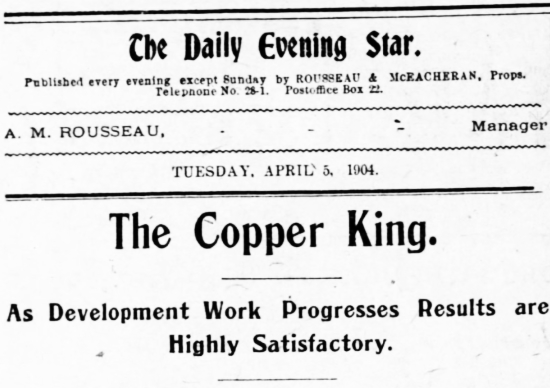
J. P. Whitney, one of the owners of the Copper King mineral claim, brought into town a few days since samples of the high grade bornite ore which is being taken out as sinking below the adit level progresses. Although no assays have been made of these samples it is perfectly safe to say that judging from appearances, this ore will assay almost, if not quite as high in copper values as any that has been mined from this property. Up to date the Copper King holds the record for high grade, copper ore over any other proposition in the Whitehorse camp. That record was 46-62 per cent. of copper to the ton of ore. The sample shipment from which this high value was obtained was made in 1900 and weighed 84 tons. Recent shipments of 100 ton lots, which were less carefully selected than that made in 1900, in fact, represented the "run of the mine" roughly sorted yielded highly satisfactory values.
On the last south-bound trip of the steamer Princess May she carried in all about 100 tons, a part of which was sacked, but the major portion was shipped in bulk, for treatment at the Ladysmith smelter of the Tyee Copper Co. There is still on the dump ready for future shipment about 50 tons, in addition so the dumps accumulated during the earliest work done on the property, and from the development work alone several tons of high grade ore are being extracted daily.
The present condition of the mine workings is as follows:
From the adit level, about 72 feet in vertical depth below the outcroppings, an upraise has been made connecting that level with the bottom of a shaft, or pit, more properly speaking, which is about 20 feet deep, and from which the record shipment already referred to was mined. In making this upraise the limestone footwall was followed, the distance, measured on the dip between the adit level and the surface being about 100 feet. On the north side of the upraise a stope has been opened about 20 feet in length and 80 feet in heighth at its highest point. In this the ore body exposed shows a width of first grade bornite ore on the foot wall of an average of about 3 feet, but the second grade ore body, the gangue of which is tremolite and which occupies the space between the high grade and the hanging wall, is at present of undetermined width but will exceed 6 feet, and apparently will closely approximate to the maximum width at the surface, which is about 14 feet. Owing to the structure of the ore body, which is lenticular, its mode of occurrence between crystalline limestone and felsite, the limestone being soluble, has wave lines or irregularities which cause the width of the vein material to be variable, its average width throughout could only be determined by accurate survey. In this stope, though, the hanging wall has not been exposed, which is another reason why the width of the entire ore body cannot be determined in that portion of the underground workings.
The work which is being pushed vigorously at present is that of sinking a winze below the adit level. Up to date this has been sunk about 25 feet, following the incline or dip of the limestone foot wall and the ore body, which maintains its continuity as depth is gained. It was from this winze that the samples brought in to town by Mr.
Whitney were obtained, consequently the development work is progressing in a highly gratifying manner.
The manager, W. P. Grainger, who is also a part owner, proposes sinking 100 feet below the adit level, and when that depth is attained, drifting along the line of strike of the ore body will be done in order to determine its length. This is a most important feature in the development of a mineral claim because the greater the length of
an ore body the more economically can it be worked, and the more profitable will be the results from such work.
Development on this particular property is establishing not only a precedent for the entire copper bearing zone, but also the correctness of the opinion expressed in the columns of the Engineering and Mining Journal in 1901 by Wm. M. Brewer, the mining engineer, who examined the camp at that time for that journal.