"We started," she says, "from Oakland in March with a party of fifteen
and a two years' outfit, intending to go straight to the Klondike, but nothing happened as we expected. For various reasons our original party disintegrated, some going on to Dawson and some returning to California, while we stopped at Linderman to think matters over.
"While there my husband heard that a George Miller had six years ago penetrated into the region beyond Lake Atlin and found good indications there. He also saw a rough map of that place and became convinced that it would be a good thing to visit it. Associating himself with seven others they hurriedly built two boats and in them we went
to Bennett, from which place we made our real start.
"It was a six days' trip from Bennett to Pine Creek and hard work all the
way; but we were all so eager to get to our destination that we hardly wanted to take the time to eat or sleep. We camped on shore nights, and lived on bacon, beans, baking powder biscuits and fresh eggs - duck eggs, with which the various islands which we passed were literally covered.
"When we arrived at the end of our journey we found, to our astonishment,
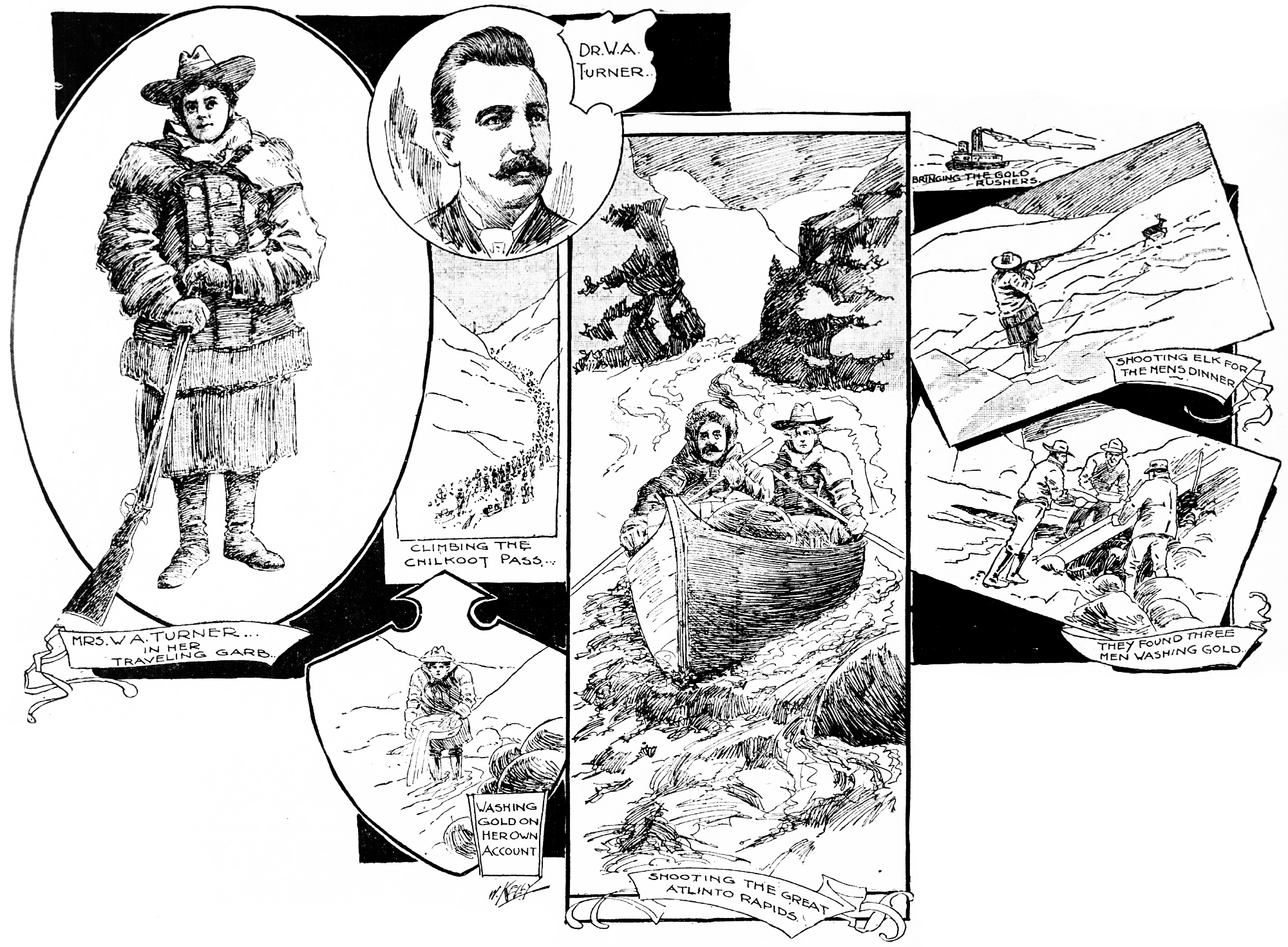
three men busily at work where we had expected to find primeval solitude. The men were Fred Miller, brother of the George who had originally visited the place, and two helpers. We were surprised to see them - and they were not only surprised but disgusted to see us.
"You see, they had felt so secure, off there, away from everybody, that they had not even staked out claims, but were working away quite comfortably just where their fancy led them, with no thought of possible interruption or competition. Our coming changed all that, and things began to hustle.'
"We could hardly wait to get our tents up, we were so anxious to begin
prospecting, and Miller and his men began to hurry up too. They jumped in to stake out 'discovery claims' at once, and as soon as possible started off to record them legally. This brought the matter to the attention of the Canadian authorities, and some of them
were sent up to look over the district. They went back to Tagish and Bennett with exaggerated reports of the richness of the 'finds,' and the next thing we knew the little steamer Kilborn came up through the lakes with 100 men on board, and a more excited crowd I never saw.
"After that the steamer ran up regularly, and thousands of men poured into the place. They didn't all stay around Pine Creek of course, for the claims there were soon taken up, but they spread out to Spruce, Birch, Muskett and Wright and all around there.
"There is free gold in plenty up there, not in big nuggets, and not lying
around loose, but it is distributed with wonderful evenness all along the creek banks, and any man who is willing to
work can make his pile.
"The climate is such that the old California mining methods are in use. As the frost does not go down any great distance thawing is not necessary, and as soon as the creeks are open in the spring work can begin. You don't have to dig for months on an uncertainty, but you see what you are doing right along. For these reasons one doesn't have to stay there during the winter; it is a summer diggings entirely, and it is now so easy to get there and back the doctor and I intend to go up every summer and spend our winters here at home. We have several very rich claims up there, and the doctor is going to take a party up with us in March next, to work on what is called a lay - that is a certain percent of the output. Wages are $5 and keep there now, and as provisions are high - flour 25 cents a pound, sugar 75 cents, and so on, the keep amounts to something.
"This year I could have sold all the bread I could make at a dollar a loaf, had I cared to make bread for sale, the men were so tired of their continual fried 'doughgobs,' but next year it will be different, for many men will take their wives up, and homemade things will be plenty.
"You want to know how I stood the journey and how I lived through the summer?
"Well, I looked upon the journey as a kind of a picnic from beginning to
end; it was all so new and strange and exciting. I was never frightened or discouraged once, though I got pretty tired going up the 1925 steps cut in the ice over Chilkoot Pass.
"We go up there in a regular procession, one after the other, holding on
the rope which is stretched along one side for a banister. Every 100 steps there is a wide one, like a terrace, where you can drop out of the line if you wish and rest, and these wide steps are the only breathing places on the way to the summit.
"We went over on the 19th of April, and, although the snow was ten feet
deep all around us, the sun beat down so terribly that my face was burned almost to a blister; that was the only real suffering I had to endure while I was away, but that was real enough, for my face did not stop smarting and heal for a long time.
"I was the first woman to ride the rapids in the Atlinto River, where it
takes four and a half hours to go up and eighteen minutes to come down; but I wasn't alarmed at all. In fact, I think I must have had the regular gold hunter's fever right along, for I didn't seem to mind or think of anything else but the object of our trip.
Everything outside of that seemed of little moment, not worth fretting about at all. I found that I could take a walk of fifteen or twenty miles, in heavy hobnailed boots, over the roughest kind of traveling, without even thinking of breaking down, and the cramped quarters in the boats, the inconveniences of tent life and tent cookings were things to be laughed at instead of worried over.
"After we arrived at Pine Creek, however, I found life a little more monotonous, for the men put in all their time prospecting, and I was left alone at the camp to look out for things generally and do the catering and cooking for the doctor and myself. I used to provide all the game - grouse, ptarmigan and so on - for I am a good shot and such sport was plenty, and all the fish for the camp besides, and I never felt the least bit afraid, for, although bears are to be found in the vicinity, I always felt able to take care of myself.
"I wore denim dresses made with conveniently short skirts, boys' stout
long legged boots and sunbonnets or wide sun hats, with generally a mos- quito net veil, for, although the mosquitoes are nowhere near so bad as they are in the Klondike, there are enough of them to be annoying, and in August the gnats were too numerous for comfort.
"I put in some of my time washing out gold on my own account, and I got
a good sized bottle full of coarse flakes and small nuggets. I employed myself for the most part, however, in 'spying out the land,' for it is a most beautiful country and full of interest to any one who is capable of appreciating it.
"To begin with, there are no reptiles there whatever. Snakes, lizards and
toads are unknown, but there are thousands of field mice, bright eyed, mischievous little creatures, a little larger than our mice, slender of body and with longer tails. These little pests are the chief discomfort of the region, for they swarm over everything and are preternaturally brave and aggressive. They scarcely ever trouble the provisions, but they make a specialty of destroying and carrying away every woolen thing which they can find, probably to use as linings for their nests.
"I made 'raised bread' right along, having brought up some dry yeast with
me and using it to 'set' some regular yeast as soon as we began tentkeeping in earnest. I made pies, too, often using bacon fat for shortening and rolling crust out on the bottom of a big gold pan with a bottle for a rolling-pin. The pies were good, too, and so was some French cream candy which I made once or twice as a 'treat' to the camp.
"Every one was wild over 'prospects,' and every now and then news would come from the different creeks which would cause a stampede in that particular direction, and as our party each held two licenses, one for the Northwest and one for British Columbia, we were always interested in all the gold news that came along. I never knew a really quiet day until we were back in Oakland, but in spite of exposure, hard work and rough fare, none of us had a sick hour during the whole time that we were away.
"I am all impatience to go back again. We have to be there by the 1st of June, else our claims are jumpable.
"One thing we have learned by experience, and that is that most people
take entirely too much outfit; they let the storekeepers plan for them and the result is much is wasted. Everybody takes too much bacon and beans - they are good in their place, but they can be purchased anywhere along the route, and quantities are thrown away by
overloaded or discouraged people. Take more canned goods and dried fruits and more cocoa and less tea and coffee and you will be healthier and happier.
"To all married women I would say, 'if your husbands are going to the Atlin district go with them.' The trip and camp experiences, though hard, are enjoyable, and the man who has a cheerful, hopeful, sensible wife to make a home out of his tent, give him good food and nurse him when he is ill or overworked, can make a good deal better fight for fortune than he who has to fight his way singlehanded."









 The Turner party found, on June 11, only three men - Fred Miller, brother of the original discoverer, and two helpers - working on the banks of Pine Creek, in the midst of a silent wilderness, but by the middle of August over 5000 people found their way there, and when work came to an end at the close of summer nearly 2000 claims had been
recorded, all of them giving promise of rich returns.
The Turner party found, on June 11, only three men - Fred Miller, brother of the original discoverer, and two helpers - working on the banks of Pine Creek, in the midst of a silent wilderness, but by the middle of August over 5000 people found their way there, and when work came to an end at the close of summer nearly 2000 claims had been
recorded, all of them giving promise of rich returns.