Highlights of History from The Whitehorse Star
Dateline: February 15, 2020.
 By RUSTY ERLAM
Former Star Publisher
With this edition, The Whitehorse Star becomes a daily newspaper, the culmination of a plan which has been in the works since the early Sixties.
It was then that the publishers decided on a gradual progression, first to go from weekly to twice weekly, then three times a week, then if things went right, to go daily.
Whitehorse's population now is nearing a stable 15,000, which in itself warrants a daily newspaper.
The Star's readers and advertisers are enthusiastic about the idea. Finally, the pipeline is coming.
Like it or not, the city is going to be larger and the Star is ready
to serve an increased population.
It has been an orderly approach involving the expansion of the news gathering staff, the building of a new plant, and the replacement over the past decade of every single piece of equipment the old Star had, with the latest technological advances. The process goes on still, for a brand new "solid state" computer typesetter will arrive
later this year to help get out the .daily
The staff,now numbers 20, and is headed by publisher Paul Erlam and editor Max Fraser. Young and enthusiastic, they are contemporaries of the new Yukoners who will run things in this latest phase of the Yukon's history.
Their paper has a lot of history behind it, for The Whitehorse Star, like Whitehorse itself, has been around for 77 years. It started during the Klondike gold rush in 1898 in the tent city of Bennett B.C. under the name of The Bennett Sun. But two years later when the White Pass railroad was completed to a shack town called White Horse, the paper was moved and its name changed.
The Northern Star
P.F. Scharschmidt was the owner and A.M. Rousseau was the business manager who produced those first papers, from a tent on Main St. At first called The Northern Star, it quickly became The White Horse Star.
There is an old cut, a picture of Mr. Scharschmidt's pet bear hitched to a sleigh in front of the tent.

In September, 1900, Mr. Scharschmidt sold out to Rousseau and McEachen and took his pet bear with him. Mr. Scharschmidt became superintendent of the White Pass river division from 1901 until his retirement in 1912.
The first available copies of The White Horse Star, a half tabloid size, were from January to May 1901. There was another blank until December 9, 1901, when it reappeared again, full size, as the Daily Evening Star with "news supplied by the overland telegraph."
But the early optimism of the gold rush must have faded with economic realities in 1902 because in February it was the SemiWeekly Star and in August, The Weekly Star.
The Stroller
Today The Star carries a column called "The Stroller." It was started by a historical character in the newspaper business, E.J. "Stroller" White who worked on papers in Skagway and Dawson before becoming editor of The Star in 1904.
The column today is largely the comings and goings of people in the area. But in Mr. White's time it was, in fact, the first of the "columnist" type of reporting ... witty comment on any subject under the sun. (And some never heard of before, either.)
For instance, Stroller White is credited with originating the story of the ice worms which were blue in colour and came out only when it got to be 70 below or colder. Somebody took him seriously, because there were letters to the editor from a
professor in the States, wanting more information for the sake of science. Stroller deadpanned his way through "advice to young wives" columns. He recorded the weather (and other) predictions of Chief Jim Boss of the Lebarge Indians.
And when things got dull he'd lapse into his recollections of characters he'd known down in the swamps of Florida, or he'd eulogize the wonders of the early
Pack Train bar in Skagway.
Start For Service
He probably got one world-renowned rhymster, Robert Service, started. In his autobiography "Ploughman of the Moon" Service wrote that he'd been asked to recite a poem at a church entertainment and he asked Stroller White what he should recite... Casey at the Bat, or what. But Stroller told him to be original. Write his own - something about the north.
The prodding got Service, already entranced with the stories he'd heard of the gold rush days, thinking and writing. "The Shooting of Dan McGrew" was the result and the start of Service's fame.
Stroller White became editor on April 16, 1904, but his name didn't appear until June 21, 1904.
In 1906 he tried again with a daily paper but managed it only for a few months and The Star returned to weekly.
Sold To Rousseaus
During the first World War, on March 10, 1916, E.J. White sold the paper to the Rousseaus, father and son who had been living in Skagway and he himself went to Douglas, Alaska (where later Stroller's Weekly was published).
Three years later A.M. Rousseau died and his obituary noted:
"On taking the paper in 1916, Mr. Rousseau succeeded E.J. White as American Consular agent at this place, which position he filled with credit both to the American government and himself, and which position he still held when summoned to a higher realm."
The Star remained a weekly but times weren't good and on June 17, 1921, there was a notice to the effect that "with this issue The Star appears under a new
management, a joint stock company is in process of organization and when completed will take over the business and property pertaining to The Weekly Star.
"When the former owner E.J. White was here a couple of weeks ago, it was for the purpose of either selling the plant or closing it down. As no individual willing
to purchase could on the spur of the moment be found, the only alternative was a community
enterprise which has been successfully launched."
To The Rescue
It was the businessmen of Whitehorse who came to The Star's rescue, pledging enough money and advertising to keep it going.
E. Chester Roberts was listed as managing editor and from June to September, Mrs. E.L. Wilson was editor. (Nobody now can recall who Mrs. Wilson was, alas. So much for the recognition of women's enterprise in earlier years.)
The paper continued until December 23, 1921 regularly, then came this notice: "The Star will miss one issue, owing to the fact that the editor has important business in Skagway and as there is no one available to do his work, The Star will be forced to miss one issue, that of the 30th of December. This is very regrettable, as The Star has missed but one other issue in the last 22 years. However, we think that you will forgive our missing this one issue and will promise that when we return from Skagway that we will give you a paper that will be better than it has ever been in the past."
No Copies
And then there were no more copies of The Star after that, until March 21, 1924, when J.D. Skinner was shown as publisher, and this item appeared:
"With this issue The Star resumes publication after a suspension of several months. The cause of the suspension is generally attributed to the lack of
stability in the then publisher. Be this as it may it is obvious to any man of experience that for some time the paper was not run upon a paying basis."
Mr. Skinner prepared a statement in detail for the businessmen in town and "each willingly agreed to assume his or her fair proportion of the advertising responsibility" so that the paper could resume publication.
What had happened in the interim? According to local sources there was no paper at all during 1922.
Summer "Skag"
During the summer of '23 a man called "Skag" came over from Alaska to run the paper but it lasted only a few months.
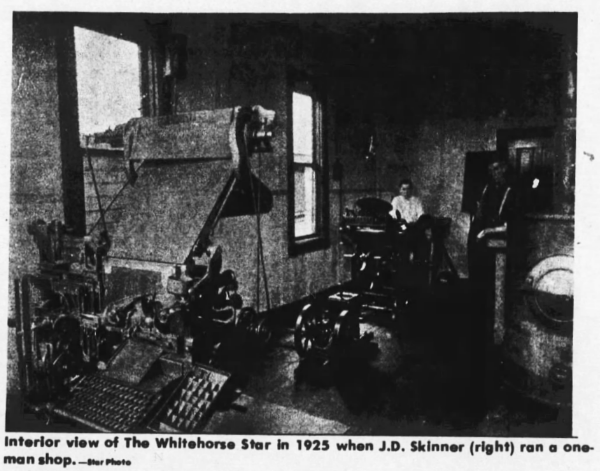
Mr. Skinner remained at the helm at least until 1930 when (from the one 1930 paper available) he got himself involved in federal politics. The copies from 1930 to July 14, 1933, are not available. But by the latter date W.R. Carruthers was managing editor.
On his leaving on August 20, 1937 he pointed out the "vast improvement in business and conditions in general when compared to the times almost five years ago when I first assumed the management. At that time business in the territory was at a standstill and we were in the throes of a modern industrial depression.
"Slowly but surely conditions have improved and there have been many changes in the Yukon, chiefly the advent of commercial aviation on a sane and business-like footing."
Hit By Depression
So The Star had been hit by the depression too, just like everyone else.
On August 27, 1937, G.C. Dingle was manager and on November 26 the same year, Horace Moore, who was to stay more than a decade, took over the reins, at first listed as editor then on March 4, 1938, as publisher.
He wrote thoughtful learned editorials and even won the weekly newspaper association award for excellence for his circulation class.
If anything, he erred on the side of caution. The second world war came and the events which were to transform the destiny of the Yukon took place. But there is
precious little about them in the war editions of The Whitehorse Star.
The Americans Come
From a little town of about 400 people, Whitehorse was swept into a crazy boom economy with thousands of American troops and construction workers arriving to build the Alaska Highway.
They built the Alaska Highway and the Canol road, the road from Jake's Corner to Carcross, and the Haines road. They laid the pipelines from Norman Wells to Whitehorse, built a refinery in the Marwell area of Whitehorse, built the first temporary army buildings, warehouses and garages all over town, established construction camps along the 1500 miles of the route, enlarged and improved the airports, had a camp of thousands stationed at McRae, just 10 miles out of Whitehorse, laid the first water and sewer lines in the town.
And when it was all over they left a shack town behind which was the foundation of the incorporated city which first tested its wobbly legs in 1950. And they
dealt a blow to the then capital, Dawson City, by bypassing her.
They left a road which would bring in future citizens and side roads which would lead to mineral development in the territory.
But you can't find much about it in The Star. Maybe it was because the whole project was designated a "military secret."
Horace Moore sold the paper in June 1950 and a printer, Tom Bain became editor.
The Harry Boyle Touch
Harry Boyle of Vancouver purchased the paper in October, 1954, and The Star took over a new personality, reflecting his own puckish, original wit.
It was he who came up with the motto on the masthead, still used: "Illigitimus non carborundum" which really is fractured Latin and should be the plural "lligitimi" meaning don't let the bastards grind you down.
His tongue-in-cheek headlines convulsed or shocked the town. "Physical jerk from the east" announced the arrival of a sports consultant from Ottawa. The subtitle "never sleep with strangers" accompanied a story on a rise in VD. "Better class of drinkers in town" was the story of a group of visiting members of parliament.
When the first American satellite was successfully launched around the earth, carrying a chimpanzee called "Ham," Harry sent a telegram offering him the presidency of the Sourdough Press Club and someone at Cape Canaveral wrote back an acceptance.
The Old Shack
Harry's editorial office was a garage in the back lane behind the old Firth Insurance company (which was actually the site of the first tent housing the Star in
1900). It got so cold in winter that he often sat perched on top of his desk to keep his feet off the floor, pecking away at his typewriter.
At the time the future publisher Bob Erlam was selling ads for The Star and he worked in the shed too, wearing a parka and boots even though the little oil space heater blazed away.
One day they pulled back the old curtain and discovered there had been three panes of glass missing all the time! No wonder it was cold!
But Harry got the urge to move on. He eventually graduated in law at UBC and is now a judge in Vancouver, still concerned with the oddballs, the dispossessed and the characters. The stories about him as a lawyer are already as legion as the stories about him as a journalist.
Bob Erlam became publisher and in 1967 bought the old bugle as Harry called it.
Flo Whyard, now a member of the Yukon government Executive Committee, became the editor, a job she held for almost eight years.
The Star, though it was continuously involved in political disputes, gained the reputation for overall accuracy. Indeed there were many times when city council members would turn to ask Mrs. Whyard whether such and such a motion had been passed by them.
It preceded the publishing of votes and proceedings as a record of territorial council sittings in Whitehorse when there were no other news sources in the
territory.
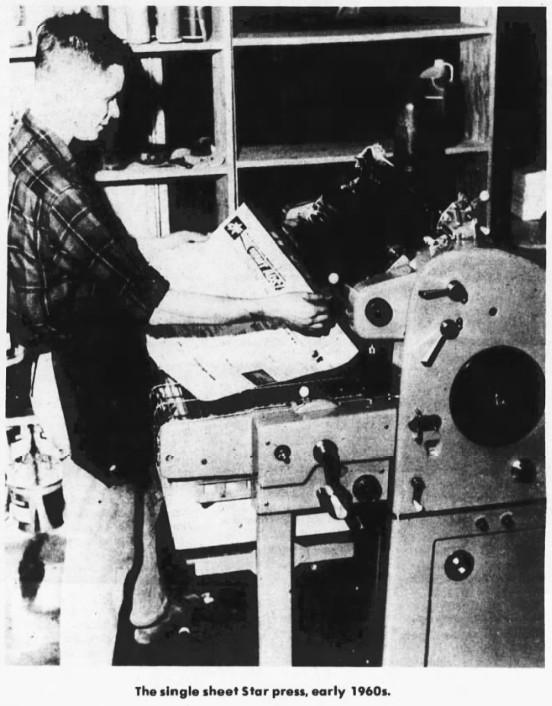
It was offset by this time and publisher Erlam had started taking pictures in the early 60s, pictures which could be reproduced in a matter of minutes in the paper compared with the old method of having to have a lead cut or impression made to print a picture.
There were some big stories and The Star was in on them all.
The Flores-Klaben rescue after 51 days in a downed aircraft, "galloping" Steele glacier, the climbing of Mt. Kennedy by senator Robert Kennedy, royal visits, the first reports of the discoveries of ore which led to Anvil mine and the town of Faro, the forest fire which wiped out that town as it was being built, the fires that threatened Whitehorse and Porter Creek and the rescue of men in a burning mine at Elsa.
The Star had pictures and filed stories of them all to news services outside.
The Star started playing up the Sourdough Rendezvous with special editions and made local heroes of the dog mushers, the flour packers and other participants, an action which has played no small part in the phenomenal growth of the winter carnival.
As it had done at the turn of the century, it published special tourist editions featuring not only the attractions of Whitehorse but of the rest of the territory as well. It became stringer for The Edmonton Journal, Canadian Press, Time and Life magazines, Canadian and Star Weekly magazines and any others who phoned for information.
And Mrs. Whyard supplied the local radio news for the CBC when that corporation was being established in Whitehorse. She had a hectic schedule - covering city hall and territorial council and getting out a twice weekly Star, re-writing it all daily for radio broadcasts and then re-writing it again to send to newspapers and magazines Outside.
A Way To Go
One sunlit summer night in May, 1966, a drunken prospector fired an emergency flare out of his room in the top floor of the “Whitehorse Inn. At the time he was proving to friends that flares wouldn't cause fires.
This one did. (It hit the roof of The Star editorial shack. and burned it down.
"Jeez Bob," the prospector told publisher Erlam later. "I didn't mean to burn down The Star. Hey. I'll buy you a drink." And he did.
The fire destroyed some typewriters and pictures files and what was worse, in Erlam's view, it burned the original Marilyn Munro in-the-nude calendar on
the wall. But it started a new building program which step by step would replace the whole
business premises, the stationery store, print shop and editorial shack.
First one small, one-storey concrete building was built, then an upstairs. Then the second section with its upstairs.
Presses and other equipment have all been replaced and modernized since 1968. The paper was published three times a week. Typesetting is done by photo-computer and printing is whizzed through at the rate of 14,500 papers an hour on web presses. It’s one of the most modern plants in Canada.
To make more room for additional press units, a new two storey building was bought on 2nd and Strickland St. and the newspaper moved there in 1974, leaving the stationery store at the old location on Main St.
The job printing was sold to Howard Patterson and is situated across the road from The Star on 2nd and Strickland.
Bob and Rusty Erlam retired as publishers in June of this year, selling The Star to their son Paul, who has been with the paper since the early Sixties.
When it became evident this year that three papers a week were not going to be enough to get in all the news and the advertising, he decided to go daily. Only now, unlike the 1901 "Daily Evening Star" with its "news supplied by the overland telegraph," the new daily will rely on increased editorial staff for its Yukon coverage, and on Canadian Press wire service for its national and international news.
The publisher says, however, that The Star will as usual concentrate on local news. That's what it's been doing for 77 years.







