
|





|
|
The Stikine River sternwheeler Hamlin
Northern Ships and Shipping
Dateline: August 6, 2024.
- C.S.Reg.#107144
- wooden sternwheeler; 141.2 feet long, with 30,.8 foot beam and 4.6 foot hold. Gross tonnage 514.91, registered as 323.41 tons.
- powered by a pair of horizontal high-pressure engines built in 1898 by James Reese & Sons of Pittsburgh; the cylinders had 15 inch diameter and 60 inch stroke, rated at 15 NHP.
- 1898, built at Vancouver by T. J. Bulger, for the Canadian Pacific Railway.
- April 26, 1898, an article in The Vancouver Semi-Weekly World describes her launch at False Creek - read the article here.
- May 26, 1898, an article in the Manitoba Morning Free Press describes the Hamlin and her first trip to Glenora, as well as other news from the Stikine-Teslin route into the Yukon - read the article here.
- July 28, 1898: "News comes from the Stikine of the loss of the C.P.R. sternwhee] steamer Hamlin in a collision with the river steamer McConnell, belonging to the same company. The Hamlin was moored just below the canyon with a cargo of coal and stores for the other steamers. The McConnell was on her way down the river with a number of passengers. When passing through the canyon her steering gear was found to be out of order, and the officers were unable to give her sufficient turm to avoid the steamer Hamlin, A crash ensued and the Hamlin was torn from her moorings. She swerved into the stream, and in a few minutes was stranded on a reef of rocks. Her bow opened right out, her planking sprung apart, and in a remarkably short time she was a total wreck, The McConnell, after striking her sister steamer, swung into the channel and drifted for about 2 miles, luckily avoiding all snags or other menaces before the officers again regained control of her. She was also damaged in the collision, her wheel being broken and a quantity of her upper works stove in. The Hamlin was built about three months ago at Vancouver. She was named after the Victoria surveyor who was frozen to death some time ago on a stampede from Dawson to some new mining district im the Klondike country." (Victoria Daily Times)
- July 28, 1898: "In an account of the collision between the C. P. R. steamers McConnell and Hamlin, already reported, the Stikine River "Journal" says:
It is due to the judgment and rare presence of mind of Captain Raab, of
the McConnell, that two of the finest river steamers are not total wrecks on the bars of the treacherous Stikine.
On the last trip down of the McConnell, just this side of Little Canyon,
her steering gear became unmanageable as she attempted to make a landing alongside the Hamlin, which was tied up to the bank with no steam up. She struck the Hamlin hard, tearing her away from her mooring and together they drifted into the current and went whirling helplessly down the rapid stream. The collision stove in a large hole in the port bow of the McConnell, but having water-tight compartments she kept afloat.
After several miles of whirling and bumping together the McConnell got
away from the Hamlin, and then it was that the Captain showed his nerve and good judgment by taking a line in his teeth and swimming ashore. After a hard struggle he succeeded in
making a line fast and soon the McConnell was landed. Here temporary repairs were hastily made, her steering gear fixed, and away she started after the Hamlin. After an exciting chase of several miles she was overtaken and towed hack.
The McConnell on her arrival here was beached and is now undergoing
the necessary repairs." (The Daily News-Advertiser)
- February 1, 1901: "The Canadian Pacific Railway Company has sold the four large and well equipped steamships constructed in 1898 for the Klondike trade by the Stikine River route, to the White Pass Railway Company. Since their construction these steamships have never been utilized by the company. Three of them have been tied up at the wharf at
Wrangel, and the fourth at Vancouver.
The White Pass Company intend renovating and fitting up the vessels this winter, so that in the spring they will be ready to be put on a regular service between Vancouver, Victoria and Skagway, thus giving the company a complete line of transportation from British Columbia ports to Dawson City.
The names of the new steamships are the Hamlin, Dawson, McConnell and Ogilvie.
Mr. Shaughnessy, president of the Canadian Pacilic Railway, speaking to a Star representative this morning, said it was quite true that the company had disposed
of the vessels. They had been constructed specially for the Klondike trade by the Stikine route, but when the Government's scheme to open up that route failed, the vessels were of no further use to the company." (The Montreal Daily Star)
[There are glaring errors in this article. At least three of the boats had been put into use, and none were suitable to be used for the ocean voyage between Vancouver, Victoria and Skagway.]
- April 1, 1901, all 17 CDCo. steamers were bought by the British Yukon Navigation Company; this included 3 Stikine River boats, 4 lake boats, and 10 Yukon River steamers. There are different versions of the Hamlin's subsequent disposition. With the other Stikine steamers, Ogilvie and McConnell, she may have been taken to Skagway and stripped, with the machinery going into the Dawson, White Horse and Selkirk. The hulls sat at Skagway for about a year, then were sold to Adair Brothers of Dawson, who had a freight service on the upper Yukon River. Adair Bros. converted the hulls to barges at Skagway, loaded them with freight, and took them to Dawson by way of St. Michael. Affleck, however, has the following chronology after the BYN purchase:
- 1903, sold to William McCallum, David S. Reeder and John H. Bonser; worked on the Fraser River.
- 1904, sold to Thomas J. Kirkham.
- 1910, sold to Edward J. Coyle.
- 1911, sold to the Hamlin Tugboat Company; converted to a tug, and used to haul powder to Yale during construction of the Canadian Northern Railway.
- 1917, sold to James H. Greer, agent for Defiance Packing Company.
- 1923, struck from Register.
- October 28, 1901, BYN employee H. Darling is going to go to Wrangell to inspect the HAMLIN (letter to WP, at YA, COR 865, f.1452)
- February 11, 1903: "The steamer Hamlin, one of a fleet of stern-wheelers built for
the Stikine during the Klondike rush, and tied up at Wrangel since, has been sold to Captain Bonsar, H. M. Callum and Capt. Reedor, and she will be brought to Victoria and remodeled for service on the Stikine and Skeena Rivers." (The Vancouver Daily Province)
- February 27, 1903: "TO REFIT HAMLIN HERE.
It is not often a stern-wheeler of the river type is seen in Vancouver Harbor, and some speculation concerning the identity of the one which steamed through the Narrows yesterday afternoon between the hours of 2 and 3 o'clock was indulged in by loungers on the waterfront till it became known that the vessel was the Hamlin, from Wrangel on February 18, in charge of Capt. Bonser.
It was announced some time ago in this column that Capt. Bonser, in association with Messrs. Reeder and McCallum, had purchased the Hamlin and intended to bring her down from Wrangel for an overhauling and refitting prior to placing her on the Skeena and Stikine River runs.
The Hamlin was berthed at the Heatley avenue wharf, and it is the intention to refit her here. In the north her headquarters will be at Port Essington, and it is expected that she will be ready to make her first run up the Skeena to Hazelton about May 1. Upon her return to Port Essington she will take a trip up the Stikine River to Glenora with freight.
The trip down the coast from Wrangel was made in excellent time, fine
weather favoring the little craft. The Hamlin was built by the C. P. R. for Stikine River traffic in the early days of the Klondike rush when the Stikine route was a possible route of ingress to the Klondike goldfields." (The Vancouver Daily Province)
- March 16, 1903: The Daily World (Vancouver, B.C.) published an interview with Captain J. H. Bonser of the Hamlin, in which he provides a glowing report on the future of northwestern British Columbia and the part he plans to play in it. Read the article here.
- March 27, 1903: "Navigation on the Skeena and Stikine rivers is expected to open next month. The steamer Hamlin, for which J. H. Greer is local representative, will be
leaving Vancouver on or about April 12th, carrying freight for both Port Essington and Wrangel. It is expected a trip can be made up the Skeena towards the end of the month.
In all three steamers will be operated this year on those rivers. The Hudson Bay sternwheeler Mount Royal will be going north, it is thought, before many more weeks. She is now on the stocks in the Turpel shipyard, and like the Hamlin will ply on both rivers. The Hazelton will be the third competitor. She is still in winter quarters on the Skeena." (Victoria Daily Times)
- April 2, 1903: "Capt. J. E. Bonser, master and part owner of the stern-wheeler Hamlin, which has recently been undergoing an overhauling at the British Columbia Ironworks wharf preparatory to sailing for the Stikine River about April 15, has taken a contract to raise the sunken steamer Ramona, now lying in the bed of the Fraser River not far from Chilliwack. Capt. Bonser went to the place where the Ramona is lying, and after surveying the situation decided that he could raise the vessel even though the snagboat Samson had been unsuccessful. Accordingly the steamer Hamlin was taken around to the Fraser yesterday afternoon by Capt. Bonser, and it is likely that she will be the
means of raising the sunken Ramona." (The Vancouver Daily Province)
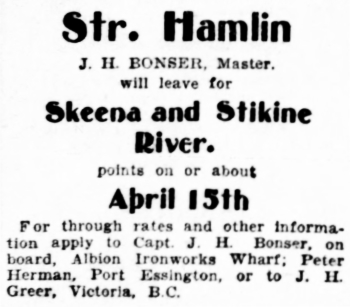
- April 6 and 13, 1903, The Vancouver Daily Province ran an advertisement:
- December 19, 1907: "The steamer Hamlin has been purchased by Mr. Finch Page of New Westminster and will be placed on the Chilliwack-New Westminster run on the Fraser River. The Hamlin was built for the Stikine River at the time of the gold rush, but has been lying at Port Moody for several years." (The Vancouver Daily Province)

The Hamlin, Ogilvie, and McConnell ca. 1900 (Yukon Archives #1330)
|

|
