Alongside the Albion iron Works' wharf is lying the steamer Hamlin, a flat bottomed stern-wheeler, representative of a type of craft that has been evolved from the necessities of river navigation in North America, an evolution that was begun on the Mississippi, and seems to have reached its highest development in the swift and often shallow waters of the British Columbia streams. Certainly it does not seem likely that development to meet conditions could go farther than it has in the case of the "Hamlin," for while her captain considers fifty head of cattle merely an item in the load of freight she can carry, the boat draws only 18 inches of water.
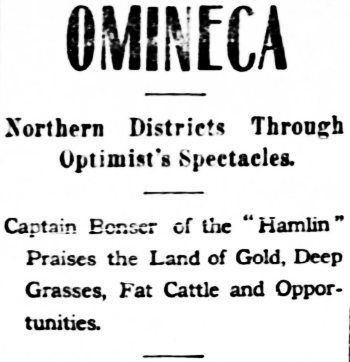
Captain J. H. Bonser, owner and navigator of the "Hamlin," has a reputation as a swift water steamboat captain that extends from St. Michael to San Francisco and he has spent the last eleven years on the Skeena and Stikine, the great water highways into the huge country, largely a "terra incognita," that constitutes the northern portion of British Columbia.
Believing that information regarding this little known portion of the province would interest the people of Vancouver, a World man had a talk with Captain
Bonser this morning and found him full of enthusiasm over the future of that country.
"You want me to tell you about that country," said the captain; "all right, come into the cabin and we'll have a confabulation.
"All that country needs is to be known. Every river on the Coast has its boom at some time or other and the Skeena's boom is about due.
"Why, there's gold up there, there's copper, and best of all there's any quantity of the finest kind of grazing and agricultural land. You can get off the boat at Hazelton and ride all day anywhere you want with the grass brushing your stirrup leathers; good grass too.
"To show you what sort of feed that grass is I'll tell you about the Hudson's Bay Company's mules. The company have mule trains that go from the Cariboo country clear through to Hazelton every summer and up to a few years ago they always took the animals back again before winter; but it occurred to the packers that where there was so much grass there was the making of lots of hay and the upshot was that the company sent up a mowing machime and a horse rake from Victoria to the Bulkeley Valley and now they winter sixty mules up there. What's more those mules come out in the spring fat and able to work hard without any grain feed at all.
"What sort of a winter is it? Well the winter is hardly as long as it is in Vancouver. It doesn't dawdle around so much. I have seen navigation open until Christmas and there is lots of grass by the beginning of May.
"There is not much snow. The thermometer goes down a few below zero and stays there and you have a couple of feet of snow on the ground and beautiful bright weather all winter. The Bulkeley Valley is about forty miles from Hazelton and you can ride a bicycle along the trail.
"At the time the government put the telegraph line through there they wintered 300 mules on that native grass with perfect success. Stock goes through the winter beautifully out in the open; all that is necessary is to feed them the hay you have cut in the summer. There is no better beef anywhere than is fattened on that grass. The climate has a lot to do with it; it is the best in the world, and a man who spends a few months in there always comes out fat.
"Hazelton was the head of navigation of the Skeena up to last summer, that is 180 miles up, but last summer I pushed it 10 miles farther to Kitzpiax - spell
it how you like; it is an Indian name.
"About the mining? Well 80 miles up the river is Singlehurst's gold-copper mine. He has spent $100,000 developing and is still at it. There has been some good free-milling gold ore found but the parties who own it haven't had capital to do anything with it. That's what we want up there - capital. The stuff is there all right.
"On Lorne Creek, 125 miles from the mouth of the river, there are two hydraulic properties, the "Dry Fill" and the "Hard Scrabble." I am interested in the "Hard Scrabble" myself and Mr. Rockburger of Rossland is floating a company to operate it. We have to spend only $20,000 to flume Lorne Creek on to the ground and then there will be a
big clean-up. We worked it a little last summer just with surface water caught in a ditch, until the snow above us was all melted and the gold is plentiful and coarse. The "Dry Hill" people have a sawmill on the creek up at the falls, where the head of our flume will be and as there is plenty of timber there and we can have the use of the mill we will soon have our flume in and connected with the 3,000 feet of pipe that is going off with the "Hamlin" on the 12th of April.
"Yes, we sail on the 12th of April and will reach Hazelton about the 4th of May. What do you think of my boat? We are overhauling and painting her and so on and we are going to give the best freight rate and finest passenger service on the Skeena and Stikine. James Greer, of Victoria, fs our agent down here and Peter Herman at Port Essington.
The "Stikine" doesn't open until two weeks after the "Skeena" and we intend to run the first trip of the season up thare after coming back from Hazelton. Wrangel is our home port for the Stikine. You see when we get to Hazelton we will wire to Telegraph Creek to find out how the Stikine is.
Well, sir, you can tell your readers that that is a great country; it grows the finest grass, the best beef and the biggest and juiciest vegetables I ever saw, and it is full of minerals. Why thirty years ago there were 1,500 miners up the Skeena and they took $200,000 worth of gold out of Lorne Creek in six weeks, but of course they did not touch the hydraulic ground; and that is where there are fortunes lying now. The only people in there at present are miners, missionaries and Indians."