
|





|
|
The Yukon Sternwheeler Anglian
by Murray Lundberg
Northern Ships and Shipping
Dateline: April 26, 2024. Last update: December 23, 2025.
The information on the Anglian that follows is simply a cut-and-paste from my database, compiled from a wide variety of sources, primarily government records and newspapers.
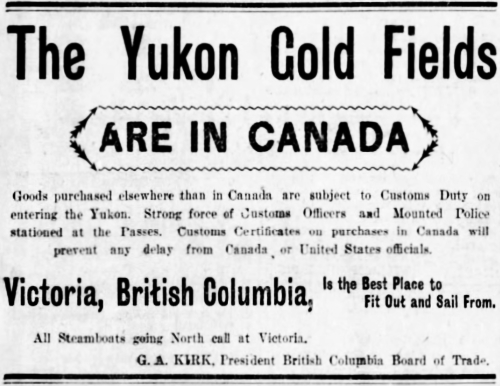
The Anglian was built to take advantage of heavy promotion of All-Canadian routes to the Klondike, such as the following ad in the Victoria Daily Times of July 30, 1897. The Anglian would serve the Teslin route, which began with travel up the Stikine River.
- Canadian Shipping Registry #107512.
- wooden sternwheeler; She was 85 feet long, 20.5 foot beam, 4.5 foot hold; gross tonnage 161.45, registered as 114.21 tons; 1 deck, no mast, carvel build, straight head, square stern, no bulkheads. Later licenced for 40 passengers, with accommodation for 30.
- the engine room was 20.5 feet long, housing 2 high-pressure horizontal engines, built in 1897 by Vulcan Iron Works of Seattle; the cylinders had 9 inch diameter, 40 inch stroke, and developed 5.4 NHP.
Victoria Daily Times - Friday, August 20, 1897
F. M. Yorke, the well-known stevedore, who has resolved to build a steamer for service on the waters of Teslin Lake, and a saw mill at the head of the lake, returned from the Sound on the steamer City of Seattle this morning. He brought with him a large amount of machinery, the loading of which detained the steamer many hours on the
Sound. This machinery, which was purchased from the well-known Seattle ship building firm of Moran Bros., consists of boilers, pipes, cylinders, etc. Mr. Yorke, with a party of Victorians to help him carry out the work, will leave Victoria about the beginning of next week on the steamer Thistle, which has been chartered for the trip. The Thistle will land the expedition and passengers and freight at the mouth of the Stickeen river and from there the machinery and men will be taken by a smaller vessel up the river to Telegraph creek, from which point the trail will be taken to Teslin Lake. Arrived there the work of
erecting the saw mill will be begun at once, and as soon as the saw mill is in running order lumber will be sawn for the steamer. This steamer will be a stern wheeler, drawing not more than two and a half feet of water at the most when loaded. Teslin Lake is on the all-British route to the Clondyke gold fields, and from this lake the Hootalinqua river,
which joins the Lewis river, takes its source.
It is understood the Dunsmuirs are the financial power behind this enterprise.
Constable A. S. Mouat has resigned his position on the city police force. He has been engaged to assist in the building of Mr. Yorke's steamer and sawmill on Teslin Lake. Mr. Mouat is a ship carpenter by trade. The police commissioners have not yet met to consider the resignation. Mr. Mouat will remain on the force until the steamer Thistle leaves for the north.
- August 23, 1897: "The steamer City of Seattle brought over this morning the remaining portion of the iron work and machinery to be used in the building of Mr. F. M. Yorke's Teslin lake steamer and saw mill. There were also many passengers, who are coming here to await the sailing of the next steamer for the land of gold." (Victoria Daily Times)
Victoria Daily Times - Wednesday, August 25, 1897
The steamer Thistle will sail this afternoon for Fort Wrangel with Mr. F. M. Yorke and his party on board. They are taking up with them a large supply of provisions and a very extensive ontfit; also about fifteen horses and the machinery to be used in the construction of the saw will and stern wheel steamer which they propose building. Included in the Yorke party, besides Mr. F. M. Yorke, who will be the general superintendent, are Mr. Mouat, who is to be the mate on the new steamer: Mr. Strickland, a former Victorian,
although of late he has resided on the other side of the line, who will be the engineer; and Messrs, James Gaudin, son of the agent of marine and fisheries, C. Barton and J. McDonald. The expedition will, on reaching Fort Wrangel, take passage on the river steamer
Alaskan, which plies on the Stickeen river, to Telegraph creek. There a saw mill will be built, and as soon as it is in operation the lumber sawn for the river steamer, which is to be built as soon ws possible. A number of other passengers have arranged for passage
on the Thistle, it being their intention to go in to the Clondyke gold fields by way of the Stickeen and Teslin lake route.
- August 26, 1897: "The steamer Thistle passed here on her way north to Wrangel from Victoria this morning with materials and machinery for two sawmills and two steamers to be
built on Teslin lake. Twelve carpenters in charge of Mr. F. M. Yorke went up on the way to Teslin lake to commence construction on the steamers and mills. There were over a hundred applications for passage made by intending Yukoners and as many as could be accommodated
were on board." (Nanaimo Free Press)
Victoria Daily Times - Monday, September 6, 1897

The steamer Thistle returned from her trip to Fort Wrangel yesterday evening, bringing a cargo of coal from Comox on her way down. Capt. Butler reports that the steamer Alaskan, Mr. J. C. Calbreath's steamer, running on the Stickeen, was ashore when he left about eighty miles up the river. The news was brought down by an Indian four days before the Thistle arrived. Capt. Butler was of the opinion that some break had occurred in her engine room and she had drifted ashore. He expected her to be down before he left and waited a day before he unloaded the machinery and effects of the Yorke expedition. She, however, not coming, on Monday evening he started downwards. There were
but few people at Wrangel awaiting the Alaskan save the Yorke expedition and the miners taken up by the Thistle.
- September 13, 1897: An article in the Victoria Daily Times about the Stikine River route includes comments about the challenges Frank York's party had getting started up the river - read it here.
- October 4, 1897: Another article about the Stikine River route in the Victoria Daily Times, much longer, includes a comment that Frank York's party had been leaving Telegraph Creek on September 13th, and that a wagon road could easily be built to Teslin Lake - read it here.
- October 6, 1897: "Harry Davey, night manager of the C.P.R. Telegraph Company, has received a letter from John M. Bogart, who left here in August for the Yukon, via the
Stickeen river and Teslin lake route. The letter was written on September 24th, from Telegraph creek, which point Mr. Bogart had reached after a trip partly by steamer and partly by canoe. He says there were thirty men at Telegraph creek who could not proceed over the trail for the want of horses, all the animals having been secured by Frank Yorke to take his saw mill and steamer machinery over. The men were waiting for the snow to fall, when they hoped to make their way across, drawing their outfits on sleds." (Victoria Daily Times)
- October 25, 1897: "...About twelve miles from Telegraph creek Mr. John M. Bowker, Jr., met the Duchesnay party of the C.P.R. surveyors, who are surveying for the railway which the C.P.R. propose building from Telegraph creek to Lake Teslin. The Yorke party
were met a little further down the trail. They were making their third trip in to the lake with their provisions. The machinery and other goods for the steamer and saw mill, which they intend building at the lake, was still at Telegraph creek, and no attempt will be made to get it in until the snow falls, when Yorke and his party will try to get it in on sleds." (Victoria Daily Times)
- October 1897: Various comments show that the trail from Telegraph Creek was not in the condition expected by Yorke, and machinery could not be hauled over it. His party had to cut portions of new trail of a new route.
- November 5, 1897: Frank Yorke is back in Victoria and talked to a Victoria colonist representative. His party is camped about 40m miles north of Telegraph Creek, and will wait there until sufficient snow has fallen to allow the use of sleighs.
- December 27, 1897: "The trail from Telegraph Creek to Teslin Lake has been put in good condition, and the transportation of the machinery for Frank Yorke's steamer and mill is being effected without difficulty. After the sleds with this machinery have passed over the trail, travelling will be easy." (Victoria Daily Times)
- January 3, 1898: "F. M. Yorke, of the Yukon-Teslin Transfer Co., returned from the east yesterday, where he has been on business for his company, which is backed by a strong syndicate, with H. Maitland Kersey, formerly of the White Star line, at the head. They will place steamers on the Stickeen and on the route from Lake Teslin, to Dawson, by the Hootalinqua, Lewis and Stickeen rivers. The Stickeen steamers will be two, one to be built in Victoria and work will be commenced on them at once. The machinery to be used in them has been built in Pittsburg, and will arrive shortly. The work on the Teslin lake and river steamers will be done at the saw mill at Teslin lake; in fact work has already begun on one of them." (Victoria Daily Times)
- January 28, 1898: "The Maitland-Kersey Company, of which Frank Yorke is the local manager, will have five steamers running from Lake Teslin to Dawson City, the frames for which are being built here. The engines for two of them were shipped from Pittsburg to-day, and the machinery for a third, a twin-screw steamer, was recently purchased in Great Britain by Mr. Kersey. Mr. Yorke says that the companyÕs steamers will make the trip
to Dawson in two days. Work on the company's saw mill at Lake Teslin is now well under way." (Victoria Daily Times)
- February 18, 1898: The Canadian Development Company,
capital $360,000, with head office in Victoria, has been incorporated, and has purchased from Francis M. Yorke and Samuel Horace Davie, both of Victoria, all the properties and assets of the firm carrying on business as the Teslin & Yukon Transportation Company, for the price of $60,000 in cash and an interest in the capital stock of the company equal to £12,000 sterling. The two steamboats under construction at the Star shipyard in Victoria were also purchased, from H. Maitland Kersey. (Victoria Daily Times)
- March 12, 1898: "Steamer Pakshan will sail on her second yoynge northward at midnight. She will have a large passenger list and a full cargo of general freight. Among the passengers who embark here are Frank M. Yorke and A. Langley, who go to Teslin lake in the interest of the Maitland-Kersey Co." (Victoria Daily Times)
- March 15, 1898: "Applications to purchase lands at Teslin lake have been received from A. Boyd, J. A Grant, J. F. Calbreath, James Dunsmuir, J. Hyland, F. M. Yorke, and C. E. Thomas. No applications have been granted. (Nanaimo Free Press)
- May 26, 1898: A report from P. I. Packard, who has just returned to Victoria: "At Teslin about 100 people were encamped. F. M. Yorke's sawmill started work on April 24th and work was begun on the steamers he is building for use on the lake and the Hootalinqua river. The machinery had not reached the lake when Mr. Packard left on May 6th. He occupied ten days on the journey to Glenora, the trail being very soft, the thaw having just set in." (Victoria Daily Times)
- May 27, 1898: "Steamer Tordenskjold will sail for Wrangel this evening, connecting with the river steamer Victorian on the Stikine. She will take up a large number of burros and packers for the pack train to be established on the Glenora-Teslin trail connecting with the steamers which Frank M. Yorke is building at Teslin lake." (Victoria Daily Times)
Daily News-Advertiser (Vancouver, B.C.), Tuesday, June 5, 1898
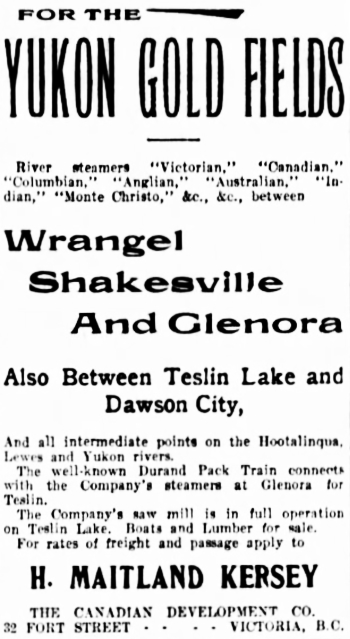
- July 20 or 21, 1898, the Anglian left Teslin Lake; C. E. McDonald and C. A. Gardner were in the pilot house, Andy Howatt was First Mate, J. E. Doddridge Second Mate, Frank Henley Chief Engineer, and J. R. P. Gaudin Second Engineer (MacBride). On board were 40 members of the Yukon Field Force. The owners of the boat had initially asked for $150 per person and $200 per ton of freight, but the price was dropped to $25 per person and $25 per ton. They arrived at Dawson on the 28th. The Anglian had no problem getting down the Hootalinqua, but when she tried to return for the rest of the Force as contracted, she could not get within 40 miles of Teslin Lake (Greenhous).
- July 30, 1898: "A New Company. The Canadian Development Co. has got its first boat here, the Anglian, and is now represented in Dawson by H. Maitland Kersey, managing director of the company. Mr. Kersey was at one time manager of the famous White Star line with headquarters in New York. The company owns two other boats besides the Anglian. The Columbian and Canadian, large stern-wheelers are expected to arrive shortly by way of St. Michaels. The Anglian will probably ply between Dawson and White Horse rapids while the two larger boats will take the lower river. Mr. F. W. Tronce has been appointed agent in Dawson." (KN)
- early September 1898, sunk at the mouth of the Hootalinqua. She had been holed while returning from a failed attempt to reach Teslin Lake for the 66 Yukon Field Force members still there; a temporary patch was put over the hole, but it shifted. She was beached on a shallow shelf, then raised and repaired (KN, Sept. 14).
The Evening Bee - Saturday, October 29, 1898
TACOMA, October 29. - The large Yukon River steamship Anglian was wrecked near the confluence of Hootalinqua and Thirty-mile rivers three weeks ago, according to a report brought yesterday by the passengers on the steamship Cottage City. The Anglian had tried to reach White Horse Rapids, where she was to go into winter quarters, but failed on account of the very low water, which usually precedes the freezing up of the Yukon's upper waters. The steamship was accordingly turned around, with the intention of returning to Dawson, After proceeding about twenty miles down river she struck a sunken rock. A few hours later she went down, as the water steadily gained on her pumps. She undoubtedly will be a total wreck, as nothing can be done to raise her before the ice breaks up. By that time she will have been entirely demolished. Her passengers und crew escaped in small boats and camped on shore until provisions could be procured to enable them to reach Dawson.
- winter 1898-1899, new engines installed (Affleck).
- July 12, 1899: "The Canadian Development Co.'s steamer Anglian reached port from White Horse rapids on Tuesday afternoon, being her first trip to Dawson this season. She has been nicely renovated and refitted and everything is as clean as a whistle. The Anglian left the rapids on Sunday afteruoon at 2 o'clock, with seventeen passengers and twenty-five tons of freight for Dawson. She had no through mail, but picked up a little along the way. From one of the officers it was learned that other boats were passed up the river as follows: The Ora at the Five Finger rapids, the Flora at Selkirk, the Eldorado at Little Salmon, the Bonanza King at Selkirk, Victorian at Hoochikoo and the W. S. Stratton six miles below Sixty-mile river." (KN)
- July 29, 1899, sunk in the Lewes River; raised and repaired.
- 1900, on the Whitehorse-Dawson run. For most of the season, medical inspections were required as boats arrived in Dawson. The Anglian arrived on July 17, August 13 and 24. After August 24, checks were done at Log Cabin (GOV 1684, f.71).
- March 22, 1901: The Anglian has wintered near Selwyn. (Dawson Weekly News)
- April 1, 1901, all 17 CDCo. and John Irving Navigation steamers were bought by the British Yukon Navigation Company; this included 3 Stikine River boats, 4 lake boats, and 10 Yukon River steamers. Read a newspaper article with details here.
- December 15, 1903, the WP&YR applied to the Customs office at Whitehorse for a refund of the $20.88 paid for the Anglian's annual Inspection Certificate; in late April, the fee had been eliminated (GOV 1678, f.11-1).
- March 31, 1904: "As soon as the ice goes out from the river between Whitehorse and Bennett lake the B. Y. N. Co. will have the steamer Anglian lined up the rapids and sailed to Atlin lake for service on that portion of the route between Caribou and Atlin during the coming summer. Although it will be a difficult passage to make up the Whitehorse rapids yet Dr. Scharschmidt, the superintendent of the fleet, anticipates no insurmountable obstacles in making the trip successfully." (The Daily Evening Star)
- 1904, Anglian, Bailey, Yukoner and Zealandian "seem to have passed their days of usefulness for economical reasons in these waters." (COR722).
- 1916, side-tracked off the ways to make more room for the barges which have been built (COR722).
- 1931, dismantled at Whitehorse (MacBride).
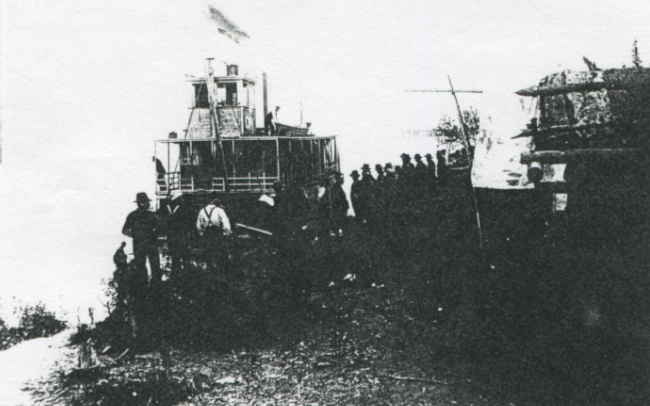
The Anglian ca. 1899. Yukon Archives: Keir collection, PHO 27, #137. Photocopy.
|

|
