
|





|
|
The Yukon Field Force, 1898-1900
Arctic & Northern Military History and Issues
Dateline: April 26, 2024.
The Yukon Field Force was authorized on March 21, 1898, to support the North West Mounted Police in the Yukon after tens of thousands of people arrived during the Klondike Gold Rush. It was commanded by Lieutenant Colonel Thomas Dixon Byron Evans of the Royal Canadian Dragoons, and consisted of 5 Staff, 16 Royal Canadian Dragoons, 49 men of the Royal Canadian Artillery and 133 men of the Royal Regiment of Canadian Infantry armed with Lee-Enfield .303 rifles, two Maxim guns and two bronze seven-pounder cannons.
The men and some of their supplies went to the Yukon on one of the "All-Canadian" routes to the Klondike, via the Stikine River and Teslin Trail. Their headquarters was at Fort Selkirk on the Yukon River, at its junction with the Pelly River, with a detachment sent to Dawson City.
Half the force was withdrawn in September 1899 and the remainder, renamed the Yukon Garrison, left in June 1900.
Below, you will find find several significant newspaper articles, and then several links to websites with more information.
Newspaper Articles
The Ottawa Evening Journal - Monday, March 7, 1898
MILITIA FOR THE YUKON.
The government has now under consideration the sending of a detachment of the permanent corps to the Yukon instead of drawing more men from the Mounted Police in the Regina and Edmonton districts, which would necessitate the engagement of a large number of recruits to the police. In this way a saving would be effected and in addition the members of the permanent corps would have an opportunity of roughing it in the west. It is thougnt that the members of the permanent corps at Quebec and Toronto could be utilized for this work In the country's interest instead of filling up the Mounted Police
with fresh recruits at a considerable expense. It is probable that from one hundred to two hundred men and officers will be selected in this way. Hon. Dr. Borden has now the matter in hand.
Major Evans, of Winnipeg, will command the contingent from the permanent corps which will go to the Yukon as soon as it is outfitted and provisioned. The route which it will take has not yet been decided.
Daily News-Advertiser (Vancouver, BC) - Tuesday, April 12, 1898
Winnipeg, April 9. - Lieutenant-Colonel Evans, Commander of the Canadian Yukon Field Force, which has been ordered to the Northern goldfields, has returned from Ottawa. To a reporter he said: "Our force shall be a military reserve, to be called upon
in case of emergency. We will go direct to Fort Selkirk, which will be our headquarters and where we will erect a barracks. We will take in two Maxim guns, two seven-pound field guns, and a large quantity of ammunition, including specially made soft bullets, for shooting game. We expect to muster in Ottawa on the 20th of this month, and will leave that City on the 25th for Vancouver, picking up fifteen members of the Dragoons in Winnipeg."
The Klondike Nugget - Friday, July 30, 1898
Soldiers for the Yukon.
The soldiers for the Yukon district are beginning to arrive at Selkirk, where they will have permanent headquarters and where they will remain for the present, at least. Col. Evans is in charge of this, the Yukon contingent of the Canadian militia, and with sixty of his men arrived at Selkirk on Monday. The balance of the 200 soldiers are scattered along Telegraph creek Lake Teslin and the Hootalinqua river.
Maior A. Talbot, paymaster of the Yukon force, arrived in Dawson on the stenmer Anglian on Wednesday evening.
The duties of the police are entirely different and apart from the functions of the military and what is agitating the minds of Dawsonites just now is what the soldiers are here for.
Two members of the Victoria Order of Nurses arrived at Selkirk with the military last week. The objects of the order, we understand, are somewhat similar to the order of the Red Cross elsewhere.
The soldiers at headquarters are much interested in the condition of the Yukon river. They have 300 tons of provisions and supplies yet to come up the river. Like all recent arrivals from the outside world they have been filled with starvation stories and the regiment will sleep better after the provisions are cached at the barracks.
The Klondike Nugget - Saturday, August 27, 1898
Col. Evans Visits Dawson.
Col. Evans, commanding the force of regular troops now stationed at Fort Selkirk, came down on the Flora on Tuesday last. The Colonel is greatly pleased with the locaton of the Selkirk barracks. He says that he has never seen a better location for a military site than the one now occupied by the troops. There are now 65 men stationed at the Fort and 135 more enroute, at the present time located at Teslin Lake. In regard to the Teslin Lake route the Colonel states he thinks it will be all right when a railroad is once constructed. Ever since their arrival at the Fort, the troops have been engaged in constructing the buildings which they will occupy during the coming winter. Three of these 22x85 feet have already been built and several others are under way. There will be three barracks buildings for the men, a store house, a mess and recreation barracks, a guard house, orderly room, and the commanding officers quarters. Before coming to the Northwest, Col. Evans was in command of the Royal Canadian Dragoons at Winnipeg.
The Klondike Nugget - Wednesday, July 12, 1899
Mr. Lapontafa, a government engineer connected with the work of improvement at the Five Fingers and on Thirty-mile, was a passenger [on the Anglian] as far as Selkirk and will be in Dawson in a few days. The gentleman won distinction by making the trip to Selkirk with the Yukon field force over the Teslin trail.
The Klondike Nugget - Wednesday, August 30, 1899

The long looked for order recalling a portion of the Yukon field force to Canada has arrived. The bearer of the important information was Capt. Bennett, who arrived on Monday evening from Fort Selkirk as a courier for Col. Evans to Capt. Burstall.
A few hours after his arrival, a Nugget reporter called upon the last named officer and requested some information on the subject. The gallant gentleman replied that, while the matter is in no wise a secret, he was not permitted by the military regulations to make it public and would be obliged to reluctantly refuse the request.
From other sources, however, it is learned that 100 men, or half the force in the territory, has been ordered out of the country. The command at Dawson numbers but 74 men and it is not believed that more than 25 of them will be taken, the other 75 being selected from the detachment at Fort Selkirk.
It is further stated that the commissioned officers who will go outside under the order are Major Young, of Fort Selkirk, and Captains Burstall and Ogilvie, of Dawson. The latter gentlemen are very popular here, and their departure will be genuinely regretted.
Capt. Bennett is assigned to the command of the Dawson force.
It is expected that Col. Evans will be down in person this week, when the
plans for the departure of the soldier boys will become known.
The Province (Vancouver, BC), Saturday, May 13, 1972
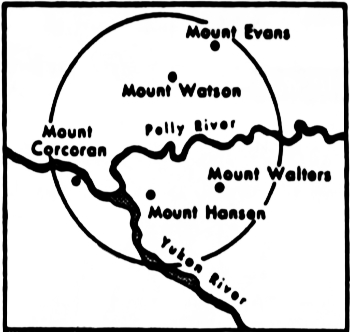

OTTAWA - Five mountain peaks in the Yukon Territory have been named in honor of men of the Canadian Army unit that went north in 1898 to maintain order during the wild days of the Yukon gold rush.
The northern affairs department announced Friday [May 12] that the mountains, all in the area of the junction of th Yukon and Pelly Rivers, will be named Evans, Hansen, Watson, Walters and Corcoran.
Col. T. D. B. Evans led the 203-man Yukon Field Force and the other four men were foot soldiers who died on active service with the volunteer unit.
Col. Evans was born in Ottawa in 1860 and died in 1908 after 27 years service. His widow, Mrs. Leigh McCarthy, now lives in Toronto.
Since personal files were not kept for soldiers before the First World War, the department does not know the first names and birthplaces of the four casualties: Cpl. G. Hansen, Cpl. M. Watson, Pte. H. Walters and Gnr. J. Corcoran.
The peaks are along the route travelled by the force on its 4,000-mile, four-month trek from Ottawa. The force was withdrawn in 1900.
Books
The only book written specifically about the Yukon Field Force so far is "Guarding the Goldfields: The Story of the Yukon Field Force" by Brereton Greenhous (Dundurn Press, Toronto, 1987).
Links
The Yukon Field Force, 1898-1900
Written specially for the Canadian Army Journal (Vol. 4, No. 6, November 1950) by the Historical Section, Army Headquarters, Ottawa.
Yukon Field Force Graves at Fort Selkirk, Yukon
Within the main cemetery at Fort Selkirk is the Yukon Field Force Cemetery, for the 3 members of the Canadian Army's Yukon Field Force who died while serving in Fort Selkirk.
Grave of Cpl. M. W. Watson
Within the Mounted Police cemetery at Dawson City is the grave of Corporal Watson of the Yukon garrison, who died of an accidental gunshot in 1900.
Yukon Field Force
This illustrated article at Wikipedia is very good.
A Flashback to the Yukon Field Force
A lengthy illustrated article by Iris Warner, from The Whitehorse Star of October 19, 1970.
All but forgotten - Canada's miniature army
A 1973 article by Don Atkinson of the Southam News Service.
Exploring historic Fort Selkirk, Yukon
A lengthy illustrated tour of Fort Selkirk covers the sites and buildings used by the Yukon Field Force.
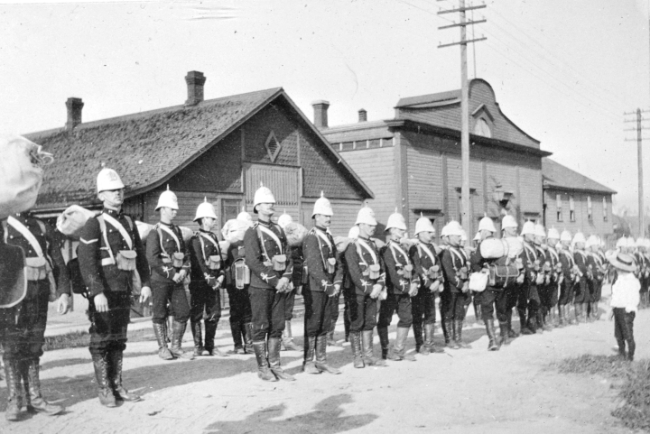
The Yukon Field Force on parade in Vancouver while en route to the Yukon in 1898.

|

|