
|





|
|
A Flashback to the Yukon Field Force
The Yukon Field Force
Dateline: April 30, 2024.
The Whitehorse Star - Monday, October 19, 1970
A Flashback to the Yukon Field Force

By Iris Warner

Klondike, last parade N.W.M.P. and Yukon Field Force, Dawson, Yukon Territory, midnight, June 26, 1900. The Public Archives of Canada.
Last week's dust-up in the House of Commons over the need, in these times of highjackers and body-snatchers, for armed guards around the capital buildings brings to
mind another time of national emergency when the Canadian Army, in the guise of the Yukon Field Force, came to the aid of law and order.
In 1894 William Ogilvie was surveying much of Yukon and Alaska and also the boundary between the two regions. His estimate of a force to keep law and order within the Canadian north was ten of the newly-formed NWMP to perhaps 500 miners and traders in the Yukon basin at that time.
Superintendent Constantine felt that this should be doubled. Accordingly he, with Inspector Strickland, Assistant-Surgeon Wills and twenty non-coms set up a post at Fort Constantine.
Neither reckoned with the discovery of gold in the Klondike 50 miles away.
The mining camps picked up and moved to the new Eldorado and thousands came over the trails and up-river with alarming speed. Mostly Americans, many of them
conditioned to the free-for-all atmosphere of Alaska, these newcomers did not take kindly to Canadian authority.
The police detachment was reinforced but was soon overwhelmed by the numbers and variety of duties they were expected to perform, chiefly the care and feeding of incompetent cheechakos. The additional population of gamblers, criminals and prostitutes demanded another kind of vigilance.
NORTHERN SOVEREIGNTY
In order to assert supremacy over its own northern territories, the Canadian government, in 1898, sent volunteers from the Permanent Force including officers
and men from the Royal Canadian Dragoons, the Royal Canadian Field Artillery, the Royal Garrison Artillery and the Royal Regiment Canadian Infantry, a total of 12 officers with 191 men and their Lee Enfield rifles, all under the command of Lieut-Colonel T.D.B. Evans.
All detachments met on a rainy day in May, in Ottawa at the armoury of The Governor-General's Foot Guards. Keeping their regular scarlet or blue uniforms and white helmets, they were issued with extra gear sufficient for a two-year stay in the Yukon. Chief items were black wool trousers with pea-jackets and knee stockings, wool
liners inside buckskin mitts and "beef boots" that laced to the knee. Lady Aberdeen gave each man a gift, a small sewing kit.
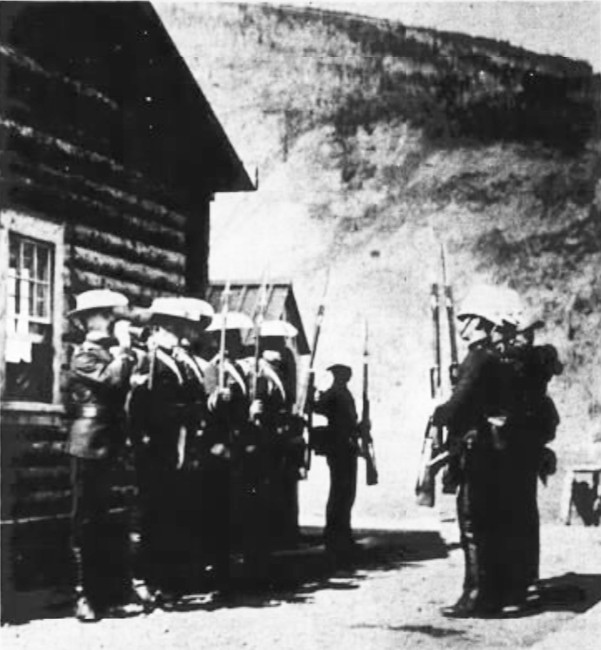
Klondike Yukon Field Force, last guard meeting, June 26, 1900. The Public Archives of Canada.
Suitably paraded for Lord Aberdeen, the Governor-General, and exhorted to greater service by Sir Wilfred Laurier for which they would get double-pay (80 cents per day) the Yukon Field Force marched to the CPR depot and left, May 6 for Vancouver with a stop half-way to pick up a detachment of the Royal Canadian Dragoons at Winnipeg.
Arriving Vancouver May 11, the men moved into an unused theatre, their officers into a hotel, and all ranks spent several days packing and labelling supplies to the tune of 60 tons, including 2 Maxim guns, all of which was loaded aboard the ISLANDER.
The ISLANDER (CPN) had been chartered to run the Force and its immediate
equipment north, leaving May 14 while another vessel would carry a heavier consignment into the Yukon via St. Michael's. Difficulties were encountered when bunks reserved for the Force were usurped by civilians; the vessel was overcrowded and the food poor.
LADIES TOO
There were ladies aboard as well, a Miss Fenton, Toronto newspaper correspondent, and the Misses Scott, Hanna, Payson and Powell, who were members of the Victorian Order of Nurses attached to the Force, and for the establishment of a hospital at their destination.
The ship reached American Customs on Mary Island, May 16. Since all arms and equipment were in bond the inspection was brief and by 7:00 p.m. they were landed at Fort Wrangel and welcomed by a U.S. infantry detachment, their uniforms arousing much interest.
The men transferred their supplies to the shallow-draught riverboats, STRATHCONA and STIKINE CHIEF with the only loss their entire supply of coffee. They were underway by May 19 and reached Glenora, B. C. on May 21. Once again, the Force moved its tons of goods, at the same time being taught the art of back-packing over rough country by some NWMP and Hudson's Bay men while on a spartan diet of corned-beef and hard-tack.
The Force was divided and an advance party of 50 competent axe-men left Glenora June 1 for Telegraph Creek and through the Yukon to Fort Selkirk. Assisted by
civilian labour, chiefly prospectors down on their luck, they began construction of a
log barracks, northern headquarters for the Yukon Field Force.
OVER THE TESLIN TRAIL
The main party spent another week in marching with heavy loads and on June 9 rode the STIKINE CHIEF to Telegraph Creek, the start of the Teslin Overland Trail.

DAWSON, YUKON TERRITORY. From a photograph loaned to the Public Archives of Canada.
The Force, assisted by Hudson's Bay packers and mules, moved their load to the top of a hill; then with each man packing 50 pounds and mules with 200 pounds apiece they hiked the Teslin Trail, a rough passage of 150 miles hardly eased by some trestles across a few streams and corduroy laid through the worst of the swamps.
Evans reported that the Hudson's Bay packers, under contract to move the supplies, had not had sufficient notice of the operation, nor a proper understanding of the magnitude of the work to be performed and had arranged for too few mules. The Force had a Manager of Transport who secured all available transport on the spot. As well, their training had encouraged the Bay men to practice economies that resulted in the Force issuing goverment suplies thus reducing the carefully estimated two years' needs.
Pilfering by packers along the Teslin weil brought swift retaliation from the Field Force that resulted in five and six months' imprisonment with hard labour for
the offenders. As well, three men of the Force were punished and a Lance-Corporal discharged as worthless for insubordination, an incident that Evans reported was "blown out of all proportion by the newspaper correspondent accompanying us."
RED COATS - RED FACES
In addition to back packing on alternately very hot or yery wet mosquito-plagued days, the men were kept reminded of their duty as soldiers by barrack-square drill properly clad in red coats, red faces fuming as they negotiated brush and stumps and rocks.
Special reports on the condition of the Glenora-Teslin Route were carried out by Mr, Garry, QE and H. P. Graham attached to the Force for this purpose. The B.C. government made improvements to a "first class pack-trail" soon after the Force had passed. These improvements resulted in the trail being shortened by ten miles so that the journey, with loaded pack animals "can be easily made in 12 days".
Taking the good with the bad, the men fished for huge salmon (with bayonet-on-sapling) and hunted when allowed, relishing any fresh addition to their menu.
TESLIN CAMP
It was mid-August before the main party reached Teslin Lake and pitched tents in a spot they called Camp Victoria, Shallow water made a dock necessary and the rates of the Canadian Development Company steamer ANGLIAN being exhorbitant, scows were next on the agenda.
Built on the spot and named Bug-a-boo, Nova Scotia and Lady of the Lake, these scows, properly called Nos. 1-4 were 46' long, 14' wide, 4' deep with a 21" draught
when loaded and capable of carrying 15 tons. They were steered by 16' sweeps at bow and stern and two oars were on each side. As well, five sturdy pilot boats were built.

Yukon Field Force camp, Teslin Bay district, B.C. The Public Archives of Canada.
TO FORT SELKIRK
Lieut-Col. Evans and an advance party took the ANGLIAN, July 21, reaching
Fort Selkirk on the 25th. The remaining men and their fleet of boats and barges were underway by August 29 and the log of the journey shows a series of misadventures but no losses from the time they entered the Hootalinqua river on September 4 until they reached Fort Selkirk, a week later.
The hard trail was behind them and at Selkirk a parade ground awaited their drill while twelve log buildings offered shelter. Evans and his men had set up a sawmill three miles upstream; contracts were let for sufficient logs and planks to complete the barracks before winter. However, their mill closed October 1, just as the Canadian Yukon Lumber Company arrived, so that there was no shortage of lumber.
Ten days were spent unloading the barges and storing supplies. The barracks were completed and chinked with moss against the winter cold. Failure of their heavy supplies to arrive via St. Michael's at an early date meant that window-sashes etc,
had to be made by hand. Much attention was paid to the woodpile, as 600 cords were required for winter fuel.
STEAMER AGROUND
There was some concern over the cargo of 250 tons for the Yukon Field Force and 50 tons for the NWMP transferred from the barge MICHIGAN to the steamer
SEATTLE which went aground near Circle City, 300 miles below Dawson. On word of the non-arrival of the SEATTLE ahead of winter, it was arranged that men from the Dawson Detachment would go over the ice to arrange with the U.S. authorities for the proper protection of the cargo.
Since the fur "Parkies" were aboard, it was necessary to get replacements in Dawson. Lieut-Col. Evans went to Dawson on this matter. While there, he received a requisition from Superintendent Steele of the NWMP asking that a detachment of 50 men and officers of the Yukon Field Force be stationed at Dawson for the winter. Whereupon Capt. H. E. Burstall, Capt. J. H. C. Ogilvy, nine non-coms and 41 men were detailed, all smartly turned out by Master Tailor Private Dumas, Royal Regiment of Canadian Infantry, who mended their uniforms so that they might appear
smartly dressed on arrival at Dawson.

Members of the Yukon Field Force at Telegraph Creek, B.C., 1898. The Public Archives of Canada.
This Force accompanied by Miss Fenton and two of V.O. nurses, left Fort Selkirk on the GOLD STAR, arriving about October 1. A smart landing and a march, with one Maxim gun, to the NWMP barracks, was marred by the unexpected appearance of Miss Fenton's cat. It no sooner hit the ground than the police dogs, which were unchained, tore it apart.
Already Dawson held 13,000 gold seekers. Sanitation was non-existent and typhoid and scurvy filled the hospitals with sufferers. The laws of Canada were firmly upheld by the small police force and gained considerably more respect with the arrival of the Yukon Field Force conspicuous in their scarlet jackets and white helmets.
SPECIAL DUTIES
Their duties were varied, from guard duty at their own barracks to guard duty at the banks and attending pack trains coming into town from the creeks. The Canadian
Bank of Commerce was the government's bank in the Klondike, acting as assayer and as collector of royalties on mining. Then men of the Field Force had special duty, armed with a 45-calibre revolver, over the "bars and bars of gold and small bags with nuggets of gold."
Fires continually menaced Dawson and the Force was called out on several occasions. The winter was long and eventful for the men of the Field Force. Their numbers were increased by the arrival of Capt. P. E. Thacker and 15 men, thankful to leave the solitude of the quiet Fort Selkirk for the busyness of Dawson.
The ice went out to the cheers of crowds on May 17, 1899, and the troops of the Yukon Field Force shared in the excitement as steam whistles blasted and bells rang joyously, bugles sounded, and rifle and revolver shots cracked in the still, crisp air.
The winter uniforms were turned in and scarlet jackets and white helmets took their place on May 29, which officially ushered summer in. Guard duties continued - over prisoners or gold.

The Yukon Garrison celebrated Queen Victoria's birthday on May 24, 1901. H. J. Woodside, Dawson, and Public Archives of Canada.
With the gold rush continuing and Dawson established as a government and trading centre, Selkirk faded away. By late August, the Yukon Field Force transferred its
headquarters to Dawson and in September half the force was withdrawn, among them Lieut-Col. Evans, who leftover the ice, November 28, returning to his base with the Royal Canadian Dragoons. His successor, Major T. D. R. Hemming, arrived Dawson October 15, assuming command November 4; in May, 1900, he was promoted to Lieut-Col.
YUKON GARRISON
The reduced Force was renamed the Yukon Garrison (from January 8, 1900). In May, the Garrison was also withdrawn, its arms and equipment going to the NWMP; the force of 100 men boarded the COLUMBIAN for White Horse, thence to Skagway and sailing for Vancouver on the AMUR, to arrive July 5.
Its place was taken by the Dawson City Rifle Company, a non-permanent militia of 48 enthusiastic volunteers.
One man, a private, died of heart attack at Fort Selkirk and is buried there. Others were withdrawn as their service time expired. The Canadian goverment expressed its thanks for the service rendered by the Yukon Field Force in treking the arduous Teslin Trail and in securing the position of the NWMP in a manner representative of the Canadian Permanent Force in the Yukon, which is as much as can be said about any such force, short of war, even today.

|

|