An extract from a book which its author values at $2,000 and which will
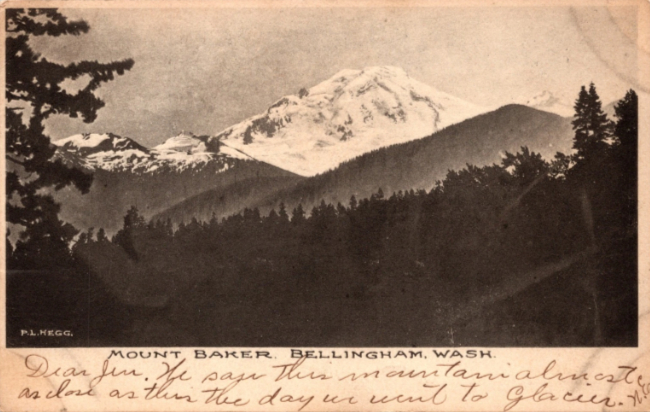
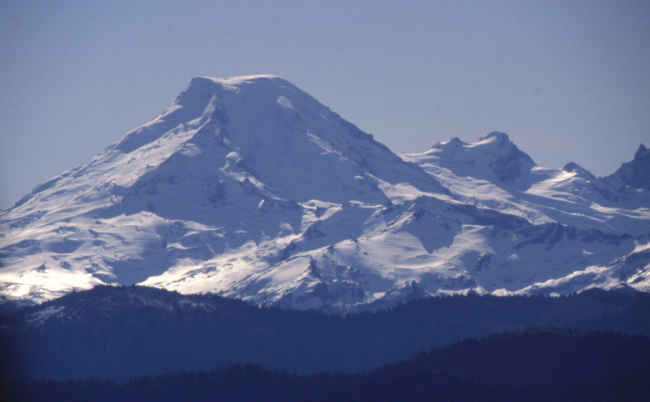
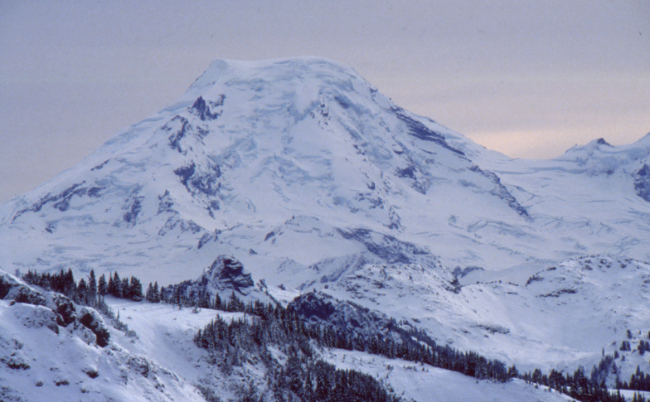
be worth $3,000 when it is completed, will be read at the meeting of the Mount Baker club at the Chamber of Commerce rooms tonight, when its members and the public generally are invited to select from a display of Mount Baker photographs the photo best suited for
reproduction in an advertising booklet soon to be issued by the chamber. This book is entitled "Mount Baker: Its Trails and Legends. A Chronology of the Discovery, Exploration, Improvement and Study and Development of the Great Koma Kulshan of the Lummis," which
is none other than Mount Baker, as Vancouver named it in 1792.
This probably is the most remarkable book ever produced in Bellingham and
certainly it is one ef the most remarkable and unique volumes ever prepared in the United States. Its author-in-chief is Charles Finley Easion, historian of the Mount Baker club, and although it has been four years in preparation, it is far from complete. It now has 100 pages, but fifty more are to be added. In its production Mr. Easton has been ably assisted by writers, artists of pen and camera and others and eleven articles on various subjects connected with the Mount Baker region are yet to be submitted to him for insertion. At present there are descriptions of all the ascents of Mount Baker, also one of the Twin Sisters, and many maps and photographs, some of them occupying pages about two feet long and more than eighteen inches wide. Among the maps is one showing the Mount Baker country in detail, including its dozen glaciers, its mountain peaks and ridges, rivers and creeks. It was the first map of its kind to be published and was drawn by Mr. Easton in 1912 from field notes taken for years from the year 1900. When the book is completed it will be presented to the Bellingham public library.
Knows the Mountain.
A more competent person to prepare such a book could not have been found,
for Mr. Easton has ascended to the summit of Kulshan four different times and has spent years exploring and surveying all around the mountain. Likewise, his assistants are peculiarly fitted for their work, for they, too, have pressed its snows beneath their feet. No small part of the work which Mr. Easton put into the book is a list of about 180 names of natural objects in the district, including the origin of each name. These names
have been made official by the United States geographic board. In addition to all this work the book is brightened and increased in value by articles on the Mount Baker district written by Mr. Easton for various magazines.
The book is profuseiy illustrated, not only by some of Mr. Easton's work, but also by such photographic artists as J. A. McCormick, W. H. Wilcox, Henry Engberg, E. A. Hegg, W. H. Sandison, F. G. Hall, J. B. Hann, B. B. Dobbs, Asahel Curtis and E. D. Welch. Among other features of the book is a beautiful poem by Ella Higginson, entitled,
"The Snow Mountain."
Fine Historical Record.
As a historical record, Mr. Easton's book is invaluable, It has accounts of all the ascents of Mount Baker that have been made since 1868, when it was ascended for the first time. The members of that party were Edmund T. Coleman and David Ogilvy, of Victoria; Thomas Stratton, of Port Townsend; and John Tennant, of Ferndale. Coleman described the trip at length in Harper's Magazine and illustrated the article with his
own pen drawings.
So far as known there were no other ascents of Kulshan until 1891, when attempts were made to reach its summit by one party from Blaine and another from Bellingham. The first failed because of a fatal accident to one of its members, Richard L. Smith, who accidentally shot himself. Aside from Smith, the party consisted of W. H. Radcliffe, J. T. Shaw, E. H. Thomas, John Lynch and William Garrett, the latter two joining the others at Sumas. The Bellingham climbers, who reached the top, comprised V. V. Lowe, Henry Lowe, Ed Whitstruck, Percival J. Parris, G. W. Smith, Tom Scatbo, Hobart Clark, W. A. Amsden. In the same year the summit was reached by the Boen party of seven,
from LaConner, and by a Seattle quartet. In the LaConner party was Miss Sue L. Nevin, the first woman to stand on Kulshan’s dome. In this year, too, the Twin Sisters range was scaled by J. M. Edson, E. A. Hegg and P. J. Parris, of this city.
In 1892 the Edson-Dobbs expedition reached the top of Baker after two trials. Its members were J. M. Edson, B. B. Dobbs, Ed Hofercamp and L. P. Palmer. In the same year they were emulated by the "street car brigade" from Bellingham, consisting of Jolin Hickok, Archie O'Byrne, Myron Hawkins and Ralph Duxberry.
Mazamas Failed Once.
In 1895 a small party of Mazamas tried to reach the summit, but an accident caused them to abandon the attempt. In 1900 the following Bellingham men were successful: F. W. Epley, R. B. Vaile, John A. Lee, F. F. Handschy, C. W. Henderson, Charles McPherson, Tom Wall, J. H. Dakin, Joe Morovits. Three years later a trio headed by George Cantwell, of Everett, tried for the summit and two of them reached it, including Cantwell. The Mazamas made a successful ascent in 1906. The next year a record trip to the top (five and one-half hours) was made by the following local young men: Harley Dodson, George Livesey, Clifford Lee, Paul Ashby, Maurice Tibbels, Chet Spearin. With them was a boy, William White, 15 years old, who refused to go farther than the snow. In 1908 the Mountaineer club got to the top and it was followed in 1909 by the Mazamas. Since that time no large parties have scaled the mountain or attempted to do so, the chief interest in recent ascents of Mount Baker centering around the Marathon races over its crest. This year it is possible that a party of seventy-five or one hundred will make an ascent, according to plans now being slowly formulated.