The Cornwall Standard (Cornwall, Ontario), Thursday, September 26, 1929
Grim, Heartless Mountains, Rivers and Rapids, the Rush for Gold, for Many Ending in Agony and Death.
(Part II of the story by Robert Ayre in Canadian National Railways Magazine.)
The Yukon! There is something exciting in the very mame. Robert W.
Service is glib with such phrases as the "Gold Lure," the "Clarion Summons," the "Big Stampede," the "Treasure Trail," the "Gold-Born City," but not one of them is quite as powerful as simply the Klondike, or the Yukon. Not one of them, nor all of them together. The name Yukon is a multitude. Just as surely as black means black and white means white, Yukon means grim, heartless mountains, lakes and rivers and rapids, and a mightier river than all; it means gold and thousands of poor wretches clutching for it; it means agony and death, triumph and exultation, and the whole thing sinking under the years and all the violence dying into a rumor.
What is to be gained in standing under the chin of the sphinx if it is not the feeling that you are there? The sensation that you are relating yourself tangibly to events, to history? There is a peculiar stimulation in exposing yourself to the clash of the Past. The reactions to an ancient city or a battlefield are manifestly different
from those you experience when your feet are the first feet to tread a new land. Captain Cook and Alexander Mackenzie and Robert Henderson had feelings quite unlike those of the tourist of to-day who finds his way into the Yukon by much easier routes than they knew. History and legend do not go very deep in the Yukon, but the Yukon was a battlefield, of men against men and of men against the relentless elements. The whole world is a battlefield, true enough, but in some spots the conflict is infused with a passion and a romance that forces it into drama. Surely the very air is charged in places like these; surely the mountain passes and the narrow trails are filled with significance.
Bearing all this in mind, this cheechako could not be satisfied with going to Taku Arm after more sights, or with stopping half way at Bennett. He boarded the train on the dock at Skagway at half-past eight in the morning, shortly after the Prince George docked, and by three o'clock was standing in the main street of Whitehorse. How
long did it take the lust-driven cheechakos of '98 to make the same trip? Think of the Chilcoot in the snow. Think of the agonizing trek through White Pass. Think of the struggle across Lake Bennett, of Tagish, think of Miles Canyon and the Whitehorse Rapids.
Barring the Midnight Sun, the glaciers, the mines, and the Past, the greatest thing they have in Alaska is the White Pass and Yukon Railway. It climbs 110 miles from Skagway; passes out of Alaska, through a corner of British Columbia, into the Yukon, and ends at Whitehorse. It is like a toy railway, with its narrow gauge track and its tiny cars, but it runs rings around the mountains and climbs to an altitude of 2,900 feet. The little engine goes whirring along so nobly that you feel like striking its purring boiler and feeding it lumps of sugar when it gains the top.
It scrambles up, up. breathlessly, until it reaches Inspiration Point, at 2,400 feet. The stampeders of thirty years ago did not stop for inspiration, but the tourists do, and they get it - if anyone knows what "inspiration" is. Seventeen miles below, lies the sea, a white glint, and if you keep on going north, this is the last glimpse you get of it for 2,150 miles. The mountains bulk up in tremendous masses, rusty red, grey and green, patched with snow; to the left, the jagged tops of the Sawtooth range are brown; in the distance, the snow-streaked peaks float in a blue haze; the white river crawls far below.
Remembering the horror of '98, the cheechako thinks that the mountains are cruel and unyielding, but the toy railroad runs around the waist of the wickedest of them and makes it look as if someone had pulled a string too tight. The ridges "ripsawing the sky," as Service put it, bullied the weaklings, "trampled the unfit," in '98; murdered them, too; but man is a match for them, after all.
Yet, there is something pathetic in the little track you catch sight of on the mountainside as the train goes on; the little brown, beaten track marked by a sign "Trail of '98."
Before the train reaches Inspiration Point, it passes Reid's Falls, the trail, that leads to Denver Glacier, Pitchfork Falls, Bridal Veil Falls and old White Pass City, which once had a population of 10,000. The train corkscrews and comes back on itself, so to speak, giving you dizzying glimpses of deep valleys and crawling rivers; crosses the ghastly Dead Horse gulch on a cantilever bridge 215 feet high, and at last it
reaches the summit of White Pass. Sitting comfortably in a train, how can a cheechako of '28 know what it felt like to get to the top in that terrinle, frenzied winter?
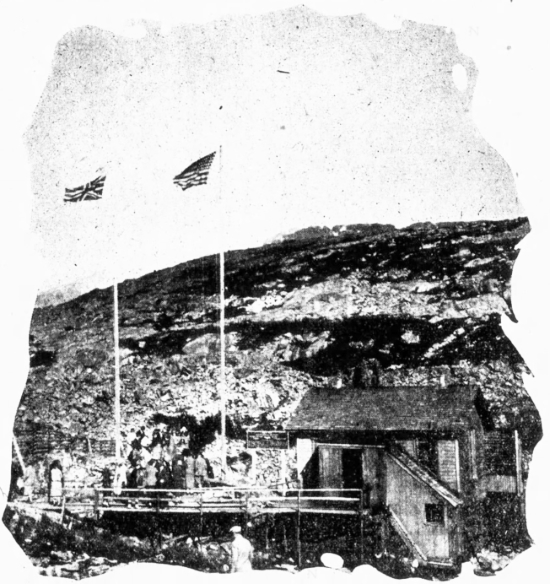
Where two flags proudly unfold to the Northern skies. The Canadian-United States boundary line, near Carcross, Alaska.
We cross the International Boundary here, twenty miles from Skagway; here, where Summit Lake sends its waters to join the others that make up the tremendous Yukon, which, before it gets into the Behring Sea, 2,100 miles away, drains 150,000 square miles of British territory and 180,000 in American territory.
The pines have become twisted and stunted. They are smaller and fewer.
The bulging mountains are dun, black and gray, mottled with snow; they are like the hulking bodies of huge animals. Silver-grey snow-fences zig-zag across the ridges. There are no trees now but a few dwarts, miniature, starved Japanese pines springing, with little vitality, from the crevices. The plateau strewn with great blocks of rock encrusted with greygreen lichens. It is like an ancient city fallen.
Down into the woods again the railway drops, past Log Cabin, the old headquarters of the Mounted Police; past Lake Linderman, whose head was the terminus of the Chilcoot trail, down to Lake Bennett. Here it was, 41 miles from Skagway, that the gold-seekers rested from the travail of their climb, their heavy packs and thanked their gods that the worst of their journey was over. It was later, in the Whitehorse Rapids, on the Yukon, and in Dawson, that so many of them cursed their gods and died. They were a motley lot and some of them did have gods. It was at Bennett that so many friendships were broken, that brothers, before starting out on the lake, divided their supplies and even went so far as to cut boats and tents in half. The world will never see again the like of
that fleet which pushed off from the head of Lake Bennett, to Carcross, into Tagish Lake and on to Whitehorse, across Lake Lebarge and down the Yukon to hell.
For 26 miles the railway runs along the shore of the beautiful lake, which must have been surpassingly refreshing to those weary, hard-pressed and storm-harried gold-seekers, and the train stops for lunch at Carcross.
"Carcross"! Even as far north as this is revealed our Canadian weakness for changing names. We gave up "Pile O'Bones," good, racy English with a meaning in it, for the pretentious "Regina"; we left "Thunder Bay" and "Rat Portage," and if it hadn't been for Rudyard Kipling, we should have become too civilized for "Medicine Hat." "Carcross" was once "Caribou Crossing." To hear the old name is to see the picture, but what can you get out of "Carcross?" At any rate, you are in the Yukon, and you can order for luncheon roast caribou, ptarmigan or a good moose steak.
From Carcross it is either the steamer Tutshi and a trip through Lake
Nares to Taku Arm, or Atlin, where beauty sits combing her golden hair and luring the wanderer, or the train again and on to Whitehorse.
Between Carcross and Miles Canyon, the railway runs along the bottoms of
several lakes, which were drained to make way for the line. It is a small railway and it was rushed through during the gold stampede; but it stands as an example of engineering skill and ingenuity. The only way to shorten the distance between Lewis station and De
Wette was to lower the water about ten feet and run the tracks along the lowered shoreline. When the water began to go out it went out with a vengeance and sank not ten but eighty feet.
Then comes Miles Canyon on the right, a glimpse of the whirling waters,
and Whitehorse, in the rain.

In the true Yukon Country: Miles Canyon, a noted spot on the Yukon River, where history and tradition mingle in extolling the exciting days of the great gold rush.
To me, there is something exceedingly attractive about Whitehorse, apart
altogether from its history. History is all very well in its place, but ruins are melancholy, after all, and there is not much thrill in looking at an empty house, no matter who lived in it, or when. After Juneau and Skagway, Whitehorse was a relief. Here, a hundred miles from the sea, was a town which did not have to lay itself out for the tourists. The tourists who come to it like it the better for that. There is one novelty shop in Whitehorse, but the Pucketts, who run it in conjunction with their hardware store, do not take seriously the novelties which stock the Alaska shops. Theu specialize in English china and Irish Beleek! They keep enough beads and totem poles to supply the demand. After some of the Alaskan ports, I was struck by the brightness and cleanliness of Whitehorse; it carried itself like a town with some self respect.
The first thing to do, after getting a room in the hotel, was to inquire about the new gold rush. We had been told at Prince Rupert and Skagway that Whitehorse was deserted and the North was waiting breathlessly for the word that was to come out of Squaw Creek. I interviewed J. D. Skinner, Editor of the Whitehore Stra, in his little one-man plant, and then the bank manager, and the government agent; the latter in the liquor vendor's store, for the government agent does all the government business, and cheering the populace when it wants cheering is one of them. Here I heard the historic phrase
"Gold is where you find it," as the old-timers dropped in for the purchases and stayed to gossip about the strike. Opinions as to the value of the discovery were at odds. The gold was rough. You could see that it hadn't travelled far. That didn't matter. It might easily be only a local deposit, but it might be a rich one. Everybody was most casual about a strike that everybody was hoping would be a second Klondike.
The gold was on display in the window of the big trading company's shop.
A thousand dollars' worth of nuggets. Late that evening the trader took me through the darkened store to the winow and pulled up the curtain so that I could see the gold.
"Do you leave it here all night?" I asked.
"Why not? We're not in civilization here, you know," he said with a grin.
The gold lay on a tin pie plate. A thousand dollars' worth.
Two Indians, Big Jim and Paddy Duncan, had made the find and Whitehorse, although it did not go out of its way to show the symptoms of gold fever, was interested. You never knew; this might be another Klondike. A few men who worked on the river steamers
had thrown up their jobs; others had booked off on a sort of holiday, but Whitehorse was by no means deserted.
From Whitehorse to Champagne by car was sixty miles. Boats go to Dezadeash and pack train to Dalton Post, then 120 miles to Squaw Creek. It was not easy to get to the new Klondike, breaking through untravelled country, but it was nothing like the days of '98.
I sat on the counter in Puckett's shop and talked to two sourdoughs, Puckett himself, and Jack Hayden - two sourdoughs who went through the epidemic of '98 and stayed in the Yukon. Hayden was between sixty and seventy, white-haired, with a long, sweeping white moustache and clear blue eyes. He looked like a southern gentleman and he was a northern trapper, which is the same thing, except for the direction. He worked his way up from Wyoming im the nineties. A woodsman, an alert and skillful canoeist, he piloted green cheechakos through the Whitehorse Rapids and when the excitement was all over, struck out 200 miles to Kluane Lake and that was where he lived, trapping, and coming into Whitehorse for supplies, and hankering as little after civilization as he ever did.
The winter before, he had broken both his ankles. Thirty miles from the
home camp; four miles fram his nearest trapping cabin; and the weather twenty below. He stumbled into a ravine and the sudden slip and fall snapped the bones of both his ankles. He lay for a moment stunned. But not for long, with the weather twenty below. He tried to crawl and sank back. He could not move. There was nothing for it but to fire his rifle in an attempt to make his wife hear. She was four miles away. She heard and realized that Jack was in trouble. She came with the toboggan and the dogs hauled him back to camp. He set the bones himself and lay with heavy bags of cement pressing against them. Jack pulled up his trousers and showed me. The ankles were not quite straight; they were knotted; but he could walk well enough. He was not a young man. Something besides lust for gold went into the rush of '98, I thought.
Yes, they told me, those were the days when sugar was a dollar a pound. "I remember shooting a moose," said Hayden, "and selling the meat for the same price. It brought me a cool thousand."
Whitehorse shone in the rain, a town of new wood, a town open to the sky and with nothing to hide, and, as the rain slackened, I strolled about the streets and down to the river, enjoying the freshness after rain. Superannuated, the hulks of the old river boats dozed on the bank - the Bonanza King, the Eldorado. Such names! Rheumatism lay in their great, still paddle wheels, gaping holes in their keels. They had become immense hotels for innumerable colonies of sparrows and swallows. Time had thrown and left them on their backs to rot. Time had gone off to wrestle with the rest of the world. The Klondike was a story that had petered out.
But new river steamers, with names as romantic, still ply the waters of the Yukon. The Five Finger Rapids are there yet and Lake LeBarge is to be crossed, and there is still a thrill in going down to Dawson.
On one of the river steamers there is an engineer named Jack Elliott. The
North is full of stories, but one of the most interesting is the story of Jack Elliott. It is not one of the yarns of a man who lost a claim that brought fortune to another; it is not the tale of an accident that unearthed treasures too great for the strength of man; it
is not the romance of a heavy poke of dust lost on one throw of the dice; it has nothing to do with gold at all. Jack Elliott came to the Yukon when the first flash of the fever had paled. He found another treasure. His is a story of ivory. It begins in the days so dim that men can never quite comprehend them, when the gigantic shaggy mastodons lumbered over the earth and gored each other with appalling tusks. The monsters perished. Merciless time crushed them and buried them deep. When man's quest for gold in the Yukon turned from an adventure into an industry, man dug them up again - colossal skeletons fifty thousand years old. Elljott brought some of the tusks back to Whitehorse with him, great smooth masses of ivory, as thick as the trunks of small trees. |
"This," Elliott told me, "is the true ivory. The walrus tusk is another kind of tooth that hasn't the texture of this. It's brittle stuff..."
It never really falls dark in the summer in the Yukon. Under the wan light, I could have read a newspaper at midnight standing outside Puckett's shop.
With regret that I did not have time to spend longer in Whitehorse, or to go to Dawson, I took the morning train to Skagway. But before leaving Whitehorse, I went in one of Cam Smith's automobiles to the Rapids and the canyon.
Between Whitehorse and Bennett, I chatted with the Scandinavian brakeman and heard tales of moose running down the track in front of the train and of caribou. The caribou herds were almost unbelievable, he said. The droves of them coming down the Yukon River were among the greatest spectacles of the North. He had seen in the river what looked like an immense island that should never have been there. It was covered with a
thicket of dead trees. But the island was a herd of swimming caribou and the dead trees were their antlers. I looked out the windows and watched the loons sitting on their nests in the middle of the lakes as if they were sitting on nothing. We were back again in the plateau with its dwarf trees, its moss and its dazzling white snow patches. I settled down to read "The Trail of '98," which I had never read and which I had bought at Puckett's. There would never be a better time to read it.
At Carcross, a host of tourists from Taku and Atlin boarded the train,
drunk with scenery and bedecked with forget-me-nots and lupin picked along the railway track.
"Ah, bluebonnets!" exclaimed a man from Texas. "Our state flower," he explained. "Isn't it strange how it got away up here!"
White Pass summit again; Dead Horse Gulch; Inspiration Point, and the ocean a blur of milky white in the depths. Pitchfork Falls, where the train empties itself of all passengers and everyone scrambles over the polished rocks among the ferns to photograph the superb white water cascading from steep to steep, and to peer up the mountain slopes for goats.
Skagway again and a few hours to see the sights before the Prince George
turges southward on its thousand miles so Vancouver.
More languorous sailing over the quiet sea, with the green islands pushing up on all sides and the green forelands nosing into the water, with the mountains looming up and spreading out their glistening glaciers, with the sun astonishing the green sea into silver and lighting up the wide white wing of the wheeling gulls. The enchantment of the sun lay on the sea, day and night. There was no night. The glory of sunset had not failed before it was outshone by the glory of sunrise. To go to bed under such a sky was impossible.
Juneau and Ketchikan and Price Rupert again. But on the return voyage, Wrangell, too.
Wrangell is possibly the most interesting of the Alaskan ports visited by
the Canadian National Steamships. Its history began many generations ago with the Thlinget people, whose chiefs went to the other world escorted, as were the ancient Egyptians, by a bodyguard slaughtered so that they should not be lonely and unprotected. The Russians came to the coast more than a century ago, followed by the Hudson's Bay Company, which leased the Russian Governor's fort, at Wrangell. But there is little left of either the Russians
or the traders and the fort has disappeared. The Indians remain. The totem poles stand in the street and give the town as bizarre an appearance as that of any oriental city. You go out along the dock, through smells of shrimps and fish and smells of furs and hides, along the weather-beaten wood of the street, and your progress is slow, for you must stop to look at the whales and the whalekillers, the frogs and the sea lions, the bears and the ravens that were once trees but charmed by crude yet cunming tools into images of creatures as strange as the mind of man has ever devised. There is the raven who filched the sun, the moon and the stars for the good of man, just as Prometheus stole the fire for the old Greeks; there is the beaver who undermined the village and brought it down around
the heads of the men who laughed at him; and Hiyishonagu, the Atlas who bears the burden of the earth on his flat head and square shoulders; and Konakadet, the monster who lived at the bottom of the sea; the eagle, the wolf and the thunder bird; all grim and silent, but thinking strange thoughts in their wooden heads and brooding over strange stories.
You pass the sun house and the old churches, walk across the planks that
bestride a sort of swamp, or backwash, from the sea, weedy and littered with craft, and come upon Chief Shakes' house. It is a small, low frame building and outside it stand two ancient totems, so weather-worn that they have long since lost all their paint and most
of their features, and grass sprouts from their heads. There is the famous grizzly bear crouching safely on top of a naked pole that still shows traces of the footprints he left on his upward climb to escape the flood that submerged the world. In his haste the bear lost one of his toes and the deformity shows in his footprints. The other totem is the konakadet, squatting with his knees drawn up and clasped by his hands.
The old squaw sewing the Stars and Stripes and the American eagle in beads on new-made moccasins welcomes you with a nod, which is at once a recognition of your presence and an acknowledgment of your contribution to the museum - for Chief Shakes'
house is a private museum - and her daughter, with a face as round and shining as a full moon, escorts you into the low room and gives an intelligent lecture on the history of the
Shakes family and the objects with which the house is crammed; blankets and hats and masks, tools and utensils and weapons; the grizzly bear head which was worn by those who murdered slaves at the potlatches; the corner poles of the old houses; shamans' rattles; dancing costumes. To top it all, you go outside and see the great Kit war canoe, cut out of a tall tree and chipped into shape by stone hatchets, beautifully proportioned and decorated and so seaworthy even now that the chief embarked in it to welcome President Harding when he came to Wrangell.
At Prince Rupert, I left the George and went to Jasper by train, thus completing what is known as the "Triangle Tour," as well as visiting Alaska. The Triangle Tour, which becomes more popular every passing season with tourists, particularly from California and other sections of the United States, usually begins at Vancouver, proceeds by the steamship Prince Rupert or the Prince George, to Prince Rupert, or Alaska, goes east to Jasper by rail and then turns back by rail to Vancouver. As it happened, I set out from Jasper and went down, past Mount Robson. through British Columbia, along the Thompson and the Fraser to the sea. The mountains, the forests, the rivers and the canyons of this route, and the journey from the northern port through Hazelton and Prince George, through the Indian village of Kitwanga with its long line of totem poles looking over the Skeena, through the little fishing and canning villages of northern British Columbia, have a fascination that even Alaska and the Yukon cannot dim, and of Jasper itself nothing need be said here.
It is now the Trail of '29 and the North is submitting proudly to the invasion of new throngs. Graceful steamships ply from Vancouver to Skagway and from Skagway to Vancouver, and their brothers are running to Anyox and the Queen Charlotte Islands. "Tinkle-to-tinkle-te-tink!" goes the jaunty steward from deck to deck, calling the hungry; the wooden disks of shuffleboard click; the jazz band salutes the lingering sun; the green islands slide by in the quiet sea, the gulls rise and fall in the sky with a long rhythm; Old Man Alaska spreads out his wares; the squaws squat on the dock with their beaded moccasins and their fur gloves set out on newspapers beside them; the totem poles of the Past glare at an alien Present and utter never a word.








