The Cornwall Standard (Cornwall, Ontario), Thursday, September 5, 1929
(By Robert Ayre in Canadian National Railways Magazine.)
The August number of the Canadian National Railways Magazine contains
a very interesting account of a trip to Alaska, written by Robert Ayre, from
which we take the following :-
As a cheechako on the Trail of ‘28, I sailed from Vancouver on the Canadian National Steamship Prince George. We shook off the ligts of the city with a gesture of nonchalance and pushed north, out into a sky of rose and cream, and beyond, into the night. To starboard, a cloak of gray cloud was flung back over the dim mounds of the shoreline. Was it the open sea on our port? No; we could descry a few lights blinking on a smudgy string. Buoys danced on the silvery water. Below, the engines were throbbing and a little group of college students was gleefully and assiduously jazzing for the shuffling feet of the dancers. I stayed on deck until the sea went black and the rigging
became trangled in the stars. The Watch, gathering up the colored paper streamers that had snapped so easily when we backed away from the dock, sat down beside me and told me about
fishing days off the coast of Newfoundland. He told mighty tales of storms and sea-sickness and boasted of his cast-iron stomach. I began to feel uneasy and I sounded him out on the relative temperaments of the Atlantic and the Pacific. But, "Pooh!" he said. "This ain't nothin'! We're never out of sight of land. Them as gets sick gets sick because they expect to. Feel cheated if they didn't."
Reflecting on the ties of convention, even in a matter like seasickness, I went below to my stateroom.
At noon next day, we crossed Queen Charlotte Sound. I was in the saloon,
at the fish course, when I felt the ship begin to roll a little from side to side. Why the change in gait? It had been doing nicely with the stem and stern motion. It was then I decided that my breakfast had been substantial enough to sustain me until dinner-time. Striding briskly, I kept the wind company round and round the deck. The open sea stretched away to the left, but we hugged the mainland on the other side, and I laughed at the thought of sea-sickness.
Vancouver, Powell River, Ocean Falls, Prince Rupert; and, in between, the
long green sea, the melting shapes of headlands and islands, the slopes ragged with trees and patched with snow. The gulls poising and wheeling, screaming, dropping suddenly rising, floating, circling, being tossed back by the wind. Islands, islands everywhere, long ones and short ones, peaked ones and flat ones; and, on the other side, the mainland, with the snow-cloaked mountains in the distance. Rain and mist and the land blurred in all the tones of blue and gray. Rain on the sea and rain on the deck. A keen, salty wind, the flung spume, and a hearty appetite. The jaunty steward marching with his chimes "Tinkle-te-tink!" like a pied piper, not pied and without pipes, but with a tune as magic as was ever heard in Hamelin town. I think he worked for Cornucopia, or whoever the mythical gentleman was who poured out his largesse for the ancients.
"Pretty soft!" I said to myself as I sat down to those huge meals and when I was through remembered the plate of fruit in my stateroom. "What a difference a few years can make! The boys who stampeded through here on their way to the Yukon lived on pork and beans."
Sun and the sea sparkling. Rainbows over the shaggy hills. The gentle insistence of the vessel lulling and soothing, Or coats off for shuffleboard, or nine times around the deck for a mile. And "Tinkle-te-tinkle-te-tinkle-te-tink!"
At Ocean Falls, we all went ashore and in true tourist fashion gaped at the big paper mill. A company town, Ocean Falls, very clean and creditable; possibly very dull with no one to talk to but the people who were in the same business as yourself, but no doubt content. What do you do, hemmed in like this, by the bristling mountains? How do you amuse yourselves? Oh, they say, we have dances and concerts, and every winter we get
up two or three comic operas. And there is some talk of a golf course. God forbid! Even here? This is one spot where you have a chance to keep your virtue.
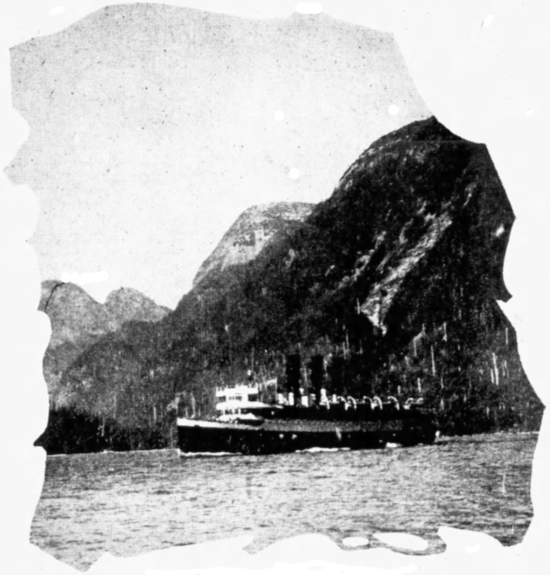
The Prince Rupert leaving Ocean Falls Harbor.
The Prince George lay most of a day at Prince Rupert, and I, as one who
"Stood on Guard for the True North Strong and Free," could not, in the face of a host of California tourists, do anything less than show an enviable pride in the Cold Storage Plant and the new Grain Elevator. The capacity of the elevator, which is helping build Prince Rupert into an important seaport, I forget, but I made a note of the awesome fact
that the fish house shipped out, every year, 20,000,000 pounds of fish. I saw the fishing smacks disgorging their net-fulls of slippery halibut and salmon; saw the executioners above, with deft strokes, hacking off heads; saw heads shovelled away and bodies dumped into boxes of ice and nailed down. I shivered in horrible, frost-lined chambers and gazed with awe at tons and tons of frozen corpses stacked from floor to ceiling; watched the glazing of enormous halibut; and came away with a cold and a new pride in Canada.
Forty-five miles out of Prince Rupert, the steamer crosses the boundary line between Canada and Alaska, and the United States immigration officer comes aboard to hold his levee. If you can keep a straight face and assure him that you are neither a polygamist nor an anarchist, all will be well and you are free to enter the land where men are men.
That night we were in Ketchikan. The stampede began. Not the stampede to
get gold; the stampede to spend it. The boat was scarcely moored before they began streaming down the gangplank. The way they saw Alaska was to buy it and take it away with them. The comical part of it was that most of the Alaska they bought was made in Japan, or in the factories of Seattle. From one shop to another they scurried. There was a danger that the Prince would not stay in port long enough to give them an opportunity for spending all their money. Blase, and with my eyes on the True North, I forbore to buy even a stickpin. But I paid a dollar for a book called "Totem Lore of the Alaska Indians and the Land of the Totem," a book which I could have had later in Skagway for seventy-five cents. However, I learned from it that we had passed through a channel named Revillagigedo, and if that wasn't worth the price, the information that Ketchikan was an Indian word (a Thlinget word, in fact) meaning "Town Under the Eagle" was.
Ketchikan looks like the new Alaska, the lusty son of the old sourdough.
Ketchikan is as up and coming as Seattle, brisk and business like, prosperous, modern, well-ordered: It has a Board of Trade, or Chamber of Commerce, and the other signs of self-reliant babbitry. It even has a Sunday paper with the Katzenjammer Kids in colors. Its streets are wooden planks, laid closely together. There is no suggestion of the disreputable, frowsy, wild-eyed Gold Rush about it.
We were not so much in Alaska as in The United States, in an extension of, say, the State of Washington. The Stars and Stripes were flying, the gossip was about Al Smith and Hoover, and the eagerness with which the citizens accepted invitations to come on board for a gulp of Scotch whiskey was pathetic. As a newspaperman pointed oul to me, Alaska is "double dry." It moans under the Volstead Act and a Bone Dry Law of its own. The lusty son is not a chip off the old block.
Ketchikan has a population of about 6,000, touching as it does, the fishing, timber, mining and fur farming - blue fox - industries.
Out of Ketchikan we ran into Clarence Strait, (named after an English Duke by Captain Vancouver), lying between the mainland and Prince of Wales Island. English names in the midst of a welter of outlandish Indian and Russian names. And these names are a reminder that there are other Alaskas than the three we mentioned at the outset of this narrative, Alaskas that are now well nigh obliterated, the land of the Indians, who hoisted the magnificent totem poles, who made the beautiful Chilkat blankets, the land known to Captain Cook and Captain Vancouver, and the land known to the Spaniards and to the Russians, before Alaska was sold to the United States, in 1867.
The next day's cruise took us through the Wrangell Narrows. Wrangell itself we should visit on the return journey. The way the vessel threaded its way in safety through those tortuous eighteen miles was nothing short of marvellous. You could have thrown a stone on the grass on either side. The Narrows cuts off ninety miles of a route that must be taken, around Cape Decision, in bad weather. I am too ignorant of things nautical to know how many varieties of buoys and beacons and riding lights there
are, but Wrangell Narrows is a catalogue of them. A big dredge was at work here and tiny launches bobbed up and down, saluting us with their impudent little whistles. We brushed by the front doors of fur farmers who sported patches of the greenest grass imaginable. It was impossible for the most hardened traveller to escape the scenery. The intimacy of the forested mountains and islands was a delight.
We floated on a placid sea. In our wake the gulls haggled over the entertainment we provided for them, and, besides the squabbling gulls, we had the splendid eagles, splendid in their isolation, swooping down on independent wing to catch the living fish out of the ocean. We had other game, too, fat porpoises shouldering out of the water and turning flips, as if they were trained to do it as another attraction of "The Land
of the Midnight Sun."
In the Main Tent that day was the Taku Glacier. Little icebergs, like sherbets floating on the water, pointed the way. We pushed into the inlet and the mountains rose up around us, showing off with waterfalls like white lace spread out on their bulky bosoms. I don't know whether it's worse to stay below and play bridge when landscape and seascape are doing their stuff than to burst into poetry about it. I escaped both and admired Taku exceedingly. Always ready to oblige, Alaska had provided a dead, ugly brown glacier beside it, as a foil. After taking 15 for Taku and being satisfactorily disappointed, everyoody went into ecstacies over the real thing. For fifteen miles, Taku Glacier, magnificent river of ice, sweeps down to the sea. At its mouth it is a mile and a quarter wide.
It rises two hundred feet above the water. Like molten glass, it glistens in the most bewildering blue. Carefully but persistently, the Prince George approached. No steamer, the captain told us, had ever come so close. Whether that was to please us or not, doesn't matter. As the lady said in the Jasper Park Lodge log book, "We came, we saw and were conquered." The eyes of the passengers had all they could do to keep pace with
their inner—imaginative—eyes. The ice was fashioned in thousands of pinnacles. There were blue hoodoos, blue shrouded witches brewing, blue giants threatening, blue elephants trampling blue alligators, blue conspirators huddled in blue conspiracy, blue armies destroying blue armies, all carved out of ice. The steamer sounded its whistle and before the echoes came back from the hills, a tall obelisk snapped in the middle and collapsed with a thundrous splash into the sea. The whistle blasted again. "One shall be taken and the other shall be left." A witch was broken off at the ankles and flung headlong into the water, whilst her fellow schemers went on with their dazzling blue scheming. Taku is a wonder of the world.
We turned our backs on the glacier, glimmering in the distance, and headed for Juneau.
Juneau is more like Alaska than Ketchikan. Wasn't it named after a
prospector? On the west, as the vessel goes in, lies the old Treadwell mine, producer of $68,000,000, and the desolate town of Douglas. In a night Douglas failed and hundreds of men were thrown out of work. Too ambitious man tunnelled too far; the mine caved in and the ocean took possession. Now Douglas is a melancholy, empty morning after the night before. But across the channel, under the steep green hill, stands another mine, defiantly prosperous, rattling its stones down the slag pile and swinging its chains of busy little cars backwards and forwards, empty and full, round and round, endless chains; champing and grinding, night and day.
As the capital city of Alaska, Juneau may be entitled to some respect, but a more ramshackle heap of cast-off lumber could not be found this side of China. "When we got to Prince Rupert," said a traveller from Long Beach, "I thought, My God! what a dump! It must be because it's a British town. When we reached Ketchikan, I said now this is something like a town! And I burst a button off my west. But when I saw Juneau, my pride went down like a toy balloon that had been pricked by a pin."
The good Canadians on board let it go at that, with becoming modesty, remembering the story of the man at the funeral who said: "If no one has anything further to say in eulogy of the departed, I should like to take the opportunity of giving a few facts about the glorious climate of California." Prince Rupert - without considering its many merits - was not the capital of even a Province.

In the "Land of the Midnight Sun": An unusual photograph of Juneau, capital of Alaska, taken shortly after midnight, from the deck of the steamer Prince George.
They have a museum in Juneau and we are told that they are "well supplied
with churches" - the old man must wonder where his son got the new fangled ideas! They have no legislative building, but instead, point with pride to the Governor's mansion, a huge frame building of eighteen or twenty rooms. The Governor, who lives alone in it, we were told, does not care for the social whirl. Old Man Alaska was not a myth. His
Excellency was off on an airplane tripto Nome.
A long, free run down the Lynn Canal to Skagway. The water is an incredible green. Glaciers pour down into the sea, first on this side, then on that. Islands slip by. Lighthouses begin to blink. The sun, after staying up long after dark, reluctantly disappears, and the sky, for hours after, is glowing. Islands and forelands take on a nimbus of purple. It is like being in another world, a world of water and sky and color, where land might be only mirage. The ship floats under a clear tinted sky, over a clear, serene tinted sea. This is the wonder of Alaska that out-reaches the romance of
its history, of its past and its present, of its totem poles and its gold. The work of man does not matter. The shabbiness of the towns that cling to the sea-margin under the climbing mountains is obliterated. A glamor lies on land and sea. Skagway is a sunken city. It sprawls at the foot of the mountains as if it had tried to go up over the Chilcoot Pass and had fallen back despairing. That is just the trouble with it. Thirty years ago, Skagway went up through White Pass and the Chilcoot and never came back. What was left behind ts today draggled and miserable. A sunken city. It seems to lie in a marsh, with the weight of the sea on it: color and life seem to have been beaten out of it. The Klondike is no more. They tell us that the sweet peas in Skagway are as big as your fist and that the dahlias are like sunflowers. Perhaps, but I was on the first boat of the season and did not see them. Just as well, because I should have been reminded of a graveyard in summer.








