Ed. Note: Mackintosh Lodge is situated on Bear Creek, at Mile 1022 on the Alaska Highway.
The Whitehorse Star,
Whitehorse , Yukon.
Dear Sirs:
I was very glad to receive the Whitehorse Star Discovery Day edition that Mrs. Abbott sent to me. I was especially pleased to have the Sept. 28th copy of The Star with article about the closing of the Experimental Farm.
I lived three miles west of the "Farm" and was very interested in its start and gradual growth. It added a great deal to the life and advancement of that section. To close it and let that soil that has been built up by nearly 20 years of cultivation and fertilization go back to weeds and shrubs seems a crime. I know what wonderful vegetables and berries were raised at Bear Creek with the only tools a hoe and shovel and no fertilizer.
Just as I was about to get the letter off to you I received a letter from Mrs. Abbott telling me that you had asked her about the start of Bear Creek or the Mackintosh Lodge. I have delayed this letter to enclose a little that my interest you about the start of the place.
I hope I have given a correct account of things. You can check this with Olaf Wickstrom who is living in Whitehorse and Mrs. M.A. Cyr who knew the Beauchamps well.
Again I thank you for the newspapers.
Dorothy Mackintosh
Anaheim, California,
THE STORY OF MACKINTOSH LODGE
In 1902 when the search for gold began on the creeks northwest of Whitehorse a number of places were built along the trail to furnish food and overnight
shelter for the prospectors going out to the creeks.
In 1935 when I went into that section many of these buildings were standing empty. Two of them near Indian villages, one at Champagne and one at Bear Creek, had survived as Trading Posts. The one at Bear Creek had been sold several times and then was open only in the winter for trade with the Indians.
The Bear Creek Post had been started by a Frenchman from Quebec, Joe Beauchamp. He cleared a small spot for a garden and cabin. Then in 1904 he built a large cabin and a bunkhouse that often housed 20 men at a time. He also built barns for horses, hay, and farm machinery. In all there were seven large log buildings beside the house and buhk house.
He staked 40 acres of land around his buildings, cleared land and broke some ground, but never proved up on the land and had it surveyed. In order to get Indians to live there he built three houses for them to live in. He seemed to have been a very hard working and shrewd man.
He had the name of being strictly honest in his dealings but very close. He would not accept a gift and would not give one. If a man brought in a fish or a piece of meat and offered it to him, he would weigh it and pay for it or refuse it. When he sold vegetables he cut potatoes etc, in two so he would not give an ounce more than he would be paid for.
When Beauchamp had been there about 30 years his third wife, a bride of one year who had lived in a town in Quebec, could not be happy in such an isolated place and urged him to sell and go to Whitehorse to live. He sold to two men who expected to raise mink and trade with the Indians. He took a chattel mortgage on the contents of the store. In a year he was back but his wife would not come. He then sold the place to the trader at Kloo Lake, Frank Sketch, for cash.
Eugene Jacquot who had a trading post at Burwash offered to look after the place for Sketch but did not buy it from him. He had Olaf Wickstrom keep the store open in the winter but there was no one at the place for six months in the year. The
buildings were not taken care of and the cottonwoods were taking over the cleared land.
CAME WITH NWMP
G.W. Mackintosh (my husband), who had come into Whitehorse with the first detachment of N.W. police to make their headquarters in Whitehorse , knew the many advantages that Bear Creek had over all the other places in that section. As he had left the police force a number of years before, he decided that he wanted to have the place for a home.
When he inquired about it he was told that Jacquot owned it. Jacquot said that he and Wickstrom owned it and would sell. A deed, for 40 acres and the buildings, was made out by a Whitehorse lawyer and signed by Jacquot and Wickstrom. When Wickstrom took the deed to the police to have it recorded, they told him that nobody owned the land around the buildings.
Staked land cannot be sold but once so it had gone back to the government. He owned only the buildings. But as Sketch had not been paid for the buildings he did not own them. Jacquot paid Frank
[a typesetting error resulted in some text missing here]
as I had come in to make our home there we staked 160 acres in the spring of 1936.
For four years we put in every hour we had in clearing, breaking ground and fencing it so as to prove up on the place and get it surveyed. In the fall of 1939 we went out to California to get medical aid for Mackintosh but it was too late. Before his death he had talked with me about what was to be done with the place. He felt sure that the U.S. would put a road through that country in order to have an overland route to Alaska. If they did, the road would have to go through our place or by way of Aishihik and he thought that by way of Bear Creek was the better way. With that in mind would I want to go back?
A CHALLENGE
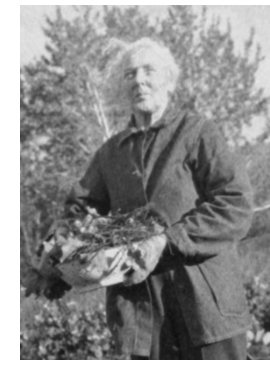 I had liked life in that country; hard work did not bother me and to go back alone and see what I could do offered a challenge to me. By the last of March in 1940 I was in Whitehorse. Although the police told me they could not allow me to go out there alone I went.
In 1943 when the road was being built through my land I began plans for a house. I had the Indians take down the two barns on the hill east of the old house. The house was completed and I moved into it and put up my sign in the summer of '45. To me it was a wonderful home for it had running water and even a bath tub although no electricity.
The place was surveyed in 1944 and I received a deed to it. In the spring of 1954 I sold it to Mr. and Mrs. Nygren for cash.
DOROTHY MACKINTOSH
Anaheim, California.







