
|





|
|
USAF C-119 Flying Boxcar crash in the Yukon, 1961
Arctic & Northern Aviation
Dateline: September 19, 2016. Last update: October 6, 2026.
On November 23, 1961, at about 3 pm, a United States Air Force Fairchild C-119C Flying Boxcar, registration 50-0145, crashed and burned near Annie Lake, south of Whitehorse, Yukon Territory, where it had just departed from a few minutes before. Of the ten men on board, seven were killed. Five men were able to bail out of the plane with parachutes, but only three survived.
The aircraft, with the 446th Troop Carrier Wing at Ellington Air Force Base near Houston, Texas, was returning home with Air Force reserve members after a two-week-long joint Air Force-Army exercise called "Operation King Crab II" at Kodiak, Alaska. The aircraft had departed from Elmendorf Air Force Base at Anchorage.
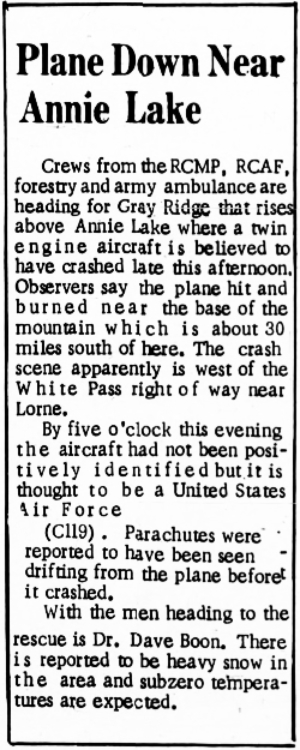
Several newspaper reports are reproduced below, starting with a brief report from Whitehorse Star, published 2-3 hours after the plane went down. The articles show how the story developed and was modified as the days went on. The cause was ultimately determined to have been frozen brakes - the pilot was able to overcome the drag by adding more power, but the brakes got hot enough to start a fire when retracted into the fuselage after taking off.
A detailed report from the inquest held in Whitehorse was published in two parts by The Whitehorse Star on November 30 and December 4 - click here to go directly to it.
Killed in the crash were:
- Capt. Wayne Delroy Sager, 37, pilot (grave);
- Capt. Milton Leroy Kimey, 38, co-pilot (grave);
- Capt. Alan Jon White, 28, navigator (grave);
- Airman First Class William Joal Murphy, 25, loadmaster (grave);
- Staff Sgt. Lonnie Z. Foreman, 36, mechanic (grave);
- Airman First Class David Leo Paul, 38, mechanic (grave);
- Senior Master Sgt. Roger Joseph Forstner, 48, mechanic (grave).
The survivors were:
Staff Sgt. Leroy Cotton, 37, line mechanic (died 2002, aged 78 - grave);
Staff Sgt. Clyde L. Nicholas, 46, mechanic (died 2009, aged 93 - grave);
Airman First Class Jean R. Conklin, 30, mechanic.
On October 3, 2026, ExploreNorth editor Murray Lundberg hiked to the crash site, and posted an article with 45 photos of the hike and crash site. See "Hiking to the crash site of a USAF C-119 from 1961".

A Fairchild C-119C Flying Boxcar like the one that crashed near Annie Lake, Yukon Territory,
on November 23, 1961 - it was registration 50-0145, MSN 10463 that crashed.
Whitehorse Star: Thursday, November 23, 1961
Democrat and Chronicle (Rochester, New York), Friday, November 24, 1961
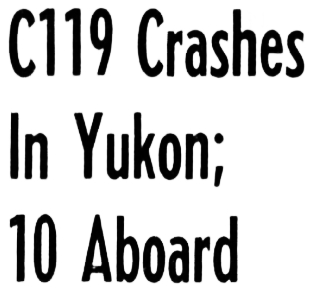
JUNEAU, Alaska (AP) - A United States Air Force C119 aircraft, struggling to return to the airfield at Whitehorse, Yukon Territory, after reporting an emergency,
crashed last night. The fate of the 10 persons aboard was not immediately determined.
Coast Guard headuarters here reported a small civilian plane had flown over the crash scene shortly after the accident. Its pilot said he saw five parachutes in the snow but no sign of life. The C119 had started to burn, he said.
The flight surgeon aboard another Air Force plane that landed at Whitehorse soon after the C119 crash was sent to the scene by truck. The crash occurred about 30 miles south of Whitehorse and about two miles west of the Yukon-White Pass Railroad track.
The Coast Guard here reported Whitehorse authorities said the pilot of the C119 had reported an emergency but did not say what it was. Several motorists on the Alaska highway saw the big plane circling. They said the pilot then headed back toward Whitehorse.
An amphiban from the Coast Guard station at Annette Island was ordered to
fly survival gear to the scene. Officers said it would take about three hours for the flight and that the drop would be hampered by darkness.
The origin of the flight was not definitely determined. Air Force headquarters in Washington, D.C. said the plane was headed for Houston, Tex. It was expected to make a stop at McChord Air Force Base at Tacoma, Wash.
Houston Chronicle (Houston, Texas), Friday, November 24, 1961
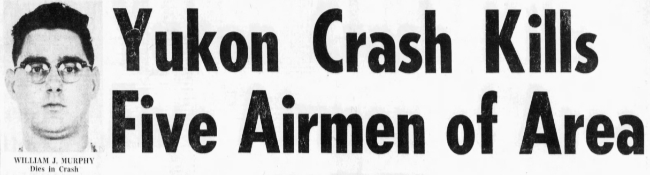
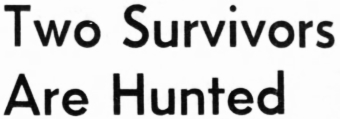
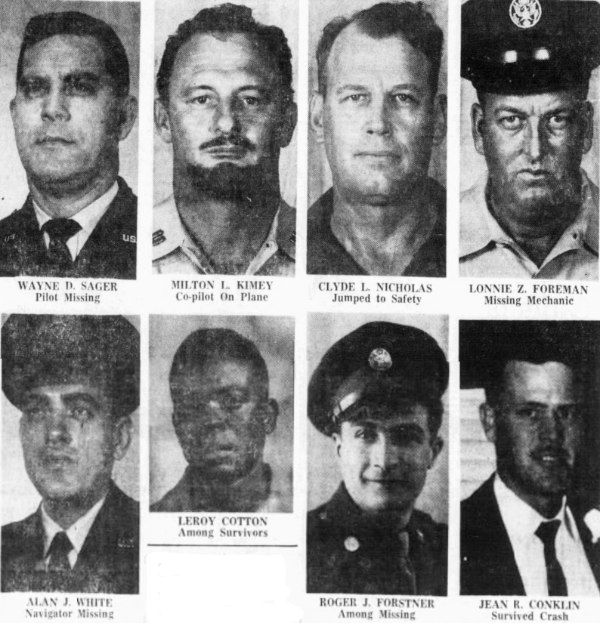
Air and land search teams hunted in the frigid Yukon Friday for survivors of an Air Force cargo plane which crashed and burned Thursday, killing at least five of the 10 Houston crewmen.
Two of five bodies found have been identified. Three men who parachuted from the falling plane have been picked up only slightly hurt. Two others who parachuted are being sought in the snowy, below-zero wilderness.
The C-119 flying boxcar, carrying reservists from the 446th Troop Carrier Wing at Ellington Air Force Base, smashed into the base of a 5000-foot mountain 17 miles from Whitehorse, Yukon Territory, Canada.
Training Mission
It was on a training mission from Whitehorse to Edmonton Canada. The crewmen, who left Ellington two weeks ago, were due back here Saturday.
The known dead:
Airman 1/c William J. Murphy, 25, of 11514 Bannister Lane, loadmaster.
Airman 1/c David L. Paul, 38, Box 729, League City, mechanic.
Others dead or missing:
Capt. Wayne D. Sager. 37, of 1410 Butler, Pasadena, pilot.
Capt. Milton L. Kimey, 38, of 110 Fauna, copilot.
Capt. Alan J. White, 28, of 8211 Detroit, navigator.
S/Sgt. Lonnie Z. Foreman, 36, of 12017 Palmcrest, Genoa, mechanic.
Sr. M/Sgt. Roger J. Forstner, 48, of 1318 Globe, mechanic.
Three Survive
The known survivors:
S/Sgt. Leroy Cotton, 37, of 2502 2d St., Galena Park, line mechanic.
S/Sgt. Clyde L. Nicholas, 46, of 2931 Village Way, Pasadena, mechanic.
Airman 1/c Jean R. Conklin, 30, of 13430 Conklin Lane, Genoa, mechanic.
Cotton and Conklin received only minor injuries, while Nicholas was admitted to a hospital with bruises and suffering from shock.
The C-119 was one of 12 Ellington based-planes on current maneuvers.
Five Bail Out
The doomed craft smashed after a refueling stop. Motorists on the Alcan Highway, less than five miles away, and a civilian pilot in the air said they saw five persons parachute. An Army helicopter and an air-rescue team were flown in a C-123 to search for the two missing men.
The crashed plane and another C-119 had just refueled at Whitehorse Base after embarking at Elmendorf Air Force base, Anchorage, Alaska. Shortly after takeoff at
Whitehorse, the C-119 radioed an emergency and tried to return.
Find Survivors
An Air Force ground party reached the crash scene and found the three survivors. Two bodies were found inside the burned craft, and three were oh the ground.
Murphy was a Houston police officer, joining the force in February, 1958. He is survived by his wife, Fannie, 24, a daughter, Nancy, 5, and a son, Bill, 2.
Paul is survived by his wife Lottie, and five children ranging in age from 3½ to 12 years. He was a civilian airplane mechanic.
Sager, employed by a refrigeration service company, was born here and was graduated from Pasadena High School. He has a wife and three children, Wayne, Jr., 13, Deborah Jean, 11, and Don, 9.
Kimey, an operator at Rohm & Haas, was a native Houstonian and was graduated from Austin High School. He has five children, Gary Leroy, 15, Michael Edward, 13, Steven Westcott, 11, Cynthia Ruth, 10, and Matthew Sherwood, 8.
Forstner, a civilian flight line chief at Elllington, has lived in Houston 14 years. He has two daughters, Patti, 14, and Julie Ann, 12.
Conklin works at Ellington as a civilian mechanic, Born in Houston, he attended Webster High School. He is married, has no children.
Cotton, a resident of Houston 15 years, is employed by Frederick Post Co. He has four children, Evelyn, 15, Joseph, 10, Reginald, 7, and Stephanie, 4.
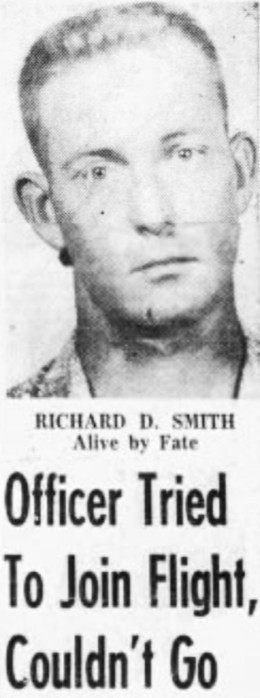
By Jack Weeks
Chronicle Staff
"I tried to get off for this flight, and I was very disappointed when I was turned down.
"But now I'm glad," said Houston policeman Richard D. Smith, a flight engineer in the 446th Troop Carrier Reserve Wing at Ellington Air Force Base.
Smith, who had flown with most of the men on the downed cargo plane, said he probably would have been on the ill-fated craft.
Used Up Leave
"Last week," he said, "I was assigned to fly with the pilot," Wayne D. Sager, 1410 Butler, Pasadena.
Smith, however, had already used up his 15-day military leave from the police department in trips with his squadron to Panama and the Arctic Circle. Smith is
with the 705th Squadron.
Smith was a friend of William J. Murphy, 11514 Bannister, also a policeman, who died in the crash.
Kidded by Buddy
Roland English, 32, of 4327 Jorns, another policeman on the flight but not on the doomed plane, "kidded me about not being able to go on the flight," Smith said.
"I used to kid with him when he couldn't get permission for a flight."
English and Smith are motorcycle officers and ride as a team.

While rescuers were identifying the dead and the survivors in the snowy
wastelands around the crash of the Houston-based plane, wives, children and relatives huddled anxiously in their homes awaiting word.
Five bodies have been found, but only two have been identified. Five other crewmen parachuted from the dying plane.
Three of them are safe. Two more, believed safe, have not yet been identified by the Air Force.
Which two men survived?
Mrs. Ruth Kimey, 110 Fauna, is the aunt of Capt. Milton L. Kimey; 38, who
lives at her home. He is one of the men whose fate is not known.
"I have talked to the families of the other men," she said sadly. "We're all thinking the same ugly thoughts and are afraid to say it. We're all hoping that somebody else's boy is one of the dead."
Chicago Daily Tribune (Chicago, Illinois) Saturday, November 25, 1961

WHITEHORSE, Yukon Territory, Canada, Nov. 24 (UPI) - Two ground parties and two airplanes searched an area of 64 square miles south of here today for two United States airmen, missing after they parachuted yesterday from a crippled C-119 Flying Boxcar.
The two men bailed out of the plane shortly before it crashed and burned about 17 miles south of here, killing five crewmen. Three other men who parachuted from the plane were rescued late yesterday.
Temperature Below Zero
An Alaska Air Command spokesman said the search was being conducted in a "very mountainous and heavily wooded area about 8 miles square." The weather was reported to be clear with temperatures ranging from as low as four degrees below zero.
The bodies of two men were found outside the burned wreckage and three bodies were believed to be still inside the plane. Rescue parties reported the aircraft was still burning early today.
The C-119 took off from Whitehorse, following another Flying Boxcar, only minutes before the crash. Both were headed for the next stop, McChord air force base, near Tacoma, Wash., on a flight from Anchorage to home base at Ellington air force base near Houston, Tex.
The planes and crewmen were returning home after participating in operation King Crab II - a joint armed forces maneuver held on Kodiak Island last week-end. The entire 446th troop carrier wing [reserve] from Ellington came to participate in the exercises.
Three Believed Inside
The remains found outside the wreckage were identified as those of Airman 1/C William J. Murphy, 25, Houston, a city traffic policeman in civilian life; and Airman 1/C David L. Paul, 38, League City, a civilian mechanic at Ellington.
The three, whose bodies were believed still in the plane, and those two still missing were identified as:
Capt. Wayne D. Sager, 37, Houston, pilot; Capt. Milton L. Kimey, 38, Houston, co-pilot; Capt. Alan Jon White, 28, Houston, navigator; M. Sgt. Roger J. Forstner, 48, and Ellington maintenance chief; and S. Sgt. Lonnie Z. Foremen, 36, Genoa. It was not known immediately which two of these five had parachuted.
The three Texans rescued yesterday are S. Sgt. Leroy Cotton, Galena Park; Airman 1/C Jean R. Conklin, Genoa; and S. Sgt. Clyde Nicholas, Pasadena. Cotton and Conklin had minor injuries. Nicholas was bruised and in shock.
The Kingston Daily Freeman (Kingston, New York) Saturday, November 25, 1961
FAIRBANKS, Alaska (AP) - The Air Force cargo plane that exploded in flight, carrying possibly seven Texans to their deaths, was notified shortly after take off that a wheel was afire, a survivor says.
S.Sgt. Leroy Cotton, 37, Galena Park, Tex., who gave the account, was one of three known survivors. The C119 taking reservists home from Alaska maneuvers crashed
Thursday near Whitehorse in Yukon Territory.
Five Still Missing
The Air Force listed two men as dead and five others as dead or missing.
M.Sgt. Clyde L. Nicholas, 46, Pasadena, Tex, said he was the last of four to parachute.
Cotton and Nicholas told in teleinterviews of the plane's last minutes.
The plane, south from Elmendorf Air Force Base at Anchorage, landed at Whitehorse and four of the 14 passengers got off.
At take off, the plane's brakes were frozen and the pilot gunned the engines, said Cotton, who is a mechanic. Within minutes, the Whitehorse airport radioed that the right wheel was afire. The pilot, Capt. Wayne D. Sager, 37, Pasadena, Tex., turned back to Whitehorse, Cotton related.
No Time to Fight It
"The right engine was starting to burn," Nicholas, the plane crew chief, said. "We had fire extinguishers but there wasn't time and the pilot gave the jump signal." Cotton jumped first, followed by M.Sgt. Roger J. Forstner, 48, Houston, Tex, mechanic; and Airman 1.C. Jean R. Conklin, 30, Genoa, Tex., also a mechanic.
The explosion came and the plane started to plunge to earth. "I didn't know how far it fell before I could get out," Nicholas said. His parachute barely opened. A tree broke his fall.
Nicholas said he saw three other parachutes in the air and hobbled to the plane and saw two men dead. He said they were Airman 1.C. William J. Murphy, 25, Houston, loadmaster; and Airman 1.C. David L. Paul, 38, League City, Tex., a mechanic.
Cotton joined Nicholas and an hour later Canadian Mounted Police found them and took them to a Whitehorse hospital. An hour later Conklin was brought out.
A search was under way for Forstner.
Air Force officials listed Murphy and Paul as known dead and these men as dead or missing: Forstner: Seger; Capt. Milton L. Kimey, 38, Houston, copilot; Capt. Alan J. White, 28, Houston, navigator; and S.Sgt. Lonnie Z. Forman, Genoa, Tex., mechanic.
Daily News-Miner (Fairbanks, Alaska) Monday, November 27, 1961


An extensive search was called off Saturday for an airman believed to have bailed our of a Air Force C-119 cargo plane before it crashed and burned near Whitehorse Thursday.
Shortly before noon Saturday a specia] Air Force investigating team found that the airman, M. Sgt. Roger J. Forstner, 48, of Houston. Tex., did not parachute from the plane but was burned to death inside the plane.
Five bodies were found inside the wreckage, two bodies were found outside the plane, and there were three survivors.
When the plane crashed about 17 miles South of Whitehorse about four miles off the Alaska Highway on Thanksgiving Day, there were conflicting reporis of the number of parachutes seen.
Motorist Report
Motorists on the Alaska Highway reported they saw five parachutes. A civilian aircraft in the area reported seeing four.
S. Sgt. Clyde L. Nicholas, one of the survivors, said he believed that Forstner jumped from the door of the plane before the right wing exploded. Nicholas said he jumped from the plane after it had flipped over on its back and was plunging toward earth.
An Air Force spokesman said there were so many conflicting reports as to the number of parachutes that the search was continued until it could be established positively how many men died in the plane's wreckage. He explained that in the excitement many of the witnesses may have seen the same parachute twice.
Friday morning the plane was still burning and it was not until Saturday morning that the Air Force investigating team headed by Major Allan Lane could be flown to
the scene.
The team is at Whitehorse now and will spend some time there interviewing witnesses, inspecting the wreckage, and putting together the pieces of evidence to determine how the accident happened.
The three survivors are: S. Sgt. Leroy Cotton, 37, 2502 2nd St. Galena Park, Texas, a line mechanic; S. Sgt. Clyde L. Nicholes, 48, 2931 Village Way, Pasadena, Tex., mechanic, and Airman 1.C. Jean R. Conklin, 30, 3430 Conkin Lane, Genoa, Tex.
Found dead outside the plane were: Airman 1.C, William J. Murphy, 25, Houston, Tex., loadmaster, and Airman 1.C. David L. Paul, 38, League City, Tex., mechanic.
Inside Plane
Found dead inside the plane were: Capt. Wayne D. Sager, 37, 1410 Butler, Pasadena, Tex., pilot; Capt. Milton L. Kimey, 38, Houston, Tex., co-pilot: Sgt. Alan J. White, 28, Houston, Tex., navigator; S. Sgt. Lonnie Z. Foreman, 36, 12017 Palmcrest, Genoa, Tex., mechanic, and M. Sgt. Forstner.
The men, all reservists from Ellington AFB, near Houston, had been on active duty in a joint Air Force-Army maneuver "Operation King Crab II" at Kodiak. The transport was one of several which took off from Elmendorf Thursday morning carrying reservists back to their homes.
The Houston Post (Houston, Texas), Thursday, November 30, 1961
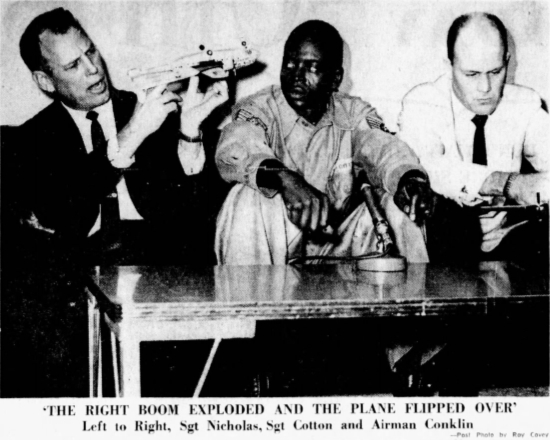
By Cecil Hodges
The three Houston-area airmen who parachuted to safety last week from a burning Air Force C-119 cargo plane in Canada were back in Houston Wednesday, still
uncertain as to the cause of the crash that took seven lives.
Staff Sgt Clyde Lee Nicholas, 46, Staff Sgt Leroy Cotton, 37, and Airman First Class J. R. Conklin, 30, were the only survivors of the 10 Air Force reservists who were returning to Houston after a two-week training exercise in Alaska when the crash occurred.
THE MEN, WHO arrived at Ellington Air Force Base late Tuesday night, said they did not know what caused the fire in the right engine of their big cargo plane. Sgt Nicholas discounted an earlier report that the plane's brakes had frozen in the sub-zero weather.
In a press conference at Ellington Wednesday, Nicholas said it was a miracle that he got out of the burning plane alive.
NICHOLAS SAID he was making his way to the escape door in the rear of the plane when an explosion blew off the right boom of the twin-engine plane.
"I must have been knocked unconscious for a few seconds," Nicholas said. "The next thing I knew, the plane was inverted and I was stretched out on the ceiling of the plane - it was upside down - with my head hanging out the open door.
"I remember trying to open my 'chute, thinking that the slipstream would pull me out of the plane. I couldn't get it open and I realized that this was the end.
"I THINK I accepted it."
Nicholas paused as he told of those long seconds. Then he continued.
"The next thing I knew, I was out of the plane; how, I don't know, and I looked down and saw that I hadn't pulled my parachute ring. I pulled it and the 'chute opened. About the same time, I hit a tree.:
NICHOLAS SAID he must have got the parachute open when he was only 200 or 300 feet from the ground. "A flight surgeon later told me that the tree probably saved my life by breaking the fall."
Nicholas said the plane crashed a short distance away, just about the time he landed in the tree.
He made his way to the burning plane, hoping to help any other crew members who might have been in the plane
"I WOULD RATHER not talk about what I did or saw there," he said, swallowing hard. "I saw there was nothing I could do for anyone there."
Nicholas stayed at the plane until he was joined by Cotton about two hours later. Then both were rescued by a search team of Royal Canadian Mounted Police, a trapper and a forest ranger.
Cotton said he was the first to see the fire in the engine.
"WE HAD MADE a normal take-off from Whiteborse," he said. "Someone joked about it being the best landing and take-off of the whole trip. I had checked the nose gear and the main gear and all were up and locked."
Then he looked out the right window and saw fire streaming from the bottom of the right engine nacelle. "I told Sgt Nicholas and he told the pilot and engineer," Cotton said.
Nicholas said he was in the jump seat and had watched the pilot, Capt Wyne D. Sager, 37, of 1410 Butler Drive, during the take-off. "We had no trouble with the brakes on the take-off; everything wags normal," Nicholas said.
"WE WERE ABOUT 10,000 feet when Cotton saw the fire. The captain went through his emergency procedures and alerted the crew.
"He sent me back twice to see if the fire went out. The last time I told him that the ship was on fire and he rang the bail-out bell.
"I was making my way to rear door when the right boom blew up."
Cotton was the first man to bail out and Conklin followed him.
COTTON SAID he jumped feet first and counted to 20 before he pulled his ripcord. "As I was tumbling, I saw the boom of the plane biow off and then the plane flipped over on its back and went down," he said.
"While I was floating down, I saw another chute hit in a tree. This turned out to be Sgt Nicholas," Cotton said.
Cotton said he crawled and slid down the mountain toward the site of the crash. Hr joined Nicholas about an hour later, just as it was getting dark. They gathered
wood to keep a fire going.
Conklin, who followed Cotton in bailing out of the stricken plane, landed on the side of the mountain. He said he had spotted another parachute as he floated down. He also started making his way to the spot where the plane had crashed. He arrived there just about the time that the rescuers showed up.
THE THREE MEN WERE taken to the hospital at Whitehorse. Nicholas got a sprained left leg and back, Cotton was bruised, but Conklin was not hurt.
"The plane, a Flying Boxcar of the 446th Troop Carrier Wing (Reserve), crashed at a base of a hill about 20 miles south of Whitehorse.
THE THREE airmen said that the weather was clear, but very cold. "It was 10 degrees below zero when we left Whitehorse," Conklin said.
The plane went down about 3 PM, their time, and we were rescued about 6 or 7 PM, a couple of hours after it got dark," Conklin said.
Nicholas is an aircraft maintenance worker at Ellington; Cotton is a shipping clerk for a Houston firm, and Conklin is an aircraft mechanic at Ellington.
NICHOLAS LIVES at 2931 Village Way in Pasadena; Cotton lives at 2502 Second St in Galena Park and Conklin lives at 13,430 Conklin Lane in Genoa.
The airmen who died in the crash were Capt Sager, Capt Milton L. Kimey, 38, of 110 Fauna St, co-pilot; Capt Alan Jon White, 28, of 2811 Detroit St, navigator, and Staff Sgt Lonnie Z. Foreman, 36, of 12,017 Palmcrest St, mechanic.
Also, Airman First Class William J. Murphy, 25, of 11,514 Banninster Lane; Airman First Class David L. Paul, 38, of League City, and Master Sgt Roger J. Forstner, 48, of 1318 Globe St.
The Whitehorse Star (Whitehorse, YT), Thursday, November 30, 1961
The voice of a dead man was heard by the inquest jury which met Monday night to determine the cause of death of the seven U.S. airmen killed in the crash of a
C119 30 miles south of Whitehorse one week ago. The D.O.T. tower tape-recorded emergency
call from Capt. Sager in the ill-fated plane was played back to the jury members.
Fifteen minutes after take-off he called the tower to report an emergency and advise the plane was returning to the airstrip. It was the last message heard. There was no "May Day" call, the international air distress signal.
The six jurymen determined the men came to their death due to a fire which started in the wheel well of the C119 from an overheated brake mechanism at the time of take-off.
Dr. J.D. Munro acted as coroner while RCMP Cst. Asbil conducted the enquiry.
Lawrence Popovich, D.O.T. air traffic controller, described the pre-take-off movement of the plane. He said the plane should have taxied up to the left
to reach the runway but had to make a complete right-hand circle instead. The pilot reported he had trouble with his right brake, necessitating the round-about manoeuver.
While taxiing he was informed his right main landing gear was not turning but was sliding on the gravel. Later he appeared to have trouble getting the plane co-ordinated in the right direction on the runway.
The plane was airborne at 2:28 and reported in to the range station at 2:32. Aboard were four passengers and six crewmen. Seven died in the crash.
After receiving the emergency call, the tower called the plane "10 or 11" times but received no answer.
Five minutes later a call was received from the RCMP stating the plane had been spotted going down by White Pass section men near Lorne.
The CPA Dawson flight, which was inbound at the time, took a pass over the area but could not sight the crash.
Mr. Popovich told the jury he had been watching the aircraft particularly because of the brake trouble but saw nothing abnormal about the take-off. The circuit
and turnaround seemed "about as normal as any other C119 that goes out of here."
When the aircraft was east of the tower, it appeared to be flying okay and the observer could see nothing wrong.
DRAGGING
Lloyd Romfo, who had been gassing up an aircraft at the time, reported the C119 seemed to have great difficulty moving forward. It appeared that one
brake was dragging and that excessive power was being used. He felt the take-off had not
been "a good clean break". The plane had "jerked" into the air.
After take-off it was observed the starboard wheel was very red, as if on fire. A witness stated "it did not seem like a very good idea" to retract the wheels when one appeared to be so hot.
Smoke was observed coming from the starboard engine nacelle but, when smoke was seen coming from the other side as well, it was dismissed as being the result
of a "too rich mixure".
Kasmaer Maczka, White Pass section foreman, reported seeing the plane from where he was working, 11 miles North of Carcross. It was trailing black smoke and then started a horseshoe turn back to Whitehorse. Before the turn was completed, flames were seen from the area surrounding the right engine.
From the ground it appeared five parachutes blossomed from the plane but, later, it was thought two of these were pieces of the disintegrating plane that appeared as parachutes. Mr. Maczka stated the plane was still in a flying position when the first of the parachutes appeared.
Erik Cunnert, at a hunting cabin west of the Carcross road, spotted the doomed plane also. He had stepped outside for firewood when it flashed across the sky. "It seemed to me that part of the wing fell off," he told the jurymen. "It fell pretty nearly straight down with the tail higher thanthe nose and one wing pointing straight up into the air."
One of the survivors, Staff Sergeant Cotton, loadmaster on the plane, described spotting the fire and reporting it to the cockpit.
He also told of the takeoff which seemed to him as though the brakes were frozen on the right side. The plane zig-zagged before moving ahead smoothly. When the plane reached three thousand feet the men removed their parachutes.
After he saw the fire he told the other men to put their chutes on. Then they heard the "boom" of the fire extinguisher going off in the right engine ... at that time the jump light went on. They had been told in briefing, "when that green light goes on, jump; don't hesitate." This was the second burning plane Cotton had jumped from and, he told the jurymen., "I didn't wast any time".
It took him about two hours to reach the crash scene where he found Staff Sergeant Nicholas "who was saying his prayers". He told Cotton, "Am I glad to see you."
Another of the surviving airmen, Ray Conklin, said as he stood near the rear door adjusting his chute straps, he motioned to an airman named Paul to jump but Paul said, "You go ahead". Paul was one of those killed in the crash.
[Continued on Monday, December 4]
An expert officer, well-acquainted with the flying characteristics of the C119 type of aircraft that crashed 30 miles south of Whitehorse, testified as to the cause of it catching fire when he appeared at an inquest here.
Captain Gagnon of the U.S.A.A.F, gave expert testimony concerning the C119. He said the plane had disc type brakes. A slight leak in the hydraulic system could cause enough application of brake pressure to create heat but not enough to halt the plane. "They have been known many times to get red hot".
He pointed out the wheels on this type of aircraft were of magnesium and heat had been known to cause their failure. If the wheels were retracted when red hot they would “very definitely" cause the plane to catch fire, he testified. He suggested the heat could melt the neoprene seal allowing a brake fluid leak which would drip on and catch fire from the red hot metal. Behind the wheel was a canvas curtain which shielded a 40-to-50 gallon engine oil supply tank. Behind that, in turn, were oxygen bottles.
He said the wheels were not visible when retracted into their wells, being covered by doors.
He testified the brakes could "freeze" from frost action but the
friction of using them would give enough heat to free them.
Flight Surgeon Capt. Parks, U.S.A.A.F, told the jury the men died from the impact, not from the fire. He had located seven bodies in the plane. It was his opinion the plane had fallen straight into the ground from a height of about nine thousand feet.
Last week the experiences of S/Sgt. Cotton were detailed. His were similar to Airman Ray Conklin who landed between a mile and two miles from the crash
scene. He told the jurymen he did not think the engine ever caught fire. RCMP Constable Pope and Forestry Warden Keith Brammer reached the scene in a forestry 4x4 before he arrived.
Of the take-off he said, "it seemed like the brake had frozen or that the wheel was in the snow". Earlier take-off from Elmendorf had been normal.
UNCONSCIOUS
Staff Sergeant Nicholas told the jurymen, after checking the fire and reporting to the cockpit three times, he headed for the rear door. There was an explosion
and he lost consciousness. He came to hanging part way out the door but lost consciousness
again. He returned to his senses to find himself in mid air.
It appeared to him that he and the plane hit the ground "simultaneously". He was only a few feet from it with his parachute caught in a tree, leaving him dangling a short distance from the ground.
He moved two of the dead men partway from the wreckage and then set about making a signal from a parachute and one of the plane doors.
One of the men at the crash scene, he said, had a partly opened parachute.
When the first of the search party arrived to find Cotton and himself, he said, "We were thrilled to see them. We thought that the they were from the plane."
The Houston Post (Houston, Texas), Thursday, December 21, 1961
The reservists of Ellington Air Force Base are making Christmas a little happier for the children of seven fellow flyers killed in a Yukon crash on Thanksgiving Day. Altogether, the dead Air Force reservists left 23 children, ranging from 3 months to 15 years old.
An Ellington spokesman said Wednesday that the 446th Troop Carrier Wing has collected $3,621 to buy U. S. savings bonds for the children.
"THE MONEY WAS collected throughout the wing in a week-long drive that was supposed to have ended last Friday," the spokesman said, "But donations are still coming in."
In addition, two Ellington units have collected Christmas gifts of toys and clothing for the children. The officers and men of the maintenance section of the 446th collected $450 to buy presents for the 12 children of the three maintenance men who died in the crash. Those presents have already been delivered, the spokesman said.
Another bunch of presents from the officers and men of the 8511th Air Force Reserve Recovery Group will be delivered Friday. The men of the recovery group picked out a child from a list of the 23 and bought individual presents of toys and
clothing.
"We wanted to let the families know that their sacrifice has not been forgotten," said Lt Col Percy E. Arthur, deputy commander of the recovery group.
The seven dead reservists were all members of the 446th. They died when their C-119 Flying Boxcar crashed near White Horse in Yukon Territory while on a training mission.
The scattered wreckage of the C-119 remains on site, close to the Annie Lake Road - indicated by the arrow at the bottom centre of the photo below. Click on it to enlarge it.

|

|
