|





|
|
The Eastman E-2 Sea Rover
Arctic & Northern Aviation
The mining adventures of James Henry Eastman II
Dateline: March 9, 2013. Last update: November 24, 2025.
- Designed by James 'Jim' Eastman and Tom Towle of Beasley-Eastman Laboratories of Detroit, Michigan. Also known as the Beasley-Eastman Flying Boat.
- Upper wing span is 36 feet; lower wing span, 20 feet 8 inches. Length overall is 26 feet.
- Initially powered by a 90 hp Anzani radial, later by a 120 hp Warner Scarab radial. One E-2 (NC464M) was converted to the final E-2-D version, fitted with a 225 hp Packard diesel engine.
- The first flight of the prototype (c/n 1, registered as NX3643) flew from the Detroit river in 1927.
- The hull consisted of an oak framework with a Dural aluminum alloy skin, while the wings and tail empennage were built of wood and metal with a doped linen covering.
- The pilot(s) and up to two passengers sat in two separated open cockpits, with passengers in the front.
- The improved E-2 version was powered by a 185 hp Curtis R-600 Challenger six-cylinder two-row radial. A total of 17 were built.
- The amphibious E-2-A version first flew in 1930. Only two were built, but three E-2s were converted (NC466M, NC470M, NX592M).
Newspaper articles about Eastman flying boats (we believe this tom be a complete collection, avoiding duplications)
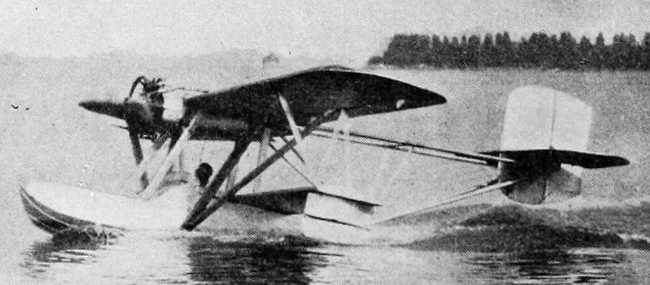
Beasley-Eastman flying boat taxiing on water. Reproduced from Aero Digest Magazine Vol.12 No.4, April 1928.
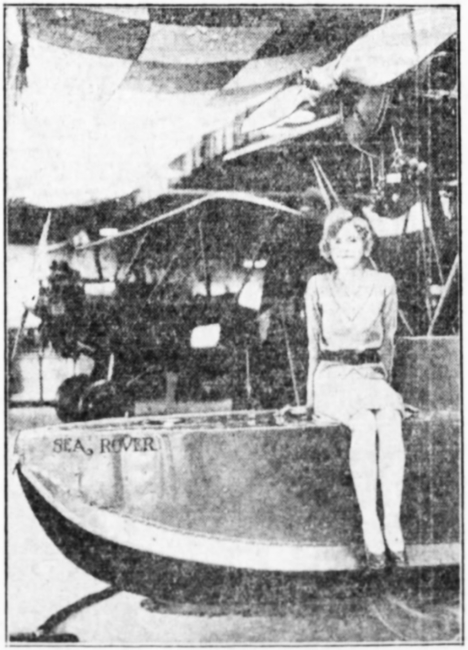
Miss Thelma Green of the Aeronautical Chamber of Commerce
on board the new Eastman Sea Rover flying boat
at the All-American Aircraft Show in Detroit (The Detroit Free Press, April 11, 1929).
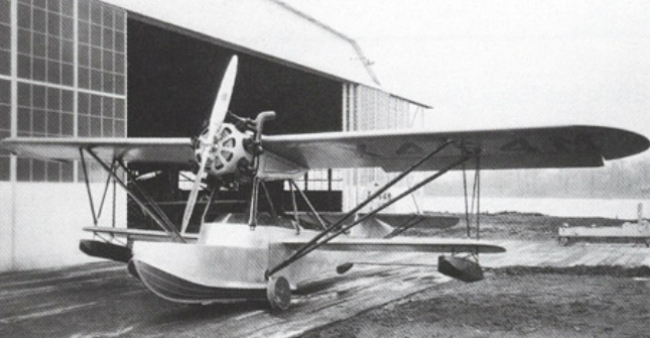
NC464M was built as an E-2 but was soon converted to an E-2-D, an amphibian version with a 225 hp Packard diesel engine.
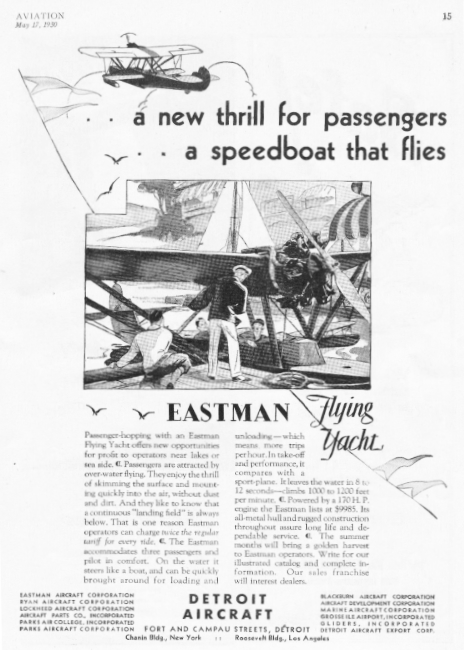
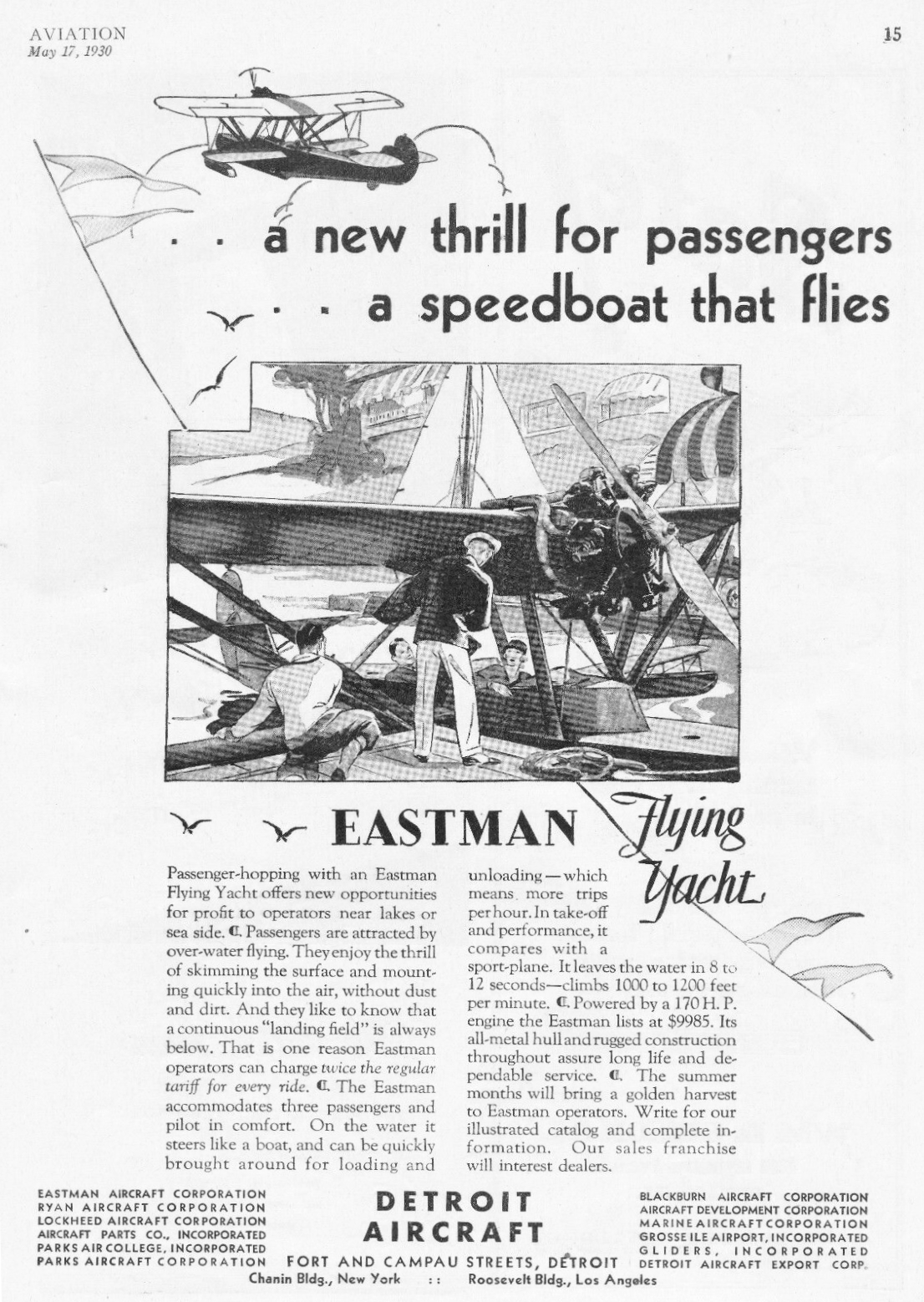
Aviation, May 17, 1930. Click to enlarge it in a new window.
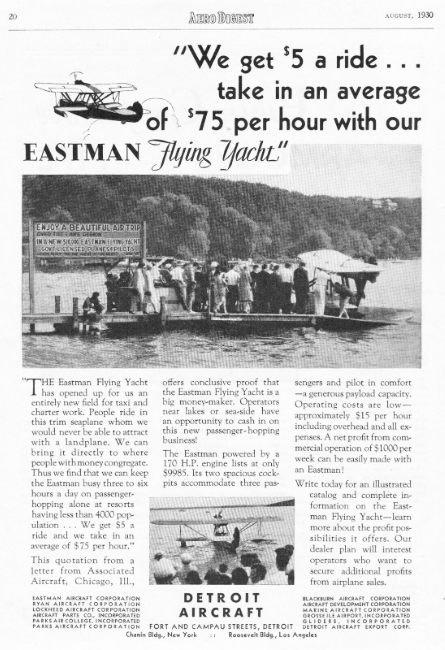
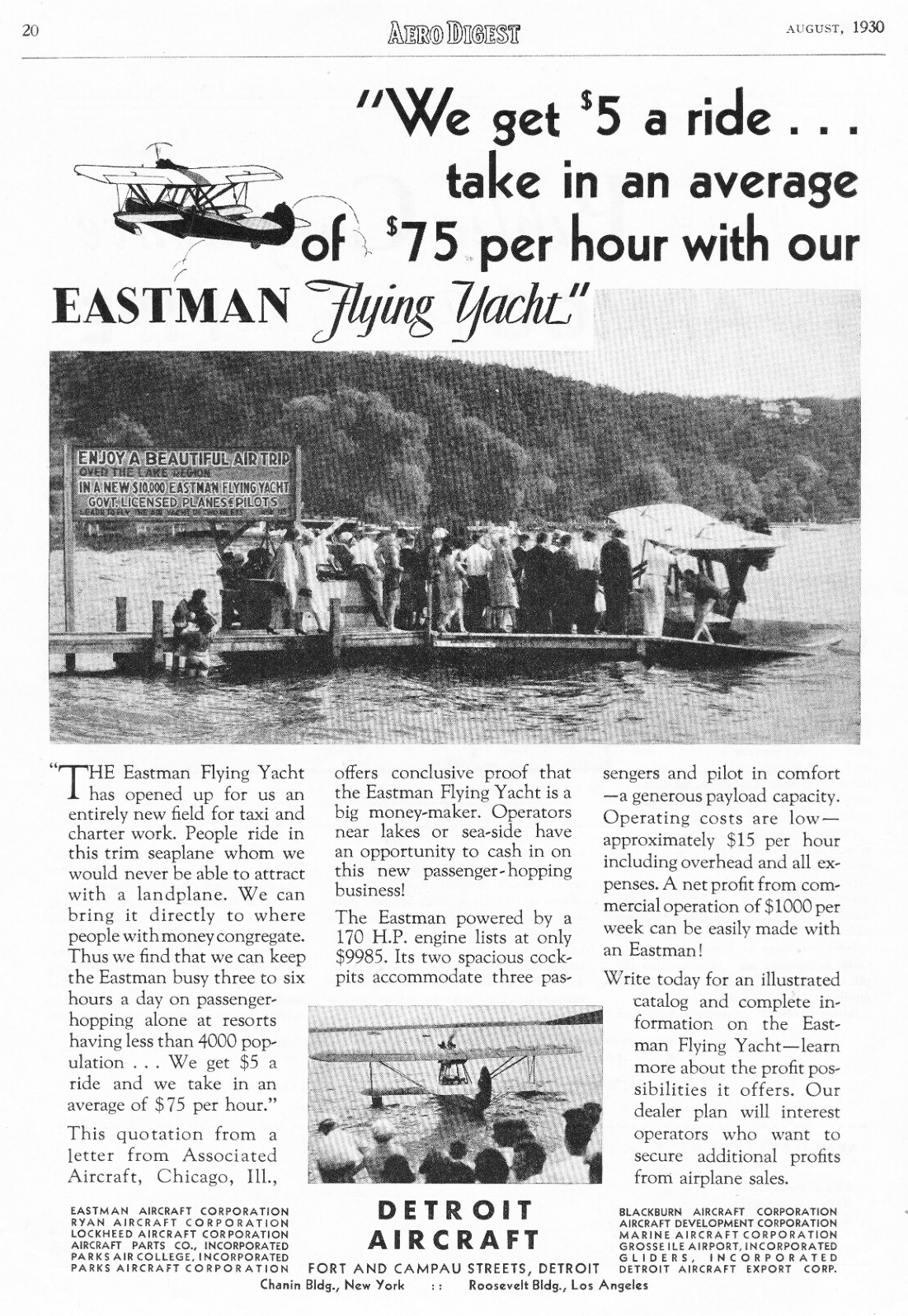
Aero Digest, August 1930. Click to enlarge it in a new window.
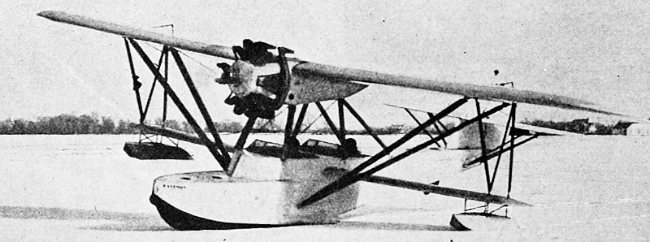
Eastman E-2 Sea Rover landing on_snow. Reproduced from Aero Digest Magazine Vol.16 No.2, February 1930.
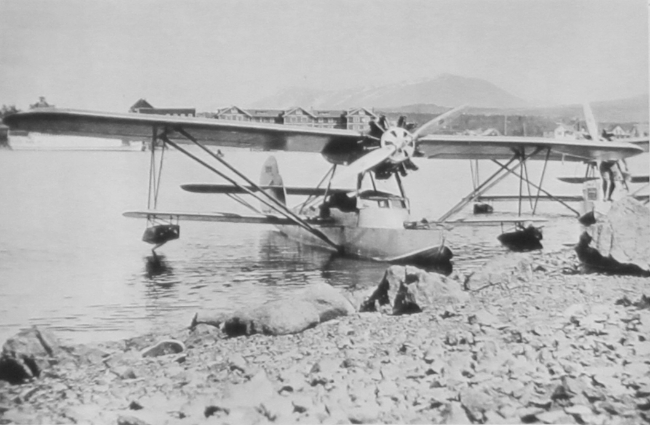
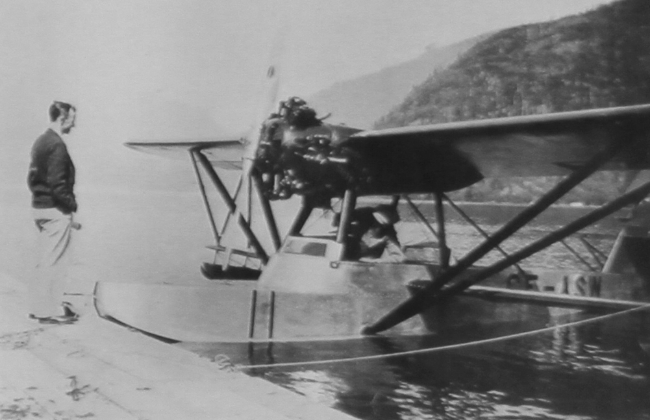
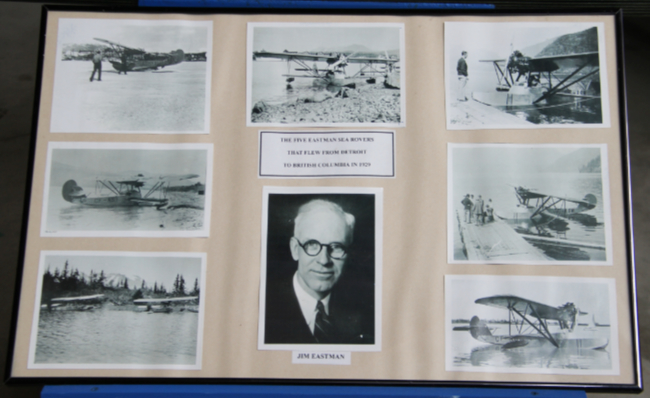
The five Eastman Sea Rovers that flew from Detroit to British Columbia.

Teslin, 1934.
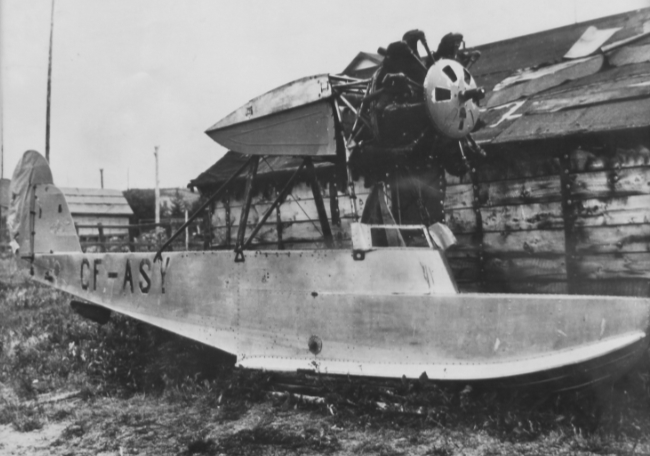
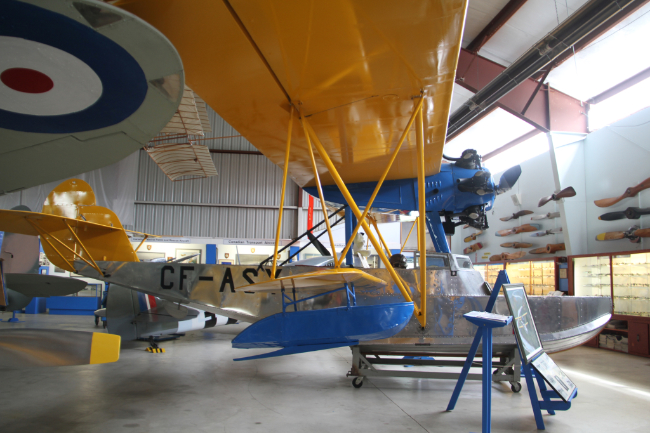
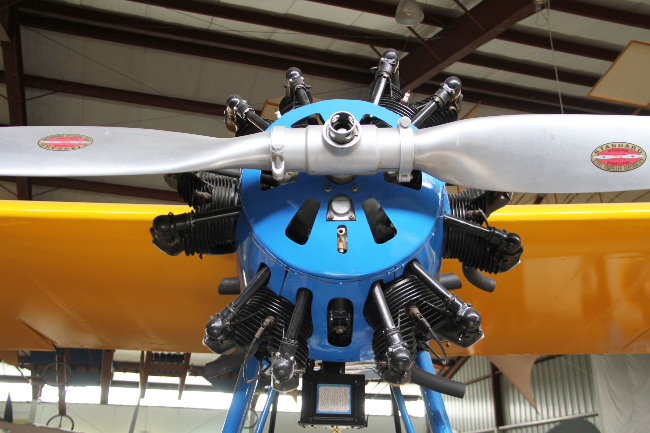
Click to enlarge it in a new window.
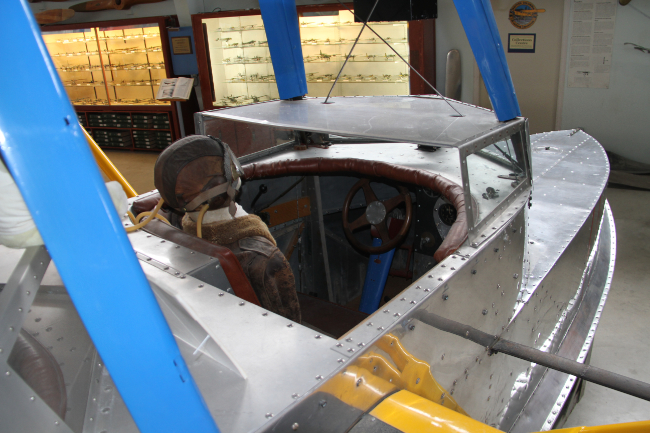
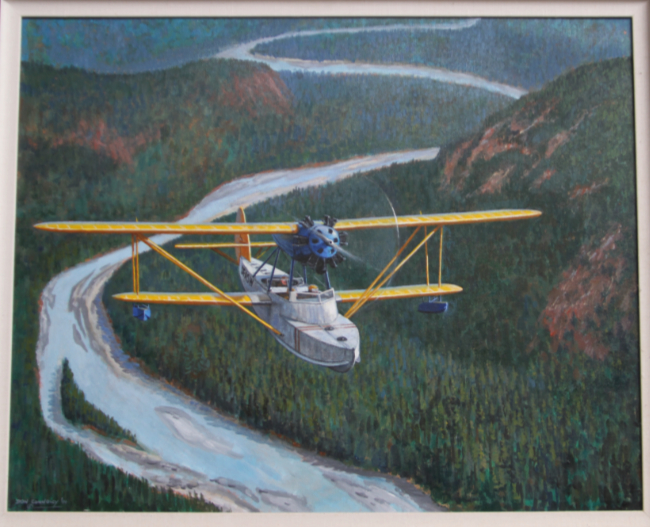
Painting of Eastman E-2 Sea Rover CF-ASW by Don Connoly at the BC Aviation Museum. Click to enlarge it in a new window.
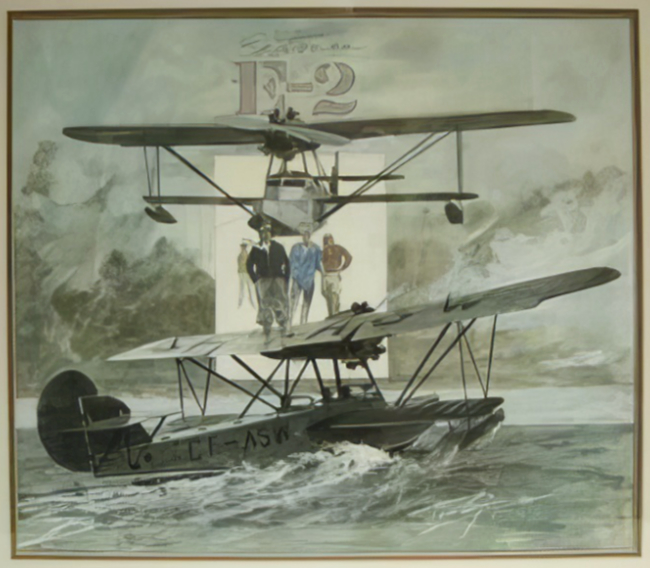
Painting of Eastman E-2 Sea Rover CF-ASW by Tom Bjarnason (1925-2009).
Newspaper articles
The Detroit Free Press - Sunday, March 24, 1929
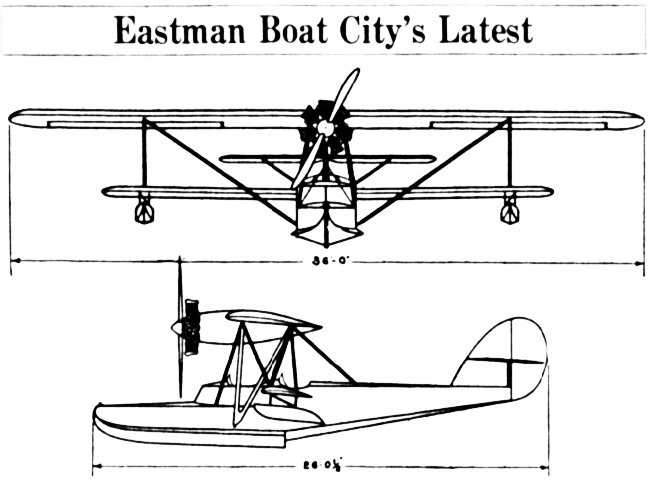
Plans for the new Eastman flying boat, which is already in production and will be test-flown this week. The staggered sesquiwing is a notable feature of the craft The hull's European type sponson is a designed to throw water clear of the ship.

James H. Eastman and Captain Carl S. Squier, president and sales manager, respectively, of the Eastman Aircraft corporation, Detroit's newest aircraft manufacturers, early this week plan to test fly the company's initial product, a three-place open sesqui-wing flying boat, which will be displayed in the second annual All-American Aircraft show, to be held in Convention hall April 6-14.
The Eastman craft, known as the "Sea Rover," is powered with a 180 horsepower six-cylinder Curtiss "Challenger" air-cooled motor. It's upper wing span is 36 feet, and lower wing span, 20 feet 8 inches. Length overall is 26 feet. Among the craft's interesting features is an all duralumin hull, equipped with a European type sponson, designed to throw water clear of the ship. The wings are considerably staggered, that is, the upper wing sits a considerable distance forward of the lower one to prevent interference in its efficient operation.
Can Carry Three.
Although the "Sea Rover's" two cockpits, located in tandem are called two-place size, the forward one, reserved for passengers, can accommodate two persons. In the after cockpit the builders have installed side-by-side dual control.
The "Sea Rover" was designed to meet a demand in the small sport model flying boat field, a field now offering little competition.
The Eastman Aircraft corporation, backed by a group of wealthy Detroiters, has its office and factory at 287 Minnie street. The company is incorporated under Michigan laws, with capitalization set at $150,000. Besides Mr. Eastman, officers are: G. R. Reddock, vice-president; LeRoy J. Gilbert, secretary, and Andrew G. Schlee, treasurer. Including the officers, directors are John G. Painter, J. L. Thompson and Archibald H. Jones.
Captain Carl B. Squier, who is sales manager and chief test pilot, is an officer of the 107th Observation squadron, Michigan National guard, and is regarded as one of the best airplane pilots in Michigan.
In addition to the "Sea Rover," the company plans to produce a four-place convertible cabin flying boat designed along similar lines. The second product is to be known as the "Sea Pirate."
The Flint Sunday Journal (Flint, Michigan), Sunday, March 31, 1929

America, with her thousands of miles of ocean front, her great inland
waterways and her myriads of lakes, has presented a challenge to her commercial aircraft builders and designers - a demand for safe and speedy flying ships that may utilize the surface of the water as a landing field.
How that challenge hes been met will be demonstrated at the All-American aircraft show, opening here in Convention hall next Saturday under auspices of the Detroit Board of Commerce and the Aeronautical Chamber of Commerce of America.
Among the 107 airplane entries are more than a dozen new flying boats and amphibians. Numerous manufacturers who until this year have built only land planes, are
bringing forth their first water craft.
There is a real demand for this type of plane in waterfront cities. While airports may be located some miles from the heart of such a community, the flying boat in
most cases can nose her way directly to a waterfront terminal. They are also coming into wide usage for summer resort travel, transporting tired week-enders to their favorite recreation spots on lakes, rivers or at the seaside. The amphibian has been found of great service in opening sparsely settled regions, such as Northern Canada, where airports are scarce, but lakes are numerous.
Ivor Sikorsky, noted builder of amphibians, is expected to bring one of his ships here during show week, anchoring off the Detroit Yacht Club. Anthony G. H. Fokker has turned out his first amphibian, which he calls the Flying Yacht. This has been entered in the show. The latest product of Grover Loening, pioneer in this branch of aircraft manufacture, will also be displayed. A new organization, the Cadillac Aircraft
Corporation, of Detroit, is introducing the Voyageur, a four-passenger amphibian.
Chance Vought, veteran builder of Navy and Marine Corps planes, is expected to present an amphibian at the Detroit show. The Ireland amphibian this year will be shown by the Curtiss Flying Service of Michigan. The "Sea Rover," a three-passenger flying boat, is to be shown by the Eastman Aircraft Corporation of Detroit. The Savola Marchetti, six-passenger seaplane of Italian design, but manufactured by the American Aeronautical Corporation, New York, is another entry.
In addition to these exhibitors, several makers of land planes are
showing models transformed into flying boats by replacing the regular landing gear with pontoons.
The Detroit Free Press (Detroit, Michigan), Sunday, April 7, 1929
To the Eastman Aircraft corporation, of Detroit, goes the distinction of having on display the newest aircraft entered in the All-American Aircraft show, in so far
as exhibition following first proving tests are concerned.
The Eastman flying boat was given its initial flight tests by James H. Eastman, president of the corporation, and Captain Carl B. Squier, salesmanager, Wednesday afternoon, and less than two hours later was being set up in the exposition building. The test flights were necessary, due to a rule of the show committee that "it can't be shown, unless it's flown."
Known as the "Sea Rover," the Eastman job is of the three-place sesqui-wing type, with a full length open duralumin hull. The upper wing has a span of 36 feet and the overall length is 26 feet. A Curtiss "Challenger," 160 horsepower motor, powers the craft.
The pilots report a take-off of five seconds, a top speed of 120 miles per hour, a cruising speed of 95 miles an hour, a rate of climb of 1,000 feet per minute, and a landing speed of 45 miles an hour.
The Evening News (Wilks-Barre, Pennsylvania), Saturday, June 8, 1929

Detroit, June 8. - Formation of the Detroit Aircraft Corporation as a
consolidation of five of the leading companies in the industry, and embracing in its directorate some of the best known executives in the automotive and aeronautical industries, including Ford and General Motors officials, was announced here today.
The five companies that will be included in the Detroit Aircraft Corporation are: Ryan Aircraft Corporation; Aircraft Develoyment Corporation; Winton Aviation Engine Company (partly owned only); Eastman Aircraft Corporation; and Blackburn Aeroplane Company of Michigan.
There is also included in the consolidation the Grosse Ille airport, located just outside Detroit, which is being developed into one of the largest and most modern flying fields in America, which is expected to be designated by the government as an International port of entry into Canada, and which has a large potential earning power. It was also announced that negotiations are in progress for the acquisition of other
companies.
This represents one of the largest and most important consolidations that has occurred in the aviation industry. The new corporation will have a broader scope than any other unit in the industry today, for the reason that it will build a complete line of lighter-than-air as well as heavier-than-air craft, and will produce motors as well as ships. The products of the various divisions to be consolidated embrace aeroplanes, small and large flying boats, and dirigibles. Its line of air craft will embrace products selling all the way from $3,000 for the smaller flying boats, up to the largest dirigibles
costing $5,000,000 to $6,000,000.
The corporation also has a material advantage in its experience in the use of metal for aircraft construction. One of its divisions - Aircraft Development Corporation - is building a dirigible for the navy departing a dirigible for the navy department entirely of metal.
E. S. Evans, who is president of the corporation, in announcing the
consolidation, said: "The Detroit Aircraft Corporation will be an operating company in every sense of the word. Four of the divisions already have achieved distinction as producers of various types of air craft. The fifth will soon be producing an entirely new line of aeroplanes based on the experience and engineering skill of the Blackburn Aeroplane & Motor Co., Ltd., which is one of the oldest and largest manufacturers in England, and which will have a substantial financial interest in this new Michigan
company.
"The aviation industry has passed out of the stage of infancy and is now prepared for a period of intensive development. The Detroit Aircraft Corporation will be a leader in that development. It will be the most important producer of airplanes in America.
"We will apply the famous Detroit industrial methods to the building of
air craft of every description. Each of the companies which is now building an established and recognized plane, will form a separate division of the parent company, which will
direct all manufacturing and selling activities from its Detroit headquarters.
"We will offer to the industry engineering experience, complete facilities, financial stability, and technical ability. The directors of this company will include men of wide industrial experience, leading engineers in the aviation and automotive industries, business executives and financiers. We believe we have gathered together as strong an executive omganization for the management of this Corporation as can
be formed.
"Further, because of the fact that the corporation will engage in the
manufacture of lighter-than-air, as well as heavier-than-air craft, we will be in a particularly advantageous position, participating in the growth of all branches of air development and not entirely dependent upon any outside source for a supply of motors. In short, the Detroit Aircraft Corporation will be probably the most self-contained unit in the industry."
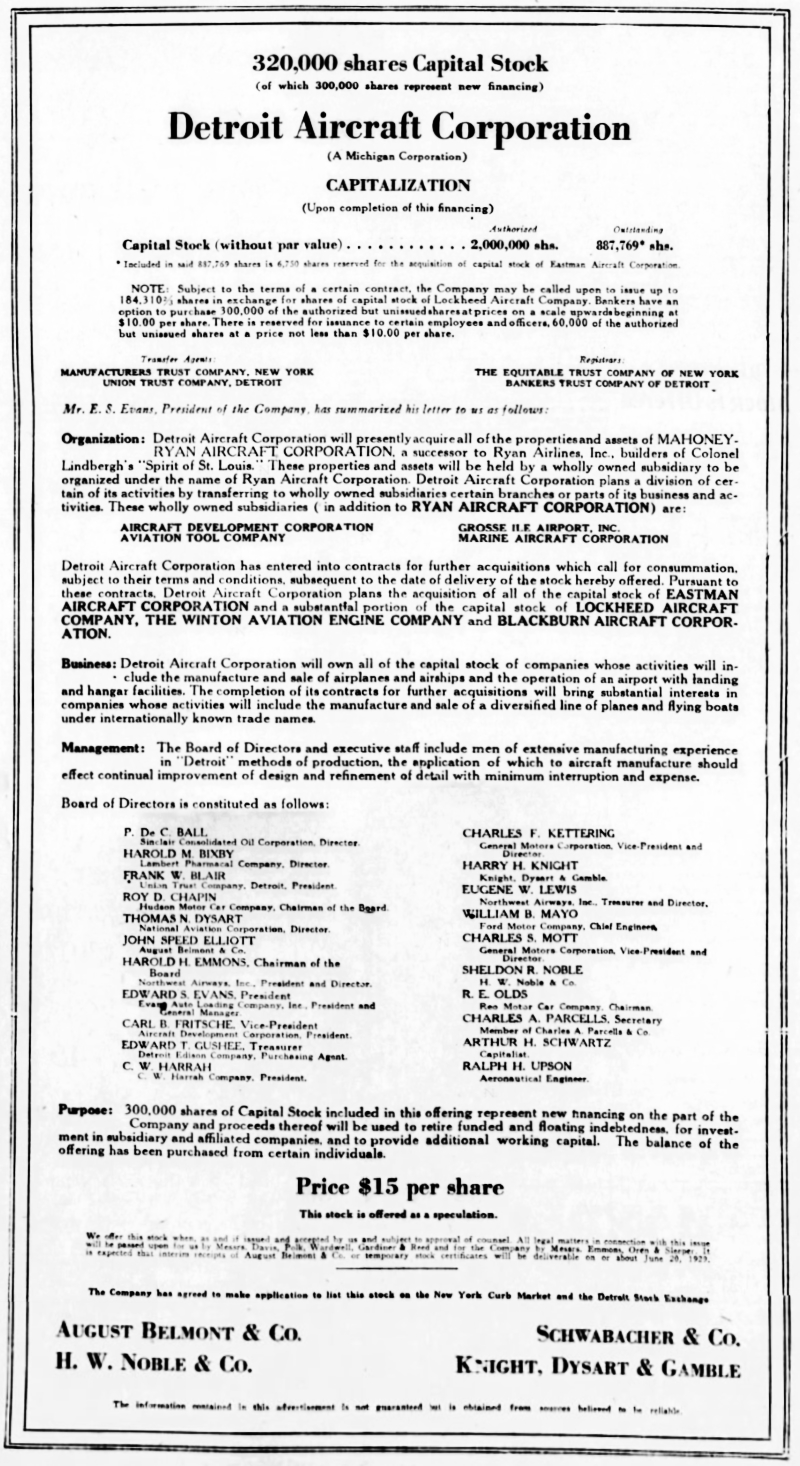
San Francisco Chronicle (San Francisco, California), Monday, June 17, 1929
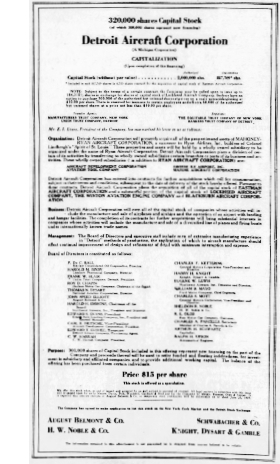 One of the key points in the prospectus of the Detroit Aircraft Corporation, seen to the right, is "Detroit Aircraft Corporation plans the acquisition of all of the capital stock of Eastman Aircraft Corporation" - click on the image to greatly enlarge it in a new window.
Buffalo Courier-Express (Buffalo, New York, Saturday, July 20, 1929

Detroit, July 19 - The Detroit Aircraft Corporation has leased approximately 50,000 square feet square feet of floor space in the Studebaker plant at Detroit on Campau street between Jefferson avenue and Fort street and will concentrate its executive offices and manufacturing operations there, it was announced today by E. S. Evans, president.
The Studebaker plant has been vacant since the company moved its manufacturing operations to South Bend several months ago. It is so constructed and equipped as to be readily adaptable to the "line" method of airplane construction which Detroit Aircraft plans to use, modeling its operations after the methods which the automobile industry has found practicable in reducing costs to a minimum.
Eastman Aircraft Corporation, which manufactures flying boats, will move
from its present plant in Detroit into the new quarters within a week. Operations on the Biackburn line of planes and Marine Aircraft Corporation's six-place metal amphibian will also be centered in the new plant immediately.
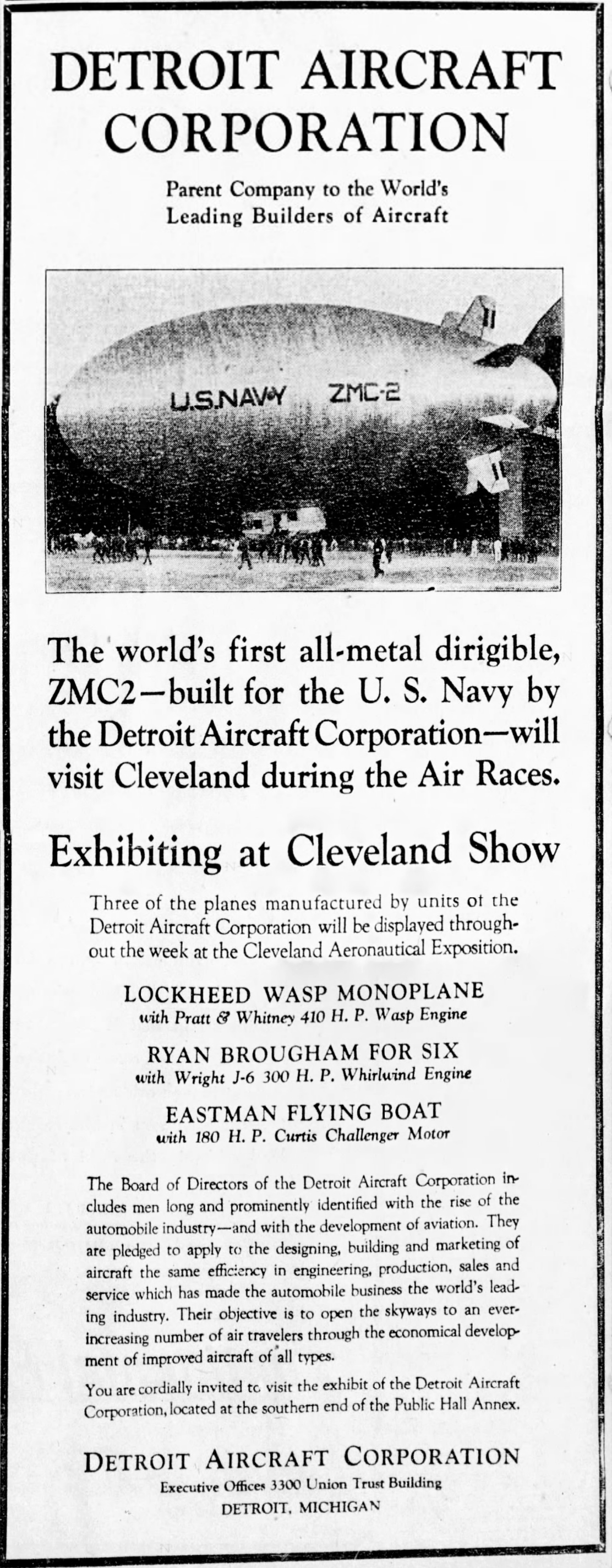
Cleveland Plain Dealer (Cleveland, Ohio), Sunday, August 25, 1929
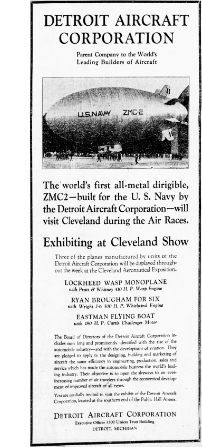 Three of the planes manufactured by units of the Detroit Aircraft Corporation, the Lockheed Wasp, the Ryan Brougham, and the Eastman Flying Boat, will be on display at the Cleveland Aeronautical Exposition. Click on the image to greatly enlarge it in a new window.
The Detroit Free Press (Detroit, Michigan), Tuesday, January 7, 1930
One of the first Eastman flying boats to be completed here by the Detroit Aircraft corporation was shipped Monday to Miami, where it will be shown during the all-American winter races next week. The boat was shipped instead of flown, it was said, because it would have to fly by New York, so as to take advantage of the water route.
Claire Fahy, coast aviatrix, and her husband, Herbert J. Fahy, will remain in Miami several months to demonstrate the little flying boat. They are expected here Wednesday, and will pilot a Lockheed monoplane from Detroit to Miami.
The Herald (Miami, Florida), Sunday, January 12, 1930
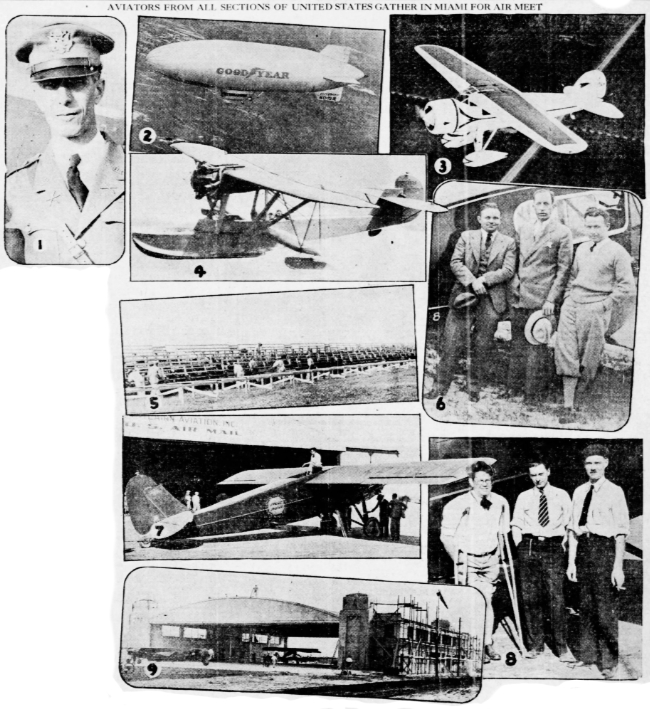
The All-American Air meet which will start tomorrow is bringing together at Municipal airport here aviators from all sections of the country. Activities at the airport yesterday in preparation for the races made it the scene of much varied activity.
No. 1 above shows Maj. C. H. Hale, United States Army reserve corps, president, Miami Chapter, Army Reserve Officers Association. Major Hale is chairman of the reception committee greeting fliers when they land at the field.
No. 2 shows the Goodyear dirigible, Defender, making its winter base here, which will participate in the meet.
No. 3 is the Lockheed Vega in which Amelia Earhart broke the world's speed record for women, attaining a speed of 184.17 miles an hour. It is entered in the local meet by the Detroit Aircraft Corporation.
No. 4 is the Eastman Flying Boat which is making its first public appearance at the Miami show. It also is representing the Detroit Aircraft Corporation in the meet.
No. 5 shows construction of seats at the airport.
No. 6 Is the Texaco plane, a Travelaire, and, left to right, C. J. Fox, Marbury B. Fox and W. T. Snowden, pilot. The plane is from Baltimore.
No. 7 is the Stinson-Detroiter which flew here from New York in less than 12 hours. It is owned by the Pilot Radio and Tube Corporation.
No. 8 shows the crew of the Stinson-Detroiter. Left to right they are Zeh Bouck, navigator, who ts aeronautical engineer for the Pilot firm and editor of Aero News and Mechanic, New York; Arthur H. Lynch, radio operator, editorial director for the
McKinnon-Fly publications, and William Alexander, pilot.
No. 9 shows the new hangar and administration building being constructed
for the Curtiss-Wright Flying Service at Municipal airport, which will be completed shortly.
Photographs by Herald Studio.
The Sunday Province (Vancouver, B.C.), Sunday, January 19, 1930
When we printed on this page last week an item about a Ryan seaplane
which took off from the ice surface of a lake on its pontoons, we thought we had discovered something new. Now, however, comes the story (duly verified) of a flying boat which was chopped loose from a lake into which it had frozen overnight, and flown off the ice.
This aircraft - an Eastman fiying boat -w as moored in Detroit River overnight while waiting to complete tests for its approved type certificate. When it was chopped loose and dragged onto the ice, its metal hull skidded along so easily that it took off in half the time required for a water take-off.
[It was announced in the Detroit Free Press the next day (January 20th) that the Detroit Aircraft Corporation had received that approved type certificate for the Eastman flying boat.]
The Herald (Miami, Florida), Monday, January 27, 1930
Miami has been selected by the Detroit Aircraft Corporation, one of the
"big four" of aviation groups in the United States, as the best location in the United States for introducing and demonstrating the newest develop- ments in its line of aircraft, L. J. Robinson, general sales manager of the organization, said yesterday.
"Almost every yacht club in the United States and Canada is represented in Miami during the winter season by some of its members," Mr, Robinson said. "By demonstrating our new flying boats here, we can reach the largest number of prospects available In any city. Those who are interested in boats and boating almost always enter aviation by way of the flying boat, and learn later to fly land planes. The fact that there is a representation of all parts of the country among the sportsmen who gather here is what makes Miami ideal for our purpose."
Mr. Robinson and James H. Eastman, chief research engineer of the organization, are here to demonstrate two Eastman flying yachts, four-place flying boats powered with 165-horsepower Curtiss Challenger motors, designed by Mr. Eastman and manufactured by the Eastman Aircraft Corporation, one of the 14 subsidiaries of the Detroit Aircraft Corporation. The boats have been assembled at the Curtiss-Wright seaplane base in Biscayne boulevard.
Both Mr. Eastman and Mr. Robinson were pilots in the United States Army
during the World war.
The Detroit Aircraft Corporation subsidiaries include many firms well
known in American aviation circles. Some of them are the Lockheed Aircraft Corporation, Burbank, Calif; the Ryan Aircraft Corporation, Robertson, Mo.; the Parks Aircraft Corporation, St. Louis, and Parks Air Colleges throughout the United States; the Aircraft Development Corporation, Detroit, which built and sold to the United States Navy its first all-metal dirigible, the ZMC-2, and which recently lald the keel for another dirigible to be 1,500 feet long; the Marine Aircraft Corporation, Detroit, builders of 16 and 32-passenger flying boats; the Blackburn Aircraft Corporation, Leeds, England, and Windsor, Canada, builders of fighting aircraft. The corporation also owns the Grosse Isle
International airport in the Detroit river between Detroit and Canada, and the Aviation Tool Corporation, manufacturers of the special aircraft machinery, such as a machine which
rivets and sews metal like a sewing machine. This machine with two operators did the daily work which 100 men would have been required to do with riveting machines when the ZMC-2 was under construction, Mr. Robinson said.
The Brooklyn Daily Times (Brooklyn, New York), Sunday, February 9, 1930
Being chopped loose from soft ice, dragged to solid ice and flown from
it, then landed upon a snow covered flying field, is the recent experience of an Eastman flying boat.
A few days before the recent cold spell in Detroit, an inspector from
the aeronautical branch of the Department of Commerce and James Eastman, designer of the craft, took off from the water in the Detroit River to conduct the necessary tests for the
receiving of an approved type certificate from the department. As it was late in the afternoon, the tests were postponed until the next day which found ice in the river, and the tests were then postponed until warmer weather.
As the Detroit Aircraft Corporation was anxious to put this type of ship in production, Mr. Eastman prevailed upon the inspector to chop the ship from the frozen ice and drag it upon solid ice. They then took off and found that as the hull was metal, it skidded along so easily that only about one-half of the time required for a water take-off was used in the hop off the ice.
Safely in the air, the tests were completed and the boat was then landed upon Grosse Ille Airport in about three feet of snow, coming to a dead stop in about the same time as had the landing been made in the water.
The Oregon Sunday Journal (Portland, Oregon), Sunday, February 16, 1930

Entrance of the Detroit Aircraft corporation's sales organization into
the Northwest with a full line of its planes, amphibians and flying boats was announced last week when W. A. (Billy) Williams, newly-appointed Northwest sales director, stopped at Swan island airport, en route to Seattle.
Sales activities of the corporation, Williams reported, are to be carried on under his direction in Oregon, Washington, Idaho, Utah, Montana and Western Canada. Tex Rankin, who has sold Ryan planes here in the past as distributor for the Ryan Aircraft company, a division of the Detroit Aircraft corporation, has become an associate dealer of the corporation in Portland. Other Oregon dealers are to be named, it was reported.
Flying the newest type Ryan Brougham plane, Williams came up the coast from San Francisco with D. C. Davisson, San Francisco, in charge of the Shell Oil company's automotive division on the Pacific coast, and Mrs. Davisson.
"By the nature of its terrain, the Northwest offers opportunity for use
of a wide variety of planes," Williams said. "There are undeveloped possibilities for the flying boat and amphibian because of the large number of water landings available. Our
Northwest branch plans to handle the corporation's Eastman flying boat and Eastman amphibian along with its Lockheed, Parks trainer and Ryan planes."
While Williams plans to make his headquarters at Seattle, he will divide his time between that city and Portland. He is a sales director who believes in using the thing he sells and his hours in the alr are many.
He started flying in 1917 as one of the first 20 United States army aviators to go overseas. After 21 months there he came out of the war a captain. Before joining the Detroit Aircraft corporation he was for two years sales promotion manager for the Alexander Aircraft company.
Divisions of the Detroit Aircraft corporation, which has its executive
offices in Detroit, are the Aircraft Development corporation, Aviation Parts Co., Inc., Eastman Aircraft corporation, Blackburn Aircraft corporation, Marine Aircraft corporation and Grosse Ile Airport, Inc., all of Detroit; Parks Air College, Inc., and Parks Aircraft corporation, East St. Louis, Ill, and the Ryan Aircraft corporation, Robertson, Mo.
Chicago Sunday Tribune (Detroit, Michigan), Sunday, February 23, 1930
SEAPLANE LANDING ON GROUND
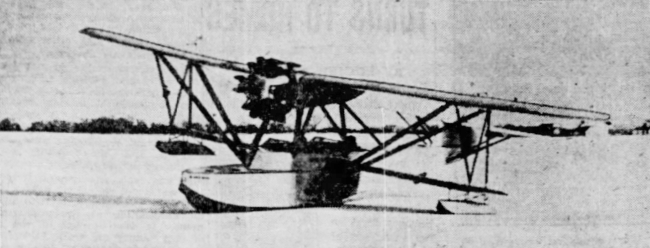
A department of commerce inspector chopped this Eastman flying boat loose from the ice in the Detroit river, towed it onto smooth ice, and took off. Later he landed
in three feet of snow on the Grosse Isle airport in Detroit, taxiing to a stop on the bottom of the hull.
The Herald (Miami, Florida), Friday, February 28, 1930

Miami aviators yesterday paid tribute to the memory of Thomas B. Ward,
pilot of the Miami Maid, who was killed with two passengers when the plane crashed into Biscayne bay Sunday. Flowers were dropped over the spot where the plane fell.
The tri-motored Ford plane owned by Capt. O. M. Goodsell, a plane from the Curtiss-Wright Flying Service marine division, piloted by Cal Lathan, with Russell Rogers as co-pilot; a Viking Flying Boat, piloted by Jack Tweed, with L. H. Fales, vice president of the Viking Flying Boat Company, Florida, as passenger, and an Eastman Flying Yacht, piloted by James Eastman, took part in the ceremony.
Those killed in the accident Sunday were Merritt S. Carlton, Miami Beach; Frank J. Somers, sales manager for the Miami Aircraft Corporation, and Ward.
[February 24: "Three men are dead as the result of the crash of a Miami-made airplane on an experimental flight. The plane, a flying boat built by the
Miami Aircraft company, sideslipped at a 200 foot altitude and fell into Biscayne bay as it was being demonstrated yesterday to a prospective purchaser. The dead are: Merritt S. Carlton, Miami Beach jeweler and former resident of Watertown, N, Y., Frank J. Somers, chief engineer of the aircraft company and Thomas B. Ward, pilot. The latter two were residents of Miami."]
The Indianapolis Star (Indianapolis, Indiana), Monday, March 3, 1930
The Oregon Daily Journal (Portland, Oregon), Wednesday, March 12, 1930
GOES TO GET PLANE
On his way to San Francisco to get the first Eastman flying boat to be
shown in the Northwest, W. A. (Billy) Williams, Northwest representative of the Detroit Aircraft corporation, landed at Swan island airport from Seattle in a Ryan plane this morning. Williams said two of the flying boats had been shipped to San Francisco from Detroit and that he planned to fly one north through Portland within the next three or
four days.
The Herald (Miami, Florida), Sunday, March 30, 1930
J. H. Eastman, vice president of the Eastman Flying Yacht Company, hopped off from the Curtiss-Wright seaplane base at 4:30 p. m. yesterday in the Eastman Flying Yacht, NC461M, for Stuart, Fla. After spending the night there, he will proceed to New York with Bert Kreuger as passenger.
Los Angeles Times (Los Angeles, California), Sunday, March 30, 1930

DETROIT, March 24. (Exclusive) The "ducks," as the aircraft industry refers to flying boats and amphibians, are advancing rapidly in popular favor, judging from the number and variety of this type of craft entered in the third All-American Aircraft Show, which opens here next Saturday.
The size and power of the "ducks" range from small jobs suited for owner-pilot use, to multimotored transports. Among the smaller ones to be shown are the three-place Savioa-Marchetti and the Eastman flying boat, shown last year, but which appears now in improved form as a product of the Detroit Aircraft Corporation. Consolidated Aircraft Corporation of Buffalo will introduce a new seven-place, high-wing cabin amphibian, Issoudun, a new amphibian built at Northville, Mich., also will make its first public appearance. Fokker has an eight-place amphibian in his family of six exhibits, Sikorsky will show not only his giant twelve-place multi-motored craft, but a new model of five-passenger capacity as well. Another debut for an amphibian is being arranged by the Towle Aircraft Company of Detroit, which has recently completed an eight-place amphibian.
The Stuart Daily News (Stuart, Martin County, Florida), Monday, March 31, 1930
FLIES TO STUART
Mrs. T. B. Speirs arrived Saturday for a week-end visit with Mrs. A. R.
Krueger, having made the trip from Miami in an Eastman Flying Boat, which has the famous Chandler motor, the type of engine which holds the world's record in edurance. Mrs. Speirs returned to Miami Sunday. Bert Krueger, however, took the plane and, with a friend, left Stuart early Sunday morning for New York City, hoping to make the trip in one day.
The Detroit Free Press (Detroit, Michigan), Sunday, April 6, 1930
In a lengthy article about the Detroit Aircraft Corporation displays at the third annual All-American Aircraft Show in Detroit:
"The Eastman division of the company will have two Eastman Flying Yachts on the water front for demonstrations, one being equipped with the new Packard-Diesel and
the other a standard job equipped with a Challenger engine. Another standard job will also be on display in the Detroit Aircraft booth."
A section called "Notes of the Show" on April 9th reported that "The first boat sale, and probably the first sale made by a saleswoman, was reported when Claire Fahy closed a deal with the Belle Isle Boat & Engine Co., for an Eastman flying boat. It will be powered with a Diesel."
On April 20th, an article in The Sunday Oregonian stated that "Lockheed, Ryan and Eastman prices have been cut slightly but greater values have been made by the care with which the company has reengineered and designed the planes to meet specific needs," and 11 Eastmans were ordered at the Detroit show.
The Long Beach Sun (Long Beach, California), Thursday, April 17, 1930

Harvey Martin, of Monday Flying Service, is the first local pilot to take aloft the newest arrival in marine aircraft at Los Angeles-Long Beach harbor.
Martin has been flying the new Eastman "Flying Yacht," based at the California Yacht club, Wilmington, and is enthusiastic in its praise. The new ship is a four-place, biplane flying boat, with 170 horsepower Curtiss "Challenger" engine mounted in the center section of the upper wing, driving a tractor propeller. Tandem cockpits seat two per sons each. Dual "Dep" controls are provided; one set in each cockpit on the port side. Full set of instruments is mounted on a panel fn the forward cockpit.
Performance figures given by the manufacturers state that the ship has a high speed #f 112 miles per hour, a cruising speed of 90 miles an hour and a landing speed of 42 miles an hour. A rate climb of 1000 feet a minute with full load gives the ship an advantage over most craft of its type in this respect.
“Fuel consumption at cruising speed is given at eleven gallons per hour. Cruising range is limited to 280 miles with four persons aboard, but is increased to 400 miles if only three persons are carried.
Eastman Aircraft corporation, a subsidiary of Detroit Aircraft corporation, manufactures the ship. Ted Schleuter is the Pacific coast representative for various branches of the holding company, including the Eastman Aircraft corporation.
The Detroit Free Press (Detroit, Michigan), Monday, April 21, 1930
Demonstrate Police Plane
Police officials, according to an announcement of the Detroit Aircraft corporation, will witness tests of an Eastman fiving boat at the Belle Isle Boat and Engine company Monday afternoon. The announcement said the demonstration was designed to show the practical use of such a ship in border patrol work.
The Flint Sunday Journal (Flint, Michigan), Sunday, May 4, 1930

Detroit, May 3. - A path-finding trip for the first Great Lakes air cruise, sponsored by the Detroit Flying club, will leave Detroit May 26 for the purpose of making complete arrangements for the cruise at every contemplated stop.
The itinerary of the cruise, scheduled for Aug. 8 to 17, will be definitely fixed after the pathfinders return. The tentative itinerary, according to Wayne J. Sheldon, crulse commander, leads through Toledo, Cleveland, Erie, Bugalo, Hamilton, Ont., Toronto, Port Hope, Peterboro, Barrie, Parry Sound, Little Current, Sault Ste. Marie, Mich., Otter Head, Port Arthur, Duluth, Houghton, Marquette, St. Ignace, Sturgeon
Bay, Sheboygan, Racine, Benton Harbor, Muskegon, Frankfort, Traverse City, Petoskey, Mackinac Island, Alpena, Bay City, Harbor Beach, Port Huron and back to Detroit.
Cities receiving the cruise are asked to provide entertainment for its active personnel. Enthusiastic replies have been received from members of boards of commerce in the cities named on the tentative itinerary and Mr. Sheldon anticipates no difficulty in making satisfactory arrangements in the cities where noon and overnight stops are to be made.
Will Take Passengers
Manufacturers of flying boats, amphibians and planes which can be fitted with pontoons will participate in the flight. Also, a limited number of passengers will be
carried and a number of applications already have been received from persons planning to make the 2,700 mile cruise their vacation trip.
Paul Strasburg, Detroit, who has been flying in Great Lakes territory for eleven years, has been selected as tour referee. On the cruise committee are: Edward J.
Hill, president of the Detroit Flying club; Clark C. Hyatt, Gaylord W. Norton, Ray Cooper, and Major Floyd Evans. The technical committee consists of Arthur Schlosser and James Eastman.
The cruise has received the sanction of the National Aeronautic association, under the rules of the Federation Aeronautique Internationale.
The Hamilton Spectator (Hamilton, Ontario), Tuesday, June 3, 1930
An Eastman flying boat piloted by V. F. Halibuttom of the Detroit
Aircraft corporation, landed on the surface of the bay at MacNab street near the Royal Hamilton Yachtclub's quarters this afternoon, in connection with the Great Lakes air
cruise to be held by the Detroit Air club from August 8 to 17 inclusive. A delegation of local flying officials, headed by L. H. Smith, president of the Hamilton Aero club,
greeted the visitors and invited them to be their guests at lunch. The trip today was in the nature of a pathfinding visit. Pilot Haliburton is making a 1,000-mile tour of the Great Lakes chain, paving the way for the summer invasion when over 100 Detroit flyers. will take part.
The Pathfinders tour was covered extensively, with articles in many newspapers. However, despite forecasts of between 25 and 40 aircraft taking part in the main Great Lakes Air Cruise, only 3 did, and the various banquets and festivals planned all along the route were cancelled.
The Sheboygan Press (Sheboygan, Wisconsin), Monday, August 4, 1930
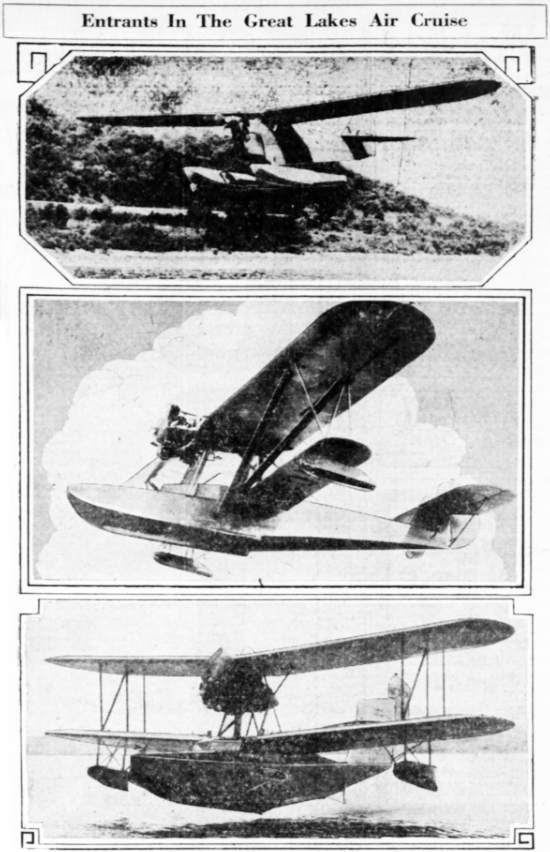
Above are three of the interesting entrants in the Great Lakes Air cruise, which will leave Detroit Aug. 7, and which will arrive in Sheboygan on Aug. 14. People from this and several other cities on the Great Lakes borders will have the opportunity of viewing these and several other types of planes equipped to land on water.
The top picture is a tiny Aeronca single seater "flying glider," which has astonished aviation experts by its performance on pontoons. These are probably the smallest pontoons for a practical airplane ever constructed. They are eleven feet long, and weigh forty pounds each. The tiny craft takes off in about six seconds.
Middle is the Eastman four-place flying boat, which will be flown by
its designer, James Eastman. This ship has an all-metal hull, and is of the sesqui-wing type. It is considered unusually efficient as a water craft.
Below, the Keystone-Loening "Commuter," powered with a Wasp engine. This is a four-place plane especially designed for the private owner who can commute between a
distant shore home and the city. It is used effectively in passenger-hopping, and as a shuttle plane between airports and downtown water landing places.
The Sunday Times (Perth, Western Australia), Sunday, September 21, 1930

Taking off from water in a cross wind, as is often necessary on narrow
stretches, is always regarded as a difficult feat, but the new Eastman flying boat has special features designed to overcome this embarrassment. Fitted with a water rudder, the machine may be steered like a boat, and as it rests low in the water it offers comparatively little resistance to the wind.
Landing on water is claimed to be particularly easy for a pilot in an
Eastman, since his position in the craft is such that his line of vision is about 30 inches above the surface of the sea. Contact with the water may be made at practically any point of the keel forward of the step and short of the nose. Only a one-point landing is
mecessary, instead of a three-point landing as with a land plane. To keep a lateral level is essential, but this is facilitated by the oversized ailerons that are provided.
The engine is mounted in a chrome molybdenum steel support, cushioned
against vibration, and well above and ahead of the front cockpit.
The Hickman Courier (Hickman, Kentucky), Thursday, October 30, 1930
SEAPLANE HERE
G. F. Freeman and J. G. Walier of the Syracuse, N. Y., airport arrived in town ahont 3:30 o'clock Wednesday flying an Eastman Flying boat with 180 H. P. motor. They were en route to Florida but stopped here long enough to take up some passengers.
St. Petersburg Times (St. Petersburg, Florida), Tuesday, August 11, 1931

H. M. Fraser accompanied by Ed Taafe flew in from Winter Haven Monday morning in one of the new Eastman four-place open flying boats made by the Detroit Aircraft corporation. It was the first visit of this type of ship to St. Petersburg.
H. A. Strickland, demonstrator for the All-American Airways of Tampa, flew over in one of the new Aeronca high-wing monoplanes.
On August 30, 1946, The Whitehorse Star reported that Jim Eastman had died on August 24th:
We much regret having to record the death of Mr. James H. Eastman of Atlin, B. C., which occurred in the Whitehorse General Hospital last Saturday at 7 a. m., at the age of 50 years. He had been in the institution a week earlier, having been brought to town by a Northern Airways plane which had made an emergency trip for that purpose. Suffering from a ruptured ulcer he was immediately operated upon but too late to save him. Peritonitis set in and caused his death.
Read the entire article about his death here.
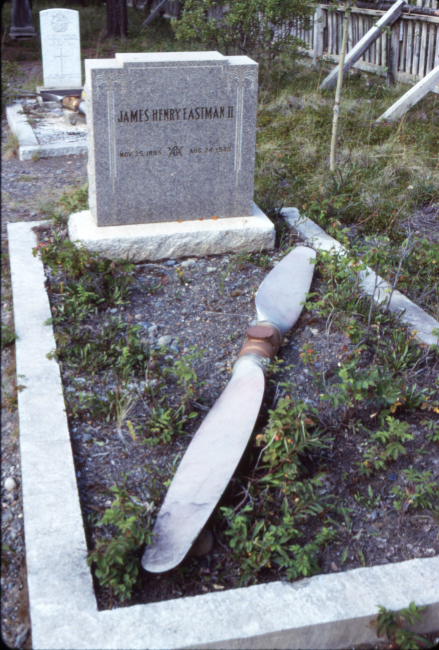
Grave of James Henry Eastman II at the Atlin Pioneer Cemetery at Atlin, British Columbia.
Times-Colonist (Victoria, BC), Friday, February 12, 1988

By Ab Kent
Times-Colonist staff
Parts of an aircraft which has not been seen anywhere in the world for half a century have been rescued from a Cowichan Valley dump.
"You could almost call this the find of the decade," said David Maude, curator of the Commonwealth Military Aviation Museum at Pat Bay, which now has the relics of the Eastman flying boat. "You just don't restore an extinct aircraft."
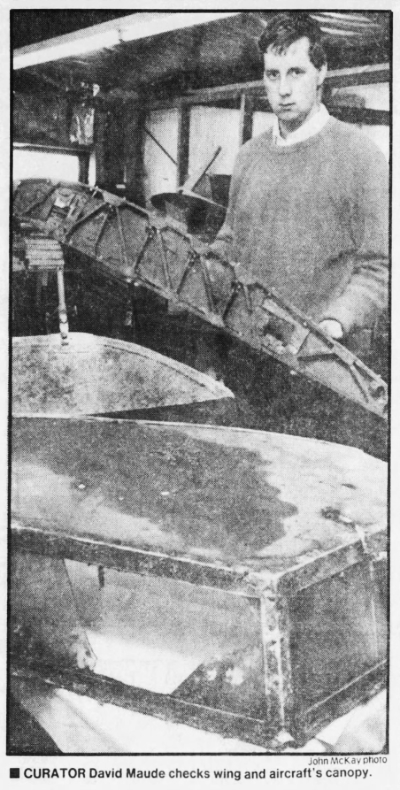
The parts had been gathering dust in a barn owned by Roy Barnes of Duncan, who decided to tear the structure down. He had already hauled some of the parts to the dump before deciding to see if anyone was interested in what was left.
"It's really quite fascinating," Maude said Thursday. "They (the parts) have been sitting in this barn for about 50 years.
The last known Eastman E-2 Sea Rover to fly was owned by the Toronto-based Columbia Development Co., which Maude said was likely a mineral exploration company flying out of Atlin near the Yukon boundary in 1945. Its fate is unknown.
Only five of the planes came out of the Detroit Aircraft Co. plant before production stopped with the 1929 stock crash. All ended up in B.C. as part of a gold-seeking expedition to northern lakes and rivers. "Unfortunately, they didn't find
too much and the planes were sold off," Maude said.
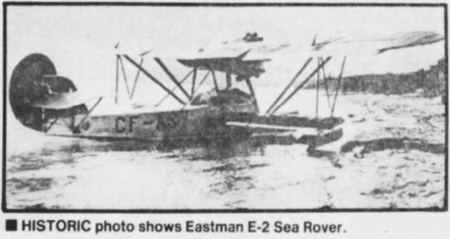
From what he has found out so far, the Sea Rover from Duncan may have been CF-ASV, whose registration lapsed in 1935 and was last known to have gone into storage at Alice Arm, far up the mainland coast, in 1939. If it is the same plane, no one has explained how it came to be in the Cowichan Valley.
Barnes said the property, farm buildings and contents were owned by the late Martin Braden, a sawmill operator who sold the land to Barnes's father. "Lots of people knew it (the dismantled flying boat) was in there, but nobody gave it much notice. "My dad never gave it any mind," Barnes said.
About 25 years ago Braden apparently had the engine running, hanging from rafters in the barn, according to what Barnes was told. But the motor was then taken apart
and lay in pieces along with frames, ribs and spars of the wing and tail sections. At some time, the hull was stripped and burned.
The museum eventually found out about the plane after Barnes, in preparation for demolishing the barn, had taken some engine parts to the dump, and belatedly realized they might be of use. "I just figured it must be worth something to somebody."
It was, to Maude and his volunteer colleagues, who jumped into action. They recovered some of the engine parts from the dump but the cylinders and crankcase are lost forever. Only the magnetos, connecting rods, cam and some gears remain of the engine, but Maude is amazed there was so much of the airframe left. "I didn't think there were any
more airplanes left in the barns."
He said the Sea Rover hull was of plywood and will be easy to reproduce from available drawings and some old photographs in the museum's hands.
The original Curtiss Challenger six-cylinder radial engine can be replaced, he hopes, by a not-so-rare Curtiss Robin power plant, which Maude said was identical in size and configuration.
Building the Rover's full-length hull will likely be a summer project for the museum volunteers with possible assistance from craftsmen.
For its time, the Sea Rover had rather stylish lines, its one-step hull
long and slim, like a seaplane float, with two, two-seat open cockpits and the single engine mounted above and forward of the front cockpit. A long-bladed propeller turned
within a few centimetres of the hull immediately in the pilot's face.
For the northern expedition and the likelihood of freezing temperatures, a canopy was fitted over the cockpits.
Realizing how close he came to junking something comparable to the return of the dodo, Barnes said he is glad the museum can put the pieces back together. "They said I've got a lifetime pass. I'm happy with that."
Times-Colonist (Victoria, BC), Tuesday, March 15, 1988

By Ab Kent
Times-Colonist staff
What was thought to be an extinct flying boat may have mates waiting to be discovered, says the son of the plane's designer.
Last month many pieces of an Eastman E-2 airframe were rescued by the Commonwealth Military Aviation Museum as they were about to be junked with a farm shed at Duncan where they lay neglected for more than 40 years. Their discovery was regarded by the museum as a lifetime windfall.
Jim Eastman, 54, of Saltspring Island, surfaced after seeing a Times-Colonist story of the E-2 find. He read the article ""with considerable excitement," and supplied more details about his father James and the Sea Rovers designed and built at Detroit Aircraft Corp. in 1929.
A photo of CF-ASY from newspaper archives accompanied the story. "ASY is the plane Dad used in the 1940s," Eastman said.
Five Eastman E-2s were flown to the north on a gold-seeking venture early in 1932, Eastman recalled. "Three of the planes were sold in the fall of '32 or spring of '33 to settle up debts incurred during the '1932 Expedition' as it was called.
"One was bought by Bill Emery, one by Lynn Staples and the other by someone in southern B.C. as I recall. "I don't know what happened to the planes after their sale. I have a vague recollection that Staples' plane was wrecked but it may have been rebuilt. It could very well be the one left in Alice Arm."
Eastman said he has several souvenirs of the flying boats, including the
log book for CF-AST, the eighth plane off his father's Detroit airplane assembly line; a number of pictures; some box-end wrenches and a tool box from ASY, and the manufacturer's
name plate for AST.
He thinks AST or ASY were the last of the line to fly, both in the livery of Columbia Development Ltd., of Atlin, of which his father was a founder.
"Dad died in 1945 and the plane he used that year was dismantled and stored in Atlin. Some years later I heard that someone had modified the hull to use it for an outboard motor boat. The other plane was in Carcross (Yukon) at the time of Dad's death
awaiting some fabric repairs and I believe it met the same fate as the one in Atlin.
"There are two propellers remaining in Atlin, one on my father's grave
and one on the grave of Francis Henning in the Pioneer Cemetery."
Eastman referred to a 25-year-old rumor that an E-2 flying boat seized
by a repair shop for non-payment rested for years in a Vancouver airport hangar. He does not know who its owner was.
He said a Gordon Ballentine, of North Vancouver, may know something about the flying boats, and when Ballentine was contacted Thursday he said, "I used to fly one."
Ballentine said CF-ASW was an E-2 "sent down from Atlin for repairs." He was in partnership with another flyer at the time. "We got one of our pupils to buy it and we used it professionally and personally for a couple of years."
The pupil was a Vancouver dentist, Dr. Walter Sproule, who in attempting to take off in Howe Sound crashed the plane. It was towed to the beach at Gibson's Landing where it remained for a time, and according to Ballentine, is now at the bottom of the
sound.
But there may be more relics of the type stashed away in other corners of
North America in numbers unsuspected by museum curator David Maude.
"A total of 29 or 30 had been built by the time Detroit Aircraft went bankrupt in late 1931 or early 1932," Eastman said. "Dad was the founder, part-owner and principal designer of Detroit Aircraft." Lockheed Aircraft was the successor company.
Eastman offered details about the plane's construction, including the
fact that the hull was formed of Dural aluminum alloy, over oak ribs and stringers, and not of plywood as had been supposed.
Raised in the north, Eastman also became a pilot, but instead of going
into commercial aviation he spent his career in mining, both in B.C. and South America. He worked for Placer Development, of Vancouver, from 1960 to his retirement to Saltspring Island in 1985.
Eastman senior was a contemporary of northern flyer Herman Peterson, of Coast Range Airways, which he sold to Trans North. When Peterson was contacted Friday at his home in Atlin he said he was living in a house on the site where the Eastman family had lived in the 1930s and 40s.
Peterson also remembered CF-AST and -ASY, the last two Sea Rovers in
the north, more or less confirming Eastman junior's story. "I was going to buy both of
those flying boats, but didn't have the money." He said a Teslin man, Tiny Kitchen, bought them after Eastman died in 1945, and used their two hulls to make a catamaran boat. He said they were sent in the early 1970s to Winnipeg where he thought a museum took them.
In the mid-50s, Peterson said, he picked up a Challenger engine from one of the E-2s, and sent it to a friend in Tuscon, Ariz., who was rebuilding a Curtiss Robin, which used the same type of power plant.
He thought a third E-2 had gone to Anyox, Alice Arm, a mining and smelter town that died before the Second World War. Where the rest of the plane's pieces ended up he could not say.
|

|