
|





|
|
The crash of Consolidated B-24 Liberator KK-241, 1945
The story of Airplane Creek, BC
Dateline: December 25, 2024.
On June 1, 1945, Consolidated B-24 Liberator KK241, assigned to No. 5 Operational Training Unit (OTU), took off from the RCAF base at Abbotsford, British Columbia, at 09:06. It was a navigational training exercise in the 4-engined heavy bomber, with 11 Royal Air Force members aboard. The last communication with Abbotsford tower was initiated 34 minutes after takeoff, and although there was no indication of a problem, the aircraft then vanished.
In the following weeks, hundreds of people, both military and civilian, searched on the ground, and aircraft flew a total of 672 hours, usually severely hampered by adverse weather. Wreckage was finally spotted from the air on June 16th, and on the 20th a ground team confirmed that it was the missing Liberator and that there was no chance that anyone had survived the impact.
On June 25th, a group of 6 men consisting of military members, civilian guides, and an Anglican padre, climbed to the crash site, and buried the remains. Padre E. W. S. Gilbert's detailed diary, with three photos, can be read here.
The crash was one of the 10 worst air training accidents in Canada during WWII. Killed were:
Flying Officer Arthur William David Hill, pilot (21 years old)
Pilot Officer Gilbert Ewart Ellis Long, co-pilot (21 years old)
Sgt. Graham Murray, navigator (20 years old)
Sgt. Stanley Aldridge, Air Gunner (20 years old)
Sgt. Albert Eric Broadbent, Air Gunner (19 years old)
Sgt. John Randall Dale, Air Gunner (32 years old)
Sgt. William Peter Watt Drummond, Air Gunner (24 years old)
Sgt. Isaac Gibbons, Air Gunner (19 years old)
Sgt. James Leonard Gordon Hammond, Air Bomber (20 years old)
Sgt. David Robertson Langlands, Wireless Air Gunner (34 years old)
Sgt. William Thomas Swatton, Wireless Air Gunner (34 years old)
More information about each can be found here.
In June 1983, Air Cadets from 861 Silverfox Squadron in Abbotsford, with Commanding Officer Chris Weicht, constructed a memorial cairn on top of one of the Liberator's engines on an island in Airplane Creek. It was probably badly damaged in the disastrous floods of 1988 and 1989, and in 2015 a new memorial was built in Thompson Regional Park in the Chilliwack River Valley. That impressive memorial was unveiled on September 26, 2015 - more information about the memorial, including photos and videos can be seen at airplanecreek.com. Although it implies that Airplane Creek was named for this crash, the creek had been named 2 years earlier by a team climbing to the wreck of Canadian Pacific Air Lines Lockheed 14-H2 Super Electra CF-CPD - see The story of Airplane Creek, BC for that story.
The material that follows consists of the most significant of the newspaper reports published. The articles chosen have been reproduced in their entirety, with no editing.
Monday, June 4, 1945.
The Vancouver Daily Province

HOPE, June 4. - Flying under a heavy overcast that obscured mountain tops above 5000 feet, planes of the R.C.A.F. shuttled back and forth over the area east of Hope throughout Saturday and Sunday in search of the lost Liberator bomber with 11 R.A.F.
men aboard.
Conditions for observation were also rendered difficult by presence of a ground haze that limited visibility to three miles.
Today unfavorable weather washed out all search by air.
No reports of a plane crash have been received from the Coquihalla Pass, which is on the route of the east-west radio beam and which is inhabited at evenly spaced intervals by railway section hands, and it is therefore feared the lost plane might be
down off the regular channels of flight.
Wednesday, June 6, 1945.
The Vancouver Daily Province

Short wave radio signals from Mt. Cheam district near Chilliwack - where 13 died in crash of a Canadian Pacific Airlines transport in December, 1942 - today started five R.C.A.F.-directed land parties in search of a Liberator bomber and 11 men
missing since last Friday. There was strong hope the "Graveyard of Planes," as the area has been termed, might give up the lost aircraft's crew.
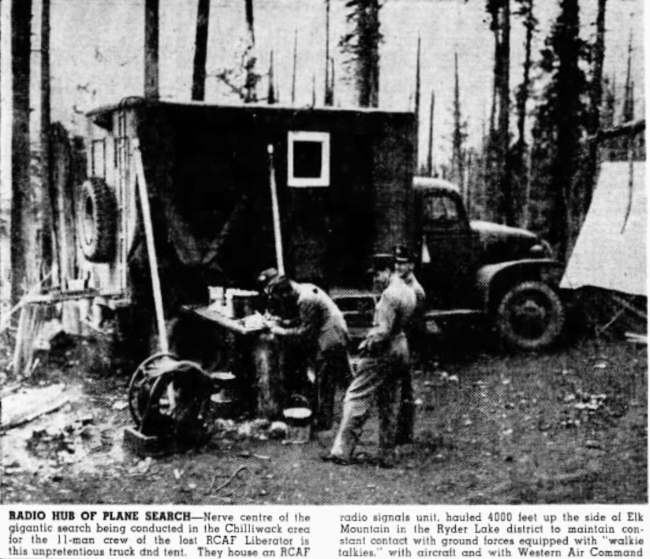
The radio signals had been coming in at half-hour intervals since noon Friday, an hour and a half after R.C.A.F. authorities believe the Liberator went down. At 3:30 p.m. Tuesday, they suddenly stopped. But they had continued long enough for receivers with "walkie-talkie" sets and others in aircraft to narrow down the area from which they emanated.
It is narrowed to a 10-to-20-mile section of the wildest, roughest kind of country in British Columbia. It is southeast of Mt. Cheam, in an area bounded by Elk Mountain, Lady Peak, Chilliwack and Mt. Tomiki.
FIVE SEARCH PARTIES.
R.C.A.F. authorities at Western Air Command had no comment to make. But five ground search parties started out from Chilliwack today. A party has gone out from
Jones Lake, and a second is heading over Elk Mountain. A third has taken the B. & B. Logging trail and two others have gone up Chilliwack River to a base camp at Ford Creek. All five parties are directed by Flt-Lt. Stuart Forbes, R.C.A.F.
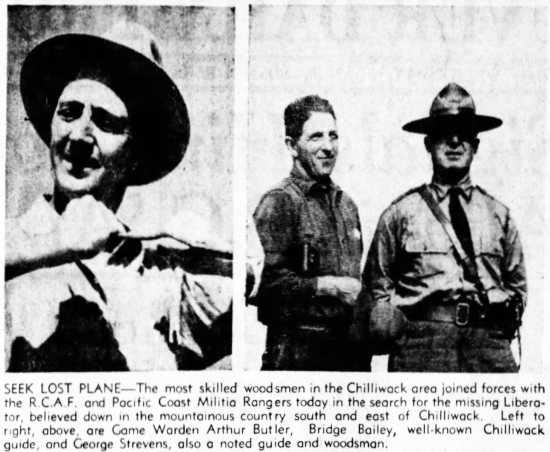
An all-out aerial search is also under way, though hampered by very poor visibility today. Pacific Coast Militia Rangers and R.C.A.F. personnel make up the search parties, led by veteran game wardens and guides. Taking part are Game Warden Arthur Butler and guides Bridge Bailey and George Strevens.
IN 1943 SEARCH.
Game Warden Butler and Bailey played major roles in search for the C.P.A.L. transport after wreckage was located by aircraft off an unidentified Cheam range peak in the summer of 1943.
Earl Brett, well-known private flyer, made two flights over the
mountainous country last Friday and Saturday in his Waco, and is still taking part in the hunt.
Theory is that the radio signals are coming from a portable set carried in the missing Liberator.
RAIN HINDERS HUNT.
There is a steady rain in the concentrated search area today, making ground travel difficult and lessening the value of search by air.
Immediately after Western Air Command announced the Liberator was missing from an R.C.A.F. base in British Columbia, it was stated all members of the crew are Royal Air Force personnel. The aircraft was on a cross-country flight.
Today's search recalled the dramatic hunt for the 13 victims of the C.P.A.L. plane which struck a mountain peak in the Cheam range on a snowy night, December 20, 1942, only a few minutes out of Vancouver on a flight from Prince George. Search for the transport went on for months, and in late July, 1943, a civilian pilot saw wreckage on the mountain peak. Search parties started out immediately.
First to arrive at the scene was a Vancouver Daily Province party of three men, one of them Charles Woodsworth of the editorial staff. The other two were Alpine Club members, Len von Luben and Charlie McMillan. Later an official C.P.A.L. and
B.C. Police party made the ascent.
Guides and veteran mountain climbers acknowledge that today's search area is among the wildest, roughest country in British Columbia.
Thursday, June 7, 1945.
The Vancouver Daily Province

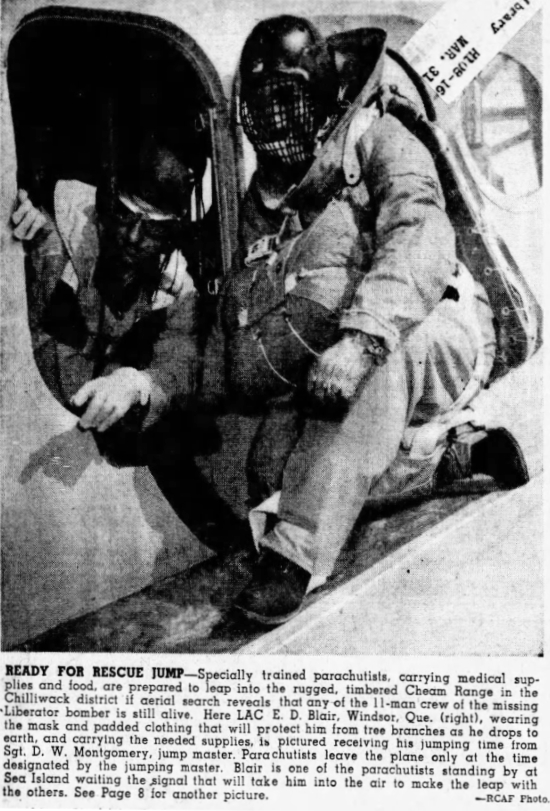
Parachute jumpers will leap into the wilderness country southeast of Chilliwack if they are needed when ground or air searchers find trace of the 11 airmen lost six days aboard an Abbotsford-based Liberator bomber. Fully-equipped land rescue parties also are ready.
Clearing weather this afternoon brought hope that five ground parties and cloud-grounded aircraft might be able to begin all-out "pattern" search of the 10 to 20-mile area in which the Liberator is believed to have come down last Friday morning.
From Chilliwack came word that the apparent crash area had been pretty definitely "fixed" by R.C.A.F. knowledge of the Liberator's course and position, and by reports from persons who said they saw or heard the aircraft.
About 40 veteran woodsmen are at high-level bases waiting for mist and clouds to lift. R.C.A.F. planes were ready to begin "pattern" flying. (In "pattern" flying, the aircraft - at different altitudes - fly in ever-decreasing squares until the area under search has been covered from every possible angle.)
Western Air Command announced that R.C.A.F. parachutists were standing by. It would be the first known time 'chutists have been used in land aircraft rescue work in British Columbia.
OFFICIAL STATEMENT.
An air official statement said: "There has been intensive search since the Liberator was first reported overdue June 1. The plane was on routine cross-country training exercises. It took off from Abbotsford at about 9 a.m. Routine radio transmission was sent at 9:30 a.m,, but the aircraft failed to reply, although other planes on the same exercise attempted to call their attention to the fact that the base was calling them. No further messages were received from the aircraft. It should have passed over Penticton at 9:45 a.m., and should have reported then, but did not. Thus it is considered most likely the aircraft struck a mountain between Abbotsford and Penticton."
AREA DEFINED.
"Careful analysis of many factors, including reports from civilians, leads to belief the plane may be somewhere in the area above Cheam, Silvertip and
Silver Peak. Since June 1, weather conditions have hampered aerial search, However, 20 to 25 aircraft have dally tried to reach the search area. Also night patrols have flown in hope flares might be seen through breaks in clouds. Constant listening watch has been maintained by numerous ground stations and by aircraft for distress signals.
"A mobile R.C.A.F. radio direction finding base was set up on June 3 on top of Elk Mountain. Many transmissions have been received, all apparently emanating from commercial stations. No distress signals which could be attributed to the missing aircraft have been picked up. Wednesday, in view of continued unsuitable flying weather, five land search parties of P.C.M.R. [Pacific Coast Militia Rangers] from Chilliwack were despatched."
Searchers this afternoon were waiting for clouds to lift above 6000 feet. It is understood the five parties are now radio equipped. They are based at high-level vantage points, and when mists lift will scan the area with the most powerful binoculars possible to obtain, while aircraft fly above. Feeling in Chilliwack is that the plane will be found, though hope that the 11 Royal Air Force men will be alive is dim.
Today, Pacific Coast Militia Rangers at Chilliwack said they had picked up shortwave signals on the international distress call frequency of 500 kilocycles, and Western Air Command said the same signals had been picked up over Chilliwack at half-hour intervals from noon Friday to 3:30 p.m. Tuesday. But, the air force officials said, after careful analysis they did not think the radio signals had any connection with the missing plane.
FIVE PARTIES.
Another R.C.A.F. official said the signais "had been roughly traced" to the area under search.
The five ground parties are equipped for a five-day search. Each man carries a week's supply of food. It takes a day to reach the area and a day to return. The concentrated search area, bounded by Elk Mountain, Lady Peak, Chilliwack River and Mt. Tomiki, is as wild a country as can be found anywhere in the Pacific Northwest. It is southeast of Mt. William Knight, scene of the crash in December, 1942, which killed 13
persons bound from Prince George to Vancouver. It is a wilderness of heavy woods, towering mountain peaks and deep cuts and ravines.
A number of persons living fairly near the search scene have reported they heard the lost Liberator last Friday morning, just before its radio signals back to base blacked out. The aircraft was obscured by low clouds, they said. The spokesman said that from the interrupted position signal and the known course of the Liberator, the search area had been plotted.
From Chilliwack came report that the shortwave signals heard from Friday to Tuesday were strongest right over Chilliwack.
Air force officials said that a Liberator normally carries full rations for five days. There is fresh water, chocolate, concentrated food and hardtack. The men have six sleeping bags, a Gibson Girl radio, medical supplies, fishing gear and a Very pistol and shells.
Friday, June 8, 1945.
The Vancouver Sun
Saturday, June 9, 1945.
The Vancouver Daily Province

"Seven injured ... Still alive..."
From three weak radio messages late Friday this message emerged. It was hoped the Liberator bomber and 11 airmen lost eight days from their Abbotsford base had been found.
At first light today, 50 men converged on Tamihi Creek, tributary of the Chilliwack River, in stretch-drive search for the missing aircraft. By noon six additional Pacific Coast Militia Ranger parties were on their way, all a in a long draw on the south side of Chilliwack River, along the side of Tomiki Mountain. One party was on horseback, one will be back at base camp early Sunday.
Western Air Command was cautious. They revealed the three fateful radio messages were picked up by J. D, Usselman, resident of the apparent crash area. Last night Usselman reported to the R.C.A.F. that he had picked up three separate messages - voice and telegraph signals. "The voice was very weak," Usselman said.
"The speaker sounded young. He was an Englishman." Usselman had to put all three messages together before he got coherence. Then the words emerged: "Seven injured; still alive." The message itself; the English voice... made Usselman sure he was in contact with the Liberator bomber which R.C.A.F. and Pacific Coast Militia have sought ceaselessly since it flew into the nowhere at 10:30 a.m., June 1.
MOVED QUICKLY.
Western Air Command hopped to it. At dawn 50 R.C.A.F. personnel and Rangers were in a camp at the base of Chilliwack Lake road. Specialists were on their way
in. The message indicated the wrecked aircraft is down in a canyon between Tamihi and
Slesse creeks. One report said the location is about a mile and a half from Chilliwack River. The specialists are carrying medical supplies and food.
Wing Cmndr, D, J. "Blackie" Williams, commanding officer of the Abbotsford base, from which the lost Liberator took off, flew in to the Tamihi Creek
scene at an early hour.
WEATHER HANDICAP.
He said weather prevented seeing trace of the wreckage or men.
Before the search parties themselves went into action, the R.C.A.F. broadcast to any airmen who might be alive messages of instruction. A few minutes later the army was asked to establish a base camp for 200 men at Chilliwack Lake road. The instruction messages kept going out all night - at 20-minute intervals. They continued this morning.
Flying is "out" today, but an R.C.A.F. Norseman is maintaining a constant weather watch in hope of a break. The specially-trained parachute jumpers are standing by at Abbotsford. They will go into action at a moment's notice.
ADDITIONAL MEN.
A Western Air Command statement said that Pacific Coast Militia Rangers, under Col. A. Leslie Coote, New Westminster, are preparing to send 20 additional parties into the area. At the Chilliwack base camp two ambulances and medical officers are waiting.
Western Air Command conjectured as to value of the Usselman report at 10 a.m. "There is some question as to the technical ability of the home-made receiver picking up messages on the 500-kilocycle frequency. Analysis reveals possibility of this set picking up second harmonic of transmission from the missing aircraft sent by them on an R.C.A.F. frequency."
HEARD AIRCRAFT.
As corroborative evidence, R.C.A.F. authorities said that a previous call from Vedder Crossing residents stated they heard the aircraft flying low in the direction of Tamihi Creek at 9:30 a.m., June 1. "Numerous aircraft bearings gave approximately this area as well as others."
Search in other areas is continuing.
STEEP CANYON.
The Tamihi Creek area is about 16 miles from Chilliwack City. First part of the route in from auto road is half mountainous and brushwood country, but further in there is a precipitous canyon and heavy woods.
Search for the missing Liberator and its 11-man Royal Air Force crew was concentrated in the wilderness southeast of Chilliwack, in the Cheam Range area, last Wednesday. At that time, it was reported that signals had been heard at half-hour intervals, presumably coming from the missing aircraft. The signals were strongest over Chilliwack and continued from noon Friday, June 1, to 3:30 p.m. last Tuesday, when they suddenly stopped.
Five ground parties left for the wilderness hills on the Wednesday, but have been hampered ever since by clouds which dropped down below 2000 feet at frequent intervals. Air search has been impossible almost from the time the plane went down.

By JAMES FAIRLEY.
(Daily Province Staff Correspondent.)
CHILLIWACK, June 9. - I know now why it has taken so long to find the missing Liberator. I found out Friday.
Earl Brett, veteran Chilliwack businessman flyer, took me over the wilderness area southeast of Chilliwack in his Waco seaplane. It was a routine hop to Pilot Brett's logging camp on Harrison Lake, but it turned into one of the first aerial
searches for the Liberator since storm clouds grounded the land-based planes early this week.
Sudden death lurks.in this wilderness for the airman who defies the elements.
Just before we took off, R.C.A.F. authorities in Chilliwack suggested that Pilot Brett cruise the Chehalis Park area on his way to Harrison and on the way back. They were taking advantage of a momentary break in the weather - first in seven days.
We flew into a frightening mass of black storm clouds. For the first time I realized how a pilot might feel when the weatherman gets vicious by producing black clouds from no where in an aircraft's path.
Over the prairie it would not matter. But southeast of Chilliwack flyers play leapfrog over mountain peaks that reach higher than 7000 feet into the blue... when there is any blue.
"Looking for fresh-broken trees," said unconcerned Pilot Brett. As he spoke the Waco was travelling 150 miles an hour down valleys, up over peaks, banking sharply every few seconds. Above our low-flying ship the overcast was ever changing.
Black cloud fingers plucked at us as we sped by.
We flew down a long valley. "See the end of that draw?" said Brett. "Keep your eye on it. We'll look down it for the Lib and come out on Harrison Lake." I could see a confusion of snow-covered mountain peaks on every side. They seemed to play hide-and-seek with us behind the clouds.
LAKE VANISHES.
Ahead I could see Harrison Lake at the end of the draw. Seconds later the Waco banked around a peak to head through the draw and, without warning... No Harrison Lake! Instead was a dirty black wall of storm clouds.
"Well," said Brett, "that's that. You see what the search boys are up against."
CLOUDS CLOSE IN.
The Waco swung back, to try another route, but clouds had closed in on that side, too. As we rammed into them our motor seemed to cut out. Pilot Brett must have sensed my dismay. "It's okay," he grunted. "I just wanted to drop her nose. I had an idea there was black stuff ahead of us and I wanted to see where we were going."
He wasn't kidding. There was black stuff ahead - and all of it was stuffed with mountain peaks. But Pilot Brett knew what he was doing. We made it.
Coming back, Brett decided to search the other side of Chehalis Mountain, and we climbed to 2900 feet with peaks flicking past as telephone poles flick by a train. "We'll go up that way." He pointed to a maze of snow and cloud-covered mountain tops.
At 3400 feet the elements took charge. Without warning the Waco dropped 500 feet. "That's that," said Brett. He swung back over the lake, bound for Chilliwack. "No sense taking chances in this stuff."
I agreed. "Yeah, no sense taking any chances," I said, and pushed my stomach back where it belonged.
FIND BROKEN TREES.
We had a brief thrill over Agassiz Mountain. Brett's keen eyes picked out a path of broken tree tops. We circled back, sharply, for a better look. "Lightning," Brett said, and we resumed course.
Our plane was on the route the lost Liberator is supposed to have been when it vanished. "From all reports, the bomber was flying about this course," Brett told me. We edged closer to Elk Mountain and a confused mass of clouds and snowy peaks.
"The pilot was going just about like this, parallel to the peak, when the logger heard him above the overcast. I'd like to slip in there and take a look for those boys." He looked at the clouds around the mountain - hanging down below the 2000-foot level - sighed regretfully, and turned for Cultus Lake.
We landed with darkness.
Monday, June 18, 1945
The Vancouver Sun
A land search party was forging ahead slowly today into the Cheam mountain graveyard of planes and by late tonight or early Tuesday morning it expects to reach the scattered wreckage of Abbotsford's missing Liberator bomber.
There is virtualiy no hope of finding any of the plane's eleven-man crew alive.
The wreckage of a plane believed to be the missing Liberator was sighted from the air Saturday, just 400 feet below the summit of lofty Mount Foley. Western Air Command is confident the missing Liberator has been found this time but is withholding any definite announcement until the search party reaches the scene and radios back positive identification.
STREWN 3000 FEET
So terrific was the impact when the plane drove into the jagged face of Mt. Foley, wreckage was strewn 3000 feet - from the 7000 to 4000-foot level - down the
mountainside.
A fuselage - its outer skin blown completely off - is wedged between two pinacles at a height of 7000 feet. Three thousand feet below the fuselage a single wheel lies amidst rock - one of the few recognizable pieces of the whole plane.
WINGS DEMOLISHED
In the 3000 feet between fuselage and wheel other pieces of wreckage are littered. The wings are lost in the debris flung against the snowy slope.
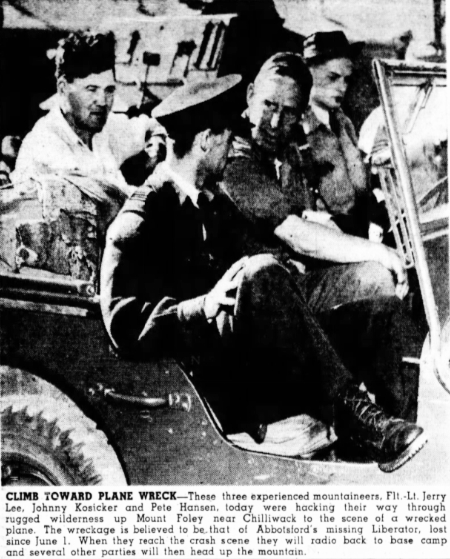
A ground party of three experienced mountaineers - Johnny Kosicker, Fit.-Lt. Jerry Lee, RCAF, and a civilian, Pete Henson - set off Sunday night on a tortuous ciilmb to the wreck scene. They went in from a base camp established at Ford Creek, about 15 miles up a deserted grade from Vedder Crossing.
OTHER PARTIES READY
Other large search parties are standing ready to go in when the three-man party radios back that it has reached the wreckage. A large RCAF party, guided by Seldon Bell, will leave this afternoon for Ford Creek to await word from the first party.
The first party goes without hope. Those who have seen the wreckage from the air say no one could have survived the crash.
NO SIGNS OF LIFE
The possibility that some may have bailed out before the crash provides a slim thread of hope, although even it is all but discounted.
No signs of life were seen around the wreckage. No parachutes were spotted by the air searchers.
The wreck scene is about 2000 feet south of the spot on Mount William Knight where a CPAL airliner crashed in December, 1942, killing 11 persons. Mt. William Knight is the third peak and Mt. Foley the fourth in the Cheam Range.
RCAF TAKES PHOTOS
The scattered wreckage of what is believed to be the lost Liberator was sighted first Saturday by an RCAF flier, F/O Roy C. Archer of Saskatoon. He was flying a Norseman out of Sea Island.
Earl Brett, veteran Chilliwack civilian pilot who has been aiding in the search, was taken aloft to make sure the RCAF had not mistaken CPAL wreckage for that of the bomber.
Service photographers took aerial shots of the whole area in hopes that some of the crew had bailed out before the ship plummeted into the mountain. However, they saw no signs of life.
TRAIL ALREADY MADE
Brett said the fuselage they spotted was at the 7400 foot level. Another 400 feet, he added, the plane could have cleared the craggy obstruction.
Brett thought ground parties would be able to use the same trail as they followed to get to the wreckage of CPA plane in July, 1943, and then go beyond it.
Scene of the wreck is about 20 airline miles from Chilliwack. Location of the wreckage, Brett said, indicates that the crashed plane was flying on a course from Abbotsford. That is why RCAF officials believe it is the lost Liberator, missing since June 1.
Squadron Leader D. G. Auld, chief signals officer, Boundary Bay bomber station, and a wireless air gunner, WO 1 Romeo Promovost were with F/O Archer when he sighted the wreckage. "It's in very bad country, the searchers can't make good time,"
Western Air Command said.
Brett said the plane must have hit the mountain head-on. "I think it blew up," he said. He saw no signs of life, but could not fly close enough to see any bodies.
Tuesday, June 19, 1945.
The Vancouver Sun

By BILL FLETCHER, Sun Staff Reporter
CHILLIWACK, June 19. - Whether plane wreckage strewn over the face of lofty Mt. Foley is that of the missing RCAF Liberator, which disappeared June 1 with a crew of 11 men, was expected to be established this afternoon when an RCAF Norseman flies over the Cheam Range, to make radio contact with a three-man search party.
The searchers are believed to have conquered the precipitous mountain and to have reached the scene of the wreckage, spread 3000 feet over the mountainside. Their goal was 400 feet from the tip of the peak, where fuselage of a plane lies at the brink of a gulley.
The Norseman flew over the range this morning but did not establish contact with the party. However, this afternoon it is felt certain that radio communication will be made.
RADIO TO BASE
At dusk Monday, the party radioed that it had reached the base of Mt. Foley where wreckage was discovered Saturday. RCAF planes took to the air to drop food and supplies to them.
At dawn today, the searchers started on the 1ast ieg of the journey. From the time the party left base, it faced back-breaking trail-riding and perilous mountain work. It climbed through some of the toughest mountain country in British Columbia.
In order to get some idea of what faced RCAF searchers and their civilian guides, I made the first 14 miles of the trip into the crash scene on Monday afternoon - to the advance RCAF base at Bowdenville. Six miles further along Chilliwack River Valley is Ford Creek, base camp from which the party set out.
ROAD BARRIERS
Riding a strange mountain horse - that seemed to know every step of the trail - and travelling light, I made the 14-mile return trip in just over six hours. It would probably take a day each way to reach the wreck and return to Ford Creek.
Roaring mountain streams - Chilliwack River and Slesse Creek - blocked a long-deserted railway grade to Chilliwack Lake at several points, resulting in long detours. Other delays are met where the trail has been washed out or old trestles have collapsed.
BOGS, CANYONS
Deep bogs along the route proved almost too much for the clever horses, veterans of many pack trains, through this rugged terrain.
Past the supply camp established at the junction of the Chilliwack and Tamahi Rivers, where ground parties concentrated their search last week, the trail is level and fairly easy going. Here army engineers from the Chilliwack camp are gradually
reconstructing a road. The route was formerly popular with sportsmen, riding the 20 miles into a fishermen's paradise - Chilliwack Lake. Now there are army pack trains, freighting supplies into the base camp.
CREEK IN FLOOD
Several miles along the base of Tamahi and other mountains in the range southeast of Chilliwack, the trail is broken by swollen Slesse Creek. This necessitates a two and a half mile detour that climbs more than 1000 feet over a logged-off and fire-scorched mountain. On the other side of this obstruction, veteran packer Ed Bell has built a bridge that crosses the 100-foot gorge of the Slesse.
Dense undergrowth, steep ascents and descents and clinging bog constantly impeded my progress. At Bowdenville, in the shadow of Elk Mountain, where three loggers said they heard a plane motor cut out on June 1, the day the Liberator disappeared, the
tortuous trail continues on to Ford Creek. High above on the left is the "graveyard of planes" - the snow-clad, precipitous Cheam Range.

Wednesday, June 20, 1945.
The Vancouver Sun

By Sun Staff Reporter
CHILLIWACK, June 20. - Snow sliding down the steep face of Mt. Foley today was adding to the perils of a three-man search party struggling towards plane wreckage spread 3000 feet over the near-precipitous side of the mountain. Low clouds and fog hid progress of the searchers as they crept toward the scene of the wreckage, believed to be that of an RCAF Liberator which disappeared with its 11-man RAF crew on June 1.
BAD WEATHER
The searchers were originally believed to have reached the scene about noon Tuesday, but radio contact with them Tuesday revealed they were forced back. "Returning to base camp... Try again" was the terse message radioed by the party at 5 p.m. Tuesday. It indicated that slides and fog had forced the veteran climbers to abandon their efforts and to return to the camp they established near the base of the peak of Mt. Foley on Monday. It indicated too that the searchers are determined to continue their fight against the elements and the mountain to reach the wreck.
Western Air Command maintained periodic radio contact with the party throughout Tuesday afternoon and evening, indicating that the weather and snow slides made movement too hazardous.
PLANE FORCED BACK
An RCAF Norseman took to the air about 9 a.m. today in an effort to get radio contact with the party, but the low-lying clouds forced it back to base.
In the meantime a threat of rain hung over the Ford Creek base camp, where a 20-man search party is standing by to go up Mt. Foley if their services are required.
Friday, June 22, 1945.
The Vancouver Daily Province
By LLOYD TURNER.
(Daily Province Staff Reporter.)
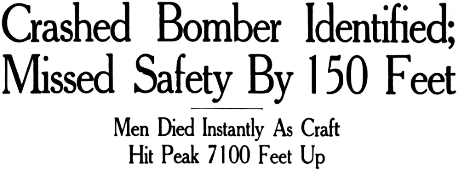
CHILLIWACK, June 22. - Bodies of three men who died when a Liberator crashed into Mt. Foley's peak on June 1 are still in the wrecked fuselage. Eight others are on the mountainside.
The plane hit with such force that the tail assembly was driven deep into the side of the hill. "There isn't a chance the men lived even a second after that crash."
The official three-man party which headed for Mt. Foley last Sunday returned to Chilliwack today after identifying the wreckage and a number of the R.A.F. crash victims.
One of the three, Johnny Kosikar, veteran climber and guide, told The Vancouver Daily Province: "One of the Liberator's four motors evidently exploded or burned. Part of the wreckage was charred. One body inside the plane was badly burned." He said that one body was found hundreds of feet from the wreck.
The wreckage is scattered over 3000 feet. "Three of the engines were found more than 1000 feet below the point where the Liberator first hit. The wings were torn from the aircraft, and thrown up the side of the mountain."
Mr. Kosikar said the plane struck at the 7100-foot level. "If the ship had been 150 feet higher it would have missed the mountain, and Mt. Foley is one of the highest peaks in the Cheam range. If it had been a short distance to elther side it would
have gone around the peak."
The men who went to the wreck scene with Kosikar were Flt.-Lt. Jerry Lee, R.C.A.F., and P. P. E. Henson, veteran climber who lives at 6369 McCleery, Vancouver.
Kosikar said the Liberator, which was on a routine cross-country flight from its Abbotsford base, was probably travelling between 225 and 240 miles per hour when it hit the mountain.
STARTED ROCKSLIDE.
"The crash started a rockslide and that carried a lot of the wreckage down the mountainside."
The veteran guide said that the climb to the wreckage was made over some of the most difficult terrain in all British Columbia. "In some of the valleys between peaks, we went through snowdrifts as deep as 40 feet. Overhanging clouds obscured our path at times."
The party started out last Sunday, going into the wilderness country to the old "Conchie" camp eight miles up Chilliwack River by auto. "From there we went by horseback 17 miles to Ford Creek, the base camp."
REAL CLIMB STARTS.
"Monday we started the real climb. We thought we were near the wreck, but clouds came down and we could not see. We came back and started out again on Tuesday. A short distance from the point where clouds forced us to stop the day before we found pieces of the wreck."
FOUND WHEEL.
"First thing was a wheel from the plane. It had rolled or was thrown at least 3000 feet. As we climbed we passed more wreckage, until at 7100 feet we found the main part. One wheel, thrown up the mountainside, had caught fire." Kosikar die not think any of the wreckage could be salvaged.
The three men arrived back in Chilliwack Thursday night, and reported immediately to Western Air Command.
It was rough country they travelled through, and full of cougar, bear and other game.
Two Liumpthin Creek loggers - Russell Thornton and George Fairclough - who got within a quarter of a mile of the wreck and returned to Chilliwack on Thursday, reported an encounter with a grizzly bear. Thornton shot at the bear five times, using a .30 calibre rifle. The shots had no apparent effect, but luckily the bear fled.
Western Air Command today issued this statement: "Wreckage on Mount Foley
has been identified as the Liberator lost from Abbotsford on June 1. There were no survivors. More detailed investigation will be made when snow and ice conditions on the mountain improve."
HUNT ENDED.
Thus ended one of the greatest aircraft hunts in the history of Canada. Scores of men and scores of aircraft took part in ground and air search for the missing Liberator from the day it crashed on Mount Foley until the wreckage was sighted last Saturday. Radio equipment, an army pack train, Bren gun carriers and horses were used at different stages of a search that at one time swung below the international border when an R.C.A.F. pilot thought he had sighted aircraft wreckage near Slesse Creek, a tributary of Chilliwack River.
Monday, June 25, 1945.
The Vancouver Daily Province

Saturday, July 7, 1945.
The Vancouver Sun

Three dynamite blasts roared through the lonely Cheam valleys and echoed from the lofty peaks.
Under a cloudless sky with heads bowed four mountaineers stood beside the ensign-covered rock-mound grave while a padre intoned the final words of the simple burial service.
Full military honors had been accorded the 11 RAF fliers who died instantly when their Liberator bomber crashed into the side of Mount Welch, 35 miles
southeast of Chilliwack, more than a month ago.
Their final resting place was marked by a plain white cross propped up with rocks on a 6600-foot high wind-swept crest between Mount Welch and Mount Still. A wreath of wild flowers, plucked from the valley, was laid at the foot of the cross.
MONTH AFTER CRASH
This was July 1, exactly one month from the day the Abbotsford bomber disappeared on a routine navigation exercise flight to Princeton and Revelstoke.
Conducting the burial service was Padre E. W. S. Gilbert, former Vancouver minister now with the chaplain service of Western Air Command.
The party was headed by S-L. G. H. "Gerry" Lee who conducted the search for the missing aircraft. Other members were Peter Hansen and Johnny Kosikar, civilian guides; and Cpl. Ken Austin, RCAF. S-L. Lee, Hansen and Kosiker comprised the first party to reach
the wrecked plane.
THANKS TO SEARCHERS
In the month of the search, aircraft flew nearly 100,000 miles in 672 hours. Three hundred and seventy-two sorties were flown. On the ground, 114 airmen and 40 civilians in addition to a large
number of army personnel aided in the search.
High praise for everyone who assisted in the hunt was voiced by Air Vice-Marshal F. V. Heakes, AOC Western Air Command. "There are so many it is impossible to thank each one personally, so I take this opportunity to commend all those who aided the RCAF in the difficult job we had." he said.
|

|
