The crash of Liberator KK-241, 1945
The story of Airplane Creek, BC
Dateline: December 24, 2024.
The document that follows is the diary of Padre E. W. S. Gilbert, an Anglican minister from Vancouver who in 1945 was with the chaplain service of Western Air Command, Royal Canadian Air Force. He went with the expedition that climbed to the wreckage of the Liberator bomber that had crashed on June 1st, to perform burial rites for the 11 men killed. The original source of the diary is not known, and we have so far only found three of the "innumerable photographs" shot during the expedition.
DIARE OF BURIAL ON MOUNT WELCH - RAF AIRMEN
Monday - June 25/45.
Picked up at home, 2830 West 8th Avenue, at 0900 hours by F/L Jerry Lee in an RCAF truck. Those in party included F/L Lee, Peter Hansen (civilian), Sgt. Maurice Bell (Reserve Army) and Cpl. Kenneth Austin (RCAF) and F/L Gilbert. When all were picked up, went to RCAF Station, Sea Island, to Air Sea Rescue Section where we were outfitted with a complete list, including sleeping bags, woolen underwear, dry-backs (coats), 6 to 8 pair of woolen socks, emergency rations, gloves, cork boots, pack sacks and pack board, two walkey-talkie radio and transmitter sets and tin mess kits.
Left Sea Island at 1120 hours byn Panel Truck to Chilliwack where F/L Lee contacted the coroner and made final arrangements with the Government officials to bury those 11 RAF lads involved in the mountain crash. We had lunch in Chilliwack at 1330 hours at a restaurant known as "Perk's Bar". We bought mentholatum and glacier cream in a nearby drug store to be used onn chapped lips, faces and hands.
Left Chilliwack at 1430 hours by the same panel truck for the R.C.E. Army camp about 6 miles out of Chilliwack. This camp is known as "A.6" and is the location for H.T. drivers of the RCAF where there is a jeep which followed us and later drove us up a logging trail through the mountains. Mr. Johnnie Kosikar, civilian, and professional mountain guide, was picke dup at A.6. Further rations were also picke dup at this camp.
Left A.6 Camp by panel truck and jeep at 1515 hours and followed a very poor road along the banks of the Vedder River to Tomahi Camp about 7 miles. The panel truck broke down in the middle of a huge 25 foot puddle caused by an over-swelling stream. Apparently water got into the distribution caps. Eventually the jeep which followed us, pushed us out of the stream. All luggage was then transferred to the jeep and some of us rode, and others walked the remaining two miles to Tomahi Camp. I rode on the board of the jeep. The RCAF driver of the panel truck (LAC Les Bird) was left with the panel to try and dry off the distribution caps, and get the motor started. We never saw the panel later as it never did reach Tomahi Camp.
Tomahi Camp is an Army Camp where there are 28 lads who work on the Road to keep it passable. We remained there only long enough for those who walked to catch up to us, then all transferred to either a Bren gun carrier or the two jeeps, one RCAF nd the other belonging to the Army. Nearly all the luggage was piled into the Bren gun carrier, and all but one in the party rode in the jeeps. For some 10 miles we rode along the worst road I have ever seen in all my life! It was formerly used by a logging train and for the most part the railroad ties had not been removed, only the tracks. One can imagine the beating those two jeeps took, to say nothing of the passengers! Most of us shook like victime sof St. Vitus Dance for an hour after we got out of the jeeps at Slesse Creek, the destination of the jeep trip. A bulldozer and about a dozen Army Engineers were working at intervals along the road, trying to keep it passable. Actually it was nothing more than a mountain trail, but they called it a road.
At Slesse Creek, where we arrived about 1645 hours, there were five Army personnel (RCE) in charge of 12 pack horses. Their camp consisted solely of a pice of 12' x 12' canvas strung up between the trees as covering. At this camp, we all transferred from the jeeps and Bren carrier to pack horses. We need eleven of them, one for each in our party, three for our luggage and gear, and two for the Army guides, one who led the party and one who followed in the rear. In this way we went over 10 mile sof rugged mountain trails, leaving Slesse Creek about 1715 hours. The trip itself was uneventful, though in spots was thrilling and exciting enough for one unaccustomed to riding horses on mountain trails and along the occasional sharp embankment and cliff side. The scenery was simply gorgeous and it was a lovely clear sunny day. We could see for miles in every direction, but alas it was the last of such days for six succeeding days. After riding on the pack trails for 2¼ hours until our posteriors and legs ached so much we could barely dismount, we arrived at our destination for our first day, a camp known as Ford Creek.
Ford Creek Camp was quite well set up, with one bell tent, a canvass covering over our supplies, a small canvass over the sleeping quarters. There were five RCAF men there, all heavily bearded, having been there for 10 days. We soon rustled up a most welcome venison stak dinner, which we all enjoyed immensely. After this, we bedded down in our sleeping bags about 2200 hours. What a full day it had been!
Tuesday - June 26
"Rise and shine it's 0600!" was the unwelcome shout of our leader, F/L Jerry Lee. After a real man-sized breakfast of porridge, bacon and eggs, bread and honey and coffee, we made up our packs on out pack boards and at 0800 hours we were on the trail, hiking with packs on our backs that varied in wright from 40 lbs. to 70 lbs. It would not be hard to guess who was carrying the 40 lb! For the first five miles the trail was good and there were few steep grades. The 5-minute rest periods were at regular half-hour intervals, and as three of the lads from Ford Creek camp wanted a bit of exercise they accompanied us for that first five miles and were willing to take turn carrying our packs.
The next five miles of our trip, however, were really terrific! At least for me, an inexperienced mountaineer. I puffed and grunted and sweated going up the continuous steep trail. It must have been at least 55 degree grade and lugging a 40 lb. pack on my back proved too much. When at last after seeing spots and various coloured rings before my eyes and falling exhausted on the trail the other fie in our gang realized that I was carrying far too heavy a pack for such a steep grade. They graciously offered to share abot 15 lbs. of it between them and I was only too willing to accept! From then on all went well and about 1700 hours we arrived at what we called "Base Camp". Base Camp proved to be a very satisfactory spot although there was absolutely nothing there, no shelter, no tables - absolutely nothing. It was just a shady spot under the massive pines, cedars and firs. However, one of the lads, Ken Austin, had brought a "pup" tent, well equipped with air mattresses, and it proved to be a very satisfactory dormitory for Ken, Maurice and myself. During the greater part of the night it rained very heavily and never stopped for four days! The other three lads slept in the open with no shelter all night.
Wednesday - June 27
After a rather restless night, we arose the next morning at 0600 hours. It was pouring with rain. Had a good breakfast of porridge, bacon, bread, honey and coffee. At 0800 we broke camp and set out with our packs and all our goods and chattels with the intention of establishing another camp near the wreck. For three hours in the pouring rain we climbed another steep ascent in all the twisted, tangled underbrush, the like of which I am sure could only be found in the jungles of Africa! We had not gone 100 yds. through all this wet foliage until we were drenched through to the skin. After three hours we were on the higher slopes of Baby Mundy. After a half hour bull session on our whereabouts, we came to two conclusions: one, that we had gone in the wrong direction, and two, that certainly there were no suitable spots for establishing another camp. The only obvious thing tom do was to retrace our steps and go back to the very spot we had left, namely, Base Camp. This, with very decided feelings of disappointment and most obvious actions, we did! About 1600 hours, wet to the skin, we plodded to the spot we had left at 0800 hours; we set up camp all over again. Fortunately Jerry Lee produced a bottle of rum, which had been supplied by the RCAF, so we all had a good hot rum before we sat down to our iron ration supper. A good roaring fore soon dried out our clothes, at least to some extent, as it was still raining very hard. About 2000 hours, three of our friends from Ford Creek camp arrived and what pleased us immensely was the fact that they came laden with fresh rations, including bread, 15 lbs. of beef steak, canned milk, oranges and a one pound carton of salt, which unfortunately broke open inn the lad's pack sack, and got nicely mixed up with the bread. But just the same we ate the bread! Not a crumb was wasted. All three lads stayed over night and slept in the open in sleeping bags.
Thursday - June 28
After the morning routine of breakfast and getting our hiking togs on, we bid adieu to our three Ford Creek friends and were just on the verge of starting up the nearby snow slide to the wreck, when an aircraft was heard overhead. It was impossible to see it on account of the clouds and fog. By the use of our walkey-talkie machine, we were able to talk to the aircraft, and Jerry Lee advised them of our list of supplies, which were at the RCAF Station, Sea Island, and which were to be dropped to us as soon as the weather cleared. That they said they would do, and left. About 1000 hours our party split up into two groups of three each. One was to up to the wreck and try to get the bodies out of the aircraft on the side of Mount Welch and ready for burial. The other party of three was to tryn to find a suitable grave site nearby. Both these projects of the two respective parties proved to be far greater problems than at first anticipated.
As we again climbed the steep ascent to Heaven to a height of 7100 feet via the snowslide, we found wreckage of the aircraft as well as portions of the occupants spread for 3000 feet down the mountain side. Here we would find a shoe with the foot still in it. Over there was a glove with a hand in it; further up the cliff there was a torso minus head, arms and one leg; still farther up there were portions of ribs, and thus it went as we made our way up the mountain. About all that was left of the aircraft at the actual scene of the wreckage was the fuselage and one of the four engines. There were only three whole bodies in the aircraft and portions of three others out of the original 11 RAF lads - the other five as aforesaid, were strewn in bits and pieces down the mountain side along with literally thousands of pieces of the aircraft, which had apparently exploded when it had hit the cliff at Mount Welch, about 150 feet from the top. When the machine exploded it blew a hole about 15 feet into the side of the solid rock. The 11 occupants were undecidedly killed instantly. It took a whole day to cut the six men out of the aircraft. A most gruesome job! The odor was terrific. they had been dead 28 days. At that high level we were in the clouds all day and vision was practically nil. The result was that the location of a suitable grave site was impossible to find. We all returned quite disappointed with our days' endeavour. After the routine of dinner, which included real beef steak, we went to bed, once again in the pouring rain.
Friday - June 29
What a night! Rain, Rain and more rain! In the morning it was so foggy we realized that it would be impossible to accomplish anything if we did go up the 7100 foot climb to the wreck - so it was unanimously agreed that we would stay around the camp. It again rained all day, and it was not until late evening that the fog showed signs of clearing. An aircraft droned overhead about 1900 hours and encouraged us with the message that they would try to drop supplies tomorrow. We were again running short of rations, but what worried us more was that we cold not start work on a grave until we had shovels, picks, dynamite and detonator caps and fuses.
The day passed quickly, even though we stayed around camp the whole day. Spent most of the time on a "Camp Improvement Programme". Built a table and seats so we could eat in comfort - cleaned up the camp, built a decent trail to the nearby creek (our water supply). We retired early.
Saturday - June 30
Up at 0600 hours and all left at 0800 for the 7100 foot climb, but me, as Jerry Lee detailed me to stay at the camp in case the aircraft came over with our supplies before they got back. It was a beautiful day. The sun was shining and the air clear as crystal. It was arranged that one walkie-talkie be left at the camp and one would be taken by the party on the climb. We broadcasted to each other every two hours, 10.00, 12.00, 2.00 and 4.00. At 1330 hours, sure enough, the aircraft loomed overhead with our supplies. It was the thrill of a lifetime for me to talk to the plane. I placed part of an old parachute on the snow slide as the target for the bundles which were to be dropped. Needless to say, they never ever came near the target - the nearest one was about 100 yards and the furthest one about half a mile away. All but one of the 12 bundles dropped in the nearby underbrush bordering the snow slide. Being alone it took me three hours to find 10 out of the 12 bundles. The remaining two we never did find. However, we had more than enough in the way of rations and luckily found all the necessary tools and equipment for digging the grave - shovels, picks dynamite, caps and fuses. When the other five in the party returned from their climb, they reported on an excellent grave site which we would prepare on the morrow. Retired at 2200 hours after another grand meal of beef steaks, tomatoes, peas, and for the first time in 6 days we saw sunshine and had a chance to hang our clothes and sleeping bags in the sun to dry out.
Sunday - July 1
This was the day we had been waiting and working for, the day of the burial Service. And what a gorgeous bright sunny day it proved to be. We arose at our regular hopur of 0600 hours and after breakfast, set out again to the 7100 foot climb equipped with our tools. I took the cross for the head of the grave which had been beautifully designed, painted and lettered at W.A.C. workshop. Also on this eventful burial day, Jerry Lee and I had our first shave in 7 days, using the bottom of a mess tin as a mirror! We all did our best to clean ourselves up a bit for the funeral Service. Before starting out on the last climb, Cpl. Ken Austin made a beautiful wreath of the wild flowers, ferns, moss and cedars which I helped him colect the night before. This we also took with us, along with an ensign which I brought with me, and of course I had my clerical collar. Johnnie Kosikar took the dynamite and a pick and Peter Hanson took the shovels and detonator caps. We made excellent time on this last trip up to the summit, doing it in just under four hours. En route we picked up bits and pieces of the remaining, scattered along the snow slide, and took them up in sacks which we had brought along for that purpose.
The grave site was the most beautiful spot, located in the saddle between Welch Mountain and Still Mountain, just near the scene of the crash. It was right at the sky line and one could look from this crest down either side of the mountain. It was literally the top of the world, at an elevation of 6930 feet as shown on our altimeter.
After completing the digging of the grave, we wrapped the remains of all the lads in parachutes which we salvaged from the aircraft and carefully lowered them into the tremendous grave. All 11 were buried together side by side - comrades on death as they had been in life as members of the crew of the fateful Liberator.
On the top of the grave, a great stone cairn was built in the head of which was set the standard Air Force Cross, which with black letters. As can be seen in the photographs, the ensign, the wreath, and other mountain flowers were placed.
The actual burial service was as solemn an occasion as I have ever witnessed. There were only five in the party at this time, as Maurice Bell had to return to his work in Vancouver and had left early in the morning. At the conclusion of the burial ceremony, the stillness and peacefulness of the mountain resounded with a military salute - not by the traditional firing party, but by three well-timed blasts of dynamite. The volleys echoed and re-echoed from every mountain side. It was a fitting conclusion to a very memorable burial ceremony. The Service took place at 1500 hours.
The remainder of the day, after taking innumerable photographs of the grave with three cameras, was spent in quietly meandering over the snow of the nearby mountain slopes pondering on the things we had seen and heard and watching the frolicking of two mountain goats.
Monday - July 2
Up at 0800 hours. Broke camp at 1200 hours and started the tedious 10 mile return hike to Ford Camp. Made the trip in rather good time, just over four hours. A grand meal of bacon and eggs, green peas, canned tomatoes, bread and butter, honey, jam, oranges and coffee awaited us at this camp, having been prepared by 4 of the lads who still waited our return. Spent the night here, and after such a rugged trip over snow, under trees, and over trees, up grades and down grades, over and through innumerable mountain creeks, none of us needed any rocking to get us to sleep.
Tuesday - July 3
Up at 0600 hours, broke camp (at Ford Creek). Left by pack horse at 1000 hours, using 21 horses in all. Arrived at Tomahi Creek at 1225 hours after 11-mile trip and transferred to jeeps and trucks returning via Slesse Creek Camp and A.6 Camp. Sorted out much of the gear and equipment to be left at A.6. Delivered much more gear to #5 OTU, Abbotsford en route to Vancouver - also 5 RCAF personnel to that unit. Left Abbotsford 1830 hours. Arrived at RCAF Station, Sea Island at 2015 hours. Turned in and checked off all afore-mentioned equipment at Air Sea Rescue Section. Arrived home at 2210 hours, very tired, but wouldn't have missed the trip and experience - as the boys say "for all the tea in China"!
 E. W. S. Gilbert, H/F/L
Chaplain (P) 1
Western Air Command
Vancouver, B.C.
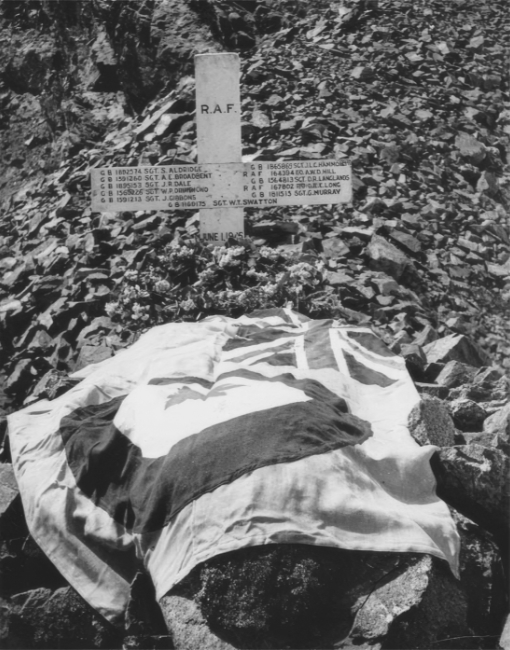
The RAF cross and ensign.
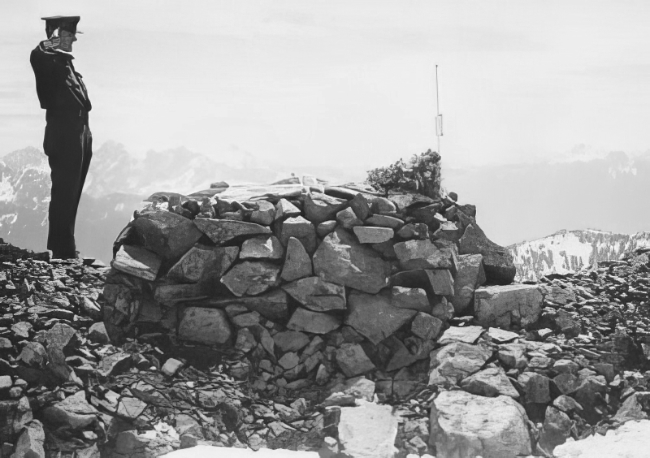
The final salute at the grave.
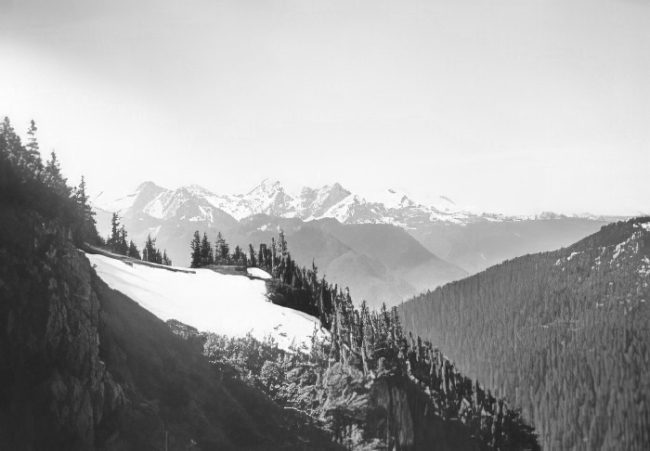
The view to the southeast from the burial site.








