Yukon's historic places
Dateline: January 27, 2026.
S.S. Klondike National Historic Site of Canada
Located beside the Yukon River, Whitehorse, Yukon
Formally Recognized: April 18, 2008
More information:
- S.S. Klondike National Historic Site: Parks Canada
- S.S. Klondike: a biography
S.S. Klondike National Historic Site of Canada is a large sternwheeler dry-docked on the bank of the Yukon River beside the Robert Campbell Bridge in Whitehorse, Yukon.
Heritage Value
The S.S. Klondike was designated a national historic site of Canada:
- to commemorate inland water transportation in the Yukon;
- to represent Yukon steamers and other vessels.
The heritage value of the S.S. Klondike resides in its completeness and legibility as a fast water shallow drafter sternwheeler steamer representative of the type of vessel built for Yukon water transportation. The S.S. Klondike was built by the British Navigation Co, launched in 1937 and operated as a freight and passenger vessel on the Yukon river until 1955, when she retired. Commercial navigation ceased on the Yukon River in 1957. The S.S. Klondike has been restored by Parks Canada to the 1937-1940 period ship and is now open for public visitation.
Sources: Historic Sites and Monuments Board of Canada, Minutes, 1962: Commemorative Integrity Statement, 7 July 1997.
Character-Defining Elements
Key elements of this site include:
- the completeness of its hull, superstructure, propulsion and auxiliary systems;
- the physical integrity of the vessel as defined by its original massing, hull construction and design, particularly as it was adapted for silver-lead ore transportation;
- the quality of the vessel's construction and its components, in particular its structural framing, mechanical systems and its well-executed carved planking;
- the surviving unity of the original vessel and its equipment, in particular its original surface materials and the details of its appearance as defined by its original colour and exterior elements (lifeboats, meat and vegetable lockers, line, spars);
- the surviving original functional organization of its interior and exterior space;
- the visual link between the S.S. Klondike's final resting place and the Yukon River;
- the vessel's siting beside the Yukon River in Whitehorse.
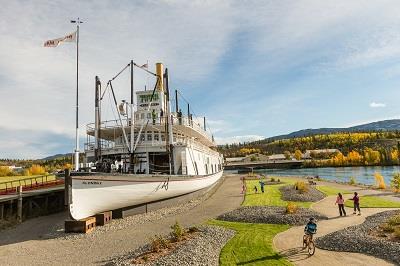
General view of the S.S. Klondike showing the quality of the vessel's construction and its components. Photo by Parks Canada.
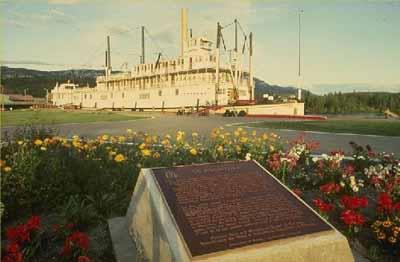
General view of the S.S. Klondike National Historic Site of Canada also showing the Historic Sites and Monuments Board of Canada plaque, 1982. Photo by Parks Canada.
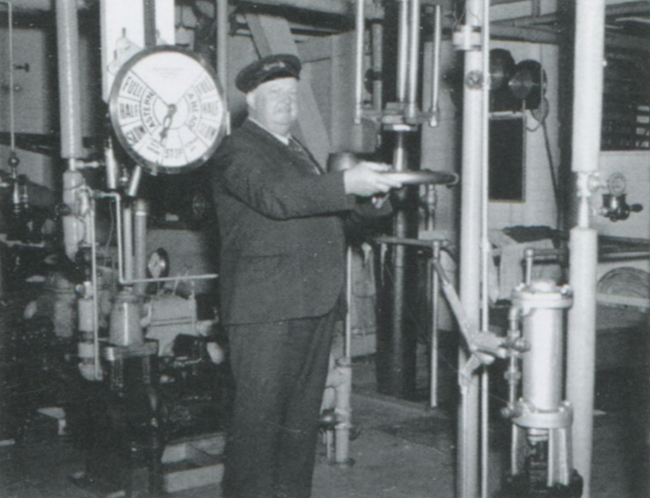
John Scotland, Chief Engineer on the S.S. Klondike from 1929 until 1944. Photo by Ian Ashdown.
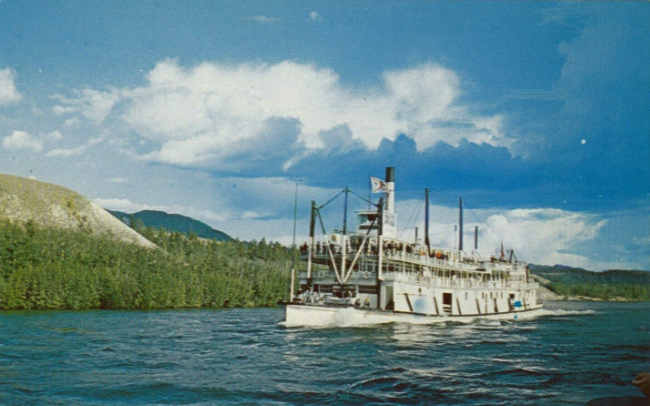
The S.S. Klondike on the Yukon River at Whitehorse. Postcard, 1954.
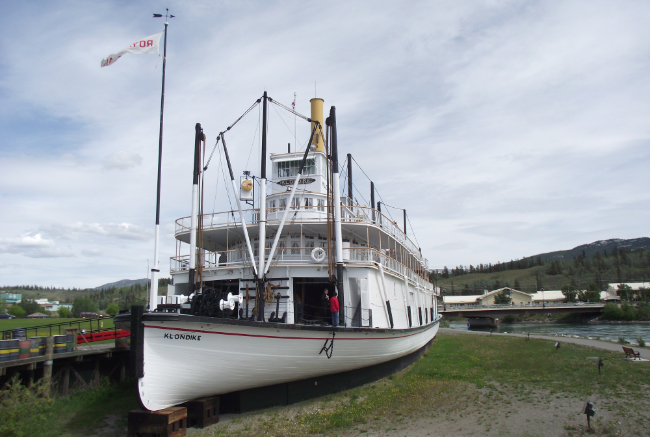
The S.S. Klondike on June 16, 2011. Photo by Murray Lundberg.
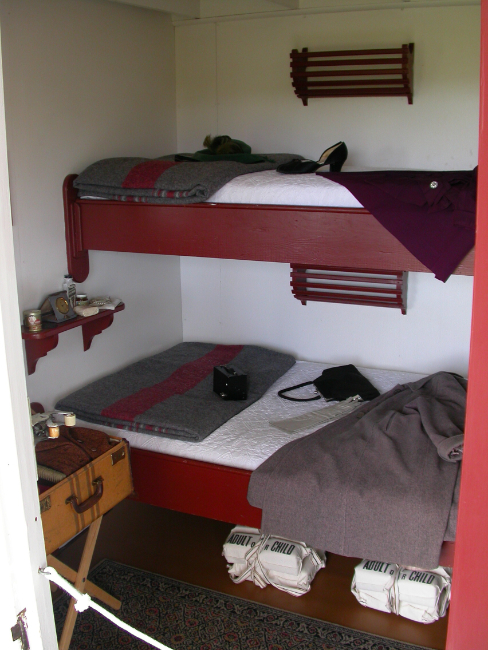
A stateroom on the S.S. Klondike on August 11, 2002. Photo by Murray Lundberg.
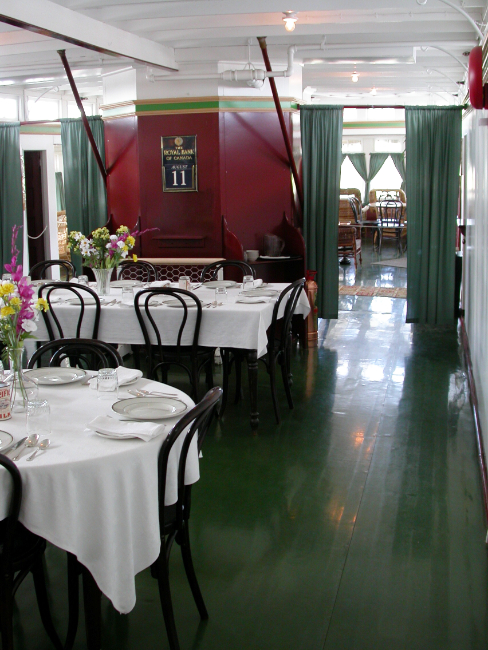
A corner of the dining room on the S.S. Klondike on August 11, 2002. Photo by Murray Lundberg.
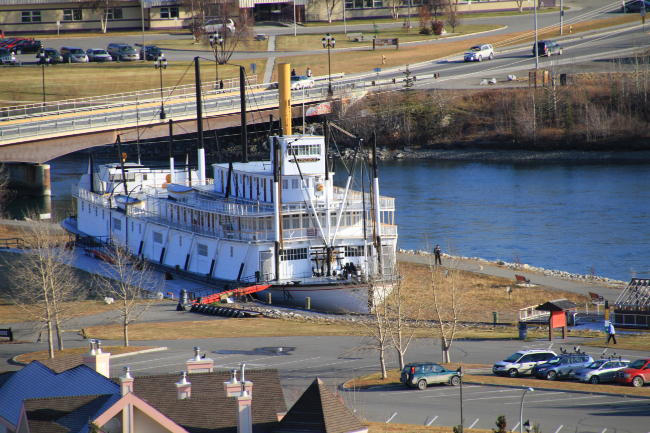
The S.S. Klondike from the top of the escarpment on October 17, 2011. Photo by Murray Lundberg.






