
|





|
|
The Polar Expedition Snow Tractor, 1926
Arctic & Northern Explorations

The photo above, captioned "Polar Expedition Snow Tractor at Nenana", seen on a wall of the museum at Atlin, BC, has no information about the bizarre machine, and sent us on a search for more information about it. It turned out to be an exceptionally interesting story.
First, the photograph itself was shot by Merl LaVoy (1886-1953), a very interesting character in his own right.
The snow tractors, designed by Armstead Snow Motors in 1924 and built in the Ford automobile factories, were chosen by Captain George Hubert Wilkins to transport gasoline for the airplanes to be used in the polar flights of his 1926 Detroit Arctic Expedition. Plans had been formulated too late for supplies to be taken to the expedition's base, Barrow, by ship, and it was felt the snow tractors, or snow motors, would be the solution. They failed, however, largely because of the deep, powdery snow common to interior Alaska, and enormous fuel consumption. Sled dog teams finally, after 63 incredibly difficult days, got enough fuel to Barrow to run some of the planned flights, but the expedition accomplished little.
The thirteen newspaper articles that follow were published in communities all over North America between May 28, 1925 and June 24, 1926.
The Battle Creek Enquirer (Battle Creek, Michigan) - May 28, 1925

(By the Associated Press)
Detroit, May 28. - Experiments in the Ford factories have resulted in the construction of a snow tractor capable of hauling heavy loads of logs, building of roads in snow bound regions and adapted to other heavy hauling demands in the northern sections of the country where transportation has long been a serious problem. Announcement of the completion of the experiments, with proof of the practicability of the new tractor, were presented at the annual meeting of the Detroit Aviation society here last night.
The tractor is mounted on large cylinders which propel it by a rotary
movement.
The tractor is the result of long months of experiment in the experimental laboratories here and is intended to solve the transportation problems in northern communities with especial adaptibility to lumber operations.
Moving pictures of the machine in action were presented showing the tractor operating over snowdrifts, hauling large loads of logs. The tractor weighs approximately two tons and is capable of drawing ten times its weight. It is flexible in movements and capable of mounting obstacles with great ease.
The Billings Gazette (Billings, Montana) - January 17, 1926
While polar explorers are engaging in a controversy over whether or not
Capt. George Wilkins will be able to use snow tractors for transporting his equipment north from Fairbanks, Alaska, over the mountains to Point Barrow for his projected transpolar flight, snow tractors of the kind are being used in the Cooke City mining district under snow and ice conditions not unlike those of the arctic to transport equipment for a 50-ton smelter the Glengarry Mining company is building six miles east of Cooke City to treat ores from the property the company is operating in that district.
Over Mountain Trails.
Dr. Simmons, secretary treasurer of the company, during his recent trip
from the district to his home in Miles City in company with a New York mill expert who has been preparing a report on progress of the smelter, told friends of results achieved in hauling the equipment from Gardiner, terminus of the Northern Pacific's Yellowstone Park branch line, to the smelter site.
Hundreds of tons of heavy machinery and smelter equipment, Dr. Simmons
said, are being transported over mountain roads and trails by use of a snow tractor in the face of conditions, which because of the high altitude and broken nature of the country, are probably as difficult as any encountered in the arctic. Drum-like wheels of the snow
tractor are equipped with steel worms that literally bore their way into snow and ice to find traction.
Ore Shows High Gold Values.
Assays of ore found in the new vein uncovered in the Glengarry property
are showing from $380 to $540 in gold to say nothing of high silver and copper values, according to Dr. Simmons, who has just received reports from assays of samples sent east, which show $32.80 to the ton in palladium, a metal of the platinum group.
The Glengarry company is a close corporation, securities of which are not offered to the public.
[Although this article was datelined January 28, it is obviously from about 3 weeks prior to that, and we have placed it in its proper chronological position]
The Minneapolis Morning Tribune (Minneapolis, Minnesota) - January 29, 1926
Copyright, 1926, by the North American Newspaper Alliance.
Seward, Alaska, Jan. 28. - The first section of the Wilkins polar flight expedition is already on its way northward across Alaska. It consists of the three units of "snow motors" - tractors mounted on revolving drums, which take the place of dogs as the motive power for long trains of loaded sledges across the snow. Two of the three snow motors will be used to carry across the Alaskan waste the 15 tons of airplane gasoline which Captain Wilkins will use on his flights over the unexplored polar sea. The third motor will be held in reserve at Fairbanks, where it will be used to clear a hop-off field for the Wilkins planes on their arrival next month.
Alaskans Are Surprised.
The snow motors had their first tests here, in the presence of a very skeptical audience of Alaskans. But all the doubting Thomases among the local population, who had been dubious that any mere "man-made contraption" could take the place of dogs for Alaskan travel, were immediately transformed into enthusiastic believers in the "iron malamute," as the Eskimos call the new machine.
The motors were officially christened at a formal ceremony in which Miss
Edith McIntosh of Seward, a 19-year-old "sourdough," had the honor of being the first native Alaskan to ride over the snow and be photographed.
At the close of the ceremony the three snow motors and their 10 giant double-ender sleds were loaded on the Alaskan railroad and started northward for Nenana, where they, will commence their 1,000-mile trek over the snow.
Dog Musher Challenges Machines.
All Seward turned out to bid the departing caravan good luck and god-speed. The commander of the snow motor's expedition, Malcolm Smith, is well known throughout Alaska, and just before his departure he received a challenge from Gunner Kaasan, famous dog musher, to race the snow motors caravan from Nenana to Fairbanks, the first leg of their over-snow journey.
Kaasan, despite his willingness to pit his dogs against the machines for this comparatively short distance, expressed his entire confidence in the reliability of the iron malamutes and volunteered to accompany Smith in any capacity on the journey from Fairbanks to Point Barrow.
The Border Cities Star (Windsor, Ontario) - January 19, 1926
JUNEAU, Alaska, Jan. 19. - The Alaska road commission reported today that a test made with a snow motor of the type to be used for hauling supplies for the Wilkins
Polar flight expedition proved the device unsatisfactory.
The test trip was made between Fairbanks and Birch Lake, on the Richardson highway, a distance of 58 miles. The machine left Fairbanks Jan. 11, with a load weighing three tons and arrived at Birch Lake, Jan. 11 with 800 pounds. It was necessary to discard the remainder of the load while enroute. The running time was 24 hours and 67 gallons of gasoline were consumed by the tractor.
This indicated that it would require more than four tons of fuel to operate two snow tractors from Nenana to Point Barrow with supplies, as planned by the Wilkins expedition, officials declared.
The Billings Gazette (Billings, Montana) - January 22, 1926
Fairbanks, Alaska, Jan. 21. - (AP) - For the second time in a week, snow tractors of the type to be used in transporting supplies for the Wilkins polar expedition were declared to be unable to cope with arctic conditions, when observers here Wednesday expressed the opinion that they were not practicable.
The motors were declared to be helpless on ice and bare ground which they will encounter in the wind-swept reaches of the interior.
The Alaska road commission reported Monday that a test made with one of the motors over a five-mile snow stretch proved them to be not useful.
Officials of the expedition have announced their intention of transporting supplies with the tractors from Nenana, near here, to Point Barrow, the farthest north settlement of Alaska.
The Minneapolis Sunday Tribune (Minneapolis, Minnesota) - February 7, 1926
Substitution of the snow motor for the husky, reported to have been successfully attempted by Captain George H. Wilkins in Alaska, brings disconcerting visions of the liveried musher "chauffing" the affluent tradesman across the northern wastes. If the "iron malemute" proves snow worthy, and if tractors, mounted on revolving
drums, bear the gear-shifting sourdough of the future across Alaska in six-cylindered
elegance, then is it time for a new Service to sing of brakes and bumpers.
Gunnar Kasson raced his huskies to Nome with diphtheria anti-toxin and thrilled a nation. May we not, in the future, look for some such prosaic news item as this: "Gunnar Kasson, accompanied by his chauffeur, rolled into Nome yesterday with a
case of anti-toxin tucked safely away in the tonneau of his new straight-eight snow
motor. A frozen radiator and a battered fender were unpleasant incidents in an otherwise uneventful journey. Mr. Kasson will leave for Washington shortly to urge a government subsidy for filling stations."
May not New York, once the husky is deposed, erect a statue of a snow motor in Central park with this inscription: "Dedicated to Skatterbolt, the faithful flivver of Gunnar Kasson, which dared rust, cold and carbon in the cylinders to bring anti-toxin to Nome in 1925." And may not Crankshaft, demon snow tractor of the cinema, sink its wheels into the villain's neck in the third reel, fastens its fenders in the villain's trousers in the seventh, and rattle to civilization with the unconscious heroine in the final spasm.
Progress, perhaps, but at what a price. The gasolined Gunnar. The brake-tested Balto, The stream-line Strongheart. The Tribune dog derby, a classic of hardware huskies.
Hail, hail to the "iron malemute." May he survive the movies and magazines, and may his spare parts ever strew the trail of faithful service in Alaska,
Dayton Daily News (Dayton, Ohio) - February 19, 1926
NENANA, Alaska, Feb. 19. (AP) - Fears were expressed here today that two snow motors traveling down the frozen Tanana river will break through the ice if they
continue journeying on the stream.
The snow motors pulling sledges of supplies for a transpolar airplane expedition of Capt. George H. Wilkins left Nenana a week ago on a 700-mile-trip to Point Barrow on the Arctic ocean. The party was 70 miles beyond Campbell's roadhouse foday, 40 miles from Nenana.
The Sun (Baltimore, Maryland) - February 26, 1926
(Copyright, 1926, by North American Newspaper Alliance.)
Nenana, Alaska, Feb. 25 (Special). - The wolf-faced Alaska sledge dog sat
patiently on his haunches today and waited his hour of triumph over his mechanical challengers, the Detroit-built snow motors, which swept out of Nenana two weeks ago seeking to carry the Detroit Arctic expedition's gasoline to Point Barrow, and, incidentally, to depose the husky as king of the North.
The freight carriers are at Tolovana, sixty-five miles from here. They have taken fourteen days and used 400 gallons of gasoline. The tractors have been repaired until spare parts are exhausted and now one of them is temporarily helpless for lack of a yoke casting
Virtual Defeat Admitted.
Gordon Scott, representative of the company which built the motors,
radioed today to Captain Wilkins, commander of the expedition:
"We can go ahead pulling these sleds by motor if we can obtain more front
castings and radiators. I think we could just about reach Point Barrow with our equipment, but we couldn't deposit any gasoline. We would burn up our gas load making the trip."
Desperate Fight Made To Win.
Malcolm Smith, veteran Alaska explorer who commands the snow-motor train, drove his team of Siberian huskies sixty-five miles yesterday in order to join Captain Wilkins here. Smith showed bodily signs of a desperate fight in behalf of the mechanical "malamutes" which he has been trying to drive to the Arctic Sea. He has lost sixteen pounds in two weeks on the trail.
"Smith said he was certain the motors could not reach Barrow in time for the proposed airplane flights over the polar sea. He urged Captain Wilkins to send the members of the snow-motors division to Barrow by dog team and to freight the load of gasoline by airplane."
The Daily Oklahoman (Oklahoma City, Oklahoma) - February 27, 1926
By Palmer Hutchinson
Special correspondent to The Daily Oklahoman
and the North American Newspaper Alliance. Copyright, 1926)
FAIRBANKS, Alaska, Feb. 26. - With orders to leave at Tolovana, thew snow motor train of sleds loaded with gasoline, and to push on by dog team to Point Barrow, 900 miles north, to establish the base for the Wilkins trans-polar flight part, A. Malcolm Smith left here friday for Tolovana.
The gasoline will be picked up by the planes departing from here, the
lender of the expedition's supply division was told by Capt. George H. Wilkins, commander.
At Tolovana, it is reported, there is a long, smooth straightway on the
ice of the Tanana river. Captain Wilkins is planning to use this ice track as a landing field, whence one of the two monoplanes can freight the 2,600 gallons of gasoline to the advance base at Polnt Barrow.
On his arrival at Tolovana, sixty-five miles from here, Smith and the
six men of the snow motors division he left there will work at top speed preparing for his leng sledge trip.
Camera Man To Go
He will carry supplies, photographic equipment, and instruments for taking weather observations.
He will be accompanied by Earl Rossman, experienced arctic photographer, who is camera man of the expedition and special correspondent of the North American Newspaper Alliance, and by either one or two other men.
Smith wilh take two or three fast dog teams, in addition to his own gray
Siberians.
He must travel more than thirty miles a day in his dog caravan to
reach Barrow before the date set for the arrival of the expedition's airplanes.
The veteran trail blazer told Capain Wilkins he would drive his men
and dogs from twelve to sixteen hours a day in a desperate effort to make up time which the ill-fated mechanical malamutes lost while working their way down the Tanana river from Nenana to Tolovana.
Mushers Are Happy
The decision to abandon the snow notors was made after Gordon Scott,
representative of the company which built them, reported to Captain Wilkins by radio from Tolovana that the motor caravan could not reach Point Barrow and deposit gasoline.
The decision was hailed by old-time mushers here as a triumph for the
sledge dog.
It gave them a chance to burnish up the crown which the north country husky has worn so many years. But in spite of the fact that the snow motors have been abandoned, Captain Wilkins said Friday that he is not at all certain that the sledge dogs won a lasting victory.
The motors hauled a load of fifteen tons a distance of sixty-five miles.
The standard dog-stedge load is 500 pounds, thus sixty dog teams would
have been required to do the same work. The constructional features which proved to be points of weakness can, and doubtless will, be changed to satisfy Alaskan conditions. If they are, the dog still must look to his laurels.
Fliers Test Clothes
The members of the expedition flyng division spent Thursday preparing
the Fairbanks airplane hangar for assembly work and unloading the fuselage and wings of the larger of their two monoplanes from the freight cars of the Alaskan railroad.
The temperature was 40 below the previous night, and well below zero all
day. In the forenoon, the men wore their light summer underwear and ordinary street suits and overcoats while at work and scoffed at the cold weather of the north.
At noon, however, some of them unboxed a shipment fron Nome of reindeer parkas, seal-hide mukluks, bear skin mittens and caribou pants.
Then they appeared in the streets of Fairbanks dressed like Eskimos. Except Captain Wilkins, none of the fliers or mechanics had been in the arctic. All were eager to test their arctic clothing, but all agreed that they were comfortable in their street clothes and that 10 to 20 below in central Alaska is no colder than 10 to 12 above in New York or Michigan.
The Progress (Pomona, California) - March 9, 1926
(Special to The Progress)
LOS ANGELES, March 9. - California is to have the most vital share in the great aerial Arctic exedition which starts the latter part of this month into the ice-
bound north to plant the Stars and Stripes on uncharted land in the desolate polar seas. For it was to this state and one of its major products, a product most essential in a 1900-mile non-stop airplant flight, that engineers of the Detroit Arctic expedition turned when they laid their exploration plans.
That California product was gasoline!
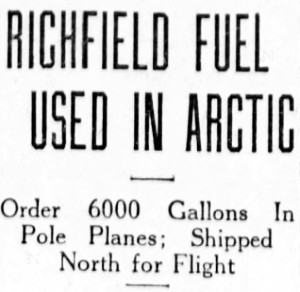
First disclosure that the all-important fuel which will power the polar planes is the celebrated Richfield "gasoline of power," famous for its victories on the speedways of Europe and America, came today when C. M. Fuller, president of the Richfield Oil company, made public correspondence with H. G. McCarrell, assistant manager of the
expedition.
McCarrell, ordering immediate shipment of 6000 gallons of Richfield to be delivered to Captain George Hubert Wilkins, commander of the flight, which starts from
Point Barrow, on the Arctic ocean, stated:
"After an exhaustive study of the various gasolines available, we selected your product as the most suitable for our purpose. Captain Wilkins will keep you informed as to results obtained from your fuel during the flight."
The gasoline was rushed by the Richfield company by boat and rail to Nenana, Alaska. Thence it was taken by snow tractor to Tolovana, Alaska, 900 miles from the hopping off point. It will be freighted by monoplane from Tolovana to Point Barrow.
The expedition, conjointly backed by the National Geographical society, Detroit Aviation society and the North American Newspaper Alliance, has the backing of such men as Edsel Ford, William E. Scripps, William B. Mayo and other prominent Detroiters, and the written endorsement of President Coolidge.
The purpose of Captain Wilkins and his party is to discover new lands, if possible, and to occupy them for the U. S. A. They will also seek to locate and photograph
the so-called "ice pole."
El Paso Herald (El Paso, Texas) - March 13, 1926

PHOTO shows the snow motors trying to make their way to Point Barrow with supplies for the Wilkins polar flight. The motors had to be abandoned and the explorers had to fall back upon the use of dog teams.
Editor's Note: Efforts of the arctic flyers to haul supplies to their base at Point Barrow with snow motors have had to be abandoned and dog teams are now being used. The following article tells of some of the difficulties encountered by the motors.
By EARL ROSSMAN.
Special Correspondent of The Herald and North American Newspaper Alliance.
FIELD Radio Station of Detroit Arctic Expedition, Tanana River, Alaska, (By Radio to Nenana, Alaska), March 13 (SP) - The Wilkins snow motors, tractors mounted on huge revolving cylinders for use over snow and ice, found that Alaska offered them a tougher test than anything they encountered in the Rocky mountains, the Alps or Norway.
Honeycomb ice, hummocks and drifts of snow like granulated sugar are the obstacles that gave trouble to the motor caravan.
Thirteen hours and 56 gallons of gasoline were required for the first 17 miles. The sand-like snow, 14 to 16 inches deep on top of the ice hummocks, gave the motors little chance for traction, and it was necessary to split the train of 10 sledges into four sections instead of two.
Chop Through Ice.
One motor, drawing two sleds, went ahead and broke trail, followed by the other motor with three sledges. In this way the loads were relayed five times. For water to cool the boiling radiators, the drivers bad to chop through four feet of ice.
At Retchover, commander A. Malcolm Smith ordered five sledges, carrying gasoline, temporarily abandoned. The regular trail being too narrow, the party was obliged to remain on the river, breaking its own trail.
Despite the hardship and the slow going, the mechanics were not discouraged and took their troubles lightly.
Casting Broken.
For the third time since leaving Nenana, a main casting on one of the motors was fractured in taking a sharp drop along the river bank, and had to be replaced from the spare parts supply.
After this accident, commander Smith decided to lead the way in his dog team, breaking trail for the motor train. The days are so short in this latitude that much of the hauling had to be done in semi-darkness. Night falls at about 4:30 in the afternoon.
The nights were spent encamped along the trail, under the gleaming stars and the continuous display of a brilliant aurora borealis. One member of the crew remained on watch throughout the night, keeping a log fire going underneath the tractors - (Copyright 1926 by North American Newspaper Alliance).
The Keyport Enterprise (Keyport, New Jersey) - April 15, 1926

Mrs. Charles Coles, of Beers street has just received a letter from her
brother, O. J. Sivewright, who lives in Hot Springs, Alaska. He refers to the Wilkins polar expedition being on the trail near his place with their outfit, being hauled with snow tractors. He says they were unable to make the trail such as is prevalent in Alaska, being over a month in making 120 miles and were unable to get any further, "I had a team of eight trained dogs and as that is the only successful way they could get through they had to turn to dogs, so I sold my dogs and sled and am now thinking of going outside for a visit this year," meaning that he intends making a visit to New Jersey. Mr. Sivewright has
been in Alaska 22 years prospecting for gold. He is now in the government mail service.
Reports of the snow tractors now end, except for a lengthy expedition report which we have posted on a separate page, "The 1926 Detroit Arctic Expedition".
|

|
