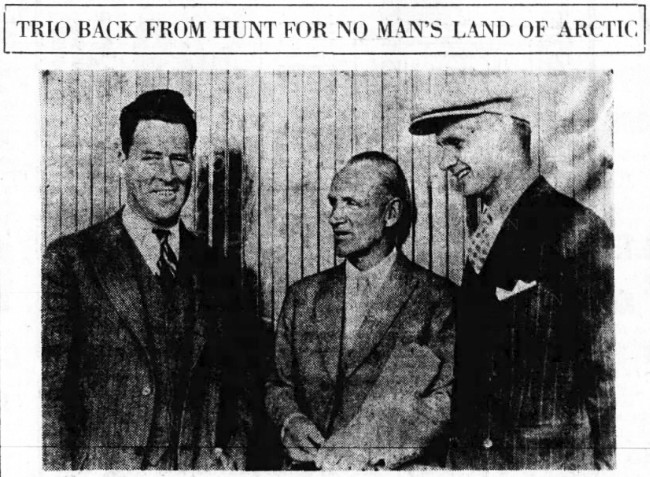
Three Arctic explorers, Major T. G. Lanphir, Lieutenant C. M. Wisely
and A. Malcolm Smith, members of Capt. George H. Wilkins party at Point Barrow, passed through Butte this morning on the Milwaukee bound for Detroit.
Captain Wilkins has remained at Point Barrow to supervise the dismantling of the planes.
The opinion was expressed by the exploring party that another attempt
will be made next spring. April and May are the best months for flights. The fogs form in May and continue to September when the temperature drops.
Three weather-beaten men, bare headed and showing in every movement the invigorating influence of the Arctic cold, swung off the train as the cars backed into the depot. Lanphir, a man of early middie age, tanned to the color of bronze, Smith, gray headed and a veteran sour-dough but of a lighter-tan, and Wisely looking little more than a boy but with six years of naval service to his credit.
Another Flight.
"We are going back to see about another flight." Major Lanphier said. "Gas difficulties interfered with the success of the expedition. Benefit of the attempt? We didn't accomplish much but we enjoyed the experience."
Major Lanphier in discussing the abandonment of the flights said that
following the failure of the snow motor and the dog teams to convey the gas, an effort was made to move it by airplane. This was found impractical also. It necessitated flying over
a mountain chain 9,000 feet in height with no landings in case of emergency. These conditions made it impossible to carry any worth-while amount of freight.
The expedition, the major explained, was undertaken for economic and
military reasons - to discover any land in the unexplored area, to assure the claims of the United States to such land and to exploit the resources, if any exist. Such land might
also be valuable in developing a "cross the polar regions" airplane route. There are a number of reasons for believing that such lands exist, Major Lanphier said.
The Wilkins expedition was "covered" by the North American Newspaper Alliance of which the Standard is the only member in this locality. The Standard presented dispatches from the expedition throughout its efforts in the far north. It was through the
North American Newspaper Alliance representatives with the Wilkins expedition at Point Barrow, Alaska that the information was given the world that Amundsen had successfully navigated the polar regions and had reached Alaska. Again the Alliance representatives flashed the word to the world that Amundsen and the Norge had landed at Teller. The Standard, together with other North American Alliance newspapers, was the first to bring this information to the public.
The Man with the Dogs.
A. Malcolm Smith in the brief interval of the train stop sketched conditions and hardships that indicated anything but a pleasant experience for the Wilkins party.
Smith had charge of the dog teams. He has lived in the Arctic 48 years
having gone in as a member of the Hudson's Bay company staff and is said to have a better knowledge of the Arctic country than any other man in Alaska.
"We had 68 dogs when we started," Mr. Smith said, "and only 15 when we
came out. What became of the others? We killed them and fed them to the other dogs to keep some of the team from starving to death."
There were many difficulties to overcome, Malcolm Smith said. "We had pretty tough going. We had 26 dogs hitched to a sled with four men on snowshoes accompanying them and six men pushing, yet we made only four miles an hour. On two
occasions we ran out of food, once for 20 days and once for 10 days. How did we manage? Why, we 'lived on the country,' to be sure."
What a Difference.
The airplane, Smith said, is destined to work some changes in the northland notwithstanding the fact that there are only two months of good flying weather.
"In 1914," he said, "I took a boat in over the route between Nenana
and Point Barrow. It took me 11 months. Recently I went over the route with a dog team. It took me four months. More recently still I came over the same trail in an airplane. It took me six hours."
Smith, Major Lanphier and Lieutenant Wisely stated, is the discoverer
of the naval oil reserve in Alaska.
"There are two seeping basins on this reserve," they said, "one ten and
one-half acres in size and the other seven and one-quarter acres. These are the two largest seepage basins in the world."
The naval reserve oll dome, they said, extends for more than 900 miles
in Alaska and shows again in Siberia.
"The snow tractor," the explorers remarked, it is all right so far as covering the ground is concerned, but it burns too much gas.
"We found that it burned as much as it hauled and were compelled to
fall back on dogs," they stated.
The suggestion was voiced that the tractor might be improved to a point
where it would render real service in Alaska.
"We were four months getting in gas," they stated. "The result was
that before we were ready for extensive explorations the visibility was so low that flying was impracticable. There were some breakages which also delayed us."
Notwithstanding the obstacles encountered and the hardships experienced the three are eager to return to the frozen north for another try at the "terra incognita" of the North Pole.