An Explorer's Guide to Whitehorse, Yukon
Dateline: August 5, 2024.
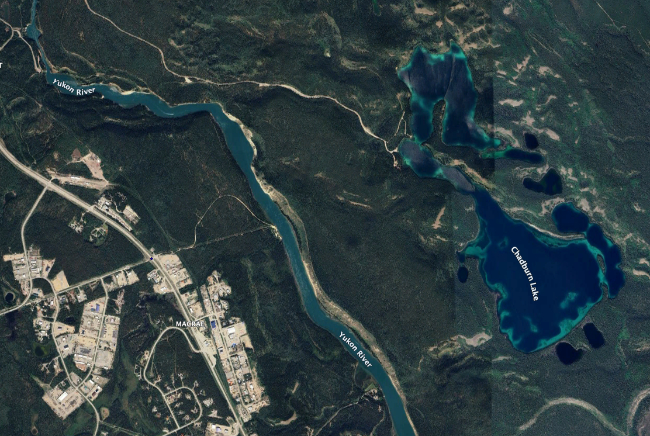
Chadburn Lake is a recreational lake located in a wilderness area near the southeast corner of the City of Whitehorse. It is accessed via the gravel 7-kilometer-long Chadburn Lake Road, which leads from the southwest corner of the Riverdale residential area. The road was built in July 1962.
The lake was named for World War II fighter ace Lloyd Vernon "Chad" Chadburn. He had no connection to the Yukon, but naming places after war heroes was common across Canada at the time. We don't know exactly when the lake was named - it just suddenly started showing up in newspaper articles in March 1962.
Lloyd Vernon Chadburn was born in Montreal but grew up in Aurora, Ontario. He was turned down when he initially tried to enlist in the RCAF in 1939 at the age of 19. In April 1940, he was finally accepted as an Air Gunner, and shortly thereafter, he was reassigned for pilot training. He received his wings in October at No. 2 Service Flying Training School at Uplands.

In November 1940, Chadburn was commissioned as a pilot officer, and went overseas to 2 Fighter Squadron (RCAF) at Digby, Lincolnshire. When the RCAF flew its first complete squadron in action over Boulogne in April 1941, Chadburn was there. He then joined RAF Spitfire 19 Squadron, patrolling over the North Sea.
The photo to the right, published in The Winnipeg Tribune on October 13, 1942 (and several other newspapers in the following week), was captioned "Squadron Leader Lloyd Vernon Chadburn, D.F.C., of Aurora, Ont., who commands squadron of Spitfires."
By February 1942 he was Squadron Leader of 416 Squadron (the "City of Oshawa" Squadron), flying RCAF Spitfires. During that service, one of 416 Squadron's primary missions was to escort USAF B-26 Marauders as they launched repeated attacks on coastal installations and enemy airfields. Amazingly, in 60 missions escorting the bombers, only a single Marauder was lost to enemy fighters. In 1943, in recognition of the safe passage the squadron had provided to the bombers, the American crews nicknamed it "The Angel Squadron".
On May 20, 1943,in the armories at Oshawa, Ontario, colours were presented to the 151 "Lloyd Chadburn" Squadron of the Air Cadet League of Canada.
In May 1943 Chadburn became one of the youngest Wing Commanders in the RCAF when he took command of No. 127 Wing, which included 403, 421 and 416 Squadrons. Their primary targets were trains, airfields and road transport. These low-level attacks resulted in heavy casualties. On May 21, though, Chadburn led his men in the destruction of 13 trains in the morning, 5 more later in the day, plus 9 German trucks and army buses, 2 despatch riders and a staff car. The next day the squadron shot down 5 aircraft and damaged 10 more trains.
On June 13, 1944, Chadburn's luck ran out. He was killed in a mid-air collision with another Spitfire at 12,000 feet near Caen, France, while leading his wing on a mission. He was 24 years old.
Chadburn was credited with over 14 enemy aircraft kills, two German E-Boats sunk, two German E-Boats damaged, and a destroyer damaged. For his valiant actions, Wing Commander Chadburn was awarded the Distinguished Flying Cross, the Distinguished Service Order and Bar, the French Croix de Guerre avec Palme, and made a Chevalier (Knight) in the French Legion of Honour.
The photo below appeared in the Toronto Daily Star on January 9, 1943.

Chadburn Lake in the middle, Canyon Mountain at the upper left (usually called Grey Mountain locally), and the Yukon River flowing from right to left across the bottom.

Clicking on the aerial view of the Chadburn Lake area below will open an interactive map
at Google Maps, in a new window.