An Explorer's Guide to Watson Lake, Yukon
Dateline: February 8, 2025.
This memorial is located at the Watson Lake Airport, on a large grassy area near the shore of the lake southeast of the large World War II hangar. It honours three men who died in separate military plane crashes near Watson Lake while serving with the Winter Experimental Establishment, a joint British-Canadian program which was conducting cold-weather testing of British designed and built aircraft between 1947 and 1951.
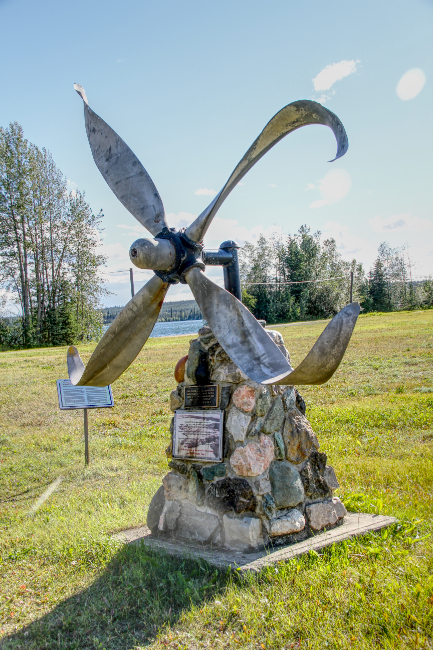
The propeller is from the Avro Lincoln bomber which crashed into Watson Lake on November 10, 1948.
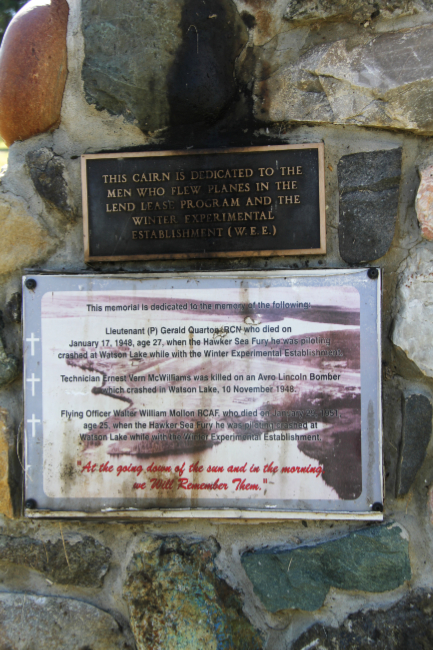
This memorial is dedicated to the men who flew planes in the Lend Lease program and the Winter Experimental Establishment (W.E.E.).
This memorial is dedicated to the memory of the following:
Lieutenant (P) Gerald Quarton, RCN,who died on January 17, 1948, age 27, when the Hawker Sea Fury he was piloting crashed at Watson Lake while with the Winter Experimental Establishment.
Technician Vern McWilliams was killed on an Avro Lincoln Bomber which crashed in Watson Lake, 10 November 1948.
Flying Officer Walter William Mollon, RCAF, who died on January 29, 1951, age 25, when the Hawker Sea Fury he was piloting crashed at Watson Lake while with the Winter Experimental Establishment.
"At the going down of the sun and in the morning, we Wil Remember Them."
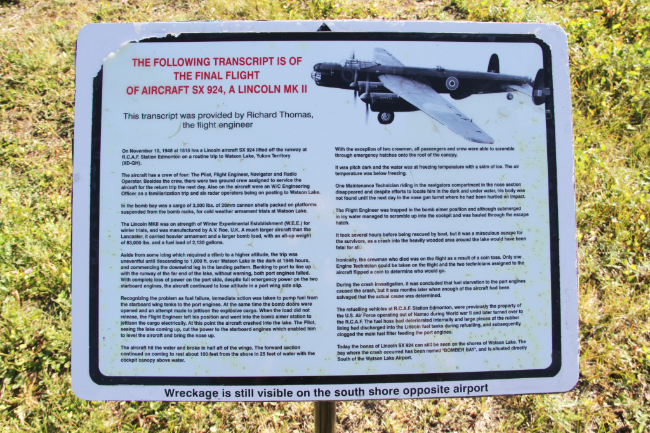
The following transcript is of the final flight of aircraft SX 924, a Lincoln Mk II.
This transcript was provided by Richard Thomas, the flight engineer.
On November 10, 1948 at 1515 hrs Lincoln aircraft SX 924 lifted off the runway at R.C.A.F. Station Edmonton on a routine trip to Watson Lake, Yukon Territory (XD-QH).
The aircraft has a crew of four: The Pilot, Flight Engineer, Navigator and Radio Operator. Besides the crew, there were two ground crew assigned to service the
aircraft for the return trip the next day. Also on the aircraft were an W/C Engineering
Officer on a familiarization trip and six radar operators being on posting to Watson Lake.
In the bomb bay was a cargo of 3,000 lbs. of 20mm cannon shells packed on platforms suspended from the bomb racks, for cold weather armament trials at Watson Lake.
The Lincoln Mk II was on strength of Winter Experimental Establishment (W.E.E.) for winter trials, and was manufactured by A.V. Roe, U.K. A much larger aircraft than the Lancaster, it carried heavier armament and a larger bomb load, with an all-up weight of 83,000 Ibs. and a fuel load of 2,130 gallons.
Aside from some icing which required a climb to a higher altitude, the trip was uneventful until descending to 1,000 ft. over Watson Lake in the dark at 1945 hours, and commencing the downwind leg in the landing pattern. Banking to port to line up
with the runway at the far end of the lake, without warning, both port engines failed.
With complete loss of power on the port side, despite full emergency power on the two
starboard engines, the aircraft continued to lose altitude in a port wing side slip.
Recognizing the problem as fuel failure, immediate action was taken to pump fuel from the starboard wing tanks to the port engines. At the same time the bomb doors were opened and an attempt made to jettison the explosive cargo. When the load did not release, the Flight Engineer left his position and went into the bomb aimer station to
jettison the cargo electrically. At this point the aircraft crashed into the lake. The Pilot, seeing the lake coming up, cut the power to the starboard engines which enabled him to level the aircraft and bring the nose up.
The aircraft hit the water and broke in half aft of the wings. The forward section continued on coming to rest about 100 feet from the shore in 25 feet of water with the cockpit canopy above water.
With the exception of two crewmen, all passengers and crew were able to scramble through emergency hatches onto the roof of the canopy.
It was pitch dark and the water was at freezing temperature with a skim of ice. The air temperature was below freezing.
One Maintenance Technician riding in the navigators compartment in the nose section disappeared and despite efforts to locate him in the dark and under water, his body was not found until the next day in the nose gun turret where he had been hurtled on impact.
The Flight Engineer was trapped in the bomb aimer position and although submerged in icy water managed to scramble up into the cockpit and was hauled through the escape hatch.
It took several hours before being rescued by boat, but it was a miraculous escape for the survivors, as a crash into the heavily wooded area around the lake would have been fatal for all.
Ironically, the crewman who died was on the flight as a result of a coin toss. Only one Engine Technician could be taken on the flight and the two technicians assigned to the aircraft flipped a coin to determine who would go.
During the crash investigation, it was concluded that fuel starvation to the port engines caused the crash, but it was months later when enough of the aircraft had been salvaged that the actual cause was determined.
The refuelling vehicles at R.C.A.F. Station Edmonton, were previously the property of the U.S. Air Force operating out of Namao during World war Il and later turned over to the R.C.A.F. The fuel hose had deteriorated internally and large pieces of the rubber lining had discharged into the Lincoln fuel tanks during refuelling, and subsequently clogged the main fuel filter feeding the port engines.
Today the bones of Lincoln SX 924 can still be seen on the shores of Watson Lake, The bay where the crash occurred has been named "Bomber Bay", and is situated directly south of the Watson Lake Airport.
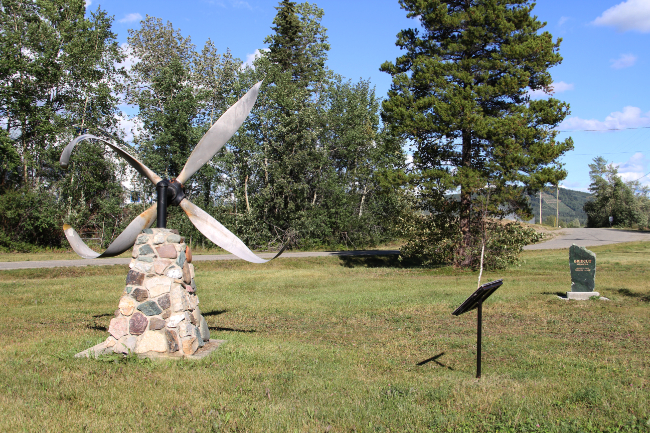
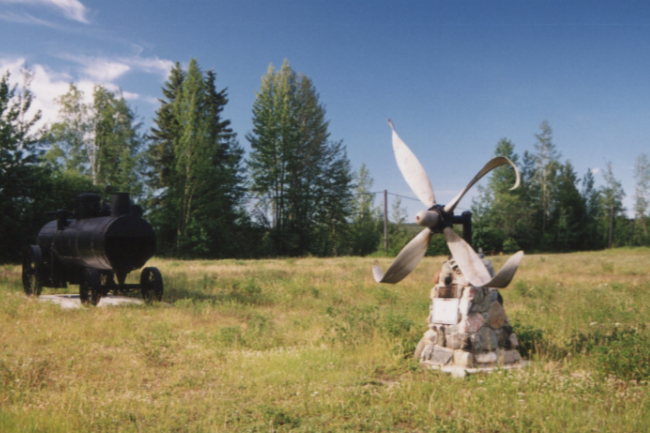
To the left of the memorial cairn is a stationary steam engine used during construction of the airport in 1940. It was donated by Katie Johnson.
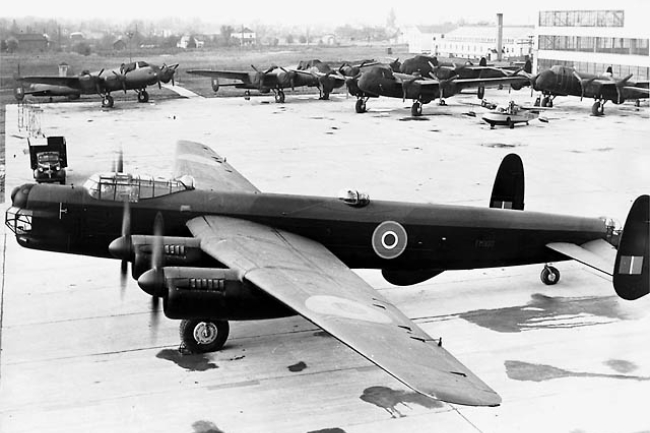
An Avro Lincoln. Read more at PlaneHistoria.
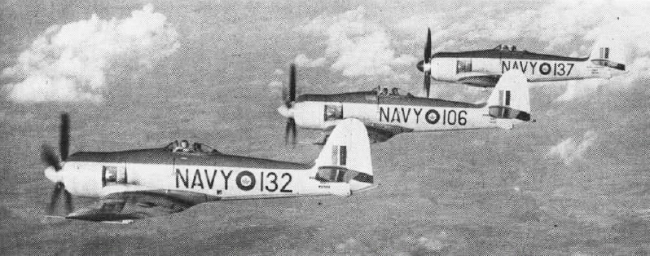
Hawker Sea Furies. Read more at PlaneHistoria.







