
Home Page | The ExploreNorth Blog | About ExploreNorth | Contact Us | Search
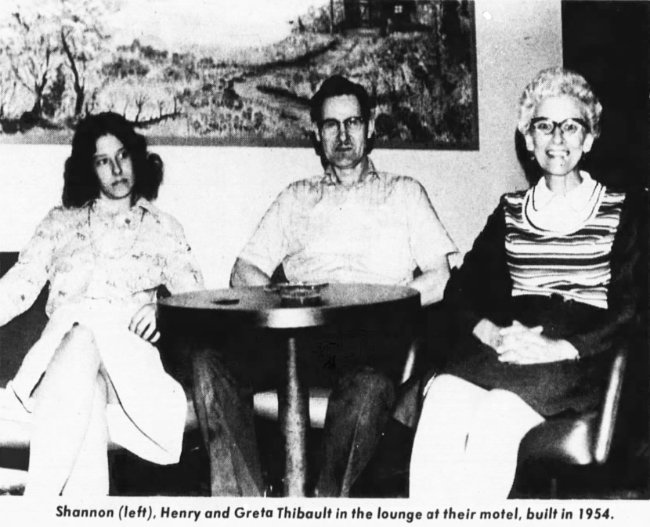
Henry and Gretta Thibault and the Shannon Motel, Whitehorse
The History of the Shannon Motel
Dateline: February 23, 2026.
The Whitehorse Star (Whitehorse, Yukon) - Wednesday, June 11, 1975

By Shirley Culpin
Star Reporter
Working in the Yukon's hospitality industry isn't a new thing for the family of Henry Thibault. Henry, his wife Gretta and daughter Shannon run the Shannon Motel here, the final adventure in what has been a long line of lifestyles and jobs since the man of the house's arrive in the North 40 years ago.
Thibault came to the Yukon on the heels of three of his uncles, who had climbed the Chilkoot pass in 1900 in the midst of the mad frenzy for gold. The trio,
however, never did get into mining - they ended up operating roadhouses in the North and
spent the rest of their working days here.
The young nephew who ventured north in 1935 did "a little bit of everything" at first to keep a roof over his head and food in his belly. "I did a little mining, got in to the timber business for a while," he recalls. "Even drove a cat for a bit."
Gretta, Irish-born and Vancouver-raised, came to the Yukon in 1941 as a teen-aged bride. She and Henry settled on Hunker Creek for a couple of years, where they had their first child.
"Henry built a cabin," Mrs. Thibault recalls. "I just loved it there - enjoyed every minute of it."
Having survived the depression and a couple of wicked winters, the Thibaults moved to Whitehorse in 1943. Mrs. Thibault and the couple's young son flew down, while Henry drove a cat train.
The young family arrived in Whitehorse only to discover there was no lumber. Not an easily-beaten man, Thibault went into the woods and eventually compiled a stack of two-by-fours by hewing them from local poplars. The first winter was spent in a
house constructed of those two-by-fours, Donnaconna board and tarpaper. Luckily, it was a mild winter.
Faced with the obstacle of making a living, the Thibaults set up a hand-wash laundry business in one half of their house. Bits and odds of other jobs were tossed in to keep the family financially afloat and by 1945 they had saved enough money to
open a dry cleaning business. That survived until 1954 when the Thibaults built the Shannon, named after their only daughter.
When the Thibaults first came to Whitehorse, Thibault recalls, there were only about 400 residents. "And there were only three hotels then - the old White Pass place, the Whitehorse Inn and the Regina. The old City Cafe was the full extent of our eating establishments."
There was moose hunting practically right out the back door, he says, and anything beyond Hanson Street was considered "gopher country."
Both of the Thibault boys have left home now - one is in Switzerland, where he goes to university and teaches, and the other lives in Chatham, Ont. Shannon is the only one to remain and between school years at university runs the new cocktail lounge at the motel.
Henry and his sprightly wife have no plans for leaving the Yukon. "Our roots are here," says Mrs. Thibault. "Even when we retire we'd like to stay. We'd like
to have the freedom to travel during the winter months, but remain here during the rest of the year. I certainly have no desire to leave."
Increasing numbers of people are becoming aware of the benefits the tourism industry is heaping upon the Yukon, and Henry agrees with the idea that it should be encouraged. "You've got to go along with progress, he says. "A lot of people up here resent that, but the tourists are actually very good for the territory - at least they aren't destructive. I have no doubt that we could do with a few more tourists up here."
And, Henry figures, the only way to get more tourists to the Yukon is to extend the season. "We could maybe start a month earlier, on May 1 instead of June 1," he says. "And the season could probably run until November without any problem. The season is just too short right now."
Biographical Notes:
There are errors in the newspaper biography above, starting with the spelling of Gretta's name - although we have corrected the error, the article was published with the
spelling "Greta."
February 14, 1941: "Henry Thibault, who worked on Yukon dredge No. 11 last summer, has
until recently been driving a "cat" at Powell River. He has now left for the Cariboo country."
February 25, 1944: "Henry Thibault was prosecuted under the Excise Act and the Liquor Ordinance for keeping liquor for sale and was fined $350." Home brew manufactured
by him was imbibed by the participants in a drunken brawl that resulted in the death of an 18-year-old First Nations girl when the tent-house she was in burned.
July 27, 1951: "Mr. Henry Thibault of the Capitol Cleaners departed on Pan Am on Monday on a business and pleasure trip to Ketchikan enroute to Prince Rupert B.C."
October 13, 1955: "Visitors in Dawson this past week included Mr. and Mrs. Henry
Thibault and their three children from Whitehorse. Mr. Thibault is owner of the Capitol Cleaners in that city. During their time in Dawson they are guests of Mr. Thibault's sisters, Mrs. John Dines Jr. and Mrs. Bill Scott."
April 12, 1956: At a meeting of Whitehorse City Council, "Query regarding building restrictions was received from Henry Thibault, owner of building in which Capital Cleaners is located on Jarvis Street. Mr. Thibault wishes to rent part of his building as office or apartment space but present fire bylaw prevents use of buildings for this purpose where dry cleaning is being done under certain conditions. Permission hinges on flash point of solvent used in the cleaning process. Mr. Thibault says he has not been able to obtain solvent of a sufficiently high flash point to come within the bylaw without becoming involved in expensive equipment changes. Matter will be looked into further by council."
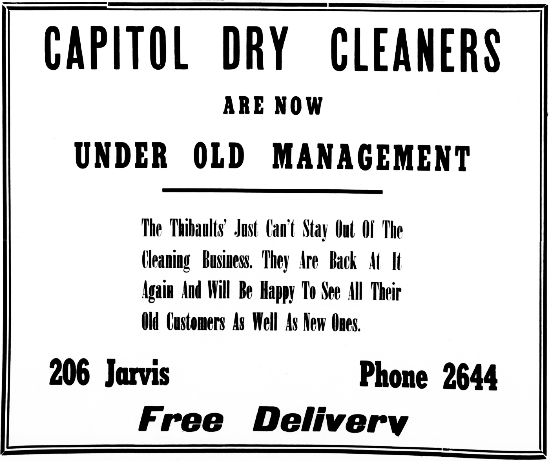
November 1, 1956 (The Whitehorse Star):
 December 20, 1956: "Card of Thanks. Henry and Gretta Thibault of Capitol Dry Cleaners wish to thank all their customers for their patience and cooperation during the recent
furnace trouble at the plant. They feel that it was not just the Christmas spirit but the
real kindness of the people of the Yukon."
December 1, 1960: "Fire Hits Plant. As far as they know, no clothing was destroyed in Monday's fire at Capitol Dry Cleaning plant, owner Henry Thibault said this week. He added
the plant would be out of operation for about a week. None of the dry cleaning equipment
was damaged as far as could be seen, Mr. Thibault added. He said all clothing at the plant would have to be re-cleaned to remove smoke. He asked any customers who have clothing in for cleaning to wait about a week before coming in. Everything should be back on schedule then."
December 8, 1960:
December 20, 1956: "Card of Thanks. Henry and Gretta Thibault of Capitol Dry Cleaners wish to thank all their customers for their patience and cooperation during the recent
furnace trouble at the plant. They feel that it was not just the Christmas spirit but the
real kindness of the people of the Yukon."
December 1, 1960: "Fire Hits Plant. As far as they know, no clothing was destroyed in Monday's fire at Capitol Dry Cleaning plant, owner Henry Thibault said this week. He added
the plant would be out of operation for about a week. None of the dry cleaning equipment
was damaged as far as could be seen, Mr. Thibault added. He said all clothing at the plant would have to be re-cleaned to remove smoke. He asked any customers who have clothing in for cleaning to wait about a week before coming in. Everything should be back on schedule then."
December 8, 1960:
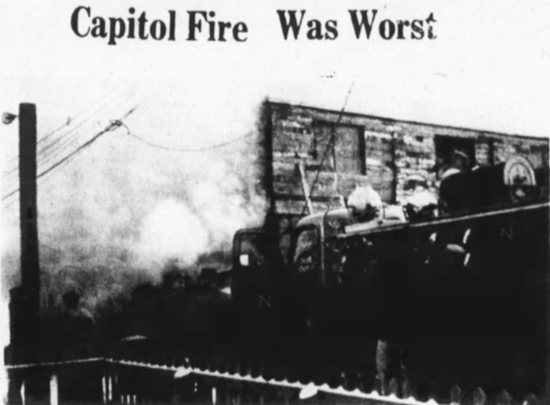
Most serious fire of the past month was at Capitol Dry Cleaners, at 11:06 a.m. November 28. The blaze started around the boiler at the rear of the building. As yet the cause is unknown. Firemen were hampered by dense clouds of steam and smoke. The fire slightly damaged part of the unfinished lower floor and an apartment on the second storey.
Shortly after 2 pm. the same day, firemen were called back to put out a blaze discovered in the insulation of the building, above the rear entrance.
Henry Thibault, owner of the plant, said as far as could be seen no clothing was destroyed in the fire. He added all clothing in the plant would have to be re-cleaned to remove smoke.
May 11, 1961: "At the April meeting of the Whitehorse Rifle & Pistol Club, prizes for the year 1960-61 were presented. ...Martha Zahara was first place winner in the Ladies Rose Bowl Competition with Gretta Thibault second and Marianne Wasywich placing third."
June 15, 1961: a curious classified ad: "To Whom it May Concern: Jim Cooke is no longer in my employ. June 13, 1961. Henry Thibault, Capitol Dry Cleaners"
October 5, 1961, a full-page ad was run in The Star, promoting their new "Economy Clean" 2-hour service - see the ad here.
Under the huge banner headline "Ask No More Cleaners Here," "Three firms in the cleaning business wrote city council registering opposition to issuance of any more licenses to dry cleaners. They argued there was insufficient volume at present. The
request was signed by Henry Thibault, Bob Sheardown and Inga Gertsen. As council has received no request for a license, the city fathers decided not to discuss the matter until an application was received."
The executive of the newly-formed Whitehorse Non Partisan Association is: "President W. R. Buchan, vice-president Jim Mutch, Treasurer Brian Daniels, Secretary Mrs. Ivor Mast and Directors Lawrence Seely, Henry Thibault and Mrs. Norman Drayton. Objectives stated are to oppose party politics in civic administration and to endorse candidates apparently best qualified for service on councils."
May 28, 1962: "Match Guns Start Fire. Children playing with home-made guns that shoot matches are believed to have started a fire which broke out this morning in some tarpaulin-covered machinery located behind the Henry Thibault residence at 502 Jarvis
Street in Whitehorse Fire Chief Fred Blaker said the guns are manufactured from clothes pins and are extremely dangerous. Parents should advise their youngsters not to play with them and, the fire chief added, older kids should know better."
July 30, 1962, the first ad was published in The Whitehorse Star for the Shannon Apartment-Motel. Detailed information about the motel can be found on its page here.
February 7, 1963: at the annual meeting of the parish of Chrust Church Cathedral, Henry Thibault was among the people endorsed as a vestry member.
June 24, 1963: "Shannon Thibault, 13, was a mighty happy girl last week when her name was drawn on CBC's Tempo for Teens. She is the first Yukoner to correctly identify a mystery singer on the program, heard in the early evening on CFWH, and will rective a long play record for her efforts."
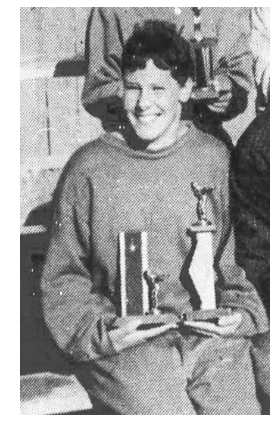
Starting in late 1963, Shannon Thibault was regularly mentioned for her proficiency at various sports, including judo, basketball, swimming, canoeing and softball over the years. The photo of Shannon with her swimming trophies from a meet at the Lions Pool was published on August 29, 1966. On May 18, 1967, she was announced as one of 48 Yukon students who would be travelling to Montreal and St. John, Newfoundland, as members of the Centennial Youth Exchange plan.
January 19, 1967: a large display ad says "To Whom It May Concern. Camp 279 and Camp 280 onn the Canol Road are Private Property. Direct enquiries to Henry Thibault, Phone 7-2642."
On July 28, 1967, Shannon Thibault pulled the seemingly lifeless body of 6-year-old Ronald Heynen from the bottom of the Lions Pool and began mouth-to-mouth breathing. Two adults took over and after a lengthy period the child responded - a near-miss that resulted in a front-page article.
January 8, 1968: "Mr. and Mrs. Henry Thibault are back after a week in Vancouver. . first trip south for him in eight years.. and the occasion for a happy family reunion; 14 of the guests at their wedding more than 25 years ago were also on hand one evening."
March 4, 1968: "A flood of irate citizens deluged the Whitehorse city council Thursday night and provided aldermen with a very clear description of the mess they had been forced to clear up earlier in the week as a result of the unseasonable spring thaw. ...Mrs. Henry Thibault agreed that the drain at Fifth and Jarvis gets all the surface water for blocks, and since it was out of operation, water came pouring right in the door and down the steps at her house."
July 21, 1969:

Two Whitehorse businessmen, whose land development proposals included housing for White Pass drivers, said today Whitehorse City Council should not permit the company to establish temporary trailer-type housing here.
Henry Thibault, who originated the plan, and his partner in the project, Bob Campbell, said they had worked on the idea since January 12, 1967, prepared architects' drawings, specifications and estimates, and offered to buy White Pass property between Second and Fourth Avenues at a price of $129,000 - only to find that the company would not release title to the land and this meant that CMHC financing could not be obtained.
Last February the local men were notified by White Pass that because of "extreme urgency of the situation, we feel we must now proceed with the project ourselves or make immediate and firm agreement with another party with firm timetable, commitment backed by personal guarantees."
Mr. Campbell pointed out that the White Pass had insisted on a $500 per day late penalty clause for completion of the housing portion. They had not been "undecided" about the project but made the one qualification "that we must have CMHC finance" and in order to obtain that, required the commissioner's endorsement. This meant a commitment from White Pass, to transfer title to the land, but Mr. Thibault said the company offered only a one year option on the land while they considered proposals from other developers.
"We weren't going to say anything about it, but when we read that City Council had given White Pass permission to put up trailers on that property, it was the last straw," the local man said, They have presented their information to Mayor Bert Wybrew and hope to discuss it with council at this week's regular meeting.

DOWN THE DRAIN? This is the architect's plan for a combined town housing and shopping area which two Whitehorse developers, Henry Thibault and Bob Campbell had hoped to build on White Pass property between Third and Fourth Avenue this year. The housing area at right was to provide accommodation for new White Pass drivers on the Anvil haul, and in order to receive returns on the investment of $5 1/2 million, the commercial section was added, at left, to include office and apartment tower, plus shopping area. Boutry photo from Thompson, Berwick, Pratt and Partners.
August 11, 1969: "Just under 100 Yukon athletes, coaches and managers will represent the Territory at the national Summer Games in Halifax, largest contingent to attend a sports event so far. Approximately 90 Yukoners travelled to Quebec City for the first Canada Winter Games, two years ago. Shannon Thibault, 19, and Stanley Jack have been chosen to carry the Yukon colours at the opening ceremonies Saturday night, when the contingents from the provinces and territories march in procession similar to the opening of the Olympics. Shannon is the daughter of a pioneering family in Yukon; her three great uncles Joseph, Archie and Gene Fournier walked in over the Trail of '98. Her parents are
Mr. and Mrs. Henry Thibault of Whitehorse."
[Shannon was named to join athletes from the other teams at a private dinner with Prime Minister Trudeau following the opening ceremony of the Games.]
August 28, 1969:
BUILDING BY-LAW HINDERING DEVELOPMENT?
City Council is looking into the possibility of narrowing down the requirements for open space and parking under the building by-law, following an appearance at last night's regular meeting by local businessman Henry Thibault.
Mr. Thibault told council that the city's requirements are for more space than CMHC needs for approval of apartment dwellings, and this section of the by-law is making it too expensive for anyone to reap a return on his investment.
"You're wasting a lot of property and hindering the development of the city" he said. "You can't attract capital investment or build up the city on these
conditions. Property is far too expensive to waste in open areas. Look at apartments in
Vancouver, for instance, where there is very little open space. You find 212 suites, in a building with three floors of parking area on a 75 by 125 foot lot. Here in Whitehorse, we came up with a plan for 100 houses on two and a half acres, which met CMHC requirements but the city by-law asks 1700 square feet per two-bedroom unit. The cost of land is too high to receive any return on the investment, when city taxes are paid. It is hindering the development of the city."
Aldermen agreed that apparently the city building by-law is not consistent with CMHC requirements but pointed out that other developers were using roof tops as the open space required for apartment dwellers.
Finally, council agreed to ask for further information on the subject, plus a recommendation from the city building inspector at the next regular meeting.
By December 1969, Henry Thibault was very active in the Whitehorse Lions, and was mentioned in the newspaper several times.
September 21, 1970: "About $70,000 has been awarded by the Yukon Territorial Government in grants and scholarships to send 85 students to universities or places of higher education this fall." On the list is Shannon Thibault, who is attending St. Mary's University in Halifax.
October 8, 1970: "Larry Carlyle and Gordon Steele will start their three months' trip abroad by attending the wedding of their old school and university buddy, Shaun Thibault in Bern, Switzerland, tomorrow. Shaun is marrying Elsbeth Zurgher, a Bern University student. Majoring in French at the University of Neuchatell, Shaun wrote his parents in Whitehorse that he may have to switch to German, his wife's language..."
Part of the wedding report on November 26th said "A civil ceremony in the morning was followed by a wedding breakfast at the bride's home. During the civil ceremony, as a special bit of Klondike flavour, the bridegroom presented his bride with her new initials in gold nugget brooches. Then at four p.m. Minister Buhlmann solemnized their marriage in
the 12th century Swiss Reformed Church at Amsoldingen, where pink and white chrysanthemums and dahlias decorated the altar."
On January 15, 1973, Capital Dry Cleaners closed forever after 29 years in business. On January 17th, ads started running to sell all of the equipment.

July 1975, Henry was in court, suing John Franklin Dumas and Elgin Irvin Gomme for fraud of $50,000 which he had loaned them in 1972. Thibault had borrowed the money at 12% and charged them 36%.
Margaret Gretta Thibault died at home on October 25, 1994, at the age of 73 and was buried at Grey Mountain Cemetery. Henry Edward Thibault died in 1997 at the age of about 82 and was buried beside her.
|
