
Home Page | The ExploreNorth Blog | About ExploreNorth | Contact Us | Search
Asahel Curtis (1874-1941)
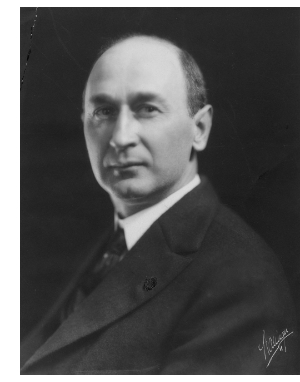 Photographers in the Yukon, Alaska and BC, 1886-1946
Dateline: January 1998.
Posted at ExploreNorth: January 25, 2024. Last update: January 17, 2026.
This page is under construction
Family Chronology (see details about Asahel Curtis specifically in the next section below)
1868: Edward Curtis is born near Whitewater, Wisconsin
1874: Asahel, fourth and youngest child of Johnson Curtis and Ellen Sheriff, is born in Le Sueur County, Minnesota
1880s: Edward works for a photographic gallery in St. Paul, Minnesota
1887: December: Edward and his father move to Washington Territory and settle in Port Orchard, then known as Sidney (or Sydney)
1888: March or April: Asahel, his sister Eva, and his mother follow after receiving an ominous telegram that Johnson Curtis is near death.
1888: May: Johnson Curtis dies
1892: Edward marries Clara Phillips and moves to Seattle to enter the photography business (Edward and Clara ultimately have four children, Harold, Beth, Florence, and Katherine)
1895: Asahel joins Edward and his partner Henry Guptill in the Seattle studio
1895-96: Polk's Seattle Directory lists Asahel Curtis as an engraver for Curtis & Guptill. Curtis & Guptill was Edward's third business venture in photography. Asahel was 21 or 22 at the time he began his photographic career.
1897: Edward begins his photographic documentation of North American Indians
1897-99: Asahel goes to Alaska to photograph the gold rush
1898-99: Asahel and Edward have a falling-out over the publication of Asahel's Alaska and Yukon photographs
1899: Edward joins the Harriman Expedition in the exploration of Alaska
1899: Asahel becomes a staff photographer for the Seattle Times & Seattle PI
1901: Asahel and William P. Romans form the firm Curtis & Romans
1902: Asahel marries Florence Carney (they eventually have four children - Asahel Jr., Walter, Betty, and Polly)
1903-04: Asahel works as a photoengraver in Tacoma and San Francisco
1905: Asahel helps found the Mountaineers Club
1906: Asahel buys an apple orchard in Yakima (he called it "the ranch" and later lost it during the Great Depression)
1907: Asahel escorts Mountaineers expedition to Mt. Olympus
1907: Edward's first volume of The North American Indian published
1908: Asahel escorts Mountaineers expedition to Mt. Baker
1908: Edward's photographs, "The Clam Digger," "Homeward," and "The Mussel Gatherer" win the grand prize at the National Photographic Expedition in Washington, D.C.
1910: Asahel photographs a Makah whale hunt as part of the "Harney State Set"
1909 & 1912: Asahel escorts Mountaineers expeditions to Mt. Rainier
1914: Edward produces the movie In the Land of the Headhunters, a Kwakiutl love story (later re-edited and re-titled by George Quimby at UW as In the Land of the War Canoes)
1911-36: Asahel serves on the Mt. Rainier National Park advisory board
1918: Edward and Clara divorce, the settlement leaves the studio and all of Edward's negatives to Clara
1920: Asahel opens the Asahel Curtis Photo Company
1930: Last volume (#20) of Edward's The North American Indian published
1932-33: Asahel serves as President of the Washington State Good Roads Association
1933: February: Asahel's photographs, both black and white as well as some rare color photographs, appear in National Geographic
1936: Edward goes to work on the film The Plainsman, starring Gary Cooper
1941: March 7: Asahel dies of a heart attack at age 67
1946-47: Edward moves to a small farm in Whittier, California owned by his daughter Beth and her husband
1952: October: Edward dies of a heart attack at age 84
Asahel Curtis Photo Company Photographs - 1,677 photographs at the University of Washington.
Asahel Curtis - biography at Wikipedia.
Washington State Historical Society - the repository of 40,166 Asahel Curtis photographs.
- born on November 5, 1874, in Le Sueur County, Minnesota. (pronounced A-shul)
- headed north in the summer of 1897.
Asahel set sail from Seattle aboard the steamer Rosalie in early September 1897. He carried with him hundreds of pounds of photographic equipment as well as enough food and supplies to last a year. In his mind he'd mapped a trail-come ashore in Skagway, follow the Skagway Trail over White Pass to the headwaters of the Yukon, then float down river to Dawson. In the months it took to reach the Yukon River, Asahel roamed the Alaskan trails, photographing the cold winter trials of the prospector's life. Supply hauling, boat building, men at work on their claims-images captured for eternity on glass, images often sent home to miners' sweethearts and families as proof that they were still alive.
- June 28, 1898, The Klondike Nugget: "Asahel Curtis and M. Lucas arrived in the city last week. Mr. Curtis is a photographer, taking views and writing sketches for the Alaska news Syndicate of Seattle. He will cover both the Canadian and American sides."
In all, Asahel shot more than 1,500 photographs of Alaska and the Klondike, most of which were shipped south to be printed by Edward's studio. Yet nearly a year before Asahel was to return to Washington, in the spring of 1898, Edward published an article in the Century Illustrated Magazine entitled "The Rush to the Klondike Over the Mountain Passes." Photo credits were given to Edward, who never mentioned that Asahel was actually the one who had taken them. This episode became the root of a lifelong feud between the brothers, a conflict that remained unresolved even after Asahel regained ownership of the Alaska negatives.
Arriving in Dawson City soon after the spring thaw, Asahel, too, fell prey to the lure of gold. He and his partner Charles Ainsworth staked a fractional claim on 60 Sulphur, outside of Dawson. Despite their efforts in below-freezing weather, the claim yielded little. Feeling dejected, Asahel noted this scene while visiting Dawson:
"Watching the throngs constantly changing. What better could his chance be than that of the thousands who are before him. Seemingly every degree of social scale has its representative. Every possible kind of garb is to be seen . . . .
The look of abstraction and gloom in many a face is heartrending. The probable cause is the same in many cases: a mortgaged home or a farm or a business that passed into other hands that the great Eldorado [sic] could be reached. These fair hills far away between which streams whose beds were pebbles of gold have faded. Weeks and months of hard work coupled with in many cases poor food have left the system weakening..."
Asahel returned home to Seattle a few months later (Stephanie Lile)
- in Bennett 1899.
- in Dawson 1899.
August 9, 1906, The Seattle Post-Intelligencer:
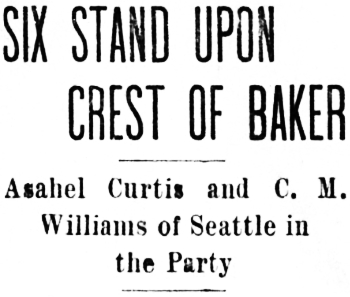
Special to the Post-Intelligencer
Bellingham, Aug. 8. - Yesterday six of the Mazamas succeeded, after long continued, hard and dangerous efforts, in reaching the summit of Mt. Baker, over a route which others had pronounced impassable. They returned to the main camp about 11 o'clock at night. The iron box containing the names of the climbers was deposited in its new resting
piace at 1 p.m. The successful six are:
F. H. Kiser, leader, of Portland; Asahel Curtis, of Seattle; C. M. Williams, of Seattle; L. S. Hildebrand, of Bellingham; C. E. Forsythe, of Castle Rock, and Martin Wahnlich, guide, of Bellingham.
At the head of the glacier that feeds Wells creek the party claims to have found a large vent [n the mountain from which steam issues thru miniature craters and from which occasionally boiling water is gushed forth with a hissing sound.
Only seventeen members of the party succeeded in reaching the point, about 400 feet from the summit, where the iron box was formerly deposited.
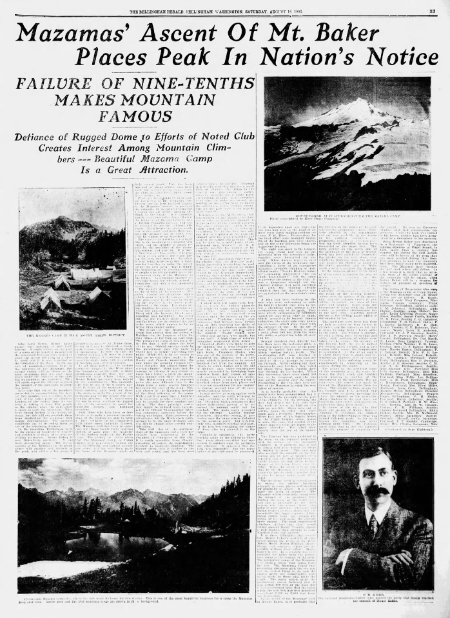
August 18, 1906, The Bellingham Herald published a very detailed story about the Mount Baker climb described above. The next day, The Seattle Post-Intelligencer published a lengthy article about the climb, written by Asahel Curtis and with 7 of his photographs of the climb.
October 1909: Several articles about a proposed climb of Mount McKinley in Alaska state that Asahel Curtis is "reputed to be the most expert climber in the Northwest." Curtis appears in countless articles about the mountains of Washington State in particular from 1906 through 1911.
In about January 1912, a new Seattle Chamber of Commerce was formed, and Asahel Curtis became heavily involved, initially in matters involving mountains, parks, and associated roads.
- From 1911 to at least 1916, possibly 1920, Asahel Curtis formally worked with Walter P. Miller under the name "Curtis & Miller."
- In June-July, 1913, Asahel Curtis was the official photographer for an Alaska-Yukon tour by the Seattle Chamber of Commerce.
- died in his studio at Seattle on March 7, 1941. Archie Satterfield, Seattle Times reporter, noted in a February 20, 1972, article that Asahel's ashes remained at Home Undertaking Co. & Mortuary in Seattle for many years after his death because the family could not decide what to do with them. Finally, Satterfield said, it was decided to put the ashes in an urn and place the urn, along with a plaque, at the site of the Asahel Curtis Memorial Grove in Snoqualmie National Forest, 23 miles east of North Bend. The words on the plaque are a simple tribute: "Devoted his mature life to making known the beauty and scenic wonders of the Pacific Northwest." The grove was formally dedicated by the U.S. Forest Service and the Seattle Chamber of Commerce in September 1964. Asahel Curtis Jr. was among those in attendance. Soon after the urn was in place, a bolt of lightning struck the rock upon which the urn sat, shattering the vessel and scattering the ashes. The family, Satterfield wrote, thought it was "the greatest compliment of all."
- collection of 36,000 negatives and 60,000 photos went to the Washington State Historical Society.
- see R. Frederick and J. Engerman, Asahel Curtis: Photographs of the Great Northwest (Tacoma: Washington State historical Society, 1983)
ACE CURTIS
In knowledge who can keep the pace
With our encyclopedic "Ace"?
Geology, ethnology, the growth of apple on the tree-
Photography, geography, are simple things for such as he.
The life of Tracy in detail
As told by "Ace" can ne're grow stale-
His nimble limbs no climb can fag-
He gaily leaps from crag to crag
And snaps his pictures as he goes,
The pictures everybody knows.
Beneath the sun he's won his place
And all of us are strong for "Ace."
-from a card in the Asahel Curtis Collection with "Ed Garrett" written on the back.
|
