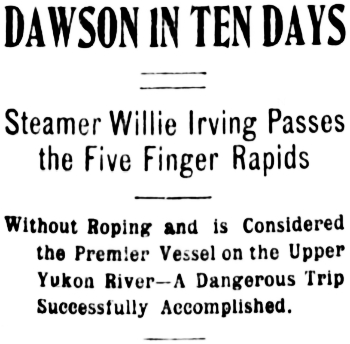
A correspondent in writing from Dawson says: "What the actual output for the winter has been no man knows, and even an estimate is very hard to get at. Those shipping gold dust keep the matter quiet for preeditionary reasons, while hundreds of thousands, probably millions, of gold have been taken out of the ground and concealed on account of the 10 per cent royalty demanded by the Government. Royalty has been paid on nearly seven millions of dust. This probably does not represent over 50 or 60 per cent. of the total production. A large amount of gold is, of course, held in Dawson, as it is practically the only medium of exchange, while hundreds of dumps on the best claims have not been washed, and will not be until fall, because of lack of water.
The up-river route is now taking practically all the travel, as one can go from Dawson to Seattle in 12 days with ease. The writer came up on the steamer Willie
Irving, named after the son of Capt. John Irving, of Victoria, which was most ably handled by Capt. Ed. Barrington, of Seattle, one of the best known and most liked steamboat men on the coast. The Irving is the first and only steamer that has run up the Five Finger rapids without roping.
Through the Rapids.
The trip was full of excitement, and the way that Capt. Barrington handled the little vessel in those raging waters, amid rocks, hidden and unhidden, was little short of marvelous. At the Five Finger rapids the Yukon narrows considerably,
rushing with terrible force in two channels, between perpendicular walls of rocks, rough and jagged. In the middle of the river five rocks loom up, rising out of the seething waters, while below the rapids and in the left hand channel are many smaller rocks, some of which do not rise above the surface. The right hand channel is the one always taken by those going down the river, as it is free from obstructions; the stream runs placidly until it apparently flows over a wall of rock, deeply submerged, when it drops off suddenly and goes roaring down a steep incline, a mass of foaming, tossing billows. The distance across between rock walls is not more than 80 feet, while the total length of the rapids is probably about a quarter of a mile.
We steamed up the Rink rapids with ease, passing a bunch of horses and some 50 head of cattle at the Yukon end of the Dalton trail, the five miles between the two rapids being spent in getting up steam for the supreme test. The Ora and the Goddard had both successfully made the passage laboriously roping up the left-hand passage, going down. The right-hand passage being the safer, Capt. Barrington decided to attempt it and crowding on all steam, headed the noble little vessel into the boiling cauldron of milk-white water, steadily but slowly mounting upward, the rocks in places being so close that I put my hand on them when standing on the upper deck.
The captain, holding the lives of all those on board in his hand, was as cool as the proverbial cucumber, placidiy puffing a cigar and giving his orders in his ordinary voice. Gradually we gained, steaming up hill, the whole vessel vibrating with the power of the engines, untill the prow extended into the clear, calm water above the brink.
Most of us thought that we had won, a half cheer rising from the groups gathered on the deck, when to our consternation the steamer, although working as hard as ever, commenced slowly to drift back.
Inch by inch she lost, uutil the captain called for a full head of steam. The safety valve blew off constantly, showing the tremendous pressure; once again we gained, winning our goal within a few feet, and once again we slowly dropped back. The captaln worked the steamer back and forth with unerring skill and judgment, but she could not quite make it, the reason being that when the bow protruded over the water knoll, the boat acted as if it was a see-saw, the bow sinking and the stern rising, until the wheel was lifted so far out of the water that it lost power.
Seeing the uselessness of wasting further time, Capt. Barrington let the steamer drift slowly back, and then urged her at full speed up the other channel, threading his way safely amidst the half hidden rocks, trying first one side and then another, until finally, amid cheers and the waving of hats from crew and passengers and the crowds gathered on the shore, she forged ahead, panting like some tired steed when its race is won. Now that Capt. Barrington has learned in a practical way the proper channel, he can run up the Five Fingers easily in half an hour, making the trip from Dawson to the White Horse In five days and a half.
To Dawson In Ten Days.
At the head of the White Horse rapids connections are made with the Flora or Killburn, the one a wooden and the other an iron boat, the run from Miles Canyon to the head of the lakes being made in ten hours. Provided that good connections with the Sound steamers are made at Dyea and Skaguay, the trip from Dawson to Seattle can unquestionably be made in 11 days, while the northern trip can be made, Seattle to the Klondike, in seven or eight days.
Freight rates are now seven cents per pound from Dyea to Lake Linderman, and 10 cents per pound by steamer from the lakes to Dawson. Think of the improved facilities for reaching the gold fields as compared with the hardships and expense of a few months since. It is now possible to go from Seattle to Dawson, with large outfits, in 10 days, at a cost of not exceeding 18 cents per pound.
Some 40 people came up on the steamer Willie Irving, bound for Sound ports, among them W. H. Conkling, manager for the Joseph Ladue Company, who is making a flying trip to New York; Ezra Meeker, the hop king of Puyallup, coming out after a new
stock of goods; Hart, who has large general stores in both Dyea and Dawson, and a number of old Yukoners, all of whom are bringing out some dust. A man named Will Stuart has some $50,000. The balance have sacks containing smaller amounts, probably $125,0000 all told. One or two are recent arrivals, who, having been seized with a bad attack of "cold feet," have sold their outfits and are going out for good, literally having shaken the dust of the country off thelr feet. Thousands will come out later, filled with hard luck stories; but they are really not in a position to pass judgment. Men go into the interior with from one to two years' provisions, knowing - if they have read the papers at all - the hardships and privations that are ahead of them.
Having reached the mighty Yukon and commenced to float down its rapid current, they apparently have used up all the energy and ambition that they have, and, reaching Dawson, are very useless members of society. They live on their scows, tied up at the waterfront, drink a little "hooch," the local whisky, at 50 cents per thimbleful, or set all day on the sidewalk, idly chatting, while whittling sticks.
Reaching their Mecca, they find it filled to overflowing at the very season of the year, midsummer, when no work is being done at the mines to ameunt to anything, when every one is idle. Two or three weeks of this existence usually finishes these "chechakos." They sell out at a sacrifice and return to civilization, giving the country an oral black eye, when they really are not in a position to discuss even the price of grub, as they have sold far below the market rates.
To the practically penniless man who is going in search of work, or the individual who expects to pick up nuggets wherever he may camp, I should most strongly say, stay away: but to the man able to pay his way, who is willing to work when necessary, with plenty of energy and, above all, perserverauce, I can say with all my heart, go ahead and good luck to you.