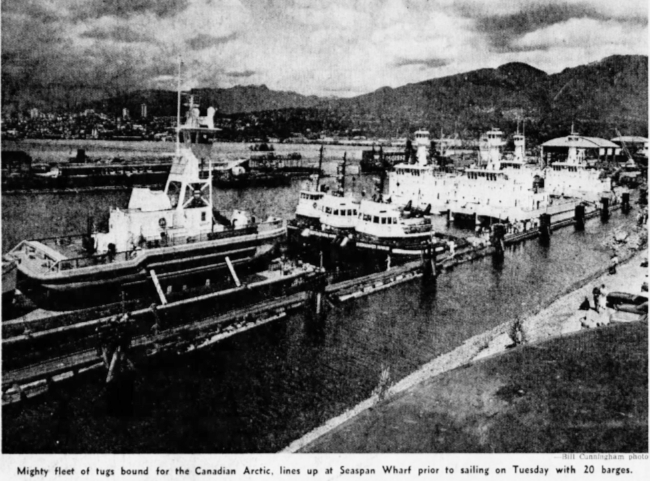
Departure of the great Arctic convoy from Vancouver on Tuesday was a gala event, such as never before has been seen in the harbor and may never be seen again.
Seven tugs with 20 huge steel barges in tow set out in brilliant sunshine on a perilous 3,200-mile journey to Tuktoyaktuk, N.W.T., near the mouth of the Mackenzie
River.
The importance of the convoy can be revealed from the fact that the barges and five river tugs, including one mounted on a barge, were built in B.C. yards for Northern Transportation Co. Ltd. at a cost of $25 million,
It is the first Canadian operation of this magnitude to the Arctic, and its success depends greatly upon its ability to clear the polar ice pack at Point Barrow, Alaska. The delivery job should take 25 to 30 days.
Previous vessels built in B.C. yards for the Mackenzie River have been shipped overland in sections and reconstructed at Hay River. The tremendous cost of such a
project and the size of the new tugs and barges led to the momentous decision to risk the tricky Aretic ice.
Tugs taking part in the exercise are three 1,200 horse power tugs owned by Seaspan International Ltd., four new 115-foot river tugs, and the yarding tug Kakisa.
Captain Al Bond, skipper of the Seaspan Mariner, is commodore of the convoy. Captain Earl Emory commands the Seaspan Navigator and Captain Alfred Anderson the Seaspan Commander.
The four river tugs are commanded by senior skippers of the Northland Transportation Co. fleet, the Henry Christoffersen by Captain Darrell Luker; the Johnny
Hope by Captain Bob Magill; the Jock McNiven by Captain George Moulton; and the Matt Berry by Captain Ken Gay.
Among those who were down at the Seaspan wharf to see the vessels away was Henry Christoffersen, retired engineer superintendent of Northern Transportation Co.,
who has a tug named after him in honor of his 40 years of service.
Captain George Tait of Arctic Transportation Co. was responsible for getting the operation underway, and Captain Arnie Birchall, port captain of Seaspan, will accompany the expedition part of the way.
Each of the Seaspan tugs has two barges in tandem, and five of these barges are threes. The sixth barge carries the yarding tug Kakisa, built here by Del-Aire Shipyard, and the wooden fish boat Pressure Ridge.
The fish boat will be delivered to an Eskimo at Tuktoyaktuk, who recently purchased her at one of the local fishing boat auctions. When the stacked barges arrive at
their destination, the carrier barge will be sunk, and the two upper barges floated off. The sunken barge will then be pumped out.
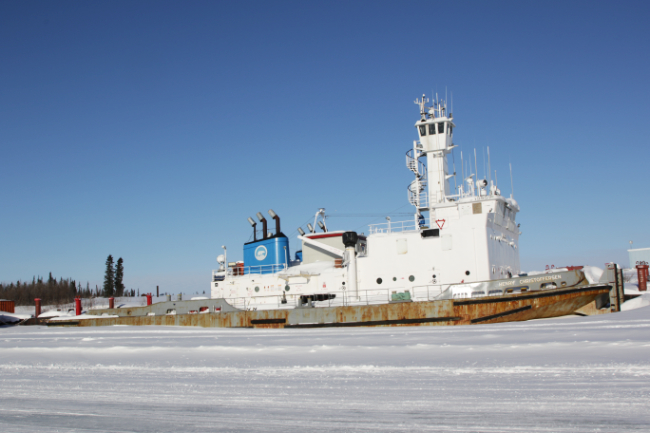
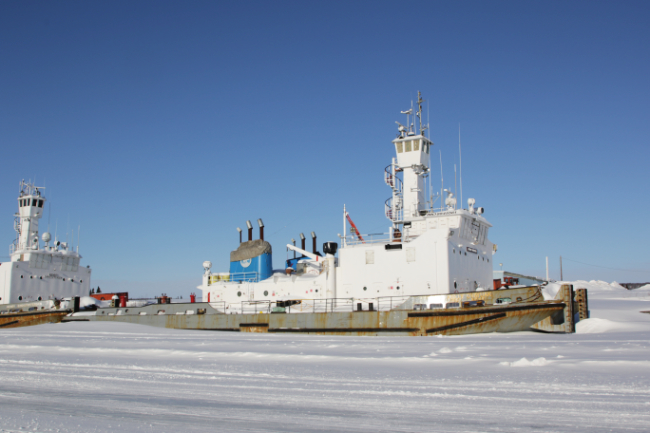
The four steel river tugboats are pusher tugs, almost rectangular in shape, with an over-all length of 155 feet, a beam of 52 feet and depth of 10 feet. Each will tow one barge. They carry 45,000 gallons of fuel, yet their loaded draft is only four feet. The superstructure is aluminum. The design was supervised by marine architect Robert
Allan. All the new tugs and barges are registered at Edmonton.