On June 9, 1950, the Antitrust Division of the U.S. Attorney General's office filed civil injunction suits in Anchorage against 23 corporations, 138 individuals and 2 retail liquor dealers' associations, all doing business in Alaska. The suits charged price fixing and restraints of trade in shipping, distribution of meats, food sales, fuel
supplies, the liquor business, dry cleaning and taxicab services. The Alaska Steamship Company, the only steamship company still serving the entire territory, was one of the primary targets.
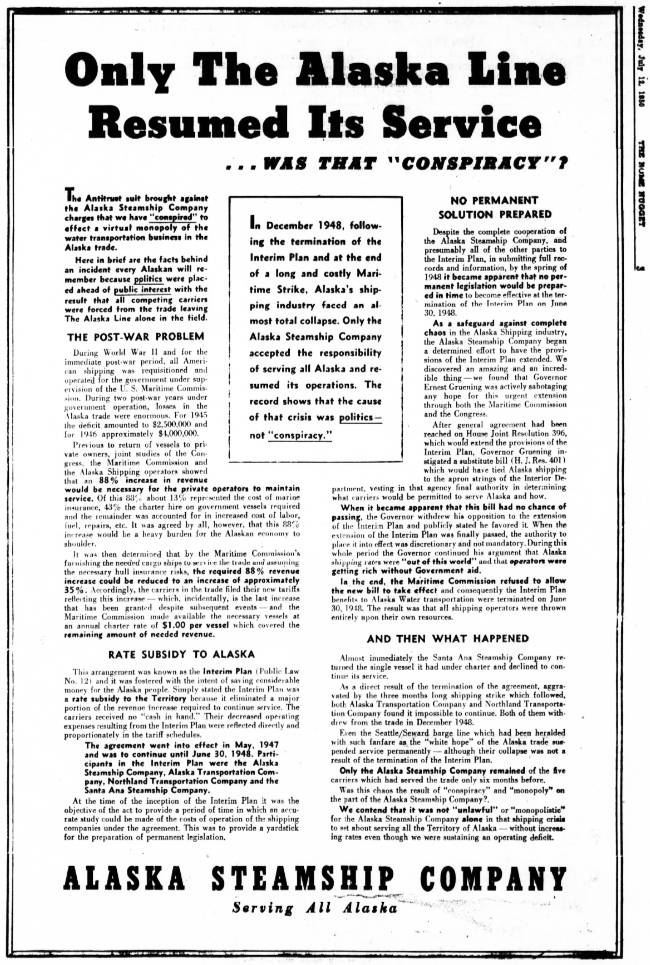
The full-page ad reproduced below was one of several published by the Alaska Steamship Company as public statements in defence of their operation.
The Antitrust suit brought against the Alaska Steamship Company charges that we have "conspired" to effect a virtual monopoly of the water transportation business in the Alaska trade.
Here in brief are the facts behind an incident every Alaskan will remember because politics were placed ahead of public interest with the result that all competing carriers were forced from the trade leaving The Alaska Line alone in the field.
THE POST-WAR PROBLEM
During World War II and for the immediate post-war period, all American shipping was requisitioned and operated for the government under supervision of the U. S. Maritime Commission. During two post-war years under government operation, losses in the
Alaska trade were enormous. For 1945 the deficit amounted to $2,500,000 and for 1946 approximately $4,000,000.
Previous to return of vessels to private owners, joint studies of the Congress, the Maritime Commission and the Alaska Shipping operators showed that an 88% increase in revenue would be necessary for the private operators to maintain service. Of this 88% about 13% represented the cost of marine insurance, 43% the charter hire on government vessels required and the remainder was accounted for in increased cost of labor, fuel, repairs, etc. It was agreed by all, however, that this 88% increase would be a heavy burden for the Alaskan economy to shoulder.
It was then determined that by the Maritime Commission's furnishing the needed cargo ships to service the trade and assuming the necessary hull insurance risks, the required 88% revenue increase could be reduced to an increase of approximately
35%. Accordingly, the carriers in the trade filed their new tariffs reflecting this increase - which, incidentally, is the last increase that has been granted despite subsequent events - and the Maritime Commission made available the necessary vessels at
an annual charter rate of $1.00 per vessel which covered the remaining amount of needed revenue.
RATE SUBSIDY TO ALASKA
This arrangement was known as the Interim Plan (Public Law No. 12) and it was fostered with the intent of saving considerable money for the Alaska people. Simply stated the Interim Plan was a rate subsidy to the Territory because it eliminated a major portion of the revenue increase required to continue service. The
carriers received no "cash in hand." Their decreased operating expenses resulting from the Interim Plan were reflected directly and proportionately in the tariff schedules.
The agreement went into effect in May, 1947 and was to continue until June 30, 1948. Participants in the Interim Plan were the Alaska Steamship Company, Alaska Transportation Company, Northland Transportation Company and the Santa Ana Steamship Company.
At the time of the inception of the Interim Plan it was the objective of the act to provide a period of time in which an accurate study could be made of the costs of operation of the shipping companies under the agreement. This was to provide a yardstick for the preparation of permanent legislation.
NO PERMANENT SOLUTION PREPARED
Despite the complete cooperation of the Alaska Steamship Company, and
presumably all of the other parties to the Interim Plan, in submitting full reccords and information, by the spring of 1948 it became apparent that no permanent legislation would be prepared in time to become effective at the termination of the Interim Plan on June
30, 1948.
As a safeguard against complete chaos in the Alaska Shipping industry, the Alaska Steamship Company began a determined effort to have the provisions of the Interim Plan extended. We discovered an amazing and an incredible thing - we found that Governor Ernest Gruening was actively sabotaging any hope for this urgent extension
through both the Maritime Commission and the Congress.
After general agreement had been reached on House Joint Resolution 396,
which would extend the provisions of the Interim Plan, Governor Gruening instigated a substitute bill (H. J. Res. 401) which would have tied Alaska shipping to the apron strings of the Interior De-partment, vesting in that agency final authority in determining
what carriers would be permitted to serve Alaska and how.
When it became apparent that this bill had no chance of passing, the Governor withdrew his opposition to the extension of the Interim Plan and publicly stated he favored it. When the extension of the Interim Plan was finally passed, the authority to
place it into effect was discretionary and not mandatory. During this whole period the Governor continued his argument that Alaska shipping rates were "out of this world" and that operators were getting rich without Government aid.
In the end, the Maritime Commission refused to allow the new bill to take effect and consequently the Interim Plan benefits to Alaska Water transportation were terminated on June 30, 1948. The result was that all shipping operators were thrown
entirely upon their own resources.
AND THEN WHAT HAPPENED
Almost immediately the Santa Ana Steamship Company returned the single vessel it had under charter and declined to continue its service.
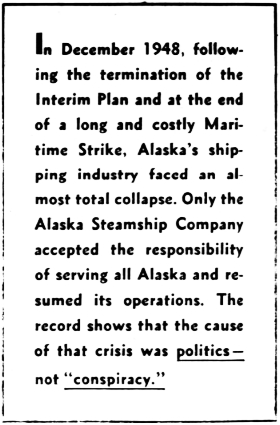
As a direct result of the termination of the agreement, aggravated by the three months long shipping strike which followed, both Alaska Transportation Company and Northland Transportation Company found it impossible to continue. Both of them withdrew from the trade in December 1948.
Even the Seattle/Seward barge line which had been heralded with such fanfare as the "white hope" of the Alaska trade suspended service permanently - although their collapse was not a result of the termination of the Interim Plan.
Only the Alaska Steamship Company remained of the five carriers which had served the trade only six months before.
Was this chaos the result of "conspiracy" and "monopoly" on the part of the Alaska Steamship Company?
We contend that it was not "unlawful" or "monopolistic" for the Alaska Steamship Company alone in that shipping crisis to set about serving all the Territory of Alaska - without increasing rates even though we were sustaining an operating deficit.