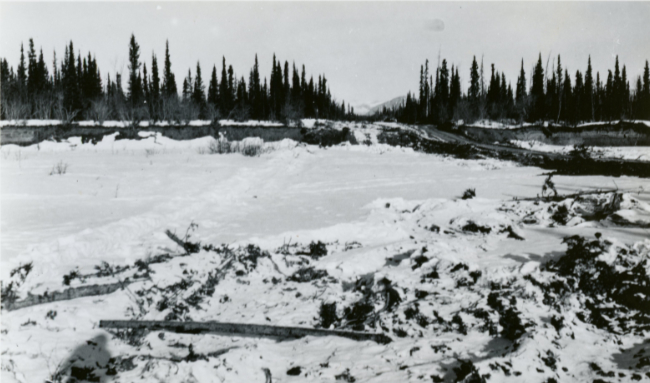
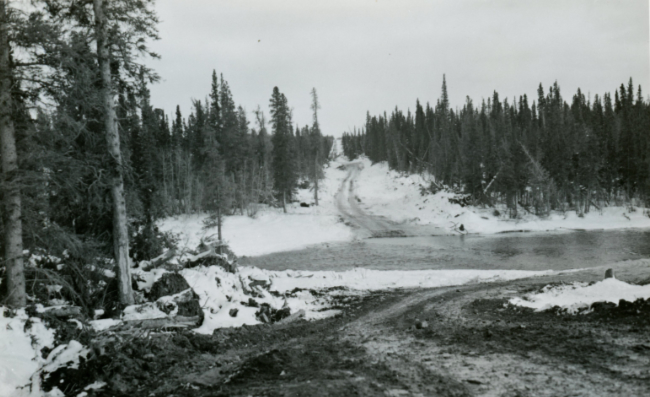
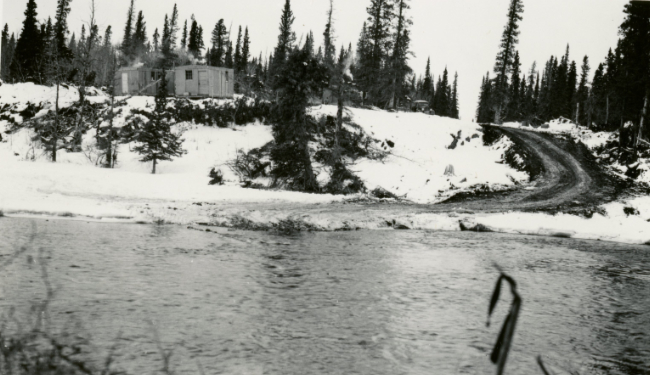
The Haines lateral road, its original name, also known as the Haines-Champagne road, was built to relieve the transportation strain on the narrow-gauge White Pass and Yukon Route railroad which connects Skagway, Alaska, with Whitehorse, Yukon Territory. At the time construction of this facility was commenced the railroad in question was being used to transport supplies and equipment to the Whitehorse section of the Alaska Highway and serious delays were being encountered in effecting deliveries on schedule at a time when they were vitally needed if construction schedules were to be met.
The final-type Haines lateral road was constructed under a contract let directly by the War Department to the firm of Foley Bros., Inc., and Rohl-Connolly Co. The pioneer trail over which the Haines Road is constructed was built principally by troops of the 340th Engineers at a cost of $1,694,000. Before the War Department contractor was employed to build the final-type road, Public Roads Administration contractors performed grading and bridge construction work at a cost of $1,610,000. The total cost of constructing the Haines Road, including the pioneer trail, was $12,216,000.
"The Haines lateral road begins at tidewater of Lynn Canal at the town of Haines, Alaska, and extends northwesterly 154 miles across the southwestern part of Alaska, British Columbia, and the Yukon Territory in Canada, where it joins the Alaska Highway 98 miles west of Whitehorse and 502 miles southeast of Fairbanks, Alaska.
Beginning at tidewater, Haines, Alaska, the highway follows the northeast bank of the Chilkat River for 24 miles, thence up the Klehini River to mile 50, reaching an elevation of 1,613 feet. At this point the highway enters Chilkat Pass, traversing steep mountain slopes subject to slides. The grade increases to mile 57, elevation 3,140,
where the road descends for 2 miles into Clear Creek Valley. The highway reaches the summit at mile 63, elevation 3,416 feet, traversing heavy grades from mile 59. From the summit the road descends by easy grades, passing the southern edge of Mosquito Flats, crossing the Nadahini River at mile 67.1, and following its left bank to Mule Creek, crossing at mile 72. At mile 74 the road passes over a gravel moraine which forms the divide between the Chilkat and Tatshenshini Rivers and continues through relatively flat country to mile 78. From this location it traverses the slopes of Mount Mansfield and
rises to an elevation of 3,183 feet at mile 94, thence to an elevation of 2,390 feet to cross the Takhanne River at mile 99, approximately 6 miles east of Dalton Post.
From Takhanne River the road rises on heavy grades to an elevation of 2,949 feet to mile 101, thence over rolling country along the east side of the Unihini River Valley to Unihini Crossing at milepost 113.5. The road continues northerly over level wooded country to reach a point opposite the southern tip of Dezadeash Lake at mile 120, thence along the west shore of Dezadeash Lake to milepost 131, where it
turns northwesterly, passing through a region of low glacial moraines and crossing Kathleen River at mile 138.2 and Quill Creek at mile 145.7. The highway descends on low grades from this point into the Dezadeash River Valley, joining the Alaska Highway at a point approximately 98 miles west of Whitehorse, Yukon Territory. The Haines lateral road was built to the same standards as the Alaska Highway." (Alaska Highway: An Interim Report from the Committee on Roads. March 13, 1946)
At the location where the Haines lateral road crossed the Dezadeash River was an Alaska Highway construction camp which had been established by a civilian contractor, Haas-Royce-Johnson. It was called Camp 108, as at that time it was 108 miles from Whitehorse. That camp would become the community of Haines Junction - see much more inforation at "A.Y. Jackson and Haines Junction".
Saturday, September 11, 1943, Edmonton Journal
WHITEHORSE, Y.T - The first emergency landing has occurred on the Alaska Highway road system.
A single-motored commercial plane, en route from Fairbanks to Whitehorse, recently found itself far off its regular route with gasoline tanks nearly empty. Mountains loomed on all sides.
The pilot saved his ship and his own life when he coasted to a safe
landing at milepost 73 on the new Haines Military Road, which connects the Alaska highway with the sea. Neither ship nor pilot suffered damage or injury in the emergency landing.
A U.S. Engineers' truck took the passengers to a construction camp for the night.
The main purpose of the Alaska highway and its connecting roads, Brig. -Gen, James A. O'Connor declared last week, in a speech delivered on the first anniversary of the Northwest Service Command, is "to supply, supplement and anchor the air route to the North Pacific theatre of war."
Monday, September 27, 1943, The Vancouver Daily Province:
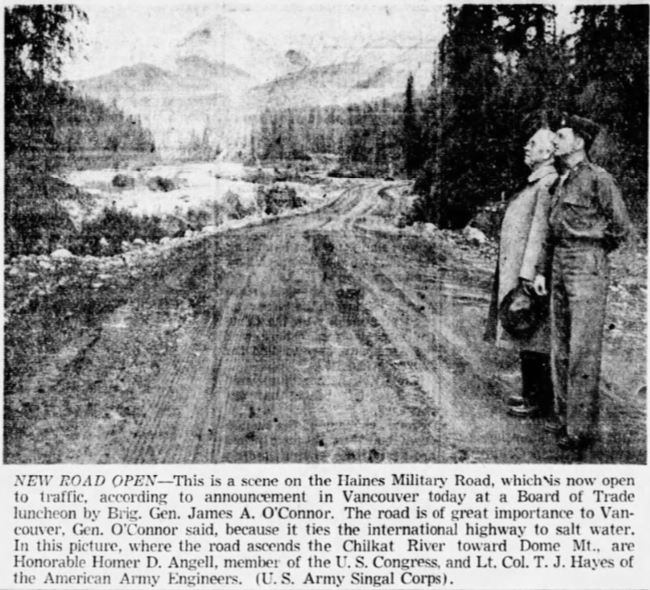
The above photo was almost certainly shot during a tour of Alaska and the Canadian Northwest by Congressman Homer D. Angell of Oregon, in mid-August.
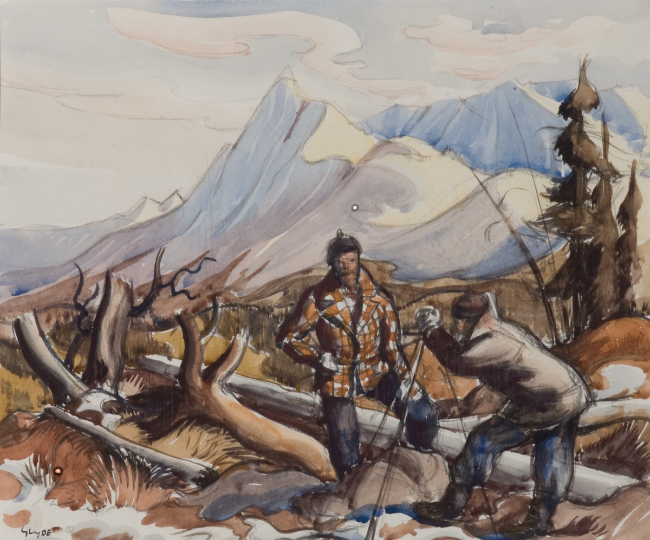
October 1943: For the last 3 weeks of October, painters A. Y. Jackson and Henry G. Glyde toured the Alaska and Haines highways under the sponsorship of the National Gallery of Canada and the R.C.A.F. Dean of Canadian painters at the time, A. Y. Jackson was a member of "The Group of Seven" and Glyde was head of the Art Department at the Institute of Technology and Art in Calgary. See much more inforation about the trip at "A.Y. Jackson and Haines Junction". The first painting below, "Alaska Highway", was painted by H. G. Glyde in 1943.
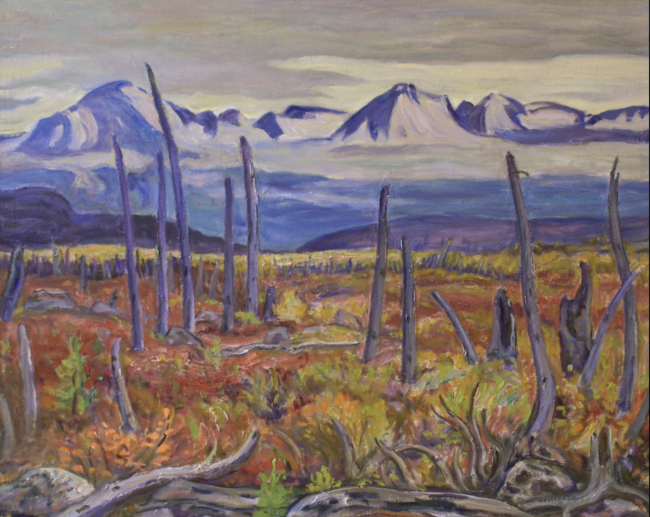
The trip provided both artists with inspiration for years afterwards. "Mountains on Haines Highway, Yukon", seen below, was painted by A. Y. Jackson in 1946.
Building the road, December 1942 - November 1943
Public Roads Administration contractors were assigned to the construction of the Haines lateral road during the winter of 1942-43 after a preliminary survey of the best possible route for the highway had been made by Public Roads Administration engineers.
A study was made during the winter of 1942-43 by Col. Theodore Wyman, Jr., division engineer, Northwest Service Command, who had over-all jurisdiction for the War Department at that time for the construction of both the Alaska Highway, the Haines Road, and collateral engineering projects in northwest Canada. As a result of this study Colonel man concluded that Public Roads Administration contractors would be unable to complete both the Alaska Highway and the Haines Road during the 1943 construction season. Public Roads Administration contractors were directed to continue work throughout the winter on the Haines Road and then return to the Alaska Highway project in the spring of 1943. Colonel Wyman then awarded the contract for the completion of the Haines Road to Foley Bros., Inc., and Rohl-Connolly Co., a new contractor operating under direct supervision of the War Department and not under supervision of the Public Roads Administration.
Construction was started by the Army contractor on the Haines Road during the latter part of March 1943. The directive was to construct a two-way road with sixty-foot clearing and 24-foot roadway, graveled, from Haines to Champagne, or some point west of Champagne where a satisfactory line intersects the Alcan Highway. Two thousand employees were used at the peak of construction. The quantities of major items of work performed by the contractor on this project were as follows: Clearing, 1,340 acres; Grading, 4,074,551 cubic yards; Surfacing, 723,223 cubic yards; Culverts, 35,396 lineal feet; Bridges; 3,100 linear feet.
A total of 36 bridges were constructed, only four of which were steel structures. The balance are chiefly pile trestle bridges. Work on this project was completed during November 1943.
During construction of the Haines Road, the War Department contractor found it necessary to deviate considerably from the route surveyed and recommended by Public Roads Administration engineers in the winter of 1942-43. This was done with the approval of the Army supervising engineers. The reason for this deviation was that the south 50-mile road alignment selected by Public Roads required approximately 2,250,000 cubic yards of excavation, 50 percent of which was rock work.
The Public Roads location is obviously more satisfactory for a permanent alignment, but use of that route, on account of the heavy rock cuts, would have delayed the completion of this feeder road at least one construction season and would have done so at a time when the facility was most needed to transport supplies and equipment onto the Alaska Highway project. All supplies and equipment for work in the Whitehorse area were then being carried in over the narrow-gauge White Pass & Yukon Route railroad. This road and its rolling stock was never built with the heavy traffic in view that this program imposed on it and some means had to be devised to prevent the further delay of moving the supplies bottlenecked at Skagway. The Haines Road was the only answer to this and speed was imperative in its construction at that time.
In several places on the Haines route selected by the Army the ground was subject to slides or was along and across rivers where fills and bridges could not be expected to remain permanently.
While overtime costs were high ($1,050,000) due to the extra hours required in order to expedite construction, some other costs were lower than on the Alaska Highway due to the proximity to tidewater. On the Haines project, added transportation cost is estimated at $20 per ton, instead of $40 per ton on the Alaska Highway. Worker housing on the Haines project was only $400 per man as against $600 on the Alaska Highway. Labor turn-over was more than 100 percent for the entire construction period, and the average cost of round-trip transportation and travel time for individual laborers is estimated at $200 per man for the Haines project as against $300 per man on the Alaska Highway.
Approximately 1,200 pieces were used by the contractor, Foley Bros., Inc. and Rohl-Connolly Co., during the construction of the Haines lateral road. Of this number, more than 900 pieces, valued at approximately $3,000,000 were Army-owned and the balance of 231 pieces, valued at $946,000 was rented by the prime contractor from an equipment contractor, Bowen & McLaughlin, while 11 pieces, valued at $458,807, were rented from the prime contractor. The equipment rented from the prime contractor, Foley Bros., Inc., and
Rohl-Connolly Co., consisted of marine equipment used for transporting construction materials up the Inland Passage from Prince Rupert to Haines.
Thursday, November 4, 1943: A Minnesota outfit, Foley Bros. and Rohl-Connolly Co. of St. Paul, is almost done with work on the Haines cutoff, a new road running from Haines, Alaska, over Chilkat Pass, to join the Alaska military highway highway in Yukon Territory 100 miles beyond Whitehorse. By this cutoff, the road distance to Fairbanks is about 750 miles. Many Alaskans think that freight may be more economically sent up by boat, transferred to trucks at Haines and sent on to interior Alaska, than to be shipped all the way overland. (Minneapolis Star Journal)
1944:
Haines Highway, 1944
A large annotated map of the road as it was in 1944.
Thursday, August 17, 1944, Edmonton Journal
Partially constructed between the Alaska coast and the Alaska Highway to relieve congestion, the Haines "cut-off" road is being abandoned as an artery of traffic, headquarters of Northwest Service Command announced in Edmonton Thursday.
The military road, running from Haines, Alaska, to a point 105 miles
northwest of Whitehorse, was constructed to relieve pressure on the White Pass and Yukon Railway in the construction days when much heavy equipment was taken into the northwest via boat to Skagway and then over rail to Whitehorse.
Heavy slides and difficult snow conditions last winter made it impractical to keep the Haines road open in view of the reduced amount of material being moved into the northwest as construction jobs were completed.
The road is being used to evacuate heavy equipment used in its construction and that of the northern half of the Alaska highway but it is not open to any other traffic, officials said.
Cost of the road was about $10,000,000. Construction was carried out by U.S. Public Roads Administration.
Thursday, September 21, 1944:
Alaska Highway north and Haines road are failures
An article in the Victoria Daily Times of September 21, 1944, reports on comments by a northern old-timer about the failures despite 'a mad orgy of spending.'
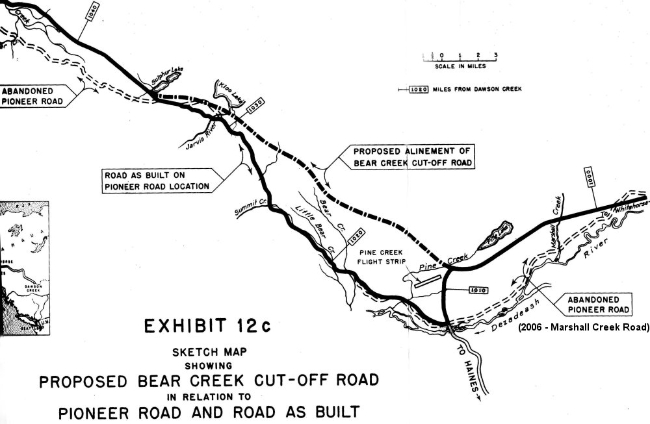
1946: A proposed major realignment of the Alaska Highway (seen on the map below captioned the Bear Creek Cut-off Road) was cancelled due to protests from the community that was developing at the site of Camp 108. This would have added about four miles to the length of the Haines road. Click on the map to enlarge it.
Friday, August 9, 1946: The first through bus trip from Anchorage to Juneau is scheduled for this week, Ken O'Harra of the O'Harra Bus Lines Inc., announced. Mr. O'Harra received notice from the Canadian government that he has permission to operate over the Haines Road. On September 12th, O'Harra started running from Whitehorse to Haines and Juneau.
September 17, 1946:
Haines Road closures
A newspaper article talks about closures of the Haines Road and the effects on prices of goods in Alaska.
August 29, 1947: Freight rates to Whitehorse were halved for Vancouver shippers this week with the inauguration of the Vancouver-Haines service of the B. C. Steamships Co. First shipments left Vancouver this week by the Alaska Prince. They will be landed at Haines and carried by truck over a 226-mile cut-off to Whitehorse.
October 3, 1947: B. Y. N. Bus Lines announces regular passenger serice to Haines, leaving Whitehorse on Fridays and returning on Mondays.
October 31, 1947: The state department informed Senator Magnuson on Saturday it hopes to be able to work out a plan for keeping the Haines cut-off open throughout the year. Canadian officials do not feel they could keep the road open during the winter because of heavy snows and light travel over the road, though they maintained the road last summer.
Tuesday, April 3, 1951: Juneau-Haines Ferry to Run. Motorship ferry service between Juneau and Haines, providing the only outlet from Juneau to the Alaska highway,
will be available as soon as the Haines cutoff road opens. R. J. Sommers, president of the
Chilkoot Motorship lines, said weekly service will be maintained on the route and the sailings may be increased. Last year, nearly 600 cars were ferried from Juneau to Haines for travel on the Alaska Highway.
August 3, 1951: Contrary to reports from points along the Alaska Highway, the ferry is operating between Haines and Juneau. It was recently taken over by the Territory of Alaska and is now being operated as a government transportation service.
Thursday, November 8, 1951: The Haines Cutoff road which joins the town of Haines to the Alaska highway now is closed to traffic, Territorial highway engineer Frank Metcalf announced today. The Canadian government has put a gate across the entrance to the Canadian section. The Territory will keep the road open to Mile 32, however.
December 21, 1953:
Haines-Fairbanks Pipeline
Construction of the 626-mile line began. It took 22 months to build, and operated until 1971.
May 24, 1956: Timed to coincide with the opening of the Haines Highway, the Lynn Canal Corporation of Haines announces the opening of its modern hotel in the city center.
Tuesday, November 13, 1956: This year, figures on tourists entering Alaska via the Haines cutoff were kept for the first time. They showed that a total of 3,829 cars entered Alaska on the Haines road.
Thursday, November 6, 1958, The Whitehorse Star
Stuck on the Haines road last weekend were three trucks whose drivers had been warned the road was closed for the winter. Marooned until rescued by a NWHS crew from Haines Junction were three flat-bed trailer trucks, operated by Arctic Motors Freight, hauling lumber to Tok Junction and Fort Greely. The lumber had been delivered by barge to Haines from Juneau. One truck got through to the Junction and the other three were rescued by an army breakdown and a 10-ton snow remover.
April 23, 1959: The United States has proposed legislation which would authorize appropriations of $11,000,000 a year for six years starting July 1, 1960, for improving and paving the Alaska Highway and the Haines Cutoff in Canada on condition that Canada spend the same amount for the program, and then would maintain the roads for year round use.
February 11, 1960: The feasibility of the keeping Haines Road open later in fall and earlier in spring is being studied. A study several years ago found there was not sufficient traffic to warrant longer opening, but present demands were considerably greater and there is now a mining operation in the Kathleen Lake area hauling out to Haines.
March 9, 1961: An economic survey is underway to consider feasibility of keeping the Haines Road open year-round, MP Erik Nielsen told the Whitehorse Board of Trade Tuesday night. He said the study followed an offer made last winter by Alaska Freightlines to keep the road open in winter itself, though they later retracted the offer.
Monday, January 21, 1963: New records for travel were set in 1962 for both the Alaska Highway and Haines Highway. At Pleasant Camp on the Haines Road, August was the big
month with 2,995 inbound passengers and 3,035 outbound. Total for the year was 14,359 inbound (up from 12,989 in 1961) and 14,632 outbound. There were 4,408 cars inbound and 4,483 outbound with 937 trucks in and 885 out, 15 buses in and 17 out.
October 24, 1963: Subject to ongoing negotiations with Alaska, the Haines Cut-Off Road will be kept open this coming winter on a one-year trial basis. On December 12th it was announced that Canada has agreed to pay $127,000 for American crews to keep the road.
September 28, 1964: Northern Affairs Minister Arthur Laing announced that the Haines Road will once again be maintained through the winter, though the program is still considered 'experimental'.
May 3, 1965: Alaska's Highways Commissioner D. A. McKinnon announced that the winter maintenance of the Haines cutoff was "a definite success" this year and proved the feasibility of winter-time operation of the route. Between December 1, 1964 and March 1, 1965, a total of 1,509 vehicles used the Haines highway, compared with 816 the previous year. Canada paid costs of maintenance, and the State of Alaska provided the men and equipment for the job.
August 9, 1965: White Pass and Yukon Route have sold their bus business to Canadian Coachways, with the change of ownership to take place on August 5th. The run from Whitehorse to Haines is affected, and four buses will be transferred: two new 39-passenger Challenger types, one 41-passenger coach, and an 8-passenger Checker.
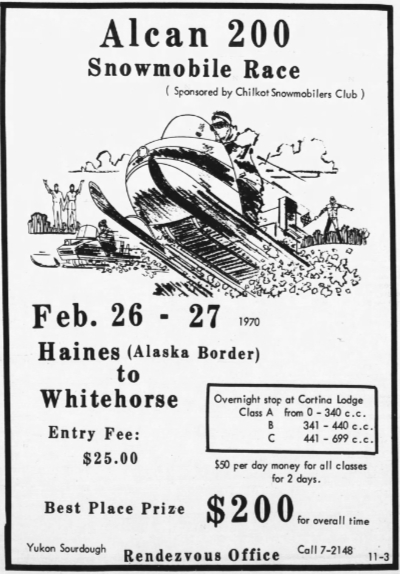
February 26-27, 1970: The first Alcan 200 snowmobile race from Haines to Whitehorse, sponsored by the Chilkat Snowmobilers Club and the Yukon Sourdough Rendezvous.
Thursday, January 5, 1978: The Shakwak Project involves the paving and realignments of the Haines Road from the Alaska-B.C. border to Haines Junction, and the Alaska Highway from Haines Junction to the Yukon-Alaska border, a distance of approximately 520 kilometers. The U.S. has offered to pay for the construction because it would provide a paved, all-weather link between Alaska and the lower 48 states. Canada could benefit from the project because it would provide easier travel for tourists.
Wednesday, August 2, 1978: "Tenders for clean-up of abandoned military sites and garbage dumps on the Haines, Alaska Road, will be received until 4:00 P.M., Yukon Standard Time, August 18, 1978."
Tuesday, August 15, 1978: Two engraved brass survey stakes were driven into the ground at Haines Junction today to officially open the Shakwak Project. One of the stakes is engraved with a U.S. flag and the symbols 0+000 while the other stake has a Canadian
flag with the numbers 0+516 which is the projected total highway distance in kilometres when it is completed in about 10 years.
August 15, 1986: The Alaska government announces $8 million of its U.S. federal government highway funds will be diverted to the Shakwak Highway project, involving reconstruction of the Haines Road in British Columbia and the Yukon.
December 8, 1987: The U.S. government comes up with another $8 million to complete the Shakwak Highway Project along the Haines Road.
July 3, 1993: The first Kluane to Chilkat Bike Relay attracted 150 riders to take on the 250-kilometer road from Haines Junction to Haines. It was won by Dan Shier and Sean Sheardown in 8:21.51.
2009: The 44 miles of the Haines Highway in Alaska was designated a National Scenic Byway.
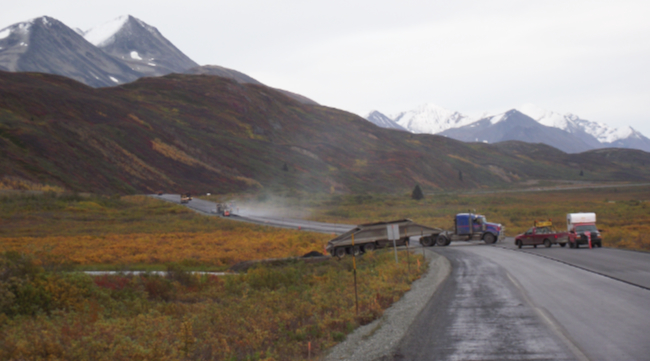
2011: Major paving project. This photo was shot looking south at Twin Lakes on September 11, 2011. A large camp and asphalt plant had been set up near the Kelsall Lake road junction.
Marinka's Hill
In 2012, a section of the Haines Highway was named "Marinka's Hill" to honour Marinka Darling, who spent 35 years with the Canada Border Services Agency, much of it as superintendent of the Port of Pleasant Camp, B.C.