
|





|
|
Finding Uranium in British Columbia, 1949-1950
by Murray Lundberg
Northern Mines & Mining
Dateline: November 15, 2025.
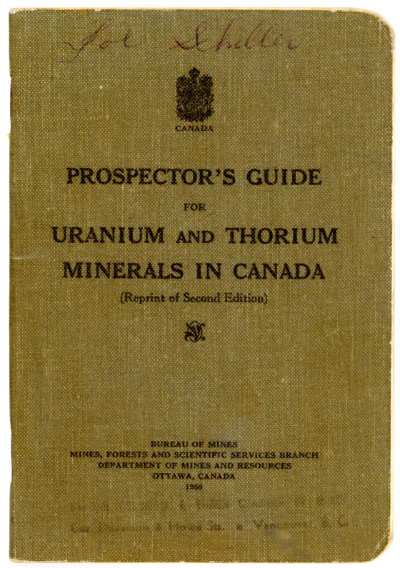
Today's article was prompted by finding the 41-page 1950 Canadian Bureau of Mines brochure "Prospector's Guide for Uranium and Thorium Minerals in Canada" in my late father's papers yesterday, and, tucked into it, an article about places to look for uranium in British British Columbia, from The Vancouver Daily Province of June 25, 1949. They pair nicely to show one of the things attracting both professional and amateur geologists at that time.
The complete newspaper article follows, then a link to a scan of the brochure.
Uranium Fields Indicated
 VICTORIA (CP) - The provincial mines department, telling B.C. prospectors how to go about finding uranium, said today that Vancouver Island, the Cassiar-Omineca, Okanagan and Nelson areas are good bets.
The advice was given in a treatise entitled "Prospecting for Uranium" by John S. Stevenson.
Noting that uranium had been discovered at two places along the eastern side of the coast range belt, Dr. Stevenson said:
"One could hope to find other occurrences of uranium minerals not only within or close to the coast range belt of batholiths but also in or near other areas of
batholithie rocks elsewhere in the povince.
THREE AREAS
"These would include the batholiths on Vancouver Island, the batholiths in the northern-central part of the province such as the large south westerly trending
Cassiar-Omineca belt of batholiths, and the batholiths in the south-central and south-eastern part of the province such as those belonging the Okanagan and Nelson intrusions."
The two uranium discoveries of the province to date were made near Hazelton and in the Bridge River area.
"The most definite advice that can be given is where not to seek uranium ore," said Dr, Stevenson. "Uranium could not be found in the Laval fields of the Interior
and it is not likely that mineable deposits of pitcheblende or uraninite would be found in sedimentary rocks of the Rocky Mountains.
WEATHERED OUTCROPS
"This does not exclude the possibility of finding uranium-bearing shales within the Rocky Mountans or elsewhere in the province. These remarks indicate that in most sections of the province, the prospector should keep in mind constantly the possibility of finding pitchblende or uraninite."
Dr. Stevenson says that the prospector may be guided by the appearance of weathered outcrops containing pitcheblende or uraninite.
"The brilliantly colored, yellow, powder-like mineral carnotite found along cracks or joints in an outcrop indicates the presence of primary uranium mineralization, and all rock outcrops showing any sign of this yellow powder should be examined carefully for pitchblende or uraninite," he said.
SHOULD BE TESTED
He warned also that not all yellow powders or films were derived from uranium minerals. A yellow coating characteristiclly forms on the weathered surface of molybdenite and stibnite.
Prospectors should also be on the lookout for weathered surfaces showing the characteristic pink coating of cobalt minerals and the green coating of nickel minerals, Dr. Stevenson said.
"All outcrops showing any sign whatsoever of yellow, pink or greenish mineralization as crusts or film on the surface or in cracks, should certainly be tested | further for uranium," he said.
Click on the brochure cover to read/download the entire publication (pdf, 7.9 MB).
|

|
