Arctic & Northern Mining
Dateline: October 19, 2025.
The photographs and associated text below were all saved to my hard drive on October 26, 2001. Each photo was on a separate page (built with Microsoft FrontPage 4.0), but an extensive search this morning has not come up with a location of the website that hosted them, and nothing in the source code of the pages gives any hint. It appears to have been a large website, as these photos were from Chapters 3, 21, 24 and 25 - I seem to have just saved the tramway-related pages. The entire text from the original pages has been reproduced here.

Looking down the tram to the Bonanza angle station. (Alaska & Polar Regions Dept, University of Alaska, Fairbanks, Alaska Historical Society, 84-48-44)
At the angle station, the tram changed directions from an easterly to a northerly, turning about thirty degrees. One cable system ended and another began. The buckets were shifted to overhead rails and then remounted onto the upper tram system for the final climb. The station sat on a gently sloping meadow that was 300 feet above the three line. The steep ridge separating the Kennicott Glacier valley from McCarthy Creek rose sharply east of the station. The massiveness of the nearby ridge made the station within its shadow seem very small.
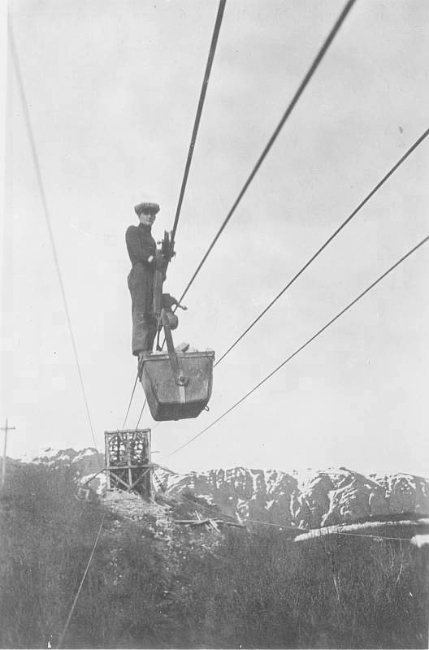
Riding the Bonanza aerial tram. (Candy Waugaman Collection)
It was a 1,500-foot gap where the cable crossed the canyon at the far end of the break-over. The small creek was 300 to 400 feet below Warren's bucket. It had become gusty over Bonanza Canyon. Due to the length of the crossing, in combination with the rising wind, an unnerving swing developed in this long stretch of cable.
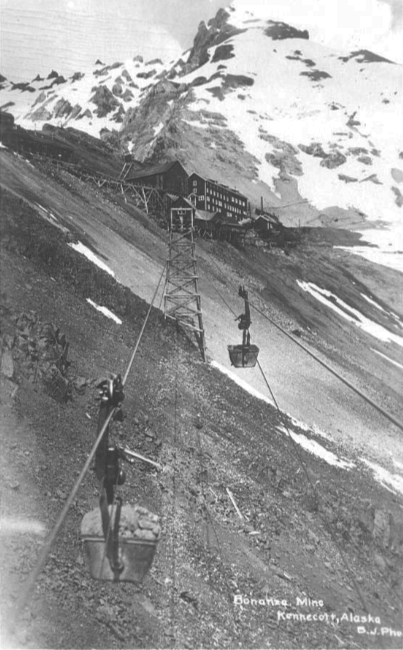
Looking northeast up the 16,000 foot-long Bonanza aerial tram toward the main Bonanza barrack, mess and amusement hall, circa 1919. (McCarthy-Kennicott Museum)
The faint hope that some of these structures could be reused remaind, but superintendent W.A. Richelson doubted that. He was intimately familiar with the inner workings of the entire 52-mile mine system. There was virtually nothing left in there to remove. Most of the recoverable copper ore had been wholly depleted. There remained one sizable area knows as the boundary pillar, on the claims boundary between Bonanza and Mother Lode. Although Richelson's final report for 1938 woud state that all the ore had been removed, this was not really true.
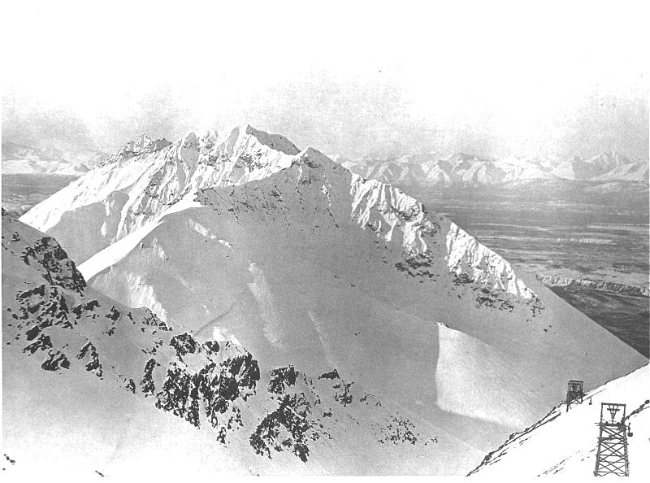
Porphyry Mountain and the top of the Bonanza tram as seen from the Bonanza mess hall. (University of Washington, Special Collections, #15556)
Once again it was a beautifully clear day with only light breezes. The spectacular view from the Bonanza barrack included the backdrop of the distant, white-capped Chugach Range. The southern end of Kennicott Glacier near McCarthy had striations which could only be seen from above. Most eye-catching was the west-facing rock glacier, which ended 1,500 feet above Kennecott, while originating near the summit of Porphyry Mountain.
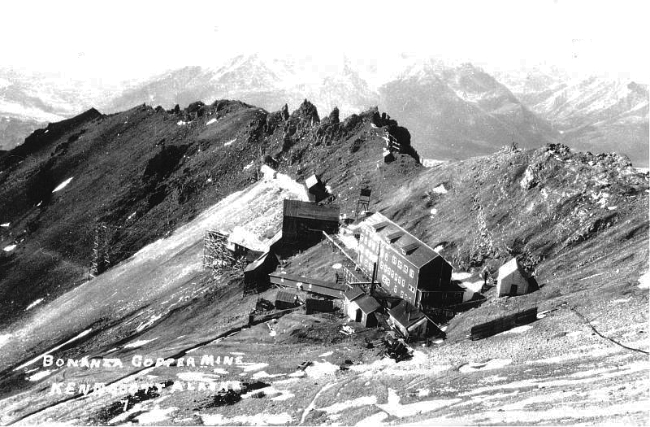
A view of Bonanza, circa 1920, looking southwest. (Alaska & Polar Regions Dept, University of Alaska, Fairbanks, Ralph MacKay Collection, 64-75-7)
The Bonanza and Jumbo have already seen their heyday. We have no reason to believe that any significant new ore bodies will be discovered in either of those mines. You will soon be asked to begin preparing a plan of retreat for Bonanza, Jumbo, and Erie. (Stephen Birch talking to the engineering staff assembled at the Bonanza mess hall, July, 1924.)
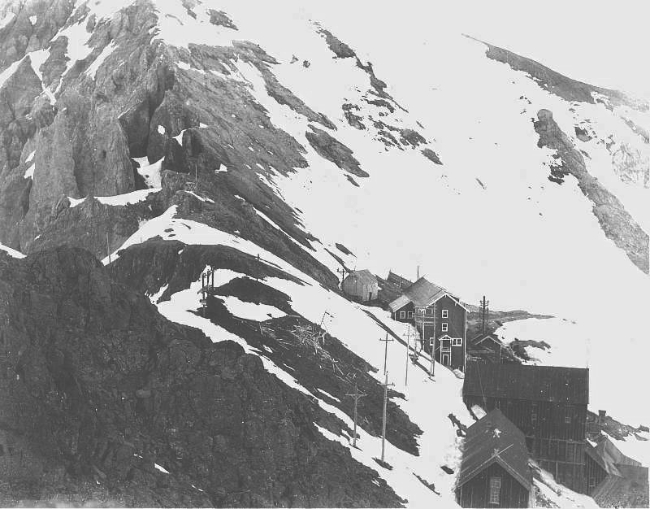
The Bonanza mine site, looking northeast. In the foreground is barrack No. 1. In the center is the ore bunker and tram terminal. The white-trimmed building is the main barrack and mess hall building No. 2. (Alaska & Polar Regions Dept, University of Alaska, Fairbanks, Nat Good Collection, 79-102-84.)
We have always prided ourselves on our engineers. We run a first-class operation only because of you and those who came before you. We have stacked up a list of engineering achievements between the mines and the railroad which will probably go down in the history books...
I thank every one of you for your very significant contributions to the Kennecott which has become our home - the Kennecott which in some way will be with each one of us all the rest of our lives. (Superintendent Douglass speaking to the engineering staff assembled at the Bonanza mess hall, July, 1924)

Looking down the Green Butte tram to the main camp at McCarthy Creek, c. 1928. (University of Washington Special Collections, #15566)
Beyond the lower Green Butte camp was the nearly sheer wall which was the east side of the canyon, rising several thousand feet. The aerial tram extended from the creek for a vertical distance of 1,200 feet to the center portal. The upper camp was out of sight, due to low-lying fog. John Barrett pointed up into the fog and asked Cap and Johnny the same question he asked all newcomers. "Somewhere up there beyond the low fog line is where you two new apprentices are headed. Have you ever ridden an aerial tram before?"
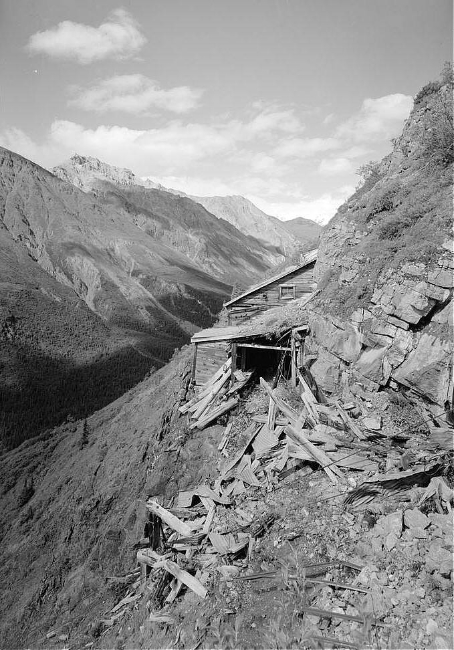
Looking beyond a Green Butte center portal, near the ruins of the upper tram, up McCarthy Creek canyon toward Bonanza Peak. (Historic American Engineering Record, 1981)
Johnny's eyes followed the rock glacier to the narrow part of the steep-walled canyon in the direction of Mother Lode. It would soon be dark enough to see the lights from the upper camp reflecting off the south face of Marvelous Ridge. The camp itself was hidden by Independence Ridge. In the distance, above Mother Lode camp, was the nearly 7,000-foot Bonanza Peak, the tallest point on the ridge.
"Cap, if you and I were to stand up there, we could probably see hundreds of miles. That's the peak we saw above Kennecott from the tracks. It overlooks this area like Spirit Mountain watches over Nicolai's country from Bremner to Chitina. We need to climb that peak one day just to see what's up there." (Johnny Gakona to Cap Goodlataw at Green Butte, August, 1924.)








