|





|
|
Arctic Mining & Development Company, 1897-1898
Klondike Gold Rush, 1896-1899
Arctic & Northern Mining
Dateline: October 19, 2024.
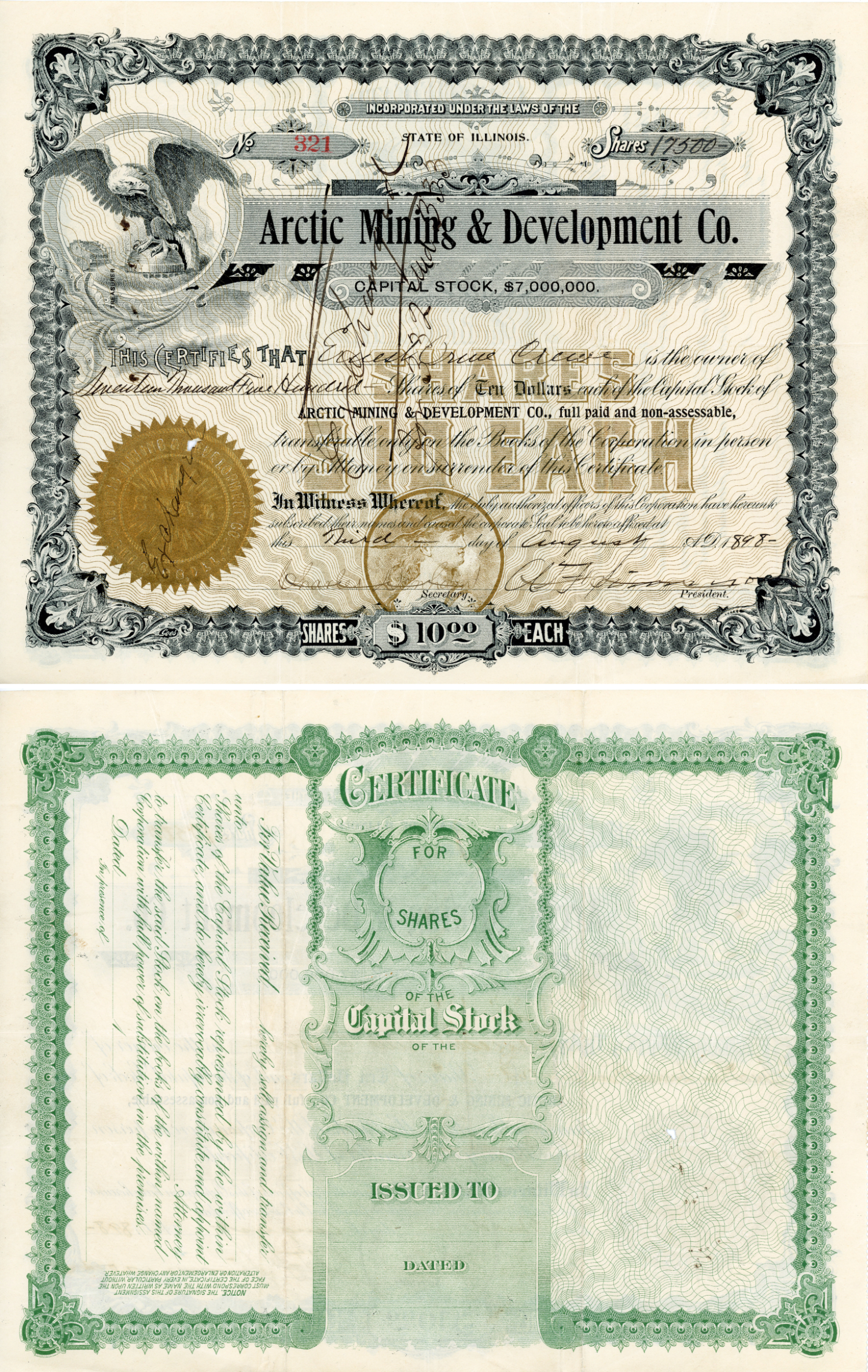
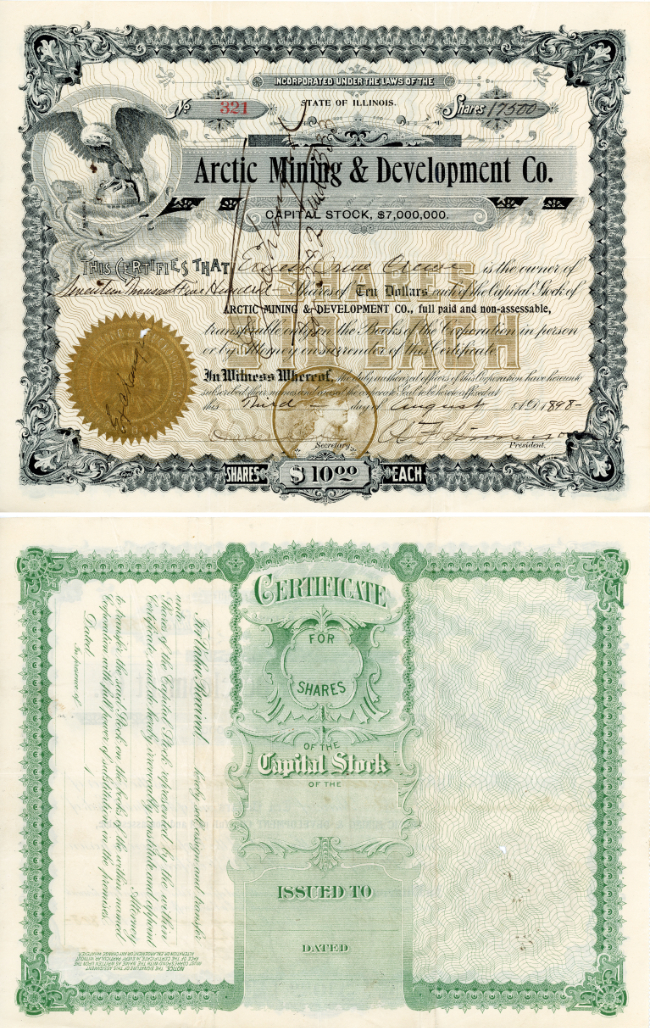
This company history was prompted by finding a share certificate for the Arctic Mining & Development Company, dated August 3, 1898, that I bought many years ago, probably on eBay. When I began compiling this, I had little idea where they operated, or planned to operate. Not until they had given up in the summer of 1898 was the Koyukuk River ever mentioned. The story does gives glimpses at what it took to get into the Yukon and Alaska, and the story is typical of that of hundreds of other companies formed to cash in on the rush to the northern gold fields, real or imagined.
News about the Company:
Thursday, July 25, 1895: The Santa Cruze Daily Sentinel (Santa Cruze, California) publishes the first report by Dr. E. O Crewe about the Yukon river gold fields - "Dr. E. O. Crewe of San Francisco has returned from the placer mines on the Yukon river in Alaska with first authentic news of the mines. He has a pocketful of good-sized nuggets to show there is gold in the Yukon country."
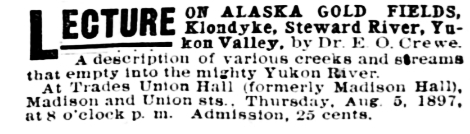 Thursday, August 5, 1897: First ad for Dr. E. O. Crewe as an Alaska gold fields expert (The Chicago Chronicle).
Monday, August 16, 1897: Following a lecture by Dr. E. O. Crewe that drew several hundred people, The Chicago Tribune published a fairly lengthy report by him - read the entire article here. His story greatly exaggerates how easy the journey is.
Tuesday, August 17, 1897:
The Chicago Chronicle (Chicago, Ill.)
Dr. E. O. Crewe of 167 Dearborn street, who three years ago returned to this city after a stay of several years in the gold abounding country of Alaska, says that he knows of a stream 500 miles north of Fort Yukon that literally abounds with the much coveted metal. He zealously guards the exact location of the stream, but says it is a tributary of the Yukon river and it is four miles long. He predicts that as soon as this El Dorado becomes known to the miners in Alaska a settlement which will rival Dawson City will grow up on its banks.
The circumstances which attend the discovery of this stream read like a novel. While traveling on a dog sled with Bishop Tosi of Alaska to visit a sick white man several hundred miles to the north, they came upon a village of Indians, among whom were
several persons ill. By bringing them all back to health Dr. Crewe says he gained their confidence und one night during their stay among them an old warrior showed him a handful of dirt, which he said he had taken from the bank of a stream some miles away. After examining it carefully the doctor says he discovered many small nuggets of gold and much gold dust in it. He believes the stream is very rich in deposits of gold and next Wednesday will leave this city to visit its banks once more.
Mrs. John Parkison, although nearly 60 years old, has asked the doctor's permission to go with him, accompanied by her husband and children, when he makes his trip
to Alaska.
Thursday, August 19, 1897: "Chicago, Ill., Aug. 19-The prospectus of the Arctic Mining & Development Company (Limited) has been prepared and is about to be circulated among would-be investors. The concern is capitalized at $7,000,000, distributed over 700,000 shares at $10 each, the stock to be fully paid and non-assessable. The officials are: Wiliam A Simmons, president; Walter M. Scott, vice president and treasurer; Charles Denham, secretary; Dr. Ernest O. Crewe, general manager; J. F. Homan, superintendent, and George Richards, auditor."
Saturday, August 21, 1897:
The Chicago Chronicle (Chicago, Ill.)
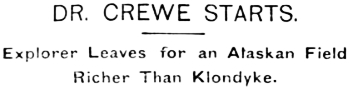
Dr. Ernest O. Crewe, the Alaska explorer, accompanied by a small party of mining experts, left Chicago last evening for Alaska. He goes to the gold fields of the north as the advance guard of the Arctic Mining and Development Company.
The Klondyke region is not the objective point of the Crewe party, as the explorer claims to know of a district containing more wealth than the Klondyke, and on American soil.
"I know how great in wealth the Klondyke district is, because I have been there, and I am positive that this district is five, yes ten times, greater in wealth, and it is easy to get at," said Dr. Crewe.
Tuesday, August 24, 1897:
Evening Telegram (Superior, Wis.)
RICHER EVEN THAN KLONDYKE.
Chicago Inter Ocean:
Dr. Ernest O. Crewe, accompanied by W. M. Scott, a mining expert, and
Charles J. Hall of the Belding-Hall Manufacturing Company, New York, left Chicago last evening over the Santa Fe for Alaska. They go to the gold fields for the Arctic Mining and
Development Company, which has offices at 806 Atwood building. Dr. Crewe claims to know of a district containing more wealth than the Klondyke and which is on American soil. The party will establish claims on the site Dr. Crewe discovered in 1895.
"There is not a trading post nearer than 500 miles to the place where we
are going," said Dr. Crewe, "but we intend to establish one. I shall call the spot Netherton, after a pretty spot in England where I was born. And I am certain the population of Netherton will be greater than Dawson City or Circle City by next fall. I know how great in wealth the Klondyke district is because I have been there, and I am
positive the Netherton district has far greater wealth, and it is easy to get at. I am going now because I know the route, and how to get there. Others will not follow until spring."
Thursday, August 26, 1897:
Deseret Evening News (Salt Lake City, Utah)

Dr. E. O. Crewe, Charles J. Hall, and W. M. Scott, representing The Arctic Mining and Development company of Chicago, were at the Reed last evening on their way to Klondike, says the Ogden Press. They expect to reach Dawson in less than forty days from the time of leaving Seattle.
Dr. Crewe has spent the last three years in Alaska, and says the climate
is no more disagreeable or vigorous than that of North Dakota, that excepting parties that may have been lost no one has starved there during the last three years, and that there is
food enough in Circle City to feed 10,000 people. The doctor was one of the first twenty men at Circle City, having been surgeon of the Alaska Commercial Co., stationed at St. Michaels Island the preceding year. With Father Tosi, bishop of Alaska, the doctor took a fifty-four day dog ride of 1,900 miles, seeing but one white man in that time.
The doctor's opinion is that the 100 or more creeks flowing into the Yukon from the north are as rich as the Klondike region, and is now en route to establish the Chicago company on a discovery of his own, some 500 miles northwest of the Klondike
region.
Sunday, August 29, 1897:
The Sunday Oregonian (Portland, Oregon)
SEATTLE, Aug. 28-The steamship Willamette sailed for Dyea and Skaguay
late this afternoon, with 250 goldseekers aboard. On a previous voyage, she carried 800 passengers. The freight was heavy, bunk room being given up to cargo. The Willamette has 300,000 feet of lumber and 400,000 shingles. She has 800 tons of coal, a part consigned to the Treadwell gold mine on Douglas island, and the rest to Hunter's bay and the government at Sitka. There were 100 horses, 10 mules and 40 cattle. The Willamette's passenger list includes Dr. E. O. Crewe and W. M. Scott, of Chicago, and C. G. Hall, of New York, officers of the Arctic Mining & Development Company, of the former city. G. P. Sproul goes north to carry the United States mail from Dyea to Circle City.
Sunday, August 29, 1897: "Will sell 5,000 shares Arctic Mining and Development company stock [par value $10 per share] for $5,250; richest Alaska mines. Adress M 606, Tribune office." (The Chicago Tribune, Chicago, Ill.)
Sunday, August 29, 1897:
St. Louis Daily Globe-Democrat (St. Louis, Missouri)
Special Dispatch to the Globe-Democrat.
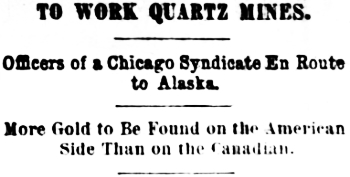
SEATTLE, WASH., August 28.-One of the most noteworthy expeditions that has been sent to the Alaska gold fields this year sailed to-day on the Willamette. The
expedition came from Chicago and included Dr. E. O. Crewe and W. H. Scott, of Chicago, and C. J. Hall, of New York. They are officers and stockholders of the Arctic Mining and Development Company, of Chicago, which is capitalized at $7,000,000. Its stockholders include some of the wealthiest men in Chicago.
Dr. Crewe spent three years in Alaska. He went there for his health in 1893 and traveled a year with the Jesuit Bishop Tosi. He became interested in mines in the vicinity of Circle City and came back to civilization eighteen months ago with $119,000. Of this sum, $48,000 was ints own property.
The Crewe expedition will make Circle City its headquarters. It will carry on its operations exclusively in Alaska. Dr. Crewe believes that more gold will be produced on the American side than in the Northwest Territory. Primarily, the object of the expedition is to develop quartz mines in Alaska, of which Dr. Crewe has knowledge, in which ore is found running $300 per ton. The party is supplied with ample funds, however, and will be prepared to take up any good proposition.
Four men will be employed to help pack the outfits carried by the party over the Chilkoot Pass. Two mules will be taken along as pack animals. It is the intention
of the party to push through with all dispatch to Circle City. They did not take a large supply of provisions, preferring to purchase them in Alaska.
Sunday, September 5, 1897: "New Incorporations: The Scott Waters and Simmons Mining company, Chicago, certified to a change of name to the Arctic Mining and Development company." (The Chicago Tribune, Chicago, Ill.)
Saturday, September 25, 1897:
Evening Telegram (Superior, Wis.)
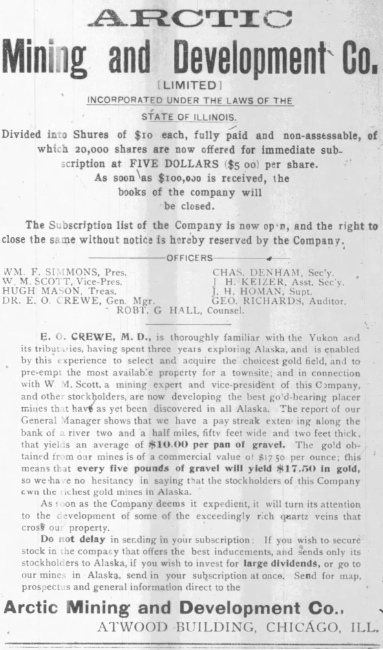
The company prospectus includes a comment that suggests that investing in the company may be a way to get to Alaska:
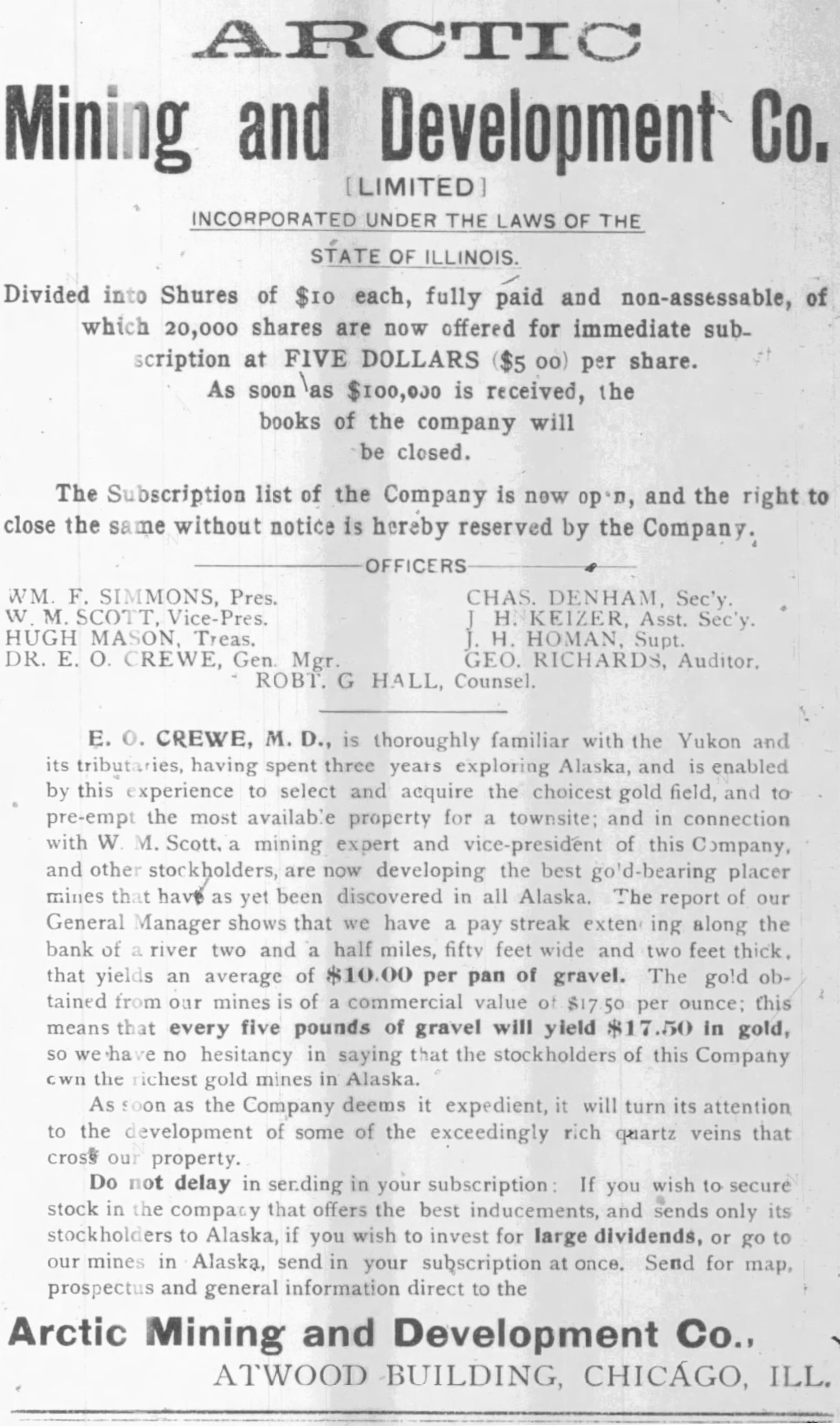
"E. O. Crewe, M. D., is thoroughly familiar with the Yukon and its tributaries, having spent three years exploring Alaska, and is enabled by this experience to select and acquire the choicest gold field, and to pre-empt the most available property for a townsite; and in connection with W. M. Scott, a mining expert and vice-president of this Company, and other stockholders, are now developing the best gold-bearing placer mines that have as yet been discovered in all Alaska. The report of our General Manager shows that we have a pay streak extending along the bank of a river two and a half miles, fifty feet wide and two feet thick, that yields an average of $10.00 per pan of gravel. The go!d obtained from our mines is of a commercial value of $17.50 per ounce; this means that every five pounds of gravel will yield $17.50 in gold, so we have no hesitancy in saying that the stockholders of this Company own the richest gold mines in Alaska.
As soon as the Company deems it expedient, it will turn its attention
to the development of some of the exceedingly rich quartz veins that cross our property.
Do not delay in sending in your subscription: If you wish to secure
stock in the company that offers the best inducements, and sends only its stockholders to Alaska, if you wish to invest for large dividends, or go to our mines in Alaska, send in your subscription at once. Send for map, prospectus and general information direct to the company."
Click on the image to greatly enlarge it in a new window.
Wednesday, September 29, 1897:
Wisconsin State Journal (Madison, Wisconsin)

Mr. John H. Keizer, of this city, who is assistant secretary of the Arctic Mining and Development company, of Chicago, has a letter from Secretary Denham, reporting a letter from the company's representatives in Alaska stating that they had made the pass over the mountains in fine shape, arriving at Lake Lindeman Sept. 11, and expected to leave in their boat the 13th or 14th. They say hundreds of people will be compelled to winter on the pass and at Lake Lindeman. "One party had borses, and attempted to follow our party, and one horse slipped and fell down a terrible pass, and broke its
neck. Many who were doing their own packing got discouraged and turned back. There are now about 100 boats being built at Lake Lindeman. Scott says the party are all in fine spirits, and hope to reach Dawson in ten days."
Sunday, October 10, 1897:
A smaller version of the prospectus in The Sunday Chronicle (Chicago) includes new inducements:
"20,000 shares are now offered at $5.00 PER SHARE.
Buy now and double your money.
Do not delay in sending in your subscription if you want the best. Secure stock before advance to par.
Dr. Crewe, general manager of this company, and other stockholders are now at our mines in Alaska, and reports received show OUR MINES ARE THE RICHEST DISCOVERED... A single pan has shown $80.00 in gold.
DO YOU WANT A FORTUNE?
We offer to send another expedition of 40 stockholders, furnishing them free transportation, to our mines, supplies for one year, and a guaranteed salary, or will
give a lay (a part of mine to work on shares).
WILL YOU JOIN A CERTAINTY and go to the greatest discovery of the age?
NO PROSPECTING TO DO.
Stock in this company is a sure safe investment and will pay enormous dividends."
Tuesday, October 12, 1897:
Wisconsin State Journal (Madison, Wisconsin)
Madison, Oct. 12, 1897
Now is the time to take advantage of the sale of mining stock. The stock offered for sale at the reduced rates by all the reliable companies is now nearly all taken up. The Arctic Mining and Development company have a few more shares to be sold at $5.00 (par value $10.00) Several of the noted mines - Le Roi, War Eagle, Josie, Center Star, Iron Mask, Nickel Plate, City of Spokane, Black Bear, etc - are paying large monthiy dividends, with returns in two years of $4.60 in dividends alone for each dollar invested. Stock in these mines was sold at 25c per share, now quoted at $8.00, and even at
that price there is none on the market. Our company will soon be working their mines that promise to yield large dividends to the stockholders. Our mines are without a parallel in all Alaska for riches, and access to them is easy, being located on one of the tributaries of the Yukon navigable up to our town site, Netherton, and within two miles of the mines. Call at 114 State street and get our prospectus, circulars and map and learn what we have to offer.
ARCTIC MINING & DEVELOPMENT CO.
JOHN H. KEIZER, Asst. Secy.
Sunday, November 7, 1897: a small Help Wanted ad is run in many small newspapers: "MALE HELP - $10 per day, transportation and provisions for forty stockholders to join Alaska expedition. Arctic Mining and Development Co., Chicago."
Sunday, November 14, 1897: a slightly different Help Wanted ad is run in many small newspapers: "KLONDIKE - $10 per day wages; transportation and provisions tor thirty stockholders to join Alaska expedition. Arctic Mining and Development Co., Chicago."
Thursday, July 21, 1898:
The Daily Inter Ocean (Chicago, Illinois)

SEATTLE, Wash., July 20.-William Scott of Chicago, of the Arctic Mining and Development company, who is now eastward bound after extensive investigations for his
company in Alaskan mining fields, says the Koyukuk district Is the richest in all Alaska
and sure to become the greatest mining region in the entire Northwest. Mr. Scott said:
"Concerning the much-talked-of gold fields of the Koyukuk country, I can say with truth that I believe them to be the richest in all Alaska. True very little actual work has been done so far, yet the prospects are unusually fine. Tramway bar, something over 125 miles above Arctic City, has for more than ten years paid handsomely. Eighteen miles above this bar is found Porcupine creek, and a short distance further is Lewis and Twelve-Mile creeks, both good paying streams. On Twelve-Mile creek there are
many sluice boxes in operation, and more will be before the summer's end. Last April two
men took out $30,000 in two weeks. On the south fork of Koyukuk is found Davis creek, the prospects being above the average. Ten miles above Arctic City is Malaruoot creek, claimed by those who know it to be good. From what I have seen of the country I do not hesitate to say that I believe it will in time produce more gold than any other section in Alaska."
Mr. Scott tells of a tremendous flood which destroyed many Indian huts and villages. "We left Fort Hamlin in March last," continued Mr. Scott, "for the head waters of the Koyukuk. in time we reached the deserted mining town known on the maps as Arctic City. It was a place of comfortable homes and business houses, but it exists now only in memory. When the side streams and the Koyukuk river broke up, followed by the
spring thaw, the snow in the mountains melted more rapidly formerly, and the Koyukuk went forty feet higher than was ever known before.
"It came like a cloudburst, taking the natives completely dy surprise. The Indian villages were swept away, while of the deserted but substantially built town of Arctic City not a log was left te mark the one-time promising camp. It seems strange no lives were lost. Hundreds were caught by the water, losing tents and camping outfits, but every one finally reached a place of safety."
It was the intention of Mr. Scott and party to remain inn the Koyokuk country until next year, but the flood swept away their outfit. They were fortunate enough to capture a sack of flour, and for more than two weeks were perfectly contented with dry bread twice a day. Not a pound of meat did they have all this time, though there was game in plain sight every hour of the day. Not finding it practicable to prospect so early in the season, Mr. Scott is now homeward bound, with the avowed intention of returning to the Koyukuk country next spring.
Friday, April 20, 1900: There has been no news about the Arctic Mining and Development Company since the article on July 21, 1898, but The Mining Times (Benton, Wisconsin) reported on this day that "the Cape Nome News tells of the discovery of new and rich finds on the tributaries of the Koyokuk and of the stampede of throngs of Nome miners
to relocate some thousand or more claims that have been thrown open through the failure of their owners to do development work on them."
Click on the image to greatly enlarge it in a new window.
|

|