
|





|
|
The Cenotaphs at Whitehorse, Yukon
Arctic & Northern Military History and Issues
The Whitehorse Star Thursday, November 9, 1978


Memorial monuments for Yukoners fallen in the Great War or "war to end all wars," were dedicated at Whitehorse in June, 1920 and at Dawson City in November, 1924. Neither was built without difficulty.
In Whitehorse, the I.O.D.E. petitioned Gold Commissioner George McKenzie in March, 1919, requesting: "(T)he lot between the Old Hospital building (now Library and I.O.D.E. Rooms) and the street - as a suitable place.
The lot where the "old hospital" stood, which was described as about 100 feet by 40 feet in Block 15, was not marked on the commissioner's map in Dawson City. He obtained the information and on May 1, approved the site in his guise as Crown Timber & Land Agent. Whereupon the ladies changed their minds, requesting instead, the centre of the square at the intersection of Main and Second Streets. However, it was located on the original site.
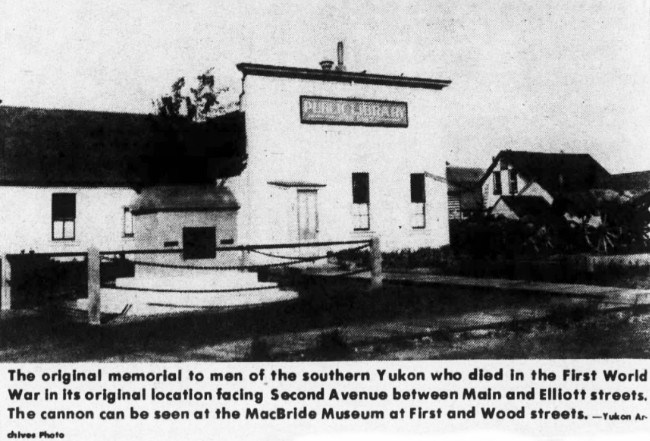
Ostensibly in a safe position, no sooner was the monument installed than a team of two horses attached to the BYN (White Pass & Yukon Route) commissary wagon, took fright. Leaving First Avenue on the run, they raced up Elliott to Second, swerved across the sidewalk and managed to chip off a corner.
No one reckoned with another World War... but Canada declared war against Germany on Sept. 10, 1939 and against Japan on Dec. 7, 1941. Into the fray jumped about
97 men and women who called the Yukon home. To honour those who died, a new memorial was
in front of the new Federal Building at Main and Fourth streets in 1954.
But this did not happen immediately.
There was a grateful attendance at the cenotaph and church service on the first Remembrance Day following the end of the Second World War. By the next, when post-war planning had commandeered the town's ball park for a new Federal Building, a temporary cenotaph was the focus of an impressive Armistice Day parade and service conducted by the Royal Canadian Legion under its president W.M. "Bill" Emery. Brigadier A.B. Connelly, commander of the Northwest Highway System, took the salute from a stand near the Highway System headquarters, accompanied by Emery and Wing Commander G.A. Falkins, RCAF.
In October 1949, a Whitehorse Board of Trade meeting discussed "the deplorable condition of the lot on which the cenotaph stands." That year, while the cenotaph stood alone three blocks away, Remembrance Day was observed as usual at the ball park. Four hundred of the Armed Forces paraded and over a thousand civilians attended a simple but impressive service.
Ever since the I.O.D.E. Library had burned during the war, the cenotaph stood alone in the centre of the large vacant property at Second and Elliott. In 1951, before the Federal Government would permit the Department of Mines and Resources to act on the sale of the increasingly valuable property, the cenotaph had to be removed. Whereupon, agreement was obtained from the I.O.D.E., the Canadian Legion and the Whitehorse Masonic Lodge and the monument was taken to the back of a lot belonging to the I.0.D.E. to be stored until a suitable site was available in front of the Federal Building, then under construction.
By Sept. 10, 1954 the new cement monument had been built at cost by Marwell Construction Co. Ltd. with the company generously donating half the cost. Local donations made up the rest. Hoping to complete the cenotaph with a suitable bronze statue, the planning committee approached Whitehorse sculptor Lilias Farley, but the project failed due to cost and lack of public response.
The unveiling of the second Whitehorse war memorial bearing the 1914-18 plaque preceded the official opening of the Federal Building. The ceremony followed a parade to the site on Sunday, Oct. 24, 1954. Doing the honours was George Gleaves, Dominion first vice-president of the Canadian Legion, B.E.S.L.
The ceremonial party included Brigadier H.W. Love, Wing Commander F.H. Pearce, Judge J.B. Gibbon, Whitehorse Mayor H. Gordon Armstrong and Legion officers.
Following the prayer of dedication by Judge Gibbon and a short speech by Mr. Gleaves, one wreath was laid by Legion President Art Hall and the sounding of the Last Post, the Silence and Reveille completed the proceedings.
Not until Nov. 13, 1967 was the 1939-45 bronze plaque attached. The 1914-18 plaque was moved to the north side of the monument and the new plaque faced Main
Street where fourth stanza of "For the fallen" by Laurence Binyon can be read.
Yet, despite the goodwill and sentiment expressed by the new cenotaph and the additional bronze plaque, no one noticed that the two separate bronze name plates of two men who died during the 1914-18 war were left in their original place at the front of
the cenotaph...and remain there today.

The second bronze plaque, commemorating the men from the southern Yukon who died during the Second World War, reminds us also that all but one are buried far from home. They are only a part of the more than one million Commonwealth servicemen - nearly 65,000 Canadian - who lie in 16,000 cemeteries in more than 100 countries reverently cared for by the people of the country in which they died.
The Commonwealth War Graves Commission in the Veterans Affairs Building,
Ottawa, maintains a register of the names of those who died during the wars, and where they are buried. Some, like Struan Alexander Higgins (K 49920) who was Tpr. of the B.C. Regiment R.C.A.C. who died Aug. 9, 1944, are recalled by a poem "The Unknown Soldier" written by F. Sgt. Ted Richards of Whitehorse, himself killed in action six months later...
There's an unknown grave in the battlefield
Rising o'er Europe's mud.
There's an unknown sound in the sodden ground
That's wet with a Soldier's blood
Though his life he gave and his soul's passed on
He has not died in vain;
For though the world has lost this soldier brave -
The Earth's the one to gain.
He may be yours and he may be mine,
This Mother's son that's gone;
But he died for a cause that was just and true,
And his name shall live on and on,
For in every war there's an unknown lad
That dies in the battle's heat;
And his grave is held as a symbol dear
Where the Gold Star Mothers meet
Oh, Soldier, as we pass your tomb
We breath a reverent prayer;
And send it up to Him on high
For you are in His care.
Little did you ever think
As you fought by your buddy's side,
That you'd represent for the Allied Force,
All the men that died.
Higgins, who worked for the mining company on Dominion Creek, enlisted Jan. 8, 1943. He is one of 4,000 buried in the Bayeux War Cemetery, France and his name is commemorated on Panel 19, Column 13 of the massive Bayeux Memorial.
Herbert Logan Corbett (K 73831) of the 2 Tunnelling Coy. Royal Canadian Engineers, died Nov. 28, 1942. He is buried on Gibraltar, in the Gibraltar (North Front) Cemetery. Age 39, he was married to Xhuzune Firenze Corbett of Dawson City.
Joseph MacDonald (K 73928) of the 3 Medium Regiment Royal Canadian Artillery, died Aug. 12, 1944, age 41. He is buried in Plot 10, Row F, Grave No. 12 at
Bretteville-sur-Laize Canadian War Cemetery near Caen, France.
Robert Morris Westman (R 101306), warrant officer with the R.C.A.F., 458 Squadron, died age 27 on April 29, 1943. He is buried in the centre of Sicily, in the
Agira Canadian War Cemetery, his grave marked Plot C, Row H, Grave No. 369.
The War Graves Commission notes that of the 490 Canadians buried here, 13 are from the R.C.A.F. Edward Gordon Coke Richards (R 25612) F Sgt R.C.A.F. was an air gunner with the 49 (R.A.F.) Squadron when he died March 15, 1945. One of 3,576 buried in the Berlin 193901945 War Cemetery, his grave is indicated in the traditional manner.
Also buried in Germany was pilot officer Ralph Edward Good (J 88030), air gunner with the 428 Squadron R.C.A.F., who died Aug. 19, 1944. He is buried in Sage War Cemetery, 15 miles south of Oldenburg in Plot 10, Row C, Grave No. 13.
Private Harry (Henry) Davis (K 76942) of the Lake Superior (Motor) Regiment R.C.1.C,, died Jan. 15, 1945, and is buried in Plot 12, Row H, Grave 5 at Holten
Canadian War Cemetery in the Netherlands.
The majority of the 1,347 Canadians buried in this cemetery died during the last stages of the war in Holland and during the advance of the Canadian 2nd Corps into northern Germany and across the Ems in April and early May, 1945.
Buried in the Carcross Cemetery is Private Richard Johnson (K 69683) a gunner with the Royal Canadian Artillery who died July 2, 1944. Age 20, Richard
was the son of Billy and Martha Johnson of Carcross.
And buried in the Whitehorse Cemetery is Patrick McCanney (R.211788) LAC with the RCAF. Patrick, age 22, was the son of Michael and May McCanney, nephew of Miss M. McMenemin of Montreal.
Chief-among Yukoners who distinguished themselves in WWI was Michael James O'Rourke. (See "Canada's V.C.s" by Lieut-Col. G.C. Machum, Toronto, McClelland & Stewart, 1956).
Born in Limerick, Ireland, March 1878, he had gone to the Klondike from B.C. in 1897, and from there to the Boer War in '99.
In 1914 he went overseas with the first Canadian contingent and became the most decorated man in the Canadian Army with the Military Cross, the Victoria Cross, later the DCM and the Croix de Guerre.
O'Rourke was awarded the Military Medal for services in the Mouquet Farm Sector during the Battle of the Somme on Sept. 8, 1916. His Victoria Cross was won the following year during the Hill 70 fighting of Aug. 15-18, 1917.
Ready to challenge life on all fronts, Mickey O'Rourke finally left adventure behind and retired on Vancouver Island.
|

|