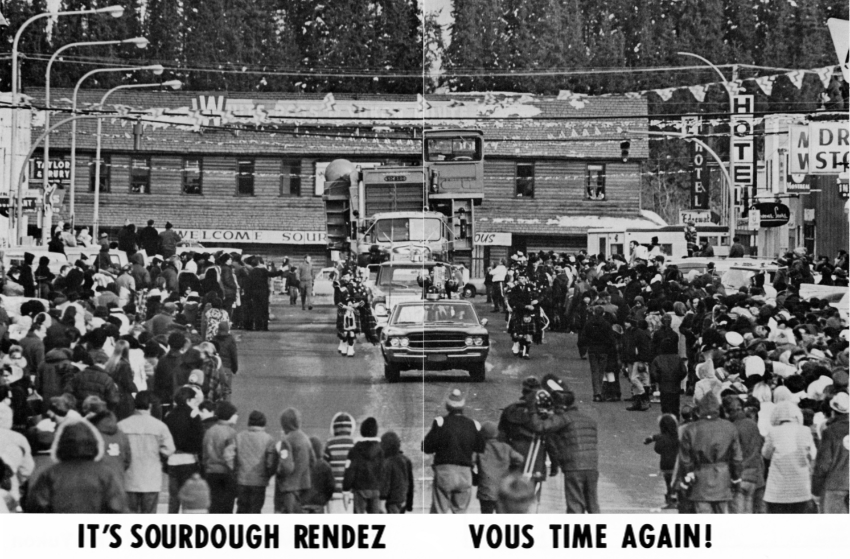
The history of Whitehorse, Yukon
Dateline: February 22, 2026.

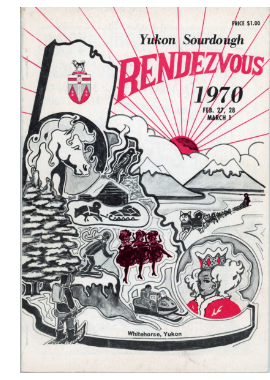 This history was published in the program for the 1970 Yukon Sourdough Rendezvous.
What is the Yukon Sourdough Rendezvous?
By Athol Retallack
For 51 weeks of the year Yukoners go about their respective business as
individuals do in any thriving part of the country - keeping office hours, store hours, trucking schedules, contract commitments, attending meetings, complaining about the cost of living and income tax, but on the 52nd week around the end of February a phenomenon takes place.
Whitehorse becomes a happy-go-lucky, uninhibited town of sleek Swiftwater Bill Gates gambler types, sourdoughs fresh from the creeks who have it made, high stepping can-can girls, velvet gowned and befeathered matrons who have that air of knowing that they are worth their weight in gold. Dog drivers in the flashiest parkas and mukluks, and everywhere the beards, beards, beards, all sizes, density and colors.
Overnight staid business establishments turn into Red Feather Saloons, or riverboats, and your favourite salesgirl sports a Gay Nineties swim suit. It is Sourdough Rendezvous time!
It is a winter carnival with that difference, its Yukon style. Dog team
races, flour packing contests, sourdough breakfasts, snow shoe baseball, Queen contest, art shows, parades, dances, skiing, rifle shoots, games nights, if it is fun it is on the program.
Every organization and individual in town takes part, one way or another. The Boy Scouts serve snacks during the dog team races, the Drama Club stages Gay Nineties shows wherever the action is, church services are held on the river bank on Sunday morning.
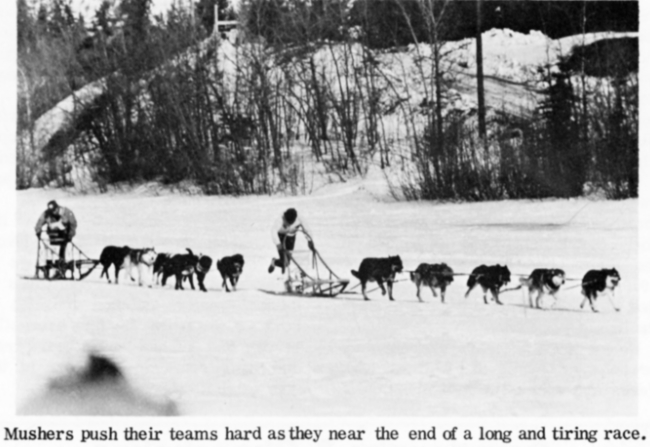
The action is all over town, but there is a fascination about the dog
team races no one can resist, the excited barking dogs, the tension of waiting for the starter's gun, the shout and snap as the team hits the traces and they are off on a 15-mile run downriver, the one day portion of the 45-mile race.
Already there is a tradition about the numbers the drivers wear - no
one wears number 8. This was the number worn by the woman dog musher, Babe Southwick, whose gallant performance in the races in 1965 cost her her life. The Babe Southwick Trophy has a special meaning to the musher who wins it.
The idea of a Sourdough Redenzvous was sparked over coffee cups one Fall
morning in 1961 by the same half dozen businessmen who had headed up the Whitehorse Winter Carnival of 1946, 47 and 48. The proceeds from that effort had been sufficient to start
the local Civic Center.
No matter how loyal a Yukoner may be, he must admit that between New Years and spring life in the north hits the doldrums, socially, spiritually and financially.
To offset this tag end of winter lull, to get everyone involved in a just-for-fun celebration, to encourage the Indian people to participate with their skills and handicrafts, was the prime purpose of the event and it would naturally follow that the area would benefit financially too.
The idea caught on and service clubs, individuals, business people offered to sponsor the various events which become more varied and imaginative each successive year.
Yukoners no longer need dread the grey, dull, pre-spring days. There are costumes to be made, dogs to train, floats and store decorations to design, winter softened muscles to firm up. Even for the less energetic, he can just sit and let his beard grow and still come up a winner at the Sourdough Rendezvous.
Rendezvous 1962
On October 16, 1961, a meeting called by the Whitehorse Board of Trade
with Rolf Hougen acting as pro tem chairman and representatives of 30 local organizations in attendance set the stage for the birth of the Winter Carnival known as the Yukon Sourdough Rendezvous. Flight Sergeart H. Kane was named as chairman of the fledging
festival and a Board of Directors composed of Harry Boyle, Major A.G. MacAulay, Bert Wybrew, Bill Grant, Zoe Cousins, D.F. Tessier was also named. Managers were Beth Drayton
and Velma Nash, and Bill Drury, Rolf Hougen and Bob Campbell (who was Director of the last Winter Carnival held in 1947) agreed to serve on an Advisory Committee.
The first business of the new Directorate was to sponsor a name contest for the carnival which would be held during the third week of February. Rolf Hougen made the comment, that from a business point of view, the 'Rendezvous' would provide an enjoyable time for the community and it would serve to attract Outside residents to the City.
The festivities opened on Friday evening, February 16th, with a parade
followed by a Sourdough Shoot, Indian Dances and Dances for the public at three centres in town. A Beard contest that night decided winners in the following categories: Bushiest, Most Colourful, Longest, Wierdest, Skimpiest and Most Artistic.
On Saturday, the first heat of the Dog Sled races began followed by the Sourdough Shoot, Junior Dogs, Snowshoe Races, Tug o' War, Boy Scouts and Girl Guides Exhibition, Talent Show, Indian Dances, More Public Dances and the Queen Crowning at the
Ice Palace with its accompanying raffle for one prize of $500 and five prizes of $100.
 On Sunday the final heats of the Senior Dogs were run, as well as a Ski Meet, Sourdough Shoot, Girls' Hockey Game and the presentation of prizes and trophies by the Queen at the Ice Palace.
The entire community was caught up in the planning and execution of the
Rendezvous. The sign makers who hung a welcome to "Rendezvous" on the White Pass station were perhaps a little eager but meant well. Belle Desrosiers organized the first dog races on a much shorter course than is run now. The Drama Club built the Ice Palace and continued to do so for quite a number of years until this task was taken over by the Jaycees.
The first announced Queen contestant was Helen Van Bibber of Champagne
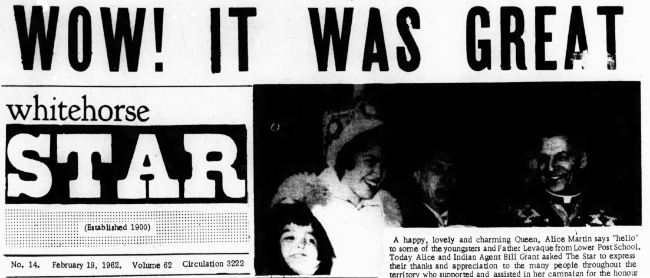
who competed in a contest which attracted 9 other girls, none of them from outside the Yukon, which was won appropriately enough by Miss Alice Martin, sponsored by Indian Affairs, who had grown up in Moosehide and was a very attractive young woman.
The dog races sponsored by the Yukon Dog Mushers Association drew six Yukon contestants and were won by Andy Smith of Teslin in 89 minutes and 57 seconds aggregate time, beating Father Rigaud of Ross River who came in 90 minutes and 7 seconds. Third was Park Southwick of Burwash. Smith at this time was 50 years old and had won the last races in Whitehorse in '47, and in '62 took home $500 in prize money.
The '62 Queen contest was full of ceremony with pomp and circumstance
provided by the RCAF cadets, the RCMP and the Dragoons.
The Hillcrest community threw a Riverboat Ball the weekend prior just
to get things started in the right spirit and people had a chance to try out their costumes and beards. The Rendezvous weekend dances were so full that one enterprising man fled to a bar and, so the story goes, auctioned off seats he had saved beside him.
When the races were announced in '62 Fred Stretch of Carmacks appeared on the starting line mushing a community team composed of Mac the lead dog, who belonged to Constable Bill Craig, and dogs owned by Mary Luke, Wilfred Charlie, George Faircough and
Professor Berry of Conwest. No one at this point maintained a working team in Carmacks. It seems that when Stretch was competing on Sunday, "Mac" on the return leg spotted an RCMP parka on the river bank and thinking this might be his owner and seeing as it was near lunch, the team proceeded towards the bank for his food - an untimely lunch break if ever there was one.
In 1962, a participant in the festivities only had to keep fixed in his
sober or otherwise mind 17 places and times.
The front page of The Whitehorse Star made the community's feelings about the first Sourdough Rendezvous very clear.
Rendezvous 1963
The 1963 Chairman was Rolf Hougen, Manager Bert Arsenault, and the Board
composed of Major S. Goat, Derek Tessier, Joe Estock, Bob Erlam, Bud Fisher, Zoe Cousins, Jim Cameron, F.S. Westfall and Jack Worsell.
Many new events were included such as Ice Fishing. The local ladies compiled patterns of Days of '98 costumes and displayed and reproduced them for the public in an effort to get everyone "dressed-up."
The 1963 Queen was Miss Gwen Carswell, sponsored by the IODE. As in '62, the Kangaroo Court sat every Saturday as was announced in the papers. Participation in all events increased in '63.
The dog races over what would appear to be a longer track (there is very little information as to the length of the dog race course) was won by Father Rigaud of Ross River in 1:42:05; second was Stephan Frost of Old Crow in 1:45:05 and third was Andy Smith of Teslin in 1:50:29.
Wilfred Charlie won the Snowshoe Races followed by John Craike and Denny Jackson. At this time there were two other contests pertaining to the Senior Dogs. Babe Southwick won the Gee and Haw; second was Wilfred Charlie and third Stephan Frost. Father
Rigaud won the Best Turned Out Dogs followed by Alex Van Bibber and Wilfred Charlie.
In '63 Moustache and Mutton Chop categories were added to the Beard Judging Contest.
Rendezvous 1964
In 1964 the rules of the dog races, which right from the first proved the
most exciting event, were changed so that each team had to start on the first day with a minimum of five dogs running and could cross the finish line with four in the sled if necessary. All sleds were to have brakes and the event was changed to a three-day contest. The race course was a grueling almost 16 miles.
The Queen contest was won by Diane McNeil, the Royal Canadian Legion
candidate who won over eight other girls. She won a one-week all-expenses-paid trip to Fairbanks courtesy of Wien and a $200 gold poke. All other girls received $50 gold pokes. The raffle was won by a San Francisco woman who took home a $500 poke and five others took home $100 pokes each.
 Bud Fisher continued in the tradition he had established in '62 and '63 as the Hangin' Judge of the Kangaroo Court, and in '64 one of his beardless customers was Commissioner Gordon Cameron.
For the first time Sourdough breakfasts were served, and the Carling trophy was awarded the aggregate dog winner.
1964 was the year PWA flew into Ross River to bring out their dog musher
entries and in the time it took to load the plane one of the teams decided to make one more practice run and off they mushed. PWA returned the next day for the errant team. The
incident gives some idea of the competitive spirit and colour of the races.
1964 drew about 1500 visitors from outside Whitehorse and the hotels were
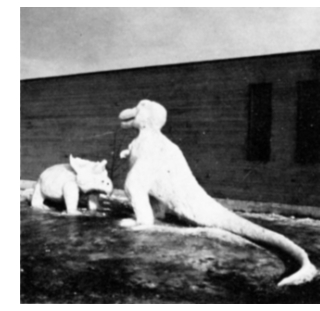
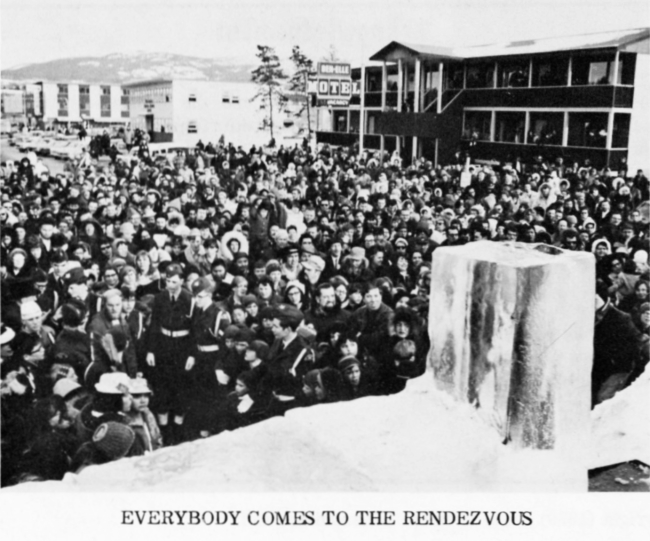
jammed full. The Flour packing contest that year was a tie between Jim MacCormick and Danny Jackson at the 500 pound mark. For the first time there were ice sculptures on the lawns built for a special contest [seen to the right]. Babe Southwick organized the dog races that year when Rendezvous ran from Feb. 28th to March Ist. The Chilkat dancers came to the festivities with $15,000 worth of costumes.
1964 was the last year the Army participated in full force (no pun intended).
Directors for that year were: Rolf Hougen, Chairman, and Jim Cameron,
F/S Les Plummer, Mr. Peter Hudson, Joe Estock, Bud Fisher, Al Prince, Frank McCall, H. Know, Major Stan Goat, Art Messier and G.H. Parker directors. Manager was Dave Robertson.
That year's events included: Basketball Tournament, Snooker, Bowling,
Barbecue at the Ice Palace Crowning, Hockey, Ice Show, Poster Contest and fireworks at the Crowning ceremonies.
Rendezvous 1965
1965 marked the first time that the school children were given a holiday
Friday and the first time a guest had been invited from the Outside. Miss Irene Seeseequasis, Canada's National Indian Princess and a Cree was invited and did attend. (Bella Kay from Old Crow had been runner-up in the Princess pageant.)
The town was packed with visitors and one store sold 2,000 hot dogs in
five hours; there was even talk of extending the '66 Rendezvous to a full week. Each year the headlines read: "Rendezvous Best Yet, Best Ever."
 On Friday, the opening day of the Dog Races, Babe Southwick, vice-president of the Yukon Dog Mushers Association the only lady competing, mushed her dogs to third place and then collapsed afterwards of a heart attack. She was taken to hospital where she died with the last wish that her team be allowed to finish the competition. Accordingly, Alex Van Bibber, an old friend who was acting as a course marshal, took over for Saturday and Sunday. Babe Southwick's number in the race, "8," was retired forever. On Saturday morning, the crowd observed several minutes silence after an eulogy and the ten mushers left, stood on the starting line with black armbands for mourning and with tears in their eyes.
Again that year there were nine Queen contestants and the winner was Miss
Donna Bigham of Skagway, one of two American girls competing, the other being from Haines. Title went to the girl with the most tickets sold in her support. Donna won a free surprise trip via CPAir, and the runner-up a trip to Fairbanks aboard Wien. Donna also won a $200 gold poke and each of the other eight received $50 pokes.
This was also the first year for a display of Indian crafts at Skookum
Jim Hall.
For the first time the One Dog Pull was run and Greg Phillips' Tango and
Andy Smith's Charlie pulled 550 pounds of dogfood over a 25 foot course. Phillips took 100 pounds and left the rest for Smith's working team.
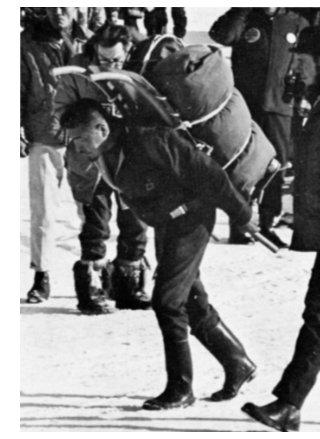
In '65 Jim MacCormick again managed feats of strength in the Flour Packing with a weight of 550 pounds, 50 pounds more than arch rival Danny Jackson.
Wilfred Charlie, a rather unlikely winner, took the Carling's trophy. He
won without his lead and one other dog, both of whom had been lost in the bush a week prior to the races. When he lined up at the start, the starter yelled go, the dogs thought
he said whoa and lost precious time getting to the trail. Charlie was sponsored by the Star and thus began the inclusion in the masthead.
Eddy Smith mushed his Uncle Andy Smith's team that year and came third
in his first race attempt. The race that year was 12 miles long and there was $1,950 in prizes.
That year there was a Junior Talent Finals, Snowmobile race and an Art
Exhibit of Yukon works in co-operation with the Regional Library. Beard Buttons made their appearance and anyone caught without one and with no whiskers went to the Crow Bar Hotel immediately.
Board of Directors: Chairman Peter Hudson and Gordon King, Rolf Hougen,
Major Hank Colyer, Al Prince, John Lammers, Fitz Fitzgerald, Mabel Taylor, Ed Lavalee, Zoe Cousins as directors, and Dave Robertson as Manager again.
The Snowshoe Baseball continued with competition for the Tangle Foot trophy.
The last place winner in the dog races received the traditional Lantern award to light his way home after dark, fell on the course.
Rendezvous 1966
Prior to the opening of Rendezvous, Paul Ben Kassi of Old Crow had no
sponsor and could not afford to bring himself and his dogs and equipment to Whitehorse. A local newspaper carried the story and the item aroused the interest of a Larned, Kansas woman, Mrs. Lavena Wheeler. She had ridden on board the "Brainstorm" from Dawson to Old Crow in June of '63 with Paul Ben Kassi at the helm. She wired Whitehorse for information concerning the costs of sponsoring and by return mail sent a cheque for $600 to Paul in Old Crow. The Yukon Dog Mushers Association made Mrs. Wheeler an Honorary Member.
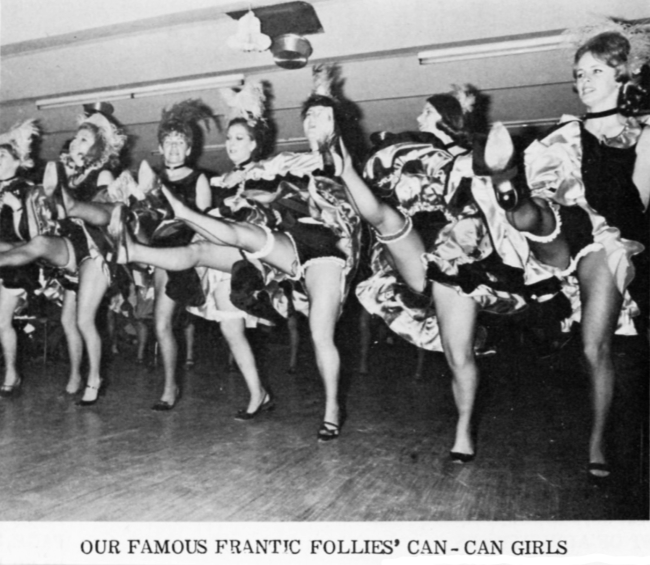
In '66, the Drama Club Can Can girls started to make the rounds of the bars presenting mimes and Rendezvous songs; generally adding to the excitement.
At this point the Sourdough pancake breakfasts were consuming between 300 and 400 pounds of donated flour and that's a lot of pancakes!
It wasn't very long before syndicated columnists and publications all over Canada began to hear about what happened in Whitehorse in February. In '66 Jim Coleman of the Southam Press arrived to take in the festivities and had a fantastic time. He advised against enlarging the Rendezvous because of the danger of losing the hospitable
feeling.
In 1966 a dog belonging to Jared Wilkinson of Pelly Crossing, one Mac, pulled 1,165 pounds of dog food - a record that has never been broken or even touched. Riverside Grocery, who donated the dog food, only had 1,000 pounds down on the river and when it became evident that Mac was capable of more, Alex Van Bibber tossed on the extra poundage from his own team's supply!
Constable Lynn Julyan's nine Siberian Husky team romped home as the winners in '66 in 3:46:35. Stephan Frost of Old Crow was not far behind in 3:47:16 and on Sunday Frost set a new course record of 1:11:12 to capture the Babe Southwick trophy
donated that year by the Edmonton Journal. Paul Ben Kassi came in at 3:48:47, Wilfred Charlie in 3:58:55, Andy Smith was back in 3:59:18 and Sam Johnston in 4:53:47 for a really tight race. George Washington of Haines Junction began the races on Friday and then that night lost his lead dog in a great fight behind Tourists Services and was forced out of the competition.
The Southwick trophy was established to be awarded to the musher who turned in the fastest lap during the three days. At this point the race was 14.3 miles, the same in the following years. In '66 Andy Smith was 58 and Paul Ben Kassi was 53. Constable Julyan donated his $700 prize to the Skookum Jim Hall for kindergarten and scholarship funds.
In '66 Miss Linda Kunze, sponsored by the IODE, beat out other contestants for the Queen title. For the first time, the grand raffle prize was a car - an
Acadian Sports Coupe with all the trimmings. Second was a stereo, third a portable TV and fourth was a transistor radio.
In that year there was even a moose calling contest held down on the river with the warning that the Rendezvous committee would not be responsible for anyone trampled by a herd of moose!
The Kangaroo court continued in its established tradition of speedy justice and fines which were moderate if the jailed ones gave no cheek. Anyone caught was even awarded a certificate to prove the whole thing really happened and was not just a nightmare. There was also a skydiver on the river that year.
Chairman in '66 was Howard Ryder and Directors were Bob Choate, Doug
Prest, Hank Colyer, Bob Cousins, Zoe Cousins, Fitz Fitzgerald (who emcees the dog races providing colourful anecdotes from his bag of stories about each contestant), Ed Lavallee, Norman Lemaire, Doug Robb, Boris Styba, Frank Stark and Manager John Lammers.
Rendezvous 1967
By this time, national photographers were coming from all over. The Sourdough Rendezvous became a movie star seen by thousands in Canadian Travel Bureau productions, National News, etc.
In 1967 Miss Lenore Hakonson of Dawson City was the Queen and wore the traditional crown of northern furs and gold, made by Mrs. Diane McCandless and donated by the Whitehorse Drama Club. At this point the girls were judged not just on ticket sales but on poise, talent, deportment, personality.
Jim MacCormick won the flour packing with 500 pounds, down from his past performances.
Paul Ben Kassi at 54 won the Carlings trophy as well as the Babe Southwick trophy for the fastest lap time, also a record of 1:09:32. His aggregate time was 3:37:13 behind his lead dog Venus.
The dog races saw a new team started every three minutes and the rules stated that if one team came up from behind, the forward team must give way.
The money for the games of '98 was printed by the Bank of the Yukon River. Winner of the One Dog Pull in '67 was Lassie, owned by Eddie Barnett of Whitehorse, who pulled 450 pounds.
In '67 the Chairman was again Howard Ryder, Vice-Chairman was Bob Choate
and Treasurer Doug Prest. Directors included Ian Ballantyne, Hank Colyer, Fitz Fitzgerald, Gerry Merritt, Al Prince, Ted Range, Bill Richardson, Boris Styba, Gordon Tootoosis and
Manager John Lammers.
Rendezvous 1968
This was the year that the first prize in the raffle, a car, was won by a seven year old girl. This was the first year that an invitation had been issued to dog
mushers all over Canada to enter the races.
Alanis Obomsowin of Montreal entertained the crowds with ancient Indian
legend songs accompanying herself on the "music stick bones" or on the drum. The Chilkat dancers were once again present, performing their famous Bear and Raven dances. The Whitehorse Star became "The Whalefat Times - we print twice a week if the staff is sober"
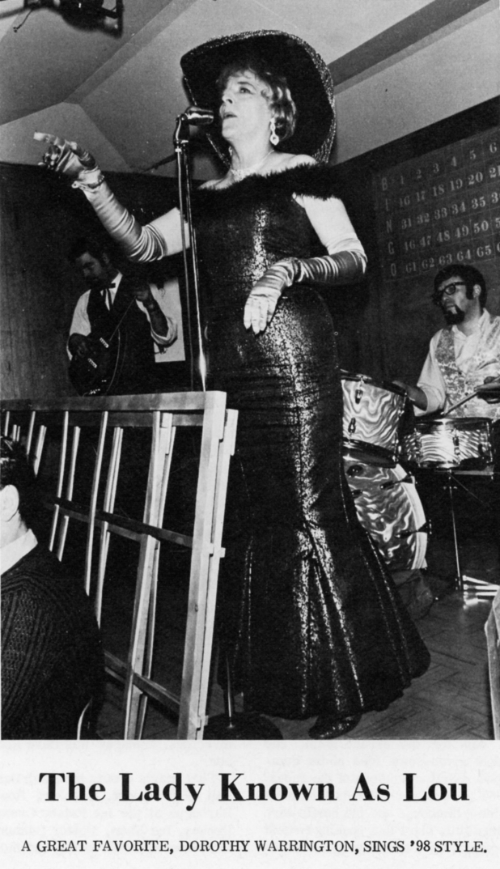
and the Bank of Montreal transformed itself into an old time saloon with swinging doors, cashiers in '98 attire and a ragtime piano. The Keystone Cops were up to their old antics and a black-gowned judge levied fines of 50 cents and up for arrest. Old time cars poured onto the streets from God knows where and the Drama Club Frantic Follies toured the bars with songs, mimes and the can-can, and Dorothy Warrington, "the Lady known as Lou," who sang in fantastic gowns.
Bob Choate was chairman this year, assisted by Bill Richardson and Neil
Stead. Board of Directors was composed of Chummy Belanger, Gordon Benson, John Dumas, Fitz Fitzgerald, Gus Gustafson, Scotty Munro and Al Prince. John Lammers again served as manager.
Daniel Jackson and Norman James performed feats of strength with flour,
lifting 650 pounds aboard a special packboard designed for Rendezvous which weighed 50 pounds by itself.
The RCMP lambasted the Canadian Forces in snowshoe baseball, winning by the improbable and still to be notarized score of 4937 to 4 to take home the Tangle Foot Trophy. The Indian people presented a native show called Koo-Eek-Kee and the CBC Challenge trophy for the best store decor went to Hougen's.
In '68 Roy Chambers' dog Chief took the Riverside Grocery for 950 pounds of dog food in the One Dog Pull, a feat equalled by Gordon Erickson's Skip.
The Chamber of Commerce entered a Yellowknife Board of Trade charter flight full of Rendezvous participants who even made the effort of challenging teams in Tug O' War.
In a race that attracted mushers from B.C., Wilfred Charlie came through
again after his win in '65 to take the contest. He ran with Dick as lead dog, substituting for Silver who cut his paw the day before start-up. Silver ran second to keep Dick on the straight and narrow. The 1968 races attracted 16 entries. At this point Charlie was a 30-year-old trapper who according to the other mushers used to run the entire course behind his five "ugly" dogs and earned himself the title of Iron Man Charlie.
Stephan Frost won the Southwick trophy for the record lap he turned in
Sunday of 1:05:07 with his six-dog team. Four mushers broke the old record of 1:09:32 on that day.
Rendezvous Queen in '68 was Miss Margo Magnusson of IODE, who won over six others and produced the IODE's third winner.
Rendezvous 1969
In 1969, the men's three-mile snowshoe race was a fight to the finish with Hans Algottson crossing the line one second ahead of Lucky John.
When the dust had finally settled after the sled races, the old record
of last year had been broken, re-broken and finally smashed, as 15 mushers entered and 14 stayed in there until the end. Philip Smith, a new entry from Nitsulin, was mushing down
the home stretch when his team decided they wanted to capture for all posterity and hamming it up headed straight for a photographer rather than the finish line. For once mishap did not visit George Washington and his dog Pat even pulled 600 pounds in the One Dog Pull to take home the dog food.
John Joseph Kay, in his first year of racing and driving Paul Ben Kassi's
team, came second in the aggregate. Peter Benjamin of Old Crow mushed the RCMP team. Benjamin is a special constable with the force and he drove one of the teams on their last trip.
The Monday morning after Rendezvous saw the laughable event of the first sponsor's race born with Cal Miller at the Sunday banquet of the Yukon Dog Mushers Association. At 10 on that fateful morning, Norm Keglovic of Liard Construction running
Alex Van Bibber's team over the mile course in 4 minutes and 25 seconds.
Bob Erlam of the Star mushed Wilfred Charlie's team in 4 minutes and 55
seconds, proving it's all in how you run and drive. Gordon Bartsch of Great Northern took Stephan Frost's team around in 6 minutes flat. Chicken Cal Miller, who never showed, was the scourge of the Association. He was fined $100 entry fee and each of the others also kicked in $100 which was sent to Miller's pet charity - the Crippled Children's Hospital in Vancouver.
In ‘69 Wilfred Charlie won it all, again taking home both trophies, the
Southwick for the fast lap which he ran on Saturday, marking the first time in racing history that the course had been run in an hour - the equivalent of the three-minute mile. Rosie was his lead dog for these important races.
Jean Chretien and his wife and father arrived for the festivities. Madame
Chretien opened the Child Care Centre, Jean Chretien was fined $5 not long after he arrived in town for being beardless. The Minister spent a few minutes in jail as the hoose-gow's most famous prisoner and goodnaturedly demanded a release petition be sent to the Minister of Justice in Ottawa. He was let out in time to open Rendezvous at 10 on the River. His father Willie Chretien, who is 81, was chosen by the Can Can Girls from a crowd at the Friday night Open House to receive the Yukon Order of the Garter as the best darn garter watcher. The old boy spoke very little English but soon caught on to the fact that he was to take the garter off Flora Dora's leg and spiritedly entered into his task with much gusto.
"Rawhide" Max Ferguson and his sidekick Allan McPhee arrived for the
carnival too and had a great time kissing Queens, interviewing mushers and awarding prizes.
For the first time a pack race down Main Street was introduced and Aldolphus Capotblance and Steve Boros packed 600 pounds of flour on their backs in the weight lifting contest.
1969 marked the last time the RCMP team from Old Crow would ever compete as a unit, being farmed out to residents to make way for the snowmobiles. The team made a last historic run accompanied by photographers and movie makers several weeks after Rendezvous ended.
The costume parades and judging were especially colorful this year, with
fantastic hats, aged green greatcoats, foxy ladies, furs and a lot of funny and wild attire including a strongman of the days of ‘98 dressed in yellow longjohns.
The Chretiens were attending the Koo-Eek-Kee native show when the announcer stated a Round Dance in which white persons were allowed to participate was about to commence, rose and to the delight of the audience, lost neither their dignity nor their step in taking part.
Last year's One Dog Pull winner Roy Chambers' Chief this year refused to do his job and would pull no more than 450 pounds before refusing to continue. One dog slipped his traces during this contest and leaped away but was back in harness within the three-minute time limit. Only now he staged a sit-down strike.