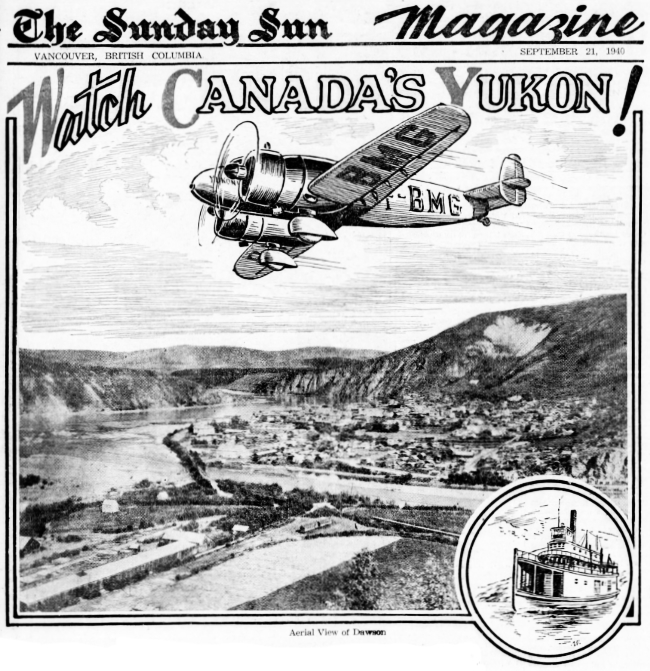
AIRPLANE transport has captured the imagination - and the business - of the Canadian Yukon and of all Alaska.
White Horse, possessing a magnificent airport site on a level bench west of the town, is an operating centre for both Canadian and United States companies.
Nearly every day, great Lockheed-Electra planes arrive from Nome (six hours) and Fairbanks (three hours) with passengers hurrying to fill business engagements in Vancouver, Seattle or New York.
The White Pass Railway maintains a fine plane service to Dawson - in addition to its river steamers and trains to Skagway. Yukon Southern flies in twice weekly from Vancouver. White Horse is a lively spot indeed for air travel.
An air-liner service in the stratosphere to join White Horse with Vancouver and Seattle is in final contemplation. The Pan-American Airways Clipper at present connecting Juneau with Seattle has not proven too successful. It will probably be discontinued for the winter, in November, and may not be re-opened next year. Eyes of Alaskan airmen are on the inland route, via Prince George and Williams Lake. Better weather conditions are available there in comparison with the fogs and rain which often prevail on the coast. The route, pioneered by Yukon Southern airline, or a modification of it - traversing a region avoiding high mountain ranges - may soon be adopted as the most
reliable of all.
These important airline developments have a direct bearing on the plan of the B.C.-Alaska Highway, which is a live question once again. Defense of the Pacific Northwest is one of the first subjects for discussion by the international commission of which New York's Mayor Laguardia is chairman. Advocates of the highway project will have to act quickly and decisively if they wish to impress the commission with the military importance of the proposed road. The Laguardia board will probably not pay much attention to arguments relating to tourist attractions and development of possible mining areas.
A newspaper in Fairbanks is advocating construction of the highway for a rather unique reason. It states the case this way - if Japan or Russia invades Alaska then railway and steamship services will be suspended and the only route of escape for the people will be across Yukon territory and through central British Columbia by road. A new reason, but a real one, according to the view of some people of Fairbanks, Circle and Nome.
* * *
Distances are vast in the Yukon and Alaska. At the top of the grade of the White Pass and Yukon Route stands a highway direction designed to help the traveller appreciate what kind of country he has now reached. "Twenty-seven miles to Skagway - 2700 miles to Nome."
The Yukon should be regarded for what it is - one of the great waterways of the world - rolling north then west through a vast area with small communities scattered all over the place. This excessively thin distribution over a tremendously wide territory brings you face to face with the chief problem of the country's development which is transportation. This is why the popular imagination proposes new highway enterprises. On the other side are some able opinions, such men as H. Wheeler, veteran president of the White Pass Railway, who does not see how a huge investment can be justified in a highway that will be closed for nine months each year in a country already reasonably served with river steamers, local roads and first-class airplanes. Mr. Wheeler points to the P.G.E. and the Hudson's Bay Railway to Churchill.
"As a taxpayer, I wish to stop making mistakes like those. The people who advocate this highway don't know the difficulties of road-building 1n this country," said Mr. Wheeler, who added that for 30 years the United States government had been trying to
make a road 300 miles from Valdez to Fairbanks and still it was a long way from being a real highway.
* * *
Replying to Mr. Wheeler, a statement has just been published by H. F. Glassey, former road engineer in Atlin, who insists that the highway idea is perfectly feasible, that it can be kept open most of the year without excessive cost and that it would be a tremendous asset in the development of Western Canada.
It is quite impossible, of course, to come to any opinion concerning the question of the B.C.-Alaska Highway without considering the future of the whole North Country. At the outset, you may as well abandon the idea of remoteness. The airplanes have cut out all that. You can have your breakfast in Vancouver, get aboard as comfortable and competent an airplane as those of the Trans-Canada service, you can have lunch at Fort
St. John and dinner at White Horse. Already you are in the Yukon. Alaska is only about an
hour away by air. You can fly to Dawson on the same evening if you are in a hurry. The
two-day trip by river steamer is more interesting.
Development of the Canadian and American West for the past hundred years has been marked by stampedes of gold-seekers who were in turn followed by a more sober settlement and civilization.
In the U.S. Leadville and Virginia City are examples of rushes to cash in on discoveries of precious metals. Dawson was the centre of one of the most exciting gold hunts in modern history. The city was not built on very permanent lines. The people who erected the Nugget dancehall or the Alexandra Hotel in the hot excitement of four decades ago were not concerned about the earning capacity of their investments 40 years later. It is a wonder the buildings of those early days have stood up as well as they have done.
You are told that Dawson is a ghost town, a mere shadow of its former greatness, its old-time excitement and its never-to-be-forgotten carousals. The truth is
Dawson is now in an interesting "in-between" era. Its glamor has departed but its ancient shacks have not quite rotted away. Its modern stores are good and substantial. It possesses a permanent commerce. Its location on the Yukon at the junction of the Klondyke makes it essential to the business of the country. In another decade the transformation from the visible evidence of its wild infancy would be fairly complete. By 1950, Dawson may be flourishing again, the centre of a new and more permanent development.
* * *
Of the future of the Yukon district you may hear many diversified opinions right in Dawson itself - and it is unsafe to contradict any of them. Some of the
oldest pioneers are pessimistic; others are amongst the greatest believers in the ultimate ability of the country to support a population of moderate size. On one hand is the optimist who came in '98 and who just won't accept any discouragement. "The country ain't but only been scratched, mister." There's gold yet out in the hills if only we had the old-time prospectors. You hear that opinion and another alongside it that the country is
no good any more for the individual miner. One shakes the whole thing down and comes to
some rather inevitable conclusions.
The first is that the transformation from the "good old days" is all but complete. It is all-embracing for the same reasons that the "combine" harvesters now reign supreme in Canadian wheat fields. The old-time pan and rocker have given away to something else, just the same as the scythe and the cradle binder have become all but extinct. The old creeks Bonanza, Hunter, El Dorado, Gold Run and all the others are being combed over by dredges, scraping away the surface of the old bed-rock, sifting gravels, sand and muck of the bars for a cash market that is always paying the best price in the world for a
much-wanted commodity. Yukon Consolidated Gold Corporation has eleven dredges in operation
and expects to go over hundreds of square miles of country during the next 20 or 30 years. It's a successful operation, this modern version, from the standpoint of gold recovery. In its early excitement, Klondyke added $250 millions to the gold store of the world. The dredging period may turn out another similar yield. So there still is a huge prospective gold harvest in the Dawson area.
Men who know the North well do not expect another Klondyke. Creek beds all over the land have been fairly well prospected. There is a chance, of course, that rich diggings have been overlooked, but that is an outside possibility. The development is proceeding along certain intermediate lines. At several points, river bars are being run
through small dredge outfits. A machine operated by two men, run by diesel power, earns a
gross return of $50 to $100 per day. This is a development parallel to the caterpillar outfit in the B.C. coast logging industry. Two or three young men looking for wealth and adventure can get lots of action on an investment of $10,000. There may be scores or hundreds of these plants, easily moved from place to place, within the next year or two. The big companies require an assured cubic yardage of 50 million in a creek bed before they invest three-quarters of a million dollars in a full-sized dredge.
* * *
Another kind of medium-sized plant is called a "dragline outfit." Some bottoms are too hard and irregular for the successful use of the bucket dredge and a
dragline outfit coupled with a bull-dozer is a better tool. Such a plant was installed recently on Fish Creek, near Fairbanks. The investment ran up to $100,000. There was a clean-up following ten shifts by the workmen and they got $33,000. The recovery averaged $2 per square foot of the bed-rock surface.
The airplane is used in scores of remote places. One company had an area which looked promising. A bulldozer was flown into a nearby lake in sections. Two men put it together and cleared a landing field. Then a crew of men and supplies were flown in and landed on this field.
Climatically, of course, the Yukon suffers in comparison with California, especially in the industry of producing gold. A lot of people do not regard it as an all-year climate. Hundreds of folks are engaged in transport and mining during the summer and autumn but come "outside" during the winter. You may recall how many so-called farmers mined their Saskatchewan ranches during the wheat season and then spent their winters in
California. They don't do it now as much as formerly. It may be the same with the Yukon. As the North Country catches its second breath, more people will wish to live there permanently - they will live there and die there.
* * *
Even a brief visit suggests that the trend is away from the roadhouse era and that something much more stable will take its place.
The B.C.-Alaska Highway may be built - war or no war - because a growing community will demand efficient and popular means of transportation by motor car, even on a basis of three months of the year.
In fish-packing, mining, producing furs and entertaining tourists the country has natural resources that must keep it on the commercial map. It will never be a wheat producing country, it will never grow cattle cheaply, it cannot be a manufacturing area, there is very little good farmland - but here again in Dawson you will be served with excellent local tomatoes, cauliflower and lettuce. It is far too good a country to walk away from. Because it is so, it must go ahead - perhaps in some new and unexpected manner.
* * *
If you don't believe it, get aboard a plane some fine morning at Sea Island and see the country for yourself. You will encounter a vast entertainment in the course of a lively week.