An Explorer's Guide to Whitehorse, Yukon
Dateline: July 2, 2021. Last updated: March 2, 2024.

By W. D. MacBRIDE
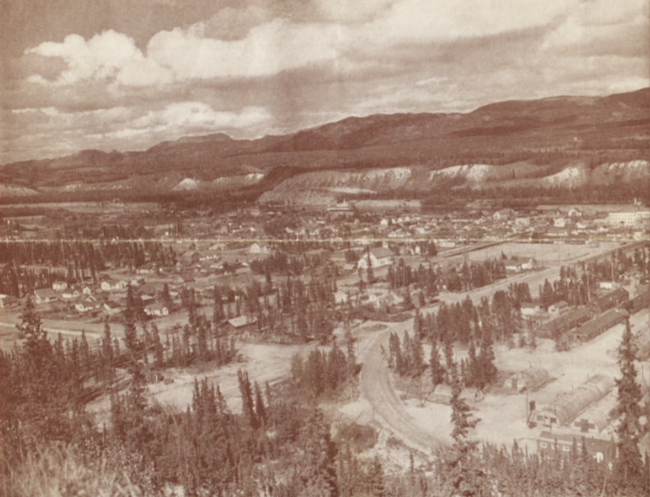
FOREWORD
The purpose of this pamphlet is to supply definite information regarding Whitehorse and vicinity and to answer the many inquiries received each year. Any questions that are not dealt with herein should be addressed to Secretary, Whitehorse Board of Trade, Whitehorse, Y.T., Canada.

AREA - POPULATION
Yukon Territory, Canada, has an area of 207,076 square miles. It is bounded on the north by the Arctic Ocean; on the east by Mackenzie District of the Northwest Territories; on the south by British Columbia (Latitude 60° North) and the United States Territory of Alaska; and on the west by Alaska (Longitude 141° West). Yukon's 1948 population was estimated at 6,500 whites and 1,700 Indians. The population of
Whitehorse in 1948 was estimated at 4,500.
HISTORY
The early history of Yukon Territory is largely the record of the fur trade explorations of the intrepid officers of the Hudson's Bay Company and the hardy gold seekers who ventured across the mountains to the Yukon River valley. In 1838 the Hudson's Bay Company established a trading post at Ft. Selkirk near the mouth of the Pelly River, 282 miles north of Whitehorse by river. This was probably the first settlement of its kind in Yukon Territory. Prior to 1895 this vast area formed part of the unorganized Northwest Territories, and though administered by the Canadian Government, was virtually occupied and controlled commercially by foreign traders. In 1895 Yukon was created a district of the Northwest Territories, and in 1898 was made a separate territory.
While gold in paying quantities had been taken from the tributaries of the Yukon River in the period from 1873 to 1895, the great Klondike stampede, which rivalled the California gold rush of 1849, was initiated on August 17th, 1896, when George W. Carmack and two Indian companions, "Skookum" Jim and "Dawson" Charlie, on information supplied by Robert Henderson, struck it rich on Bonanza Creek, a tributary of the Klondike River, near the present Dawson City. Kate Carmack, Indian wife of George W. Carmack, "Skookum" Jim and "Dawson" Charlie are buried in the Indian cemetery at Carcross, Y.T., 40 miles south of Whitehorse. "Dawson" Charlie fell off the Carcross railroad bridge in December, 1910, and was drowned.
When the news of the rich Yukon gold strike reached civilization the red-blooded men of the continent soon started their historic trek over the various trails leading from tidewater to the Yukon River. The bulk of the stampeders came by ocean steamer to Skagway, Alaska, or Dyea, Alaska, and toiled over the White Pass or the Chilkoot Pass to the head of Lake Bennett, where they whipsawed native lumber and built
crude boats and scows to convey them 550 miles by water to the new gold fields.
The greatest hazards in river navigation were found in Miles Canyon and Whitehorse Rapids located a few miles south of our present city. Let Robert W. Service describe them:
"We roused Lake Marsh with a chorus, we
drifted many a mile;
There was the CANYON before us - cave-
like its dark defile;
The shores swept faster and faster; the river
narrowed to wrath;
Waters that hissed disaster reared upright
in our path."
Numerous boats and scows were wrecked in the Rapids and many stampeders were drowned. Soon wooden rail tramways were constructed on both sides of the river around the treacherous waters. Small steamers were constructed at the head of Lake Bennett. These
steamers carried supplies to Canyon City near the head of Miles Canyon, where the freight was transferred to the crude tram cars and hauled by horses in tandem to points below the rapids. On the east side of the tiver at the terminal of the Whitehorse Rapids Tramway Service a small settlement of tents and log cabins was called "Closeleigh." Construction of the White Pass Railway was commenced in May, 1898, and Whitehorse - named from the white caps or white "horses" of the famous rapids - came into being with the arrival of the first train on June 8th, 1900. During the winter of 1899-1900 several buildings were
moved across the river from Closeleigh and some log buildings erected on the new townsite.
The lower portion of the Masonic Hall in Whitehorse was the "Savoy" hotel moved from Closeleigh. Whitehorse is the distributing point for almost the entire Yukon Territory and for settlements in Alaska between Circle City and the Yukon border. It is the northern terminal of the White Pass & Yukon Railway; the head of navigation on the Yukon river; distributing point for the Alaska Highway and base for plane operations. In 1948 the river steamer service handled approximately 13,000 tons of freight and 900 passengers to down river destinations, and carried to Whitehorse 7,000 tons of freight and 900 passengers.
Headquarters of the Northwest Highway System (Maintenance) operated by the Canadian Army is located at Whitehorse. The Royal Canadian Air Force, Department of Transport, and Department of Mines and Resources, also maintain a large personnel here.
When Robert W. Service was a teller in the Canadian Bank of Commerce here, about 1905, after a banquet in honor of the departure of a prominent business executive, he burst forth in the local newspaper with a poetic prophecy:
BOB SMART'S DREAM
"This is my dream of Whitehorse,
When fifty years have sped,
As after the Rogers Banquet
I lay asleep on my bed.
I tottered along the sidewalk
That was made of real cement;
A skyscraper loomed above me,
Where once I remembered a tent.
I thought that I'd cross the Yukon
Over the big steel bridge;
I heard the roar of the stamp mills
Up on the western ridge,
Crushing the quartz from bullion
And borne on the evening breeze
I sniffed the fumes of the smelter
And the sulphur made me sneeze."
Many true words are printed in jest, and the people of Whitehorse did sniff the fumes of the famous Canol Refinery for a period and a smelter may be in the offing.
CLIMATE
The climate of Whitehorse and Yukon Territory has been much maligned. Mere mention of the word "Yukon" causes some of our southern friends to shiver because all the fiction written about the Yukon stresses the "awful cold" but even the famous author of
"And its sixty below, and couched in the snow
the hungry huskies moan."
gives us:
"The summer—no sweeter was ever;
the sunshiny woods all athrill;"
The majority of people who read this brochure will be summer visitors so they won't have to worry about what happens up here in the winter, even if Snag Airport a couple of hundred miles northwest of us did hit 83 below zero in 1947. Actually our winter climate is very unpredictable, but extreme cold snaps usually do not last more than a few days and some winters are very mild. For instance the river at Whitehorse did not freeze over in the year 1943; it closed on January 2nd, 1944! Rainfall is light. Maximum depth of snow is seldom more than 16 inches. The air is "dry" and we seldom have wind when temperatures are colder than 20 below zero. Our summer days average between 60 and 70 degrees and the only extra clothing required by visitors might be a medium weight wrap or overcoat for evenings which are always cool.
Vacationing Yukoners shiver in Seattle and Vancouver and nearly perish in Chicago during winter cold snaps because the "moist" air found in regions close to large bodies of water is more "deadly."
TRANSPORTATION
The White Pass and Yukon Railway extends 110.7 miles from tidewater at Skagway, Alaska (20.4 miles through Alaska, 32.2 miles in British Columbia and 58.1 miles in Yukon Territory) to its northern terminal, Whitehorse, Y.T. It is a narrow gauge (36 in.) railroad which climbs 2,885 feet to its summit in the first 20 miles. The road operates during the entire year, connecting with ocean steamers at Skagway, Alaska. Skagway is approximately 1,000 miles from Seattle, Wash., by water.
The British Yukon Navigation Co. (river division of the White Pass & Yukon Route) operates river steamers and barges carrying passengers and freight down the Yukon River to northern settlements and mining camps, from approximately May 15th to October 15th.
The British Yukon Navigation Co. (highway division) maintains a scheduled bus, freight and mail service on the Alaska Highway from Milepost 0, Dawson Creek, B.C., 627 miles through British Columbia to the Yukon border, 292 miles through Yukon to Whitehorse, aud 306 miles from Whitehorse to the Alaska border Milepost 1221.5. At Dry
Creek, Y.T., Milepost 1184, connections are made with Alaska Coachways for Fairbanks and Anchorage, Alaska. At Dawson Creek, B.C., connecting transportation lines to Edmonton, Alberta, are Canadian Coachways Bus Line and the Northern Alberta Railways. It is now possible to travel by bus from almost any point in the United States or Canada to Anchorage on Alaska's west coast, via Whitehorse. A bus service between Whitehorse and Haines, Alaska, is also operated when the Haines Road is open to traffic.
Canadian Pacific Airlines offer a scheduled service to Vancouver, B.C.; Edmonton, Alberta; Fairbanks, Alaska; and Dawson City and Mayo, Yukon Territory.
Pan American World Airways maintain a scheduled service connecting Whitehorse with Seattle, Washington; Ketchikan, Juneau and Fairbanks, Alaska.
Northern Airways Ltd. Yukon Airways Ltd. and Whitehorse Flying Service have planes available at Whitehorse for charter service.
Northern Airways Ltd., Carcross, Yukon Territory, serve the communities of Atlin and Telegraph Creek, British Columbia, and handle charter flights.
Alaska Yukon Transportation Co. operate a freight service between Whitehorse and Haines, Alaska, and between Haines and Fairbanks, Alaska, when the Haines Road is open.
Inquiries regarding fares, schedules, etc. should be addressed to
the various transportation companies at Whitehorse, Y.T.
MINING
An extensive copper belt is located within a few miles of Whitehorse. This belt extends in general all the way to the Copper River region of Alaska. During the early years of this century up to about 1921, 183,000 tons of copper ore were exported from mines near Whitehorse to Tacoma Smelter, Tacoma, Washington. Since 1921 the low price of copper caused these mines to be closed and in most cases abandoned. During the past two years a mining syndicate has relocated many of the old mines and is drilling same to determine whether or not there is sufficient volume of ore to warrant the construction of a smelter in this district.
At Keno Hill and adjacent mountains, about 40 miles from the town of Mayo, Stewart River, are found some of the largest silver lead deposits in Canada. During the period from 1923 to 1942 approximately 95,000 tons of high grade ore and concentrates passed through Whitehorse destined to the Bunker Hill and Sullivan Smelter at Kellogg, Idaho. This mining camp was closed down during war years but the properties have since been re-opened on a large production scale and shipped in 1948 over 6,000 tons of ore and concentrates.
In the Carmacks district 130 miles north of Whitehorse there are large deposits of soft coal which are being developed by the Yukon Coal Co. In this area are also found some excellent showings of gold quartz but development of gold properties has been halted on account of high cost of labor and supplies, compared to gold value. Gold quartz deposits are also prevalent in the mountains near the Wheaton and Watson Rivers about 40 miles southwest of Whitehorse, and in the mountains along the Tagish Lakes 50 miles south of Whitehorse.
Over $2,000,000 in placer gold was taken from Livingstone Creek and tributaries only 50 miles airline north of Whitehorse. In July, 1948, a lone prospector found a $700 nugget in this creek. Placer gold is also being recovered by drag-line operations from properties adjacent to the Haines Highway and Alaska Highway north of Whitehorse.
The development of highways in southern Yukon has given a great impetus to prospectors and approximately 16 different mining companies have spent around $2,000,000 in prospecting, drilling and developing quartz areas adjacent to Highways in the Yukon. With the anticipated further extension of feeder roads connecting with the Alaska Highway, it is quite probable that some producing properties will be located.
Whitehorse is the headquarters for all mining supplies and the shipping point for all mining products. Inquiries regarding mining regulations, mineralized areas, etc., should be addressed to Mining Recorder, Whitehorse, Y. T.
AGRICULTURE
On account of the relatively short growing season and character of the soil, southern Yukon cannot be called an agricultural region. However, the long hours of sunshine experienced in the summer months do produce some wonderful results with vegetables and flowers. Many householders raise all the ordinary vegetables, including cabbage and cauliflower, potatoes, green peas, etc. Small hothouses will grow almost anything including such items as tomatoes, cucumbers and egg plant.
At Pine Creek, 104 miles northwest of Whitehorse, the Department of Agriculture maintains a sub-experimental station. This station was established in 1944 and in 1947 occupied 800 acres. It is gradually being enlarged. The farm has succeeded in ripening wheat, oats and barley, and their samples have been given excellent rating. They have a small threshing machine. All garden vegetables are grown, with cabbage up to 16 pounds. Poultry and cattle are also maintained.
There are several lilac bushes in Whitehorse which survive the winter freezing. Delphinium grow like weeds, occasionally attaining a height of 8 to 10 feet. Native hay is cut from meadows for winter horse feed. Horses winter outdoors and learn to follow the example of moose in feeding on willow tops.
FORESTS
Jack pine, varieties of spruce, fir, cottonwood, poplar, balm of gilead and birch are prevalent, but are not of much value for building purposes. A few small sawmills manufacture spruce and pine into lumber suitable for bridge, sidewalk and house framing, but the product does not compare favorably with imported fir. Timber growth is very slow. There is an abundance of timber suitable for pulp wood and cord wood. Wood is used predominantly for fuel and many thousands of cords are consumed in the fire boxes of the boilers on river steamers.
HUNTING, FISHING AND TRAPPING
Whitehorse is the "taking off" point for some of the finest hunting
and fishing in North America. The Alaska Highway has provided access to many districts that were almost virgin territory. Yukon is famous for its white Dall sheep, Stone and Fannin sheep, woodland and barren-ground caribou, mountain goats, moose (record head 70½-inch spread of horns), grizzly, black and brown bear.
In the bird population are found blue, ruffed, spruce, Franklin and
sharptail grouse; rock and willow ptarmigan; and geese, brant and ducks.
Game is not plentiful in areas close to Whitehorse but the best hunting grounds may be reached by horse, plane or truck.
Sports fishing is usually good in any clear streams or lakes along the Alaska Highway or in the Yukon River valley. Grayling may be caught with the fly between Whitehorse Rapids and Miles Canyon. Lake trout up to 40 pounds, northern pike, white fish, inconnu and sporty rainbow trout are found in the waters of southern Yukon. Several hunting and fishing lodges are maintained onthe large lakes along the Highway where guides, accommodations, power boats, etc., may be arranged for. These lodges are connected with Whitehorse by phone. It is advisable for prospective fishermen to bring their tackle with them. Hunting or discharge of firearms is prohibited in Yukon Territory within one mile of the Alaska or Haines Highways on either side.
The usual fur animals are present in Yukon fores Wolf, coyote, fox, beaver, fisher, lynx, marten, otter, muskrat, mink, weasel, wolverine and squirrel.
Non-resident big game hunting license costs $100 and entitles the holder to shoot one moose, two caribou (one of each species), one mountain sheep, one mountain goat and two grizzly bear. Non-resident bird license is $5.00. Non-resident fishing license is $2.00.
OPEN SEASONS FOR HUNTING
Moose, sheep, goat - August 1st to December 1st.
Caribou - August 1st to February 1st.
Grouse: Spruce, Franklin and sharptail - September 1st to February 1st.
Grouse: Ruffed and blue - September 1st to November 1st.
Ptarmigan - September 1st to February 1st.
Ducks and Geese - September 1st to October 15th.
There is no closed season on bear, and no restrictions on number except in the case of grizzly taken by non-resident hunters.
For additional information on fishing, hunting and trapping regulations, names of guides, Customs and Police regulations, write to the Government Agent, Whitehorse, Y. T.
LIVING CONDITIONS
In Whitehorse are found practically all services and facilities of a modern city including schools, Canadian Bank of Commerce, churches, convent, hospital, library, government liquor store, beer parlors, department stores, jewelry and souvenir stores, repair garages, picture theatre, bowling alley, hotels, dry cleaners, laundry, beauty parlors, barber shops, tourist camp, telephone system, electric light system, etc.
Various fraternal organizations extend a hearty welcome to visiting members. Kiwanis Club holds a weekly dinner at 6:30 p.m. each Tuesday; the Masonic Lodge meets on third Monday of each month; Order of Eastern Star meets on second Friday monthly, and Elks Lodge meets bi-monthly on second Thursday and fourth Friday. In addition to the above organizations, we have the Yukon Fish and Game Association, Canadian Legion, Imperial Order Daughters of the Empire, Young People's Association, Boy Scouts, Girl Guides and associated junior branches, and various church organizations.
Our local newspaper, the Whitehorse Star, is published each Friday. Whitehorse Radio Station CFWH, 1240 k.c., is operated by personnel of the Canadian Army and affiliated communications services, on a voluntary basis. Canadian Press news is broadcast twice daily.
There is a definite shortage in houses of family capacity, due
in part to difficulty of obtaining building material. Hotel accommodations are usually adequate, but it is advisable to secure advance reservations, which may be taken care of by any of the transportation companies, during the period from June Ist to September Ist. Prices of hotel rooms range from $2.00 to $4.00 per person; meal rates from 75c to $2.50.
In 1948 residence lots carried a value of from $350 to $750; business lots in choice locations from $4,000 to $5,000.
Yukoners have built up a wonderful reputation for courtesy and friendliness toward the travelling public and are always glad to answer questions and assist visitors in every possible manner.
BUSINESS OPPORTUNITIES AND EMPLOYMENT
Most lines of business are well represented. Among the larger investments to be considered are apartment housing, brewery, smelter, hydro electric plant and mining.
The employment situation is quite well taken care of by local residents. River transportation and mining are seasonal, as also highway construction. Enquiries re employment should be addressed to National Employment Service, Whitehorse, Y. T.
COMMUNICATIONS SYSTEMS
Whitehorse is very fortunate in this respect. We have the land lines of the Government Telegraph Service; the land lines along the Alaska Highway, operated by the Canadian National Telegraphs under the supervision of the Department of Transport; the radio system of the Royal Canadian Corps of Signals, and the land line of the White Pass & Yukon Railway between Whitehorse and Skagway, Alaska. Prompt phone connections may be made between Whitehorse and almost any place in Canada or United States that has long distance
service. This service is also available from points along the Alaska Highway.
HIGHWAYS
The Alaska Highway extends from Milepost 0 at Dawson Creek, B. C., to Milepost 1522.8 at Fairbanks, Alaska. The following lodge-type hotels were erected by the Highway Division of the British Yukon Navigation Co. for overnight stops and are available to the highway traveller.
Fort Nelson Hotel, Milepost 300; Liard Lodge, Milepost 620, and Dry Creek Lodge, Milepost 1184, near the Alaska border. The journey from Dawson Creek to Fairbanks takes five days with four night stops. Many lunch rooms, lodges, tourist cabins, gas and oil stations, etc., are found between Dawson Creek and Whitehorse. North of Whitehorse
these facilities are not as numerous but are quite adequate. The Highway Maintenance crews maintain emergency shelters at approximately 50-mile intervals, and there are also a number of Government Tourist Camp grounds along the Highway equipped with cooking and eating quarters, rest rooms, outdoor grill and fuel supply, but with no sleeping quarters.
The Alaska Highway is kept open to traffic the entire year but private car travel during the winter months is not advisable because of the danger of breakdowns in extreme cold weather at points remote from shelter. During the summer season it is not
necessary for private cars to burden themselves with excessive food supplies, bedding or camp equipment, or even extra gasoline or oil. It is advisable to carry spare tires, tool kit and some spare parts. At Dawson Creek a connecting highway runs 486 miles to Edmonton,
Alberta. Heavy snow conditions may delay travel at any time during the winter on this road.
At a point 101 miles north of Whitehorse, Milepost 1016, the connecting Haines Highway extends 159 miles to tidewater at Haines, Alaska. So far this road has not been open to traffic in winter as extremely heavy snow conditions are encountered in the Coast range through which it passes, and the amount of traffic offering for Yukon and Alaska points is not considered sufficient to warrant the high cost of winter maintenance. During the summer season there is a considerable movement of freight, passengers and private cars over the Haines Road. The Whitehorse Board of Trade has joined with Alaska
Chambers of Commerce in petitioning Government authorities for its year around maintenance.
The Canadian Government is considering the construction of a highway from Jake's Corner, Milepost 865, Alaska Highway, to Atlin, B. C., a distance of about 65 miles. Atlin Lake is one of the beauty spots of North America and the Atlin district has long been a producing placer mining camp.
In 1948 work was commenced on the construction of a highway from Mayo to Minto, Y. T., a Yukon River landing, 258 miles from Whitehorse by river and 175 by land. It is intended to eventually link this highway with Dawson City and Whitehorse. Completion of the Mayo-Minto highway will provide winter transportation service to the Mayo mines.
RECREATION
During the summer season a veritable wonderland is available to those who love the out of doors. Myriads of lakes may be reached by highway, river, railroad and plane services. Bathing, fishing, berry picking, summer camps and picnicking flourish. We have three excellent tennis courts and a live softball league, and many interesting trails for the hikers and mountaineers.
In the winter months there is a fine hockey league and basketball league, bowling, curling, skiing, snowshoeing, dog driving and skating. Around the first week in
March occurs the Annual Winter Carnival, with ski events, dog races, "Days of 98" Dancehall, carnival queen contest, etc. This carnival lasts three days and attracts visitors from some of the Alaska cities as well as contestants.
WHAT TO SEE AND DO IN WHITEHORSE
Many visitors are interested in the poems of Robert W. Service and relics of the "Trail of '98." Service composed his first Yukon verses here, and took a prominent part in the social life of the community often appearing in local theatricals. The Rector of Christ Church will show you record books signed by R.W.S. as Vestry Clerk.
The verses of our "Yukon Bard" have forever focused the minds of the world on Yukon Territory. During the building of the Alaska Highway one Whitehorse store alone sold over 5,000 copies of Service's complete poems.
The "Old Log Church," Anglican, was erected in 1900 and cherishes among the names of its clergy those of Bishop Bompas, Archbishop Stringer, Archdeacon Cody and Dr. Whittaker. Bishop Bompas died at Carcross, Y. T., and is buried in the Indian cemetery there. During the summer season the Rector presents a free lecture with lantern slides of Yukon scenes and events dating back to 1840, on evenings when a large number of visitors are in the city.
Sam McGee's Cabin is located just across the street from the Anglican Church. From the story of a man who cremated his pal, Service wrote "The Cremation of Sam McGee," which ballad brought fame both to the writer and to Sam, who was a contemporary acquaintance. With the assistance of the Whitehorse Board of Trade, a
ladies' organization, the Imperial Order Daughters of the Empire, is endeavoring to
make the "Sam McGee" cabin a repository for historical relics. On the grounds near
the cabin may be seen one of the old stage coaches used on the "Overland Trail" to
Dawson City in gold rush days; also a war canoe of the LeBarge Indians. Sam McGee
revisited Whitehorse in 1938 on a prospecting trip and his photo was taken sitting in
front of his cabin. Postcards taken from this photo are on sale. He passed away in
Calgary, Alberta, September 11, 1940.
Whitehorse Public Library. During the war the original library building was destroyed by fire, but is functioning again in temporary quarters. The reading room is open to the public at all hours. The book room is open from 7 to 8 p.m. Tuesdays and Fridays. Books are available to visitors at a nominal sum and payment of a deposit which is refunded on return of the books.
Indian Cemetery. North of town, adjacent to 4th Avenue, is an Indian burial ground, many of the graves being covered by small houses. Principal Indian tribes are the Wolf and Crow. Marriage hetween tribal members is not permitted Wolf and Crow may intermarry, but children belong to the mother's tribe. Some Yukon Indians take
the first name of the mother as their surname, as Peter "Alice"; some take the name of
their home camp, as "Big Salmon" Pat. They believe that the spirits of the departed may return from the "Happy Hunting Grounds" and often place in the grave houses such items as dishes, pipe and tobacco, matches, etc.
First Telegraph Office. The two-story log building on the corner north of the Northern Commercial Co. store was the first office of the Government Telegraph Service, erected either in the fall of 1899 or spring of 1900, after their promotion from an old log building which still stands across the river on the site of "Closeleigh".
Steamer Yukoner. This is one of the last of the old "Gold Rush" flotilla. Yukoner was built in Victoria, B. C., in sections and shipped to St. Michael, Alaska, in 1898, where she was rebuilt. Yukoner reached Dawson City on her first voyage August 22, 1898, and later ran between Dawson City and Whitehorse until the fall of 1903. She was not operated thereafter because her draft was too deep to safely negotiate shallow
bars in the river.
Whitehorse Airport. Reached by car from Whitehorse, adjoining the Alaska Highway. This is one of the key airfields of the Northwest. With its cement runways, immense hangars, aids to navigation, weather installations, living quarters, etc., its cost is estimated to be in the neighborhood of $13,000,000.
Miles Canyon and Whitehorse Rapids. Reached by car from town, via a portion of the Alaska Highway. (See paragraph on "History".) Traces of the old wooden. rail tramways may still be seen near the Rapids.
Robert Lowe Suspension Bridge across Miles Canyon. This foot-bridge was built across the Canyon for the benefit of visitors who wish to view the seething waters from close range. One of the granite pillars of the canyon wall northeast of the bridge bears a striking similarity to a totem pole. The bridge was named after a member of the Yukon Territorial Council who was instrumental in securing its construction, and was dedicated by Baron Byng of Vimy, then Governor-General of Canada. It is the only
bridge across the Yukon River in its 2000-mile course from Miles Canyon to Bering Sea.
Royal Canadian Mounted Police. No story of the Yukon would be complete without mention of the men in scarlet who are today responsible for the administration of law and order in Whitehorse just as they were in the days of '98, and although the automobile and the airplane have replaced the dog team and horse the Mounties will be seen daily directing traffic and performing their other manifold Police duties. The Headquarters for the Force in the Yukon is located at Whitehorse, in the old original "Royal North West Mounted Police" Square. South of "Headquarters", you will see a fine old log structure now used by the Canadian Army as a library. This was the original "Tagish Post", which stood at Tagish, Yukon Territory, on the Tagish River, between Tagish Lake and Marsh Lake, on the Klondike trail, before the railroad came. It was then a welcome
sight to thousands of men and women who had labored over the Chilkoot and White passes. In Klondike days more than 100 Mounted Polce were stationed at Whitehorse. In 1948 they numbered 16.
SCENIC TRIPS ORIGINATING AT WHITEHORSE
Whitehorse to Skagway and return over the famous White Pass and Yukon Railway, which follows the "Trail of '98", 220 miles - 2 days.
Whitehorse to West Taku Arm of Lake Tagish and return, 86 miles by railroad and 168 miles via Lake Steamer "Tutshi" to beautiful Ben My Chree at the end of West Taku Arm, where a wonderful garden of tropical luxuriance is set in a narrow valley surrounded by lofty mountains and glaciers - 2 days. This trip may be combined with the
Skagway trek - 3 days.
White horse to Dawson City and the Klondike and return by stern wheel river steamer on the storied Yukon River, still on the "Trail of '98," 920 miles - about 9 days.
Whitehorse to Fairbanks, via bus on the Alaska Highway, 607 miles - 2 days.
Whitehorse to Haines, via Haines Highway by bus and return, with one-day stopover at Haines, 520 miles - 3 days.
Whitehorse to Marsh Lake Lodge, 36 miles; to Nisutlin Bay Lodge at Teslin Lake, 115 miles; to Kluane Lodge on Kluane Lake, 175 miles. Transportation to the lodges may be made via bus or taxi.
The Dawson City and Fairbanks tours may also be made by plane, or may be combined with plane and river for Dawson City, or plane and highway for the Fairbanks trip.
Whitehorse Sightseeing Tour, combining a stop at all points mentioned in "What to See in Whitehorse." This tour is handled by the various taxi services and takes about 1½ hours.
A pdf copy (1.5MB) of the original brochure can be seen and downloaded here.







