"The first domestic animal of the arctic was the dog," wrote J. Ross McKay in Geography of the Northland, "used to herd reindeer and as a draft animal to pull sledges or carry back-packs."
Two thousand years later, despite new-fangled aeroplanes, snow mobiles and hovercraft, northern residents retain their respect for the dog as a working partner. One entrepreneur says, "There's nothing quite so reassuring as a dogteam and sled on the back of your old truck when you're driving the Alaska Highway and the temperature drops
to -79."
Dog-driving was developed by the Samoyeds, a Lapp-like people living on the Yenesei River in Russia, who drove reindeer and used their dogs to pull sleds or herd deer. It was perfected by the people of Kamchatka and put to good use by other Russians including Ferdinand von Wrangell (later governor of Russian Alaska). Engaged by the Czar to explore, the 28-year-old Navy lieutenant made a 900-mile round trip sledge journey down the lower Kolyma River, and out over the northern ocean.
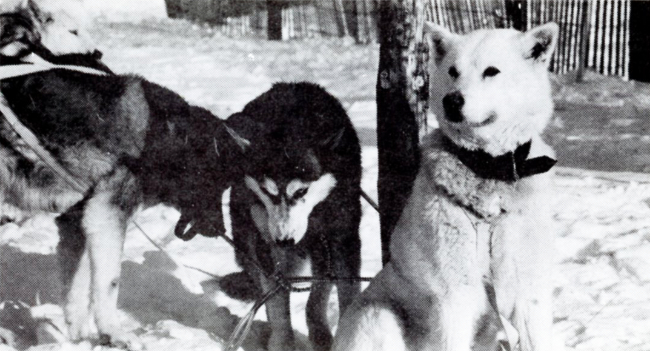
Dog-racing really comes into its own at Rendezvous time in Whitehorse when men and dogs prove their worth on a hard track at often-cold temperatures. While men are men, distinguishable more by costume than manner, good sled dogs include the Alaska
Malamute, Eskimo, and Siberian Husky.
Largest of these and most fitted for hauling heavy loads over mountainous terrain in winter and packing 40 lbs. or more in summer, the Alaska Malamute was bred by the Malamute Eskimos of Kotzebue Sound.
Farther east and 200 years later, Samuel Hearne described the people of Coppermine, and their dogs (A Journey to the Northern Ocean, 1769, 70, 71, 72): "These people had a fine and numerous breed of dogs, bushy tails etc. exactly like those seen among the Eskimaux in Hudson Bay and Straits...
"They were all tethered to stones, to prevent them as I suppose, from eating the fish
that were spread all over the rocks to dry... Tents, and their kettles, and some other
lumber, are always carried by dogs, which are trained to that service and are very docile
and tractable. These dogs are equally willing to haul a sledge, but few of the men will be at the trouble of making a sledge for them.
"The poor women are obliged to content themselves with lessening the bulk of the load, more than the weight, by making the dogs carry these articles only, which are always lashed on their backs, much after the same manner as packs are - or used tobe - on pack horses." While dogs made light work of much of the travel accomplished by northern missionaries, explorers, traders and police, they were used in every capacity by miners during the Klondike gold rush.
In his "The Sledge Dogs of the North" (Outing-v.38, 1901) Tappan Adney, who is better known for his "The Klondyke Stampede," notes: "Endurance and ability to
draw small loads with great speed peculiarly fit the dog for a wilderness where neither
roads nor railways have to any considerable extent made their appearance. In winter when the tangled forest trails have been made smooth by their deep covering of snow the dog enters upon his real usefulness...knows his place and is conscious of his worth.
"(By 1900) The best dogs had been bought up by miners and traders leaving only the poorest, undersized starved and stunted animals to their Indian or Eskimo masters. Moreover, in order to supply the extraordinary demand for sledge dogs resulting from the Klondike excitement the Canadian Northwest was raked and scraped for dogs.
"Some notion of how thoroughly all available dogs were snatched up at the beginning of the excitement is shown by the experience of the Canadian government when getting together a set of dog teams to send in with mail to Dawson. A hundred huskies were
expected, but when the teams arrived at Dawson there were only 40 dogs and half of that number were not native dogs, but setters and Newfoundlands. Thousands of 'outside' dogs were carried to the Klondike."
Suitable harness is a subject in itself. In 1557 explorer Martin Frobisher was shown a vacated village site, by his Eskimo guides. Included was a number of sledges, bridles and whips.
Adney describes harness as "Sometimes built of leather or pieces of rope, the traces, instead of leading directly over the back, first pass under the foreleg...in its original form (it) was simply a piece of fresh bearskin, through which three long slits were made lengthwise. The middle slit was pulled over the dog's head and served as a collar, and the forelegs were thrust through the remaining slits.
"To the other end, resting upon the back, was attached the trace (which) in the Eskimo style of harness, is a strand of raw seal hide about three feet in length. It is made fast to a long single trace - a thong of walrus hide - and the dogs are hitched generally in pairs, at intervals of about six feet, with a single dog as leader. The small trace joins the main trace with a bone swivel (making) it easy to straighten them out."
Devised by the Russians, for their wide-open spaces, the fan harness was used by the Samoyeds and the Greenland Eskimos and by all the arctic people in between.
In tree-country fan hitches were impractical and gave way to the tandem, or centre-trace hitch for soft, deep snow, a method perfected in eastern Siberia and introduced to Alaska by the Russians, (according to Lieutenant Zagoskins's "Travels in Russian American, 1842-44;" edited by Henry N. Michael).
"The Indians (Adney continues) harness their dogs (with) a round collar about two inches in thickness, of moosehide stuffed with moose hair. The traces, two inches wide, are of the same material. The back-band, supporting the traces, is a band of
leather four to ten inches wide, often highly ornamented with bright chenille patterns and
surmounted by a string of small sleighbells. Often the leather of the traces and back band is replaced by strips of drill or canvas.
"Fine harnesses, made by white men out of regular harness leather, the collar being stiffened with a stiff wire which serves as hames, and with regular iron snaps on the traces, are now made expressly for the Yukon trade."
Sleds were designed for the loads and terrain. One was the still-familar toboggan, of thin white birch with its front part bent up and backward. The Indians found this lightly-skimming sled suited to his needs, following his snowshoes easily while carrying all his traps and tents across the snowy central Yukon.
The Eskimo, living on the coast and at the mouths of rivers which freeze into rough hummocky ice, required a sturdy sledge which he made of driftwood and set up on
runners often shod with walrus ivory. The load was contained by a superstructure of wood uprights tied or filled in with rawhide thongs. It was driven, and kept from over-turning, by plow-like handles.
This "basket-sleigh" design becomes lighter when made by the Indians of the upper Yukon River who seldom used the flat toboggan since the creek bottoms along their trails frequently overflowed in winter and would wet their loads.
The miners came up with a "basket sleigh" design to suit their needs. Called first a "Cassiar" sleigh and then a "Yukon" sleigh, it was 7 feet long, steel-shod with a "tread" of 16 inches or so, and a floor-height above ground of 6 inches. Strongly built of hickory with ropes along each side to permit the load to be lashed to the sled, the "Yukon" sleigh featured a "gee-pole" six or seven feet long, securely lashed to the fore-part of the right-hand runner. It was used for steering, permitting one strong malamute to pull loads to 400 lbs.
More recently, a racing sleigh of aluminum and canvas makes racing at Rendezvous less work and more fun for dogs, drivers and their enthusiastic rootin' gallery.
Refinements of dog driving and racing include whips to 18 feet, with leather "poppers" at the end; a brake, an anchor - but, come to the dog races and see for yourself.


