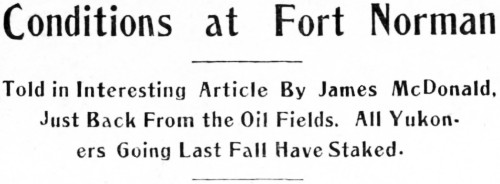
Dawson News: James McDonald, old time Dawson and Mayo miner, who arrived on the steamer Yukon late yesterday afternoon from Fort Norman via the Porcupine river and Fort Yukon, prepared for the News the following statement on the conditions at Fort Norman, and the best winter route to that place:
The Yukon as a winter route to the Fort Norman oil fields is the best for residents of the Pacific coast and Yukon. With our good transportation and roads, travelers, after leaving the beaten track, have not more than 500 miles by trail to the Mackenzie. This distance, when the trails are better known and well broken, will be gone over without undue hardships. The men going from the Yukon last winter met no difficulty except the continuous trail breaking in the snow, and all arrived in Fort Norman in good shape. A number of routes suggest themselves, but two stand out as being most likely to be used in the future.
The Pelly-Ross-McMillan-Gravel lake is favored by the residents of southern Yukon and the Pacific coast. But for Dawson and Mayo, the upper Stewart must always be the best, and, when steady travel sets in, I believe it will be the only one. The most likely way from Minto Bridge will be by Mayo lake, thence by low pass to Ladue river to north fork of Stewart, and up Stewart river to the headwaters of Gravel lake. This should offer an excellent winter mail route to Fort Norman, Fort Good Hope, Arctic river and Fort McPherson; also to points up river from Port Norman. It has the advantage of less mileage to an already established mail service and a good grade all the way.
Fort Norman will be the busiest spot in the North this summer. It is conservative to say freight on the Mackenzie will be ten times that of last year.
The Imperial Oil company's well is 47 miles below Fort Norman. The well is 875 feet deep and is a genuine gusher, and while dormant last winter, had a steady pressure of 40 pounds. The oil is much lighter than any crude oil known and of the highest grade. It does not thicken in the coldest weather. The capacity in barrels is limited to the six-inch pipe at present there, and will increase correspondingly when a larger pipe is installed.
Gasoline for local use by the company is made on the ground. The employes burned crude oil for cooking and heating all winter.
About forty arrived from Edmonton up to February. Only experienced men were allowed by the police to proceed. After February nineteen arrived from Yukon and three from Alaska up to the time we left.
The Yukoners were very fortunate. All of them staked under new regulations, and had favorable weather to thoroughly prospect the field, and find the choicest locations.
New drilling plants for oil will be limited this summer to the carrying capacity of the present transportation on the river.
Fort MacMurray, the head of navigation, was a busy place this spring. A letter dated in March stated 3,000 tons of freight was there, besides more at Peace River Crossing. The Imperial Oil company alone had 700 tons and boats of all sizes and many scows were in course of construction. It is reasonable to believe the scenes of '98 are being repeated today on the Mackenzie.
The ground located up to May 15 extends from Fort Norman, on both sides of the river, to 20 miles below the oil well, a distance of 70 miles, and in some places about 10 miles back from the river. The river will average three miles wide all the way
where located. It has high banks and the adjacent country has a level appearance. The Rocky mountains are visible to the southwest, and a lower range on the northeast.
Moose and caribou are found in the mountains, but not so plentiful as in the Yukon. Fish in summer are in the rivers and lakes and include iconnu, whitefish, grayling, termed bluefish; pike, termed Jackfish; herring and large trout. But, last winter there was none except a few herring and trout hauled 100 miles by toboggan. Dog feed was scarce. The early arrivals bought everything in sight, even feeding canned salmon and sardines to their dogs, until the cost of feed ran up to $6 per day per dog.
Most lines were short in the stores, but there was lots of flour, tallow and tea.
Three trading companies are doing business at each fort and keen competition goes on for the Indians' fur. The Indians are prosperous and independent, getting as high as $45 for marten, $20 for mink, $2 for weasels and $1.50 for rats.
Potatoes, barley and garden vegetables grow well at Fort Norman and Fort Good Hope.
No prospecting for gold, silver or copper has been attempted, and prospectors were hampered and discouraged by the trading companies. The Gravel river formation looks unfavorable for placer. A number of samples of galena ores are at Fort Norman, which were located by Indians. One sample is very rich, but the location as given was vague. "It was found in the mountains," was the nearest description given. This particular native believed he had gold instead of silver. Many of the Indians are bright and good hustlers and well educated. Others are backward, not able to count up to four.
The Catholic priests at Fort Norman, Fort Good Hope and Arctic Red River are great workers, besides caring for the sick and raising large gardens, putting up fish in summer, running trap lines in winter, and sometimes acting as mail carriers on the river. Too much cannot be said for their hospitality and the good work they are doing. They lost two of their number, who were killed by Eskimos of Coronation Gulf, a few years ago. Last year one was drowned in Great Bear lake. They are friends with all, regardless of creed. They expressed a wish that news or newspapers be sent from well wishers in Dawson, care of the police patrol via Fort McPherson. They would be much appreciated, as none are permitted via Edmonton.
The Mackenzie river presents a vast empire of undeveloped wealth, capable of supporting a big population.
To the south, agriculture can flourish. At Fort Simpson wheat, barley and oats are a sure crop - about 300 miles from Fort Norman - and the valley of the Liard is a garden spot.
Transportation is the only problem to be solved to make Mackenzie Canada's richest province.
The Canadian Pacific Railway company is taking over the MacMurray road and the Peace River Crossing road, the Mackenzie & Mann road from Portand canal towards the Groundhog country. The Pacific Great Eastern, backed by the B. C. provincial government, extends towards the Mackenzie. The purchase of the Lampson & Hubbard and other trading companies' steamboats by the B.C. Express, an auxiliary of the Canadian Pacific Railway, all shows which way the winds are blowing, and in such strong hands, transportation difficulties will soon be overcome.
In the near future Canadian oil will supply Canada, and the wealth produced will make Mackenzie the brightest ster in our fair Dominion.
* * *
Howard Colley, with his partners, Chas. McDonald, writer of the above article, Malter Murphy and David McRae, arrived on ihe Casca and left on this week's Princess for Victoria. Mr. Colley will he back here in two weeks. This party passed through here in January on their way to Fort Norman.