
|





|
|
Indian War in the Yukon averted, 1908
Crime & Policing in the North
The life of Fitzpatrick Joseph 'Fitz' Horrigan (1861-1920)
Dateline: March 24, 2024.
It is important to note that the following accounts stray further and further from the truth, the final one, though the most entertaining perhaps, being largely fictional. The Pelly River and Blind Creek people described lived in the area of what is now the community of Faro, Yukon.
It is also significant that this story was not reported in The Weekly Star, in which Inspector Horrigan was mentioned often - we do not yet have an explanation for that.
The Daily Province (Vancouver, B.C.) Tuesday, August 11, 1908
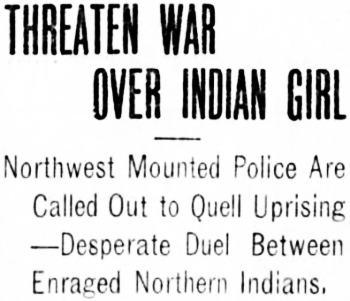
Dawson, Aug. 11 - One Indian woman, a chief's sister-in-law, pretty as far as comeliness goes among northern Indians, and a gift bestowed of a pair of moccasins to a member of another tribe, was the cause of two tribes declaring war upon each other in the Yukon territory within the last few days. Only the prompt action of the Northwest mounted police and the fact that ammunition ran short, is all that saved a merciless slaughter.
The uprising was general among the Pelly Indians and the Blind creek
tribe, headed by Chief Ijuth, over the murder of Blind Creek Jonathan by Liard Bob, a member of the Pelly tribe after a desperate duel fought in the wilderness in which Jonathan was killed. For the murder of Jonathan the Blind creek Indian chief, Ijuth, demanded 1000 blankets and thirty rifles. These were not forthcoming and war was declared.
News of the uprising was furnished by the arrival of the steamer Pauline,
which was placed in commission with Capt. Pitz Horrigan to reach the headquarters of the tribe and command the Indians to keep peace. Both tribes had assembled to exterminate each other, when Horrigan arrived. The first news of the uprising was furnished by Poole and Field, two white trappers.
Horrigan found the Pelly's willing, but the Blind creek's surly; the old
chief being a brother of the murdered man, demanding the original payment of the blood of his enemies. After a long conference Horrigan gave Ijuth ten minutes to settle, or to be seized by the squad. For a few moments it looked as if the chief might order his men t attack Horrigan's force. The chief then agreed to keep the peace. The next day the tribes held a tribal feast together.
The trouble began when the wife of Jonathan gave a pair of moccasins to Liard Bob, saying she did so because she loved him. Jonathan became jealous and attempted to kill Bob. They fought a desperate duel in the wilderness. Bob had no weapons, but overcame Jonathan who had a shotgun and a rifle. Bob wounded Jonathan slightly with his own shotgun, then both raced to get the rifle, Bob winning, killing Jonathan with his own
weapon.
Jonathan was an outcast from the tribe becatise of his stealing tendencies.
Horrigan reports a justifiable homicide on the part of Bob. Horrigan's
timely arrival settled what meant the slaying of hundreds on both sides, perhaps including white prospectors and traders.
Victoria Daily Times (Victoria, B.C.) Tuesday, August 25, 1908

Dawson, Aug. 14. - War has been pending in Yukon territory for weeks
and has been averted by the narrowest margin after the most strenuous efforts on the part of the Royal Northwest Mounted Police. The Indian tribes of the Pelly river have been threatening to exterminate one another, and only by the intervention of the police has one
of the most sanguinary conflicts been escaped.
Captain Fitz Horrigan returned last evening from the Pelly river, where
he acted as mediator between the hostile tribes known as the Blind Creeks and the Pellys. He had a difficult time getting the Blind Creeks to consent to settlement, and it was only by declaring that he would seize and carry off the chief and his counsellor to Dawson if a decision was not made in ten minutes that the captain was able to force an acquiescence on the part of the ringleader in the trouble.
The Blind Creeks had demanded that the Pellys deliver to the Blind Creeks
one thousand blankets and thirty rifles, or the Blind Creeks would proceed in their attempt to exterminate the Pellys.
Through the mediation of some of the whites along the Pelly, the ultimatum on behalf of the Blind Creeks was deferred until the dispute could be referred to the police. Poole Field, who was instrumental in the steps for peace, arrived in Dawson four weeks ago, and kept his mission a secret, conveying it only to the police. As soon as possible the matter was taken up by the police, and a steamer dispatched up the Pelly with Captain Horrigan on board to act as arbitrator. The captain arrived just in time. The Blind Creeks were restless, and about to make a murderous raid on the other Indians. It is possible that had it not been for the shortage of ammunition among them, that the appeal to arms would have been made by the Blind Creeks before the arrival of Captain Horrigan.
Fifty to sixty warriors were mobilized on each side, and had the threatened war taken place, it is likely that a bitter conflict would have resulted in
the wiping out of many if not nearly all of the men on both sides before police could be sent to interfere.
As it is, the Blind Creeks have given up their demand for the thousand
blankets and the thirty rifles, and when Captain Fitz Horrigan left several days ago the two tribes had resumed amicable relations, and were having a reunion and feast together in a way that would put to shame many warring Christlan factions. Immediately after agreeing to settle and be friends, the two tribes assembled and began feasting in token of their new bound troth.
The threatened war arose out of an incident no less interesting than the
threatened war. In the story is a murder, committed last November, the intimation of love on behalf of the wife of one of the murdered men for the other, and the passions of jealousy, anger and all the deeper sentiments that sway the human heart from infatuation to sorrow from bereavement.
The matter originated, it seems, through a petty jealousy engendered by the wife of one of the tribesmen giving a pair of moccasins to another at the time of the death of her little son, and the husband of the woman who made the present saying she did
it because she liked the man to whom she gave the moccasins. This led to a quarrel between the two men, resulting in the murder of the jealous husband by the man whom the jealous husband had attacked. The tribe of the murdered man took up the matter on being fomented into action by the chief, who happened to be a brother to the dead man. Then came the demand for the blankets and rifles, with the alternative of war.
Jonathan, an outcast of the tribe of the Blind Creeks, ostracized because he had been guilty of petty stealing, and thus bearing the awful curse inflicted by his people for his offence, is the murdered man.
Liard Bob is the man who did the murdering. Bob is a member of the tribe by birth. Jonathan had married into the Blind Creek tribe, but the inexorable law of the natives of the entire region decreed him an outcast when it was found he was a thief. He wandered alone, with only his own family, and sometimes not even with them. A year or two ago his little boy died, and Liard Bob showed his sympathy for the outcast, and helped him to bury the boy. Then the mother of the boy in gratitude, gave to Bob a pair of moccasins out of gratitude, if not with some touch of affection for Bob. Jonathan asked her why she gave the moccasins to Bob and her answer to her spouse was that she liked Bob. This kindled the flame of suspicion and the monster of jealousy in the breast of Jonathan, and he would not rest until he sought the blood of Bob.
Last November, on the beautiful banks of the Orkey river, Blind Creek
Jonathan accosted Liard Bob, and endeavored there to wreak vengeance on the suspected destroyer of his domestic love. There the two strong sons of the forest, each in the vigor of physical manhood, faced one another and battled to the death. Jonathan was, from all
that could be learned, the aggressor, and after a fierce hand-to-hand encounter, even Liard Bob had cried enough, refused to cease his attack, and declined to make peace, and cried in his wrath that he would not cease until he had killed his antagonist. Then Bob was forced to fight in his defence.
Jonathan had brought with him a shotgun and a rifle. Seizing the shotgun, Jonathan struck Bob over the head and gave him a scalp wound. In the first encounter Jonathan had bitten Bob severely on one finger. When Jonathan resorted to the gun and
struck the blow, Bob, rallying from the stinging effects, grappled in desperation and reached for the weapon. Fortunately for the Liard man, he got hold of the butt end. He realized that here it was life or death, and, putting his finger to the trigger, he pulled. The shot took effect in the stomach of the Blind Creek fighter, but did not put him out of action. The rifle stood at some distance. Realizing that the shot gun was emptied by the discharge, Jonathan dashed desperately after the rifle.
Here the fleet foot and steady hand of Bob saved his life. The Liard man
and the Blind Creek man raced over the blood-stained grass to the rifle. Bob won the race, and with it the prize of his life. Turning quickly, Bob lifted the rifle and pulled the trigger. One clear shot broke the otherwise stillness of the Pelly wilderness, and as the little cloud of smoke lifted from the end of the rifle, Blind Creek Jonathan, outcast, the man said to be possessed of a half witted mind, reeled and fell in his own blood, killed by his own rifle.
Liard Bob went back to his people, the Pelly tribe, and the people Blind
Creek Jonathan, they who had ostracized him, took his body and buried it according to the tribal custom. Then Chief Ijutth, brother to Jonathan, a brother who had refused to tolerate his thieving brother and had helped to ostracize him and keep him an outcast,
undertook a vengeance of his brother, and roused the Blind Creeks against the Pellys. They demanded from the Pellys the thousand blankets and the thirty rifies, but the Pellys were loyal to Bob, and refused. They were stubborn and declined, as they said, to be held up and robbed. It was then that war was threatened, and the Pellys, being on the defensive, appealed to the whites, and the whites brought the news to Dawson. The Pellys in the
meantime induced the Blind Creeks to await a truce. The shortage of ammunition favored the truce, and perhaps after all the Blind Creeks were glad, and were hoping more to bluff the
Pellys into disgorging the coveted plunder.
But in the meantime Captain Fitz Horrigan arrived. The steamer Pauline could land him no nearer than sixteen miles from the headquarters of the Pellys. He took a poling-boat the remainder of the distance, and with Poole Field, Dell Van Gorder, Purser John Raymond of the Pauline, Joe Cote and four prospectors, went to the Pelly camp. The Pellys delegated six men to meet the whites. Captain Horrigan, realizing the effect of display on the aborigines, was in full regimentals, and with his written documents and side arms. The Indians recognized in him the arbiter sent by the frontier power of the land, the mounted police, and with great respect heard his representations as made through Mr. Field, who acted as interpreter. The Pellys were willing for a settlement at once.
Then a search had to be made for the Blind Creeks. They were found after
much inquiry, and a delegation was sent to meet the little party of whites. The Pellys had no representative present. Chief Ijutth was at the head of the hostile delegation. Austere, furrowed and old, but, vigorous, the chief showed no gloved hand. He was dogged and surley in every action. He wanted the reprisals for the death of his brother. His people would not submit to murder without the customary compensation which all the Indians believe in; that of a life for a life or the equivalent in chattels. For an hour and a half Captain Horrigan reasoned through Indian Jake, the bright English-speaking Indian, the interpreter. Implacable and cunning, the old chief held out. Finally the blood of Fitz
Horrigan, the Anglo-Saxon in the man, rose to assert itself. The prowess of the law should predominate. Horrigan returned from a few paces apart. The Indians, several of them armed, and ugly In their talk - talk which might have meant a massacre of the whites in the conference - talked excitedly.
Horrigan saw the time had arrived. All parley must cease. He drew his
watch, slapped the table with his book, and said in stentorian tones that ten minutes would settle it. At the end of that time the chief would acquiesce in peace proposals or be seized and carried to prison.
The glowering countenance of the chief grew more grim. The interpreter
urged on him peace. The chief listened. The other counsellors paced, and spoke ominously.
As the ten minute interval closed, the chief grunted, and spoke with a shrug. The interpreter turned, and said the chief would agree to peace.
It was done. The peace was agreed on immediately. The next day the good
faith was shown by the two tribes being together in feast. The law of the white man had prevailed. War was averted, and no reprisals are to be demanded. Horrigan and the officers returned and the tribes of the Pelly are at peace.
The Sun (New York, New York) Monday, September 7, 1908
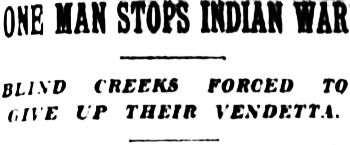
"I'll Arrest You and Take You to Dawson," Said Fitz Horrigan to 1,000 Braves - Raw Over Outcast Husband, Pretty Squaw and Kind Hunter.
VICTORIA, B. C., Aug. 81. - This is the story of a short lived and bloodless war of July, 1908, in which one man clothed in the majesty of the British law as represented by the scarlet and yellow of the Royal Northwest Mounted Police opposed single handed an army of painted red-skins and conquered them.
Capt. Fitz Horrigan is of course an Irishman. No one but an Irishman would have had the temerity to tell a thousand hostile Indians, armed for battle, that
unless they forthwith surrendered to the law it would be his painful privilege to take their weapons from them, place them under arrest and escort them to the jailhouse at Dawson City, 300 miles away. There is something hypnotio is the courage of such a man that wins success as well as admiration. Behind the story of Fitz Horrigan's defeat of the Blind Creek nation there is a story of crime and cunning, of love and jealousy, of stern primitive law and of blind adhesion to the old code of blood reprisal. To Capt. Fitz Horrigan the peaceful termination of an Indian war was "all in the day's work," just as staggering along a frozen river in the teeth of an Arctic blizzard to rescue lost and suffering travellers would have been. His official report of his achievement in daring diplomacy is not iluminative. It is brief, however.
"I have the honor to report," he wrote to hie superior officer on his return to Dawson City on August 8, "that in obedience to instructions I proceeded with all
possible despatch per steamer Pauline to the headwaters of the Pelly River, arriving on July 14 ultimo, accompanied by four constables, Poole Field and three others. Found that the Blind Creek and Pelly River tribes had taken the warpath to the number of perhaps 1,800 or 2,900 on both sides, the cause of the trouble being the shooting of Jonathan, a brother of Chief Ijutth of the Blind Creeks, by Liard Bob of the Pelly Rivers, with whom Jonathan's klootchman (wife) had fallen in love, and the demand of the Blind Creeks for 1,000 blankets and thirty rifes in satisfaction for the killing. The Pellys were quite ready to listen to reason and give up the war, but the Blind Creeks were disposed to be obstinate, and it was only when I informed them that unless they laid down their arms and gave a pledge of peace within ten minutes I should be obliged to arrest and take them to Dawson that they agreod to come in. I remained to see cordial relations between the two tribes restored and left them feasting together.
"Upon investigation I found that the shooting of Jonathan was plainly in self-defence and therefore justifiable homicide on the part of Liard Bob. Jonathan was a worthless Indian anyway and an outcast from his tribe. Bob will marry the widow, whose gift to him of a pair of moccasins aroused her husband's jealous anger and led him to attack Liard Bob, this fight in which Jonathan was shot with his own rifle being the original cause of the trouble.
"All of which is respectfully submitted."
There is nothing in Fitz Horrigan's report of the helpless terror of the scattered trappers, prospectors apd pioneer settlers of the desolate far northern plains
when word came to them that the Pellys and the Blind Creeks had taken the warpath, almost 2,000 strong, and there is nothing of the lonely dash of Poole Field to Dawson with the news, of that hardy prospector's 800 mile tramp over bleak steppes, gaunt mountains and by rushing rivers in their summer flood, done in five days and nights of constant travelling.
To go back to the beginning of the matter two years and a half ago, Jonathan, the younger brother of the chief of the Blind Creeks, became enamoured of sixteen-year-old Lucy. She was a girl of social aspirations and Jonathan was the brother of the chief. Though he did not bear the best name of the young men of the tribe he and Lucy ate from the same dish one evening, and afterward Jonathan dragged her to his own tepee by her long black hair, these primitive manoeuvres constituting the marriage ceremony of their people.
Jonathan was for six full weeks a lover-like husband. Then he found pleasure in idleness, and as the northern wilds do not acknowledge that they owe any man
a living unless he work on it he took to petty thieving. The thief is a pariah in the grim north. Tribal law is stern and inexorable against it. Jonathan was convicted in the council. His own brother, Ijutth, the chief, pronounced the curse of the outcast upon him and he was driven out of the village, forbidden ever to speak to his old tribesfolk or be spoken to by them.
For months Jonathan and Lucy struggled for existence in the wilderness, the woman bearing the heavier burden of the fight. Jonathan learned the mystery of distilling Siwash whiskey, or hootchino, with the primitive paraphernalia of an old coal oil tin, an empty salmon can and a worm made of an ancient musket barrel. From the product of his still he took comfort and found courage to beat his spouse with diligence and regularity.
A baby came at last, but the young life was pitifully handicapped, and one terrible morning Lucy found a chill little body in her arms. For three whole days she
rocked it and wailed over it, while her husband drank and slept.
Liard Bob of the Pelly Rivers found the outcasts thus as he passed to the
North on his hunting, and in pity for the distracted mother broke the tribal law, for he spoke comforting words to her and even dug a little narrow grave in which the baby was laid. Then Bob went his way. Lucy thought of him and his kindness. When he came back again when his hunting in the North was ended sne bashfully placed in his hands a pair of gayly beaded moccasins and said to him, "For you."
The moccasins did not escape the notice of her husband. When the guest had gone he inquired why she made a present to the hunter. She answeredmpromptly because Bob had been good to her and she liked him. And so the torments of jealousy became the punishment of the drunken outcast Jonathan.
Two months later, on the banks of the Orkey River, Blind Creek Jonathan fell in with Liard Bob. Jonathan leaped upon the Pelly River tribesman and made to strangle him. Liard Bob admitted his defeat and sued for terms of peace. Jonathan cried no quarter. Liard Bob realized that he was fighting for life.
Jonathan had brought with him his shotgun and rifle. Seizing the gun he
struck Bob over the head, cutting him to the bone. In the first encounter his teeth had severed one of the Pelly's fingers. When the blow with the heavy gun tore away his scalp Liard Bob grappled for the weapon. He got hold upon the butt and his finger finding the trigger pulled it blindly. The charge tore open the stomach of the outcast Jonathan but still the fever of battle sustained him. His rifle leaned against a tree not fifty teet away, and rallying his ebbing life he made a dash for it. The Pelly River brave ran for it too and won the sprint over the blood stained grass.
Turning immediately, Liard Bob lifted the rifle and fired. Blind Creek Jonathan, outcast, thief and drunkard, spun round and fell in a heap, his troubles ended and his reckoning complete.
Liard Bob washed and bound up his wounds. Then he covered with brush-wood the body of his late enemy so that neither wolves nor bears might get it. Afterward he went back to his tribe and told the story of the fight. The Blind Creeks received the tale later on, and death ending ostracism, those who had driven Jonat away as an outcast brought home his shattered body and gave it burial with tribal honors.
It was a month later that Chief Ijutth took up in council the matter of the killing of his brother. It was finally determined to demand of the Pelly Rivers as an alternative of war the payment of 1,000 blankets and thirty stand of rifles. The Pellys
stood loyally by their tribesman, Liard Bob, declined to pay blackmail and prepared for war. At the same time they made it clear to the whites that they were on the defensive not aggressors. The whites conferred and Poole Field left in the middle of the night to carry
the news to Dawson City.
Meanwhile the Pellys parlayed for a truce and the Blind Creeks, being short of ammunition, their war party agreed. The truce still held when Capt. FitzHorrigan arrived, and with him Poole Field, Trapper Dell Van Gorder, Purser John Raymond of the steamer Pauline, Joe Cope and four red coated troopers - nine men in all - to break a war to which 2,000 redskins were committed. The Pellys delegated six men to meet Capt. FitzHorrigan, in whom they recognized the majesty of the the white Man's law. Besides, they had no special desire for war.
The Blind Creeks were in a vastly different mood. They were located with
difficulty and sullenly obeyed the order to send a delegation for conference with the Captain. Chief Ijutth in person headed the deputation. Austere, furrowed and old, he still was vigorous and showed no gloved hand. He urged reprisals for his brother's death. His people would not submit to murder without the customary penalties in compensation - it was either life for life or payment for the life that had been taken. Implacable and cunning, the old man urged immemorial law and custom and refused to yield.
Then the white man's blood asserted itself, Capt. FitzHorrigan laid down his pipe and stood up. Armed Indians surrounded him and their talk was threatening. In their own tongue they spoke of it as necessary that none of the white men should carry tales back to the town. FitzHorrigan realized his danger and calmly drew his watch from his pocket as he announced in tones of command that he would no longer talk gently with
the disobedient children of the Great Mother - for Queen Victoria is still claiming the allegiance of the Northern tribes. Within ten minutes the Blind Creeks would lay down their arms and give their word of peace or he would take them prisoners to Dawson.
Surprise and consternation showed on the faces of the Indians. They talked in disjointed whispers. The grim chief listened - wavered. At the ten minutes
close the chief grunted, with a shrug significant of yielding to the inevitable. The spokesman of the deputation ap- proached Capt. FitzHorrigan.
"it is peace," he said.
The word of the red man is a bond. The peace was forthwith executed. Next day the lately hostile tribes feasted together. The law of the white man and the courage of the white man had prevailed.
As Capt. FitzHorrigan and his little party took the trail back to Dawson, having shaken the hands of all the senior tribesmen and smoked with them in
solemn and significant silence, the wrinkled father of Liard Bob approached the white man hesitatingly.
"My son," said he, "who is the cause of this trouble is not, even so, of a bad heart. He is full of a great pity for the widow of the man whose life he took. Has he permission to make of her his wife - for surely it is right that he should do this and care for her, seeing that it is through him that she is now a widow."
"What does she think of it?" asked FitzHorrigan, sparring for time in which to collect his wits, for the rules and regulations of the "finest force in the world" prescribe no code of action under just such circumstances. "How would our
bloodthirsty friends take to it?"
"They would be pleased," was the answer. "And she - she wishes it. She
says she has long loved him much."
"Well, let it be then," commanded Capt. FitzHorrigan. "They have my official consent, and my ex officio blessing."
Then to his little company: "Fall in now, men - and mush!"
|

|
