An epic story of Canadian exploration is contained in the musty old Sessional papers of the House of Commons for the years 1898 and 1899. It details, in simple language in narrative and diary form, the day by day story of a Northwest Mounted
Police patrol under Inspector J. D. Moodie, that explored, in the years 1897 and 1898, a
trail through practically unknown wilderness between Edmonton and the Yukon River.
It was an heroic effort that occupied more than a year to complete. Dangers of an unknown land confronted the police patrol all the way; food ran short on more than one occasion; Indians were undependable.
One white guide lost his way in a thickly wooded part of the Peace River country, became demented and perished.
A new pass was found through the Rockies - Laurier Pass; and Sifton Pass,
between the Finlay and Turnagain Rivers, was discovered and named.
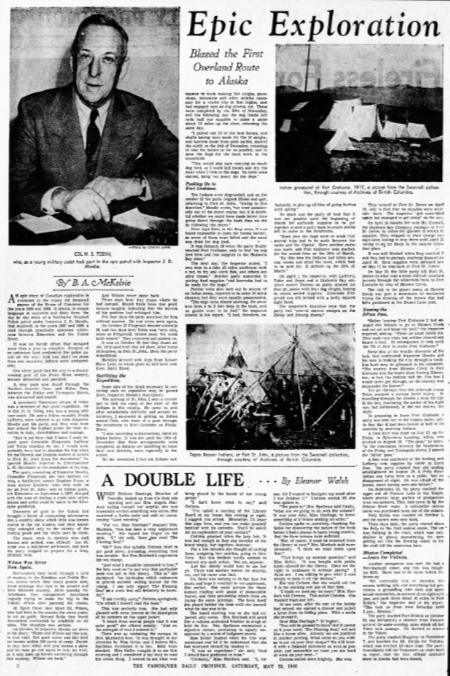
 A prominent Vancouver citizen of today was a member of that great expedition. He is Col. H. S. Tobin, who was a young military cadet. He and a fellow ex-cadet, Frank Lafferty, were selected to go with Inspector Moodie and his party, and they won from that official the highest praise for their devotion to duty, cheerfulness and courage.
"Had it not been that I knew I could depend upon Constable Fitzgerald, Lafferty and Tobin standing by me, I would most probably have had to abandon the trip when
the half-breeds and Indians wanted to return to Fort St. John from the mountains," Inspector Moodie reported to Commissioner L. W. Herchmer at the conclusion of the trip.
The party, consisting of Inspector Moodie, Constable Fitzgerald, the two military cadets, a half-breed named Baptiste Pepin, a man named Hardisty - who only went as far as Fort St. John - and an Indian guide, left Edmonton on September 4, 1897, charged
with the task of finding a route over which horses and cattle could be taken to the Klondyke goldfields.
Discovery of gold in the Yukon had brought a horde of stampeding adventurers into a country about which little was known except to the fur traders, and their knowledge extended only to the vicinity of the trading posts and fur trails used by them.
The route, even in districts now well known and settled, was difficult. Lac St. Anne was a half-breed settlement, and here the party stopped to prepare for a long, difficult trek.
Wilson Was Never
Seen Again.
Nor'westerly they went, through a land of muskeg to the Pembina and Paddle Rivers, across which they found prairie land, more muskegs that had to be scouted and then timbered country. After passing the Athabasca they encountered Americans vaguely trying to make the trip to the Yukon; others were panning the creeks.
At Spirit River they hired Ed. Wilson, who had been in the country for seven years, to act as guide. Beyond Rolla they found themselves confronted by windfalls on all sides. The situation was serious.
On October 20 Inspector Moodie set down in his diary: "Pepin and Wilson out this a.m. to find trail. Got good water and fair feed for horses within 200 yards of camp. Decide to stay here today and give horses a show and let men go out again to look for trail, as it only uses up horses wandering throug this country. Wilson not back."
And Wilson never came back.
Three days later they found where he had camped. Blazed trails from that point became tangled, indicating that the terrors of his position had unhinged him.
For four days the party searched for him without success. He was never seen again.
On October 25 Fitzgerald became violently ill, and two days later Tobin was "very sick, same as Fitzgerald, fainted once; too weak to be moved." They recovered and pushed on.
It was on October 28 that they found an old, little-used trail that led them, after many difficulties, to Fort St, John. Here the party re-outfitted.
Hardisty arrived with dogs from Lesser Slave Lake, to which place he had been sent from Spirit River.
Outfitting the
Expedition
Some idea of the detail necessary in outfitting such an expedition may be gained from Inspector Moodie's description:
"On arriving at St. John, I sent a runner out to find the camp of the chief of the Indians in this vicinity. He came in, and after considerable difficulty and several interviews, I succeeded in getting an Indian named Dick, who knew of a pass through the mountains to Fort Grahame on Finlay River.
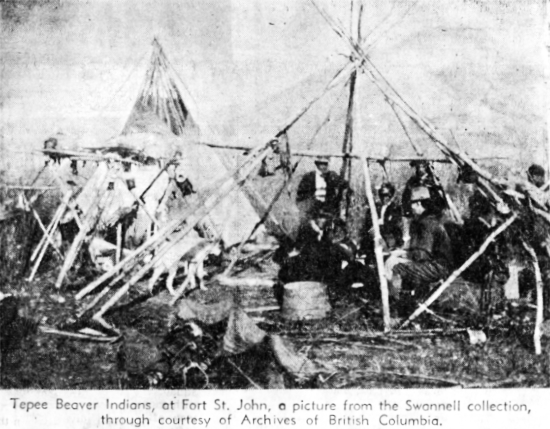
"I also, according to instructions, hired an Indian hunter. It was not until the 19th of November that these arrangements were completed, as Indians are unwilling to leave their own districts, more especially in the winter.
"In the meantime I had set Indians and squaws to work making flat sleighs, snowshoes, mocassins and other articles necessary for a winter trip in that region, and had engaged men as dog drivers, etc. These were completed by the 30th of November, and the following day the dog trains left with half our supplies to make a cache
about 13 miles up the river, returning the same day.
"I picked out 13 of the best horses, and shafts having been made for the 10 sleighs, and harness made from pack outfits, started the outfit on the 2nd of December, intending to take the horses as far as possible, and to save the dogs for the hard work in the mountains.
"This would also save carrying so much dog feed, as I could kill horses and dry the meat when I took to the dogs. No tents were carried, being too heavy for the dogs."
Pushing On to
Fort Grahame.
The Indians were disgruntled, and on December 22 the guide feigned illness and quit, returning to Fort St. John. "Owing to this desertion," Moodie wrote, "we went considerably out of the direct course, but it is doubtful whether we could have made better time going direct through the bush than we did by following the rivers."
Four days later, in the deep snow, it was found impossible to push the horses farther, so seven of them were killed and the meat was dried for dog feed.
It was January 18 when the party finally reached Fort Grahame, only to find "no dog feed here and few supplies in the Hudson's Bay store."
The next day, the inspector stated, "I sent men to a lake 25 miles southwest with a net, to try and catch fish, and others out after moose." Neither party succeeded in getting food supplies "and bannocks had to be made for the dogs."
Parties were also sent out in search of an Indian camp, reported to be some 50 miles distance, but they were equally unsuccessful.
"The dogs were almost starving, the snow was from 4 to 5 feet deep in the bush, and no guides were to be had," the inspector related in his report. "I had, therefore, reluctantly, to give up all idea of going further until spring."
So short was the party of food that it was not possible until the beginning of March for sufficient supplies to be got together to send a party back to secure stocks left in cache in the mountains.
"Even then the dogs were so weak that several trips had to be made between the cache and the 'Opsica'. Here another cache was made, and Fort Grahame was reached for the second time on the 29th of March.
"By this time the Indians had killed several moose and dried the meat, which had to be sent for. It arrived on the 29th of March."
On April 1, the inspector, with Lafferty, Tobin and Pepin and a Hudson's Bay employe named Thomas as guide, started for Fort St. James with four dog sleighs, hoping to obtain needed supplies. Constable Fitzgerald was left behind with a badly injured right hand.
The inspector's narrative says that the party had "several narrow escapes on the Finlay and Parsnip rivers."
They arrived at Fort St. James on April 19, only to find that no supplies were available there. The inspector "got snow-blind
again, but managed to get along" on the way.
On April 20 Moodie left with Mr. Camsell, the Hudson's Bay Company manager at Fort St. James, by canoe for Quesnel in search of supplies. They stopped at Fort George two days later, having to stay there until April 24 owing to an ice block in the canyon below that place.
It was stiil blocked when they reached it and they had to portage, reaching Quesnel on April 30. Here supplies were obtained and on May 11 he was back at Fort St. James.
On May 30, the little party left Fort St. James on what was a most difficult overland journey through the wilderness back to Fort Grahame by way of Manson Creek.
The trail to the placer camp at Manson Creek was just a succession of mud-holes trying the stamina of the horses that had been purchased at the Stuart Lake post.
Naming the
Sifton Pass.
"Before leaving Fort Grahame I had engaged two Indians to go to Manson Creek and cut out and blaze the trail," the inspector reported, adding: "These as usual failed me. They made two trips, but neither cleared nor blazed a trail. In consequence it took until the 7th of July to make Fort Grahame."
Some idea of the terrific character of the task that confronted Inspector Moodie and his men in making the trip through a trackless bush may be glimpsed in his comment: "The country from Manson Creek to Fort Grahame was the worst since leaving Edmonton; in fact, the Indians told Mr. Fox that I would never get through, as the country was impassable for horses."
But get through they did, although young Tobin received a serious facial injury. In travelling through the forests a stick hit him in the face, fracturing the socket of his right eye, but fortunately it did not destroy the sight.

In preparing to leave Fort Grahame, a party was sent out to the Ospica cache, only to find that it had been looted of half of its contents by starving Indians.
A final start was made on July 15, up the Finlay to Sylvesters Landing, which was reached on August 19. "The pass," he notes, "in the mountains, between the headwaters of the Finlay and Turnagain rivers, I named the 'Sifton' pass."
A boat was purchased at the landing, and Lafferty took supplies by water to Liard Post. The party reached that old trading establishment on August 29. A Pelly River Indian was hired here as a guide, "but he disappeared at night. He was afraid of the
horses, never having seen one before."
On September 23, the party reached the upper end of Frances Lake in the Yukon, where several large parties of prospectors were encountered. They had come in by the Stikine River route. A collapsible canvas canoe was purchased from one of the miners.
Pelly Banks was reached on October 1, and the horses were sent back.
Three days later, the party started down the Pelly in the frail canvas canoe. The ice was forming in the river, which was very shallow in places, necessitating the men getting out into the freezing water to lift the craft off the numerous bars.
Mission Completed
- Leave for Victoria.
Another prospector was met. He had a Peterborough canoe, and this was bought for $450. Haste had to be made before the freeze-up.
"We eventually had to abandon the canoes, bedding, kits and everything but provisions, a groundhog robe each and some actual necessaries, on account of an eight-mile jam, and pack down about 30 miles to Fort Selkirk," the inspector said in his report. "This took us from noon Saturday until 2 p.m., Monday."
The party reached Fort Selkirk on October 24, and fortunately a steamer from Dawson arrived the same evening, upon which all but Tobin took passage. He decided to winter in the Yukon.
The party reached Skagway on November 7, and boarded the SS. Dirigo for Victoria, which was reached 10 days later. The party immediately left for Vancouver en route back to report that the first official overland route to Alaska had been blazed.
The image below shows the article as laid out in the newspaper.