DAWSON CITY, Yukon, Feb. 17 (AP) - It was, in effect, the death of the Yukon, When it came this winter, it was quiet and business-like, strangely contrasting with the bawdy and boisterous birth of the Klondike gold rush 70 years ago.
The last major mining outfit to work the goldfields, Yukon Consolidated Gold Co., said it could no longer operate profitably in this area. Since 1923 it had taken out $70 million worth of gold, part of the $260 million in gold which the government
estimates as the harvest since 1896.
The Klondike is played out after giving up its fortune and breaking strong and weak men in the process.
Sixty-eight years ago, when the rush was at its height, the word Klondike was synonymous with adventure and wealth. It meant gold nuggets as big as baseballs to the starry-eyed generation produced by the gay nineties. Few people struck it rich and even fewer managed to hold onto it once they did.
* * *
THE FIRST DISCOVERY was made almost accidentally by a Californian named George Washington Carmack, dubbed Siwash George by his friends. He had an Indian wife and a long, drooping mustache.
Carmack was plying the waters of the Yukon River with two Indian friends, Skookum Joe and Tagish Charley, in search of timber. They heard rumors of gold near where the Klondike churns into the meandering Yukon.
The trio paddled up Bonanza Creek, and Siwash George dipped into the sandy bottom with his miner's pan. He pulled out a half ounce of flaky gold dust, worth about $4.50. He was astounded. A 25-cent pan was considered a workable claim.
On Aug. 17, 1896, Carmack staked four claims, two for himself and one
each for his Indian friends. The trio paddled to Fortymile, a trading post downriver on the Yukon, to register their claims at a Northwest Mounted Police post.
Siwash George bragged about his strike to everyone he met.
The area was soon alive with rumors.
* * *
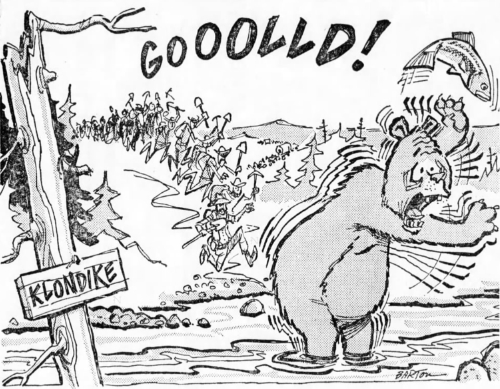
SOME AUTHORITIES estimate that as many as 60,000 men and women from around the world headed into the desolate northland. During the winter of 1896-97, those who beat the ice on the river staked most of Bonanza Creek, a chunk of the Klondike and parts of Eldorado Creek.
They were mining thousands of dollars worth of gold - and eating
beans, hardtack and moose hides to subsist through the winter.
With the spring breakup on the Yukon, the first batch of filthy but rich miners, later to be known as Eldorado Kings, headed 1,700 miles down river to St. Michael on Alaska's west coast to board ships for the U.S. mainland.
The steamer Excelsior reached San Francisco July 15, 1897. By the
time the Portland arrived in Seattle two days later with the balance of the Eldorado Kings, many of the Excelsior’s passengers were roaring drunk in San Francisco, telling tall tales and spending gold dust by the pound.
In a matter of weeks, thousands of adventurers swarmed to the west coast to get passage aboard dozens of ships chartered for the long haul up the Yukon.
* * *
A CRAFTY French-Canadian trader named Joseph Ladue, who had a penchant for starting rumors to sell his supplies to prospectors, staked out a townsite in the middle of a swampy area near the junction of the Klondike and Yukon Rivers.
This was the site of Dawson City. Within months saloon keepers were
paying his price - up to $1,000 per foot of frontage.
Other would-be millionaires arrived in Skagway, Alaska, in the late summer and early fall of 1897. They scrambled up the Chilkoot Pass and the White Pass in the direction of Dawson as winter once again closed in.
Another army of greenhorns tried traveling by ship up the Yukon River, but almost all were frozen in. They didn’t make it untl the following spring.
During the winter of 1897-98 miners worked their claims almost around the clock. The mother lode of the Klondike was discovered during the long arctic night.
A Pennsylvanian named Nathan Kresge and his partner Nels Petersen decided to explore the hills while the rest panned the streams and bored through the riverbanks.
Kresge and Petersen speculated that big Skookum Gulch, across Bonanza Creek trom the original Klondike claim, must have at one time been a riverbed.
They were right. In the next few weeks they grubbed out $10,000 worth of gold from an area of a few square yards. Though the majority of the miners failed to realize it until much later, the richest part of the Klondike goldfields had been uncovered. The claim later became known as Gold Hill.
* * *
DAWSON SKIDDED through the winter on the verge of famine, without proper rations for its swelling population. Miners whiled away their time gambling and fighting.
In Skagway, fiefdom of self-styled dictator Jefferson Randall (Soapy)
Smith, thousands of miners were milling about during the winter, preparing supplies for the dash over the Chilkoot Pass to Dawson.
The spring of 1898 brought Dawson its sorely needed supplies - and
an estimated 50,000 goldseekers.
Most of them were at Lake Bennett, having traversed the difficult Chilkoot and Dyea Trails under the watchful eye of Inspector Sam Steele of the Northwest Mounted Police and his men.
When the ice broke, the first of more than 7,090 boats, canoes, rafts
and the occasional painsiakingly reconstructed steamer bolted for the goldfields.
They carried about 30,000 persons, according to police reports of the
time. Virtually none of them struck it rich.
Dawson's population reached the 20,000-mark in midsummer. Its streets were a sea of mud most of the time.
Riverboats brought in all manner of outlandish appurtenances from the
outside world - solid mahogany bars, crystal chandeliers, bicycles, ice-boxes, champagne by the case, and chickens, to insure against a shortage of eggs the following winter.
* * *
DAWSON WAS DOOMED to failure as a metropolis almost as soon as it was born. By the summer of '98 almost all the producing claims in the gold fields had been staked.
Many miners stuck it out through the winter of 1898-99 but hundreds of
disillusioned greenhorns went home.
Fire in the spring of 1899 sealed the fate of Dawson. Saloonkeepers couldn't afford to rebuild their hotels and bars.
Of the estimated 100,000 people who actually set out on the trail of '98, only about 35,000 actually reached Dawson. Fewer than 20,090 actually went in search of gold and of these, only about 4,800 found it in any marked quantity.
Fewer than 300 persons made fortunes and a minority of those got their money out of the Klondike to enjoy it.
Siwash George Carmack invested his money in real estate and died in 1922 in Vancouver, leaving most of his money to his second wife. Tagish Charlie bought a hotel at Carcross, Y.T., but died shortly after the turn of the century. Skookum Jim held onto his money, but continued his search for the "big strike." He died in 1916 on the trail.
Joseph Ladue, despite all his business acumen, didn’t know how to
stay out of the cold and died of tuberculosis in 1898 at the height of the rush he had helped create.
Nathan Kresge eventually sank his fortune he made from his Gold Hill claim into an abortive mining venture in Oregon. He died a pauper in Seattle. His partner invested in some Yukon River steamboats, then history lost track of him.
Today Dawson has a_ population of about 600 persons and faces a bleak future with the closing of the Yukon Consolidated operation. A few tottering buildings remain downtown among modern bungalows and gas stations, a reminder of days of splendor in the northern wastelands.







