Dr. Leonard Sugden and Mr. Selwood Tanner arrived in town on Friday of last week after an absence of nearly four months. In an interview with a representative of the Star the Doctor gave an interesting account of their travels as follows:
"We left Whitehorse with a single horse and light rig, and made fine time
to Lake Kluane in spite of breaking the front axle on the Kufkawulsh meadows - we hired three more animals at the foot of the lake and traveled light to where we had cached 800 pounds of grub on the Donjek last winter; we found the river running a yellow flood in the place where our cache should have been, not a sign of anything, tent, stove, cooking utensils and camp equipment all gone; some of this outfit was for the use of the hunting party which Morley Bones had to meet at McCarthy, the loss of it entailed considerable discomfort throughout the season. We traveled lighter from that point, living mostly on meat till we landed at North Fork island; it was here we got the first news of the Chisana strike.
"We could not buy any grub for love or money, Mrs. Hamshaw kindly loaned us 5 pounds of rice till we got back from McCarthy. Hearing that Bones had gone over with his party to Chisana after bear we followed to see if he had grub enough to carry us all through the season, (we were suppose to take big game pictures with the hunting party.)
"We located hig camp about 8 miles from discovery in the new diggings, he was short, so we had to turn back and hike for McCarthy. The trail was lined with people, parties were galloping all over the tundra between the White and Chisana, it reminded me of '97 and '98.
"We went by the Scolai Pass and Chitistone. I will describe this and the
other routes in lectures in connection with our pictures at a later date. We saw that this stampede was liable to assume large proportions and be of historical interest, and also tangible visual evidence in regard to the different trails, and their impassible condition
except during the middle summer months. And so after getting an outfit at McCarthy we devoted our time to taking pictures over all the trails.
"We took a great many pictures. There was practically no summer, the worst season I have seen in 16 years; the conditions were very bad from a photographic standpoint. If our pictures turn out so that they can be seen at all I can divert 90 per cent. of the travel this way tor the spring and winter travel. The only summer route for any outfits outside of lignt foot passengers and pack animals is down the Yukon and up the
White by steamboat, thence 70 miles to the diggings. The McCarthy trail is 90 miles long. It may sound paradoxical but 300 miles is sometimes shorter than 90. We saw the Hazelet party who were sent in by the Cordovans to stake a route over the Nizina and Chisana glaciers. They lailed to get through - the Cordovans are a wonderful bunch, alive to the wonderful benefits to be derived trum a stampede, they subscribed $5,000.00 in twelve hours to send Mr. Hazelet in just to look up a trail. They have since subscribed a like
amount as a publicity fund and are going to get the business if not checked in the right manner.
"About 2000 men and some women went in by McCarthy, the Copper River
& N. W. railway had men working on all tne traiis, they are working hand and giove with the Cordovans to boost that route. They have had a taste of what stampede money tastes like, and it savors very much of milk and honey, and they want some more.
"Now as regards the camp I can say only this, I am sure Billy James took
out the amount he is credited with and also Joe McClelland, outside of these people practically no work has been done, in the first place there has never been enough grub to supply the demand, also a lack of tools and no lumber, and what was supposed to be summer was half gone before the stampede started so that only bare assessment work enough to hold ground has been done on any other ground than that mentioned, (outside of Fletcher I. Hamshaw, his coming back with an outfit figuring in hundreds of tons is sufficient
evidence of what he thinks of his findings.)
"I have private information of other prospects on creeks that are not part of the original discovery watershed and will say that I know of no section of the north I have ever seen that gives more promise of big things than the belt that runs rignt through from Kluane across the Donjek, the White and head of the Tanana rivers, all that nas ever been needed has been the right sort of man with the necessary grub and tools.
"It is a great game country, moose, caribou, and sheep, and all kinds of
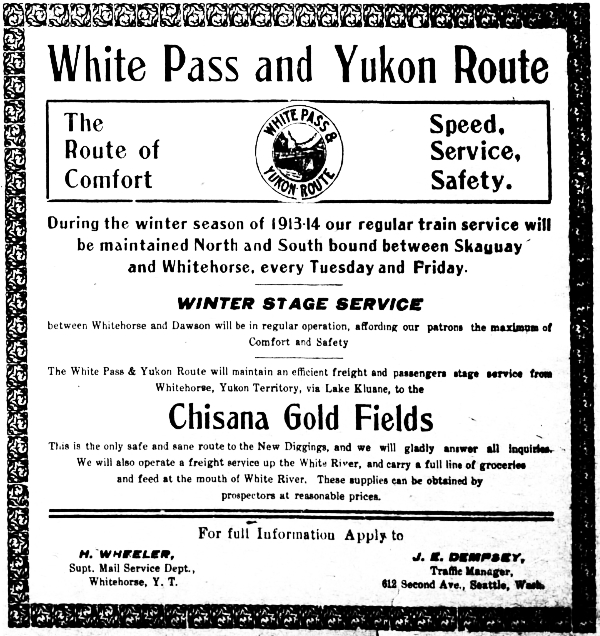
feathered game, lots of fur, lakes teeming wita fish, and over most there there is heavy timber. There are only two sure ways of going in this winter, namely, by Skagway-Whitehorse-Kluane and Horsfelt, and by Skagway-Whitehorse the Dawson trail and up the White.
"What about the McCarthy trails?" "There are no McCarthy trails in winter, three death traps that's all they have."
"Are you not putting it rather strong Doctor?" "Am I a darned Chechaco,
I know what I am talking about, I've lost paradise driving dogs on some of the toughest trails in the north; but what's the use, wait and see our pictures, they'll speak for themselves. Yes I am going to develop and print day and night, and when ready will show here. If we can get an audience of course.
"We came out by the Jenerk, Donjek, Kluane route. The trail is in better shape than I have ever seen it. The White Pass launch was at the lake and is being rapidly assembled. We came in by the Royal Mail stage line operated by Harry Chambers, in 5 days, and had a fine trip.
"Mr. Tanner is going out after his big sleigh which we abandoned on the
O'Connor in the breakup last spring. Please excuse any profanity - Hun, the McCarthy trial."