
Home Page | The ExploreNorth Blog | About ExploreNorth | Contact Us | Search
Paddy Sukhkées Duncan (1865-1955)
Highlights of History from The Whitehorse Star
Crime & Policing in the North
Dateline: December 16, 2025.
This page began as a 2-article report about a shooting death at Champagne, but as I researched and read wider and further, it has become a biography of Paddy Duncan.
Ancestry lists his birth date as 1865, and The Whitehorse Star, in a comment about his death in 1955, stated that he was then 90 years old. The 1901 census, however, lists his birth date as December 4, 1875. He reported in that census that he was working as a scout for the North West Mounted Police, and was living at Champagne in a house with 8 other people - his wife Mary, 4 sisters, his mother-in-law Jennie Koishluck, and 2 lodgers, Mary Kootawat and her 3-year-old son Johnie.
Ancestry reports that Paddy was the first child of Pete "Big Pete" Duncan and Mary Kaatshaanoox. They would have two more sons and four daughters.
On October 14, 1927, The Whitehorse Star reported a new gold strike at Squaw Creek, near Dalton Post. In June 1928, Big Jim and Paddy Duncan were credited with the discovery when they arrived in Whitehorse with 53 ounces of coarse, heavy gold. With the arrival of the gold, Yukon Councillor W. L. Phelps immediately asked for a road to built to Squaw Creek.
In the 1931 census Paddy Duncan was living at both Champagne and Klukshu, and was a trapper. His wife Mary had died, and he was living with 29-year-old step-daughter Alice Duncan, a widow.
On October 31, 1936, Paddy shot Harton Kane during a drinking party at Champagne - Kane died in Whitehorse hospital the next day. Paddy was convicted of murder and sentenced to be hanged, but that was commuted to life imprisonment. When offered parole in 1948, he declined unless he was allowed to return to the Yukon. The condition that he not be allowed to return was removed.
On about the first of October 1955, Paddy Duncan died in a car crash 35 miles north of Haines, Alaska. Although we have not found verification, it is highly likely that he was buried at Champagne.
The Whitehorse Star (Whitehorse, Yukon) - Friday, November 6, 1936
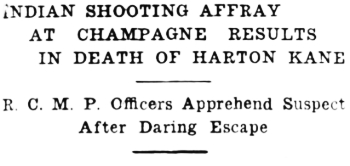
Const. D. A. Dunlop in charge of the Police Post at Champagne arrived in
last Friday afternoon with Harton Kane, native of Champagne, who was in a critical condition following a shooting affray in which he was shot in the region of the stomach.
He was rushed to the Hospital but death came to the suffering man the following morning.
At a coroner's inquest held on Monday morning, the jury composed of C. T. Atherton, foreman, T. C. Richards, Capt. P. Martin, H. G. Macpherson, W. D. MacBride and J. Sewell met. The verdict of death by gunshot wounds was returned, but owing to the lack of and the conflicting evidence by the witnesses, the jury under Foreman Atherton declined to place the blame on any party in the dispute.
While authentic details are lacking, it is reported that a quarrel took place between the deceased Harton Kane and Paddy Duncan, one of the discoverers of gold on Squaw Creek. In the struggle which ensued, Paddy Duncan it is said, shot the deceased in the back, the shot penetrating into the stomach.
Const. Dunlop immediately placed Duncan under arrest and deputized R.
Lowe of Champagne to guard the prisoner while he rushed the wounded man to Whitehorse in a desperate attempt to save his life.
On the return to Champagne the following day, Constables Dunlop and
Mabee found Duncan had escaped from the jail armed with one of Const. Dunlop's rifles and 50 rounds of ammunition.
Rushing back to Whitehorse with the news, the entire detachment, under command of Inspector Binning and Sgt. Kingston, left on Monday for Champagne to capture the escaped prisoner, who was thought to be evading capture in the wild country surrounding the district.
On arrival at Champagne the police apprehended the escaped prisoner and a preliminary hearing was held, the prisoner being charged with the murder of H. Kane.
At the trial it was brought out that R. Lowe had been supplying liquor to the Indians and he was sentenced to six months' imprisonment,
Inspector Binning and Sgt. Kingston and the other police officers returned from Champagne on Wednesday evening with the two prisoners, one to serve his sentence here, and Paddy Duncan to come up for trial on a murder or manslaughter charge.
The Whitehorse Star (Whitehorse, Yukon) - Friday, November 13, 1936
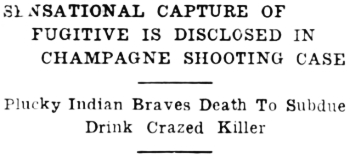
Grim death stalked the tiny village of Champagne for the second time early the morning following the shooting of Harton Kane, but was thwarted by the pluck of an Indian, says reports from Champagne.
Paddy Duncan, still crazed from the effects of home-brew, after escaping from his cell armed with a deadly rifle, hastily sought to obtain an outfit to make his get-away to the hills.
The grey of dawn was just breaking when the madman, who had spent the night in a deserted cabin only a mile from the village while a posse of natives searched for him, silently
stole by the window of Frank Smith's cabin. Seeing the crouching form go past the window, Smith, with great presence of mind, darted behind the door. As the door opened and Duncan walked in, Smith, kicking the rifle from his grasp, grappled with the killer while he ordered his younge son to take the rifle and hide it outside.
Taken completely by surprise, Duncan, suffering from exposure and in a nerve-racked condition as an aftermath of the drunken orgy, realized the game was up and was persuaded by Smith to give himself up peacefully.
Securing his own rifle, Smith stood guard over Duncan while his small son ran to the Post and notified the authorities, who hastened to the scene and placed the prisoner in custody.
Too much commendation cannot be accorded to the native, Frank Smith, for his daring and single-handed capture and arrest of the desperado.
The Whitehorse Star (Whitehorse, Yukon) - Friday, December 4, 1936
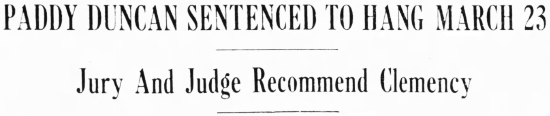
The Court convened for the trial of Paddy Duncan, Indian of Champagne
charged with the murder of Harton Kane, at 9:00 a.m, Thursday, to hear the evidence as submitted by the various witnesses.
The jury consisted of Messrs. W. A. Paterson, foreman; J. Sewell, Robert
Small, G. Bidmke, N. Murray and K. Briggs. Judge C. D. Macaulay presided and H. G. Blankman was Clerk of the Court. Prosecutor C. E. McLeod handled the ease for the Crown while Duncan was represented by W. L. Phelps, K.C., of Whitehorse.
Evidence as brought out by the Kane family and Duncan, while conflicting in many instances, showed strongly that there was no quarrel between Paddy Duncan and the deceased Harton Kane, or any member of the Kane family, prior to the shooting.
Three members of the Kane family and Paddy Duncan, it was dislosed,
assembled in the R. Kane house in Champagne, where a drinking orgy with home-brewed beer the intoxicant preceded the shooting. After having imbibed a considerable quantity of the beer, the drink-crazed men were on their way to an adjoining house when Kane, it appears, fell mortally wounded, a bullet entering his abdomen at the bark and penetrating to the stomach. Duncan was said to have been at the rear of the group with the rifle that fired the fatal shot.
Members of the Kane family testified that Duncan fired the fatal shot
while Duncan claimed he remembered nothing after consuming the liquor. In establishing the state of mind the prisoner was in at the time Prosecutor McLeod and the said Duncan were at a considerable variance.
A piece of evidence very damaging to the prisoner's case was introduced
when George Joe told of Duncan remarking that he had bought a gun to get one of the Kane boys, or words to that effect. This would tend to show premeditation of the murder but the only other party present at the time the remark was said, Sam Boss,= could not be found by the police to appear at the Court. However, W. L. Phelps, Counsel for the accused, brought out by questioning that the said George Joe had a considerable dislike for Duncan owing to money troubles.
In his testimony, Const. D. Dunlap stated that when he arrested Duncan after the shooting, the prisoner had said, "He try to get me; I get him." Duncan denied all knowledge of having said anything to that effect.
In summing up the ease for the defense, Mr. Phelps gave the jury the salient points which were brought out at the hearing. Stressing the fact that all parties were amicable previous to and also during the eventful evening, he suggested that the shooting could have very easily been a pure and simple accident caused by Duncan stumbling as they were on their way to another house. Evidence given, he said, that the gun was shot from a low angle also supported this theory. Commenting that the drunken orgy had already claimed one life, he warned the jury the gravest misjustice would be done if they returned
a verdict of guilty of murder which would automatically call for the sentence of death.
Prosecutor C. E. McLeod, in his address to the jury, called their attention to the fact that Duncan deliberately took the rifle from the Kane house when he left with the three Kanes and, agreeing that there was no quarrel, claimed Duncan had planned the shooting of the deceased. He also mentioned that George Joe, in giving evidence, had said Duncan had stated that he intended to "get" Harton Kane. Mr. McLeod commented on the fact that the prisoner claimed to remember nothing of the shooting and, when accused of the crime immediately after, had said nothing in reply, which silence, Mr. McLeod said, was evidence of his guilt. It was also a well-directed shot for an accident, he commented, and rested his case by adding that, if the jurors knew what Canadian justice demanded, they would know what verdict to return.
Judge C. D. Macaulay then gave the jurors their instruction in his able and concise manner, afterwards outlining an eloquent presentation of the highlights of the case. In his opinion the decision of the jury lay in whether the prisoner was guilty or innocent of the charge of murder. Manslaughter he said, did not enter into the case, he considered, as there was no evidence of a quarrel. The case for the jury was simple, he said, as there was no circumstantial evidence but all firm facts to judge on. He pointed out that the prisoner had made a_statement to Const. Dunlop to the effect that he had "got him" and commented on the integrity of the R.C.M.P. officers in cases such as these. The
damaging evidence given by George Joe was also mentioned by the Judge. At the conclusion of his address Mr. Phelps raised the point that the jury had the privilege to return a verdict of manslaughter if they saw fit, to which Judge Macaulay readily agreed.
After an absence of about an hour, the jury, under Foreman Paterson,
brought in a verdict of guilty to the charge of murder with a strong recommendation for clemency.
Before sentencing the prisoner, Judge Macaulay stated he would make
a Strong recommendation to the Chief Justice for mercy in this case, after which he pronounced the death sentence and set the date for March 23, 1937. Prosecutor McLeod then requested the Court to accept a recommendation from him that clemency he accorded by the Chief Justice in this case.
Before dismissing the Court, Judge Macaulay issued a solemn warning to all purveyors of liquor to Indians and placed the cause of the tragic affair directly on the liquor and its effects on the native mind.
The Whitehorse Star (Whitehorse, Yukon) - Friday, March 5, 1937
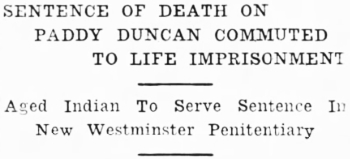
The death sentence passed on Paddy Duncan, convicted slayer of Harton Kane in a native drunken brawl at Champagne last Fall, has been commuted to life imprisonment by His Excellency the Governor General in Council. Duncan was sentenced to hang March 23rd.
It is understood that Duncan will be kept under strict surveillance until
his removal to New Westminster Penitentiary, where he will serve his sentence.
Commutation of the death sentence was received with approval by local
residents, the majority of whom endorsed a petition requesting this
measure recently.
News of the removal of the death sentence was received with great jubilation by the prisoner, who attributes it to efforts of the citizens of the town and to his counsellor, W. L. Phelps, K.C., local barrister.
The Vancouver Daily Province (Vancouver, B.C.) - Thursday, July 8, 1948
By Clyde Gilmour
A tired old Indian today tearfully decided to turn down parole and stay in prison unless he is allowed to return to his boyhood home in the Yukon.
Paddy Duncan, 80, who has served 11 years in the British Columbia Penitentiary at New Westminster for a murder he swears he didn't commit, could have gone free at noon today - but only by promising never to go back to the Yukon.
"No, no, no!" he cried when a prison official explained to him the terms of his ticket-of-leave, granted this week by the Secretary of State at Ottawa. "I go home! I go home, or I stay!" As a result, Paddy Duncan is voluntarily remaining in the prison while officials consult Ottawa in an effort to get the stay-out-of-the-Yukon clause removed from the Indian's parole.
The ticket-of-leave, as it now is worded, would bind over the Indian to the custody of the man who led the fight to free him - Andy Paull, founder and honorary president of the North American Indian Brotherhood, doughty Squamish tribesman and courtroom warrior who has fought for his people all over Carada.
Andy Paull told newsmen he is convinced Ottawa wants to keep Paddy out of the Yukon for his own protection. "They think relatives of the man he is supposed to have
murdered will wait for him and kill him."
Duncan was convicted of the murder of another Indian found shot to death outside Duncan's shack in the Yukon in 1936.
MODEL PRISONER
Originally he was sentenced to be hanged March 2, 1937, but the sentence was commuted to life imprisonment. Duncan entered the New Westminster federal prison April 3, 1937, and has been there ever since - 11 years, three months, five days.
"He has been a model prisoner,"said Deputy Warden Lewis Goss. "He never gave us one moment's trouble. All the other prisoners always liked and respected him. Paddy is a nice old fellow."
At his trial and ever since, Paddy Duncan has maintained his innocence. He blames tribal feuds, and says the killing was rigged to make him look guilty.
The old man is a great-grandfather. His wife died many years ago, and one of two daughters died last April. The other daughter, a grandmother, is in the Yukon, and Paddy also has a brother at Juneau, Alaska.
THEY TREAT ME GOOD
"I want to see them again," the Indian said today, sitting meekly in the warden's office. "I want to see home. Don't want to stay down here. They treat me good here, but I want to go home." There were tears in Paddy's faded eyes when he walked into
the office, but he blinked them back with fierce resolution. Mutely, he shook hands with
Andy Paull, who had been working on his appeal for clemency for almost three years. "Thank you, thank you," Paddy Duncan said finally, and sat stiffly on a tall chair facing the
warden. He was wearing a neat prison-made grey single-breasted suit, black ankle-boots, blue shirt and grey tie. He laid his brown fedora hat on his lap, and peered incuriously through steel-rimmed glasses.
At first everybody thought the old man would gladly accept his parole - on any terms.
HELPED MOUNTIES
But a different prospect developed during his conversation with Andy Paull and W. S. Arneil, Indian commissioner for B.C. Mr. Paull had asked Mr. Arneil to help him on the matter. Said Mr. Paull after the conference: "Paddy would just as soon spend the rest of his life here in prison than stay anywhere except his old haunts in the Yukon. And I can't say I blame him.
"He wants to go up there and see the trails he knew as a boy, and later when he was a guide helping the Mounties many years ago. He wants to live there, and to die there - and he couldn't be happy anywhere else in the whole world."
Mr. Paull and Mr. Arneil made it clear to Paddy that he could go free if he wanted - but only on condition he promised not to go home. The old man blinked again,
shook his head, and blurted out: "No, no! I go home! Please! I not make any trouble."
Then he agreed to stay in prison until his situation can be finally clarified with federal authorities.
The Vancouver Daily Province (Vancouver, B.C.) - Friday, July 9, 1948

By Clyde Gilmour
Paddy Duncan was wearing his old prison clothes of blue denim again today. His neat new "freedom suit" of grey worsted has been put away - but he hopes he'll
wear it again in a few days.
The 80-year-old Indian could have gone free Thursday on parole from the B.C. Penitentiary at New Westminster. But the parole would have bound him over to stay out of the Yukon, his homeland. Paddy said no, and is voluntarily remaining in prison while
authorities try to persuade the Secretary of State's department at Ottawa no harm would come to the old Indian from his real or imaginary foes if he refurned to the Yukon.
Airmail letters in Paddy's behalf sped eastward Thursday night from the prison and from W. S. Arneil, Indian commissioner for B.C.
The Indian has served 11 years, three months of a life term imposed on him in 1937 for the murder of another Indian. Paddy has consistently sworn he is innocent. And there are many who believe him. One of these is a 69-year-old Vancouver man, Stan Cameron, a retired prospector living at 1058 Nelson.
"It's exactly 50 years ago this week since I first met Paddy Duncan, and he's a wonderful fellow," Mr, Cameron said today.
LIVELY COMPANION
"On July 8, 1897, eight of us set out from Victoria with 54 head of cattle and 15 horses. At Haynes Mission, in Alaska, we hired Paddy Duncan as guide. He
took us 100 miles to Dalton's Post - and you couldn't wish for a finer guide, or a livelier companion. We all thought the world of him."
In prison today, the lean old Indian stoically resumed his solitaire games and his occasional games of checkers and horse-shoe pitching with other prisoners.
LIKES PICTURES
Times passes slowly for a man like Paddy behind iron bars. He has never learned to read. "But he's crazy about magazines, anyway," a prison official said, grinning. "Looks at all the pictures, and seems to enjoy them. And whenever he wants to
write a letter, which isn't often, he tells the chaplain what he wants and the chaplain looks after it."
OTTAWA (CP) - There's nothing to stop Paddy Duncan from staying in New Westminster Penitentiary for the rest of his days, if that's what he wants, Justice Department officials said today. Chief reason they qualified his parole with the stipulation that he shouldn't return to the Yukon, they said, is that he is 84 years old, according to their files, and probably would be unable to look after himself.
The department has not yet been notified that the aged Indian declined to leave prison if he can't go home.
The Vancouver Daily Province (Vancouver, B.C.) - Thursday, July 22, 1948
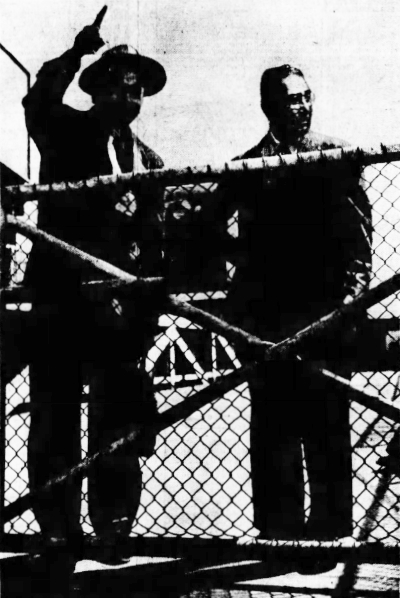
FREEDOM FELT GOOD to 84-year-old Paddy Duncan (right) Wednesday after 11 years, three months and 18 days in B.C. Penitentiary. But he'll feel better if Ottawa lets him back to his beloved Yukon. Andy Paull, founder of North American Indian Brotherhood, points to the North Shore where Paddy will stay with him until the matter is decided.

By Fred Edge
Paddy Duncan, who first chose prison rather than a parole that would exile him from his home in the Yukon, is back on the "outside."
Two weeks ago, the 84-year-old Indian refused to leave the
Federal penitentiary at New Westminster because terms of his "freedom ticket" barred him from returning to his friends and family up north. He had served 11 years, three months and five days of a life sentence.
At 2:30 p.m. Wednesday Paddy Duncan stepped out into the sunlight - a free man. But he still can not go home.
Paddy has been placed on provisional parole in the custody of Andy Paull, founder of the North American Indian Brotherhood, who began the fight for Paddy's release nearly three years ago. Yesterday, after shaking hands with Deputy Warden Lewis Goss, and other prison officials who termed him a "model prisoner," Paddy was met at the entrance to the penitentiary by Andy Paull and B.C. Indian Commissioner W. S. Arneill.
PIECE OF PIE
The former north woods guide was wearing a new grey-striped worsted suit, a brown fedora, and carrying the rest of his belongings in a soiled white canvas bag. He clearly showed the effect of nearly 12 years imprisonment on a man who had lived his life outdoors. Deep furrows lined his forehead and his eyes held an undefinable expression of mingled insecurity and embarrassment. But there was no bitterness there.
"It's all over now," he said dispassionately. "All I want is to return to my home in the Yukon. What is past is past."
At 3:30 p.m, awaiting the ferry to Andy Paull's North Shore home, the two men dropped into a coffee shop. "What'll you have?" Andy asked. "A piece of pie," Paddy replied, giving him a broad grin. "All I want is a piece of pie." His face clouded. "In prison a piece of pie was a luxury."
As the ferry docked he flashed another of his broad smiles. "The first thing I will do is telegraph my brother in Juneau," he said happily. "Peter will be glad to hear the good news. He will feel good because I am out."
Paddy has no immediate plans for the future. He is awaiting word from the
Secretary of State's department at Ottawa as to whether or not he will be permitted to return to the Yukon. Until then, in his own mind he is still serving time at the Federal penitentiary for a murder he did not commit.
Eighty-four-year-old Paddy Duncan will not feel really free until he is back at home with his friends and family in the north woods.
The Vancouver Sun (Vancouver, B.C.) - Thursday, July 22, 1948
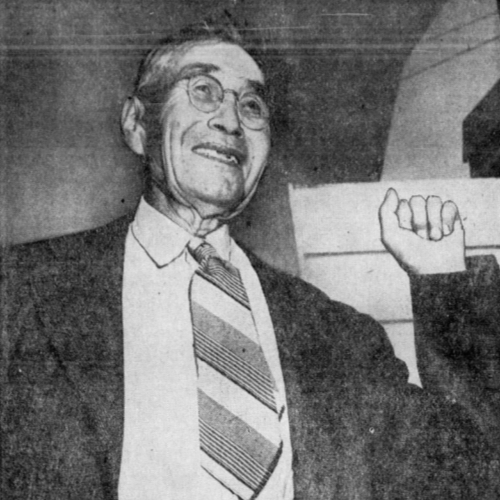
FREE AFTER 11 YEARS is Paddy Duncan, 80, Indian, sentenced in 1937 to life imprisonment in B.C. Penitentiary for murder. But Paddy isn't happy. The terms of his ticket-of-leave won't let him go back to his native Yukon, and although he is staying now on the North Vancouver Indian Reserve, he may voluntarily go back to his "home" at the B.C. Penitentiary.
There is an 80-year-old Indian heart that beats a little faster in
Vancouver today. Paddy Duncan walked through the cold steel gates of the B.C. Penitentiary Wednesday afternoon and for the first time in 11 years and four months breathed the air of freedom and saw the Fraser rolling along under a summer-blue sky. His faded old eyes danced and his hickory-lined face wrinkled into a happy smile.
The soft-spoken, kindly-face-old man received a sentence of death by hanging for the slaying of another Indian in the Yukon in 1937. It was later commuted to life imprisonment.
Paddy has his ticket-of-leave now and today is living with a friend, Andy Paull, at North Vancouver Indian Reserve. He had refused to leave the prison when he first received the parole, July 3, because it forbade him to return to his homestead at Haines, Yukon Territories. Department of Justice officials at Ottawa are expected to make a decision at any time on the conditions of the parole.
Paddy will return to the New Westminster penitentiary unless he is permitted to spend his last days in the land he loves. He has at least one brother, a daughter and a number of grandchildren in the Yukon who are willing to care for him.
"How was jail?" "It was a bad place," the old man said wistfully. "We had plenty of food, mostly beans and fish."
But what the aging woodsman missed most of all were the mountains, the green trees, the rivers and the wild animals which had been his life. "I couldn't see anything but cement walls and sky. At night, I would look at the moon and wonder what she was seeing in the Yukon bush on the other side of the big wall."
All through the 11 years of his imprisonment the old man has continued to insist thal he is innocent of the crime for which he was being punished.
When he gets back to the Yukon he will not return to his traps. "I'm pretty good yet but not good enough for that," he smiled wryly.
The Native Brotherhood is fighting his case for him.
The Vancouver Daily Province (Vancouver, B.C.) - Tuesday, December 21, 1948

Paddy Duncan's best Christmas present won't be under the tree - he got it today. And Santa gave the 84-year-old Indian just what he wanted.
Paddy, who was paroled from B.C, Penitentiary last June after serving 11 years, three months and five days of a life sentence for murder can go home to his beloved Yukon Territory.
Permission came as a pre-Christmas gift today from the State Department at Ottawa, delivered by an officer of the Royal Canadian Mounted Police.
REFUSED TO LEAVE
When Paddy Duncan was paroled, conditions of his freedom ticket barred his return to the Yukon. At first Paddy refused to leave prison on those terms, but was
later persuaded to make his home on the Indian Reserve in North Vancouver.
His friends, notably Andy Paull, continued to fight for him. Paull wrote a letter to the only man who could play Santa Claus for Paddy, His Excellency the Governor-General. "All Paddy wants is permission to go home," the letter said. It was up to Santa Alexander.
HARM THREAT
He had to consider that Paddy had been barred from the Yukon because of fear that harm might come to him from other Indians in the area where the 12-year-old murder had been committed.
The Governor-General's answer, finally, was "Yes, Let Paddy go home."
Now Andy Paull is speeding arrangements for Paddy's departure. He'll be home for Christmas.
The Vancouver Sun (Vancouver, B.C.) - Thursday, December 23, 1948
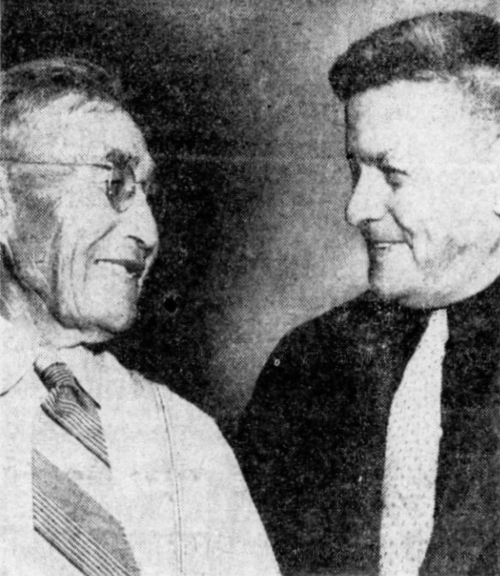
MEDICINE MAN'S PREDICTION is coming true for Paddy Duncan, 84, left, North Vancouver Indian, condemned to death for murder 11 years ago. Medicine man told Paddy he could see steps walking away from his Yukon home and returning. Now Paddy has been paroled from B.C. penitentiary, where sentence was commuted to life imprisonment, and Ottawa has granted permission for him to return to Yukon. Shown with him is old friend, Andy Paull.
|
