
Home Page | The ExploreNorth Blog | About ExploreNorth | Contact Us | Search
Alaska gold miner robbed in Portland, January 1896
Crime & Policing in the North
Dateline: January 19, 2026.
The Sunday Oregonian (Portland, Oregon) - Sunday, January 19, 1896
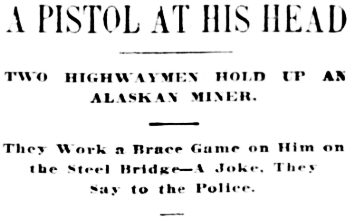
Edward S. Bradbury and Harry W. McMillin, two men who arrived in Portland
on the last steamer from San Francisco, were yesterday arrested and arraigned in the municipal court on a charge of holding up Theodore Shade, an Alaskan miner, and were held in $1500 bonds to await the action of the grand jury. The prisoners seem to look upon the matter as a joke, but, from all appearances, it will require several years' prison servitude for them to see just where the laugh comes in. Little is known of the two men; but they are regarded more as "grafters" than highwaymen, and Shade was singled out by them as a pigeon easily to be plucked.
Theodore Shade, after passing the season in the Yukon river mines, arrived in Portland three days ago, and, putting up at the New Grand Central hotel, started out to view metropolitan sights. He did so to his own satisfaction, and, while so engaged, ran against a "cold deck" of cards in a poker game, which cost him $75. This was only an incident, and never would have been mentioned had it not been for other and more exciting experiences during his short career of pleasure. In his preambulations he ran
afoul of Bradbury and McMillin, two men masquerading under the names of Carter and Shock. They first met Shade at the hotel, and later on Friday night at a saloon, with a dance hall attachment, where their acquaintance was renewed. The two men were profuse in their friendship, particularly Bradbury, who represented. himself to be possessor of about
$4000, which he was willing to invest in some Alaska scheme. Shade confided to him that he had about $600 which he was willing to invest, and this was all the information the two sharpers desired.
Bradbury clung to Shade closer than a brother, and, Saturday morning, after the saloons had closed, pursuaded him to go to the East Side, where he knew a certain place, run all night, where drinks could he secured. It was 3 o'clock when the two men crossed the steel bridge on their way to the East Side in quest of more drink. About 200 yards from the eastern approach, Shade noticed that some one was following them. They stopped, and McMillin passed; then suddenly turning around he shoved a gun in the face of Shade, saying:
You --- --- are blowing yourselves in this town, while other people are starving. Hold up your hands!"
It required no second invitation to enforce compliance with the order. Up
went the hands of Shade, over his head, and the man with the gun ordered Bradbury to go through his companion. Bradbury did so after a fashion; but McMillin was not satisfied: so, keeping the gun under Shade's nose, he used his left hand in exploiting his victim's pocket. He took $10 in gold and two silver dollars from the trousers pocket and a pocketbook from an inside coat pocket, which, after examining it, he put in his own pocket. The robber next turned his attention to Bradbury, who had been idly standing by, and, going through one of his overcoat pockets, took out a pocketbook in which Bradbury claimed was about $40. His being robbed was evidently only a blind, as later developments showed that the two men were partners. After being relieved of their money, the robber remarked, with an oath.
"Now, screw your nuts!"
Shade says he ran and was joined by Bradbury. In their flight, Shade noticed a policeman, and stated his intention to give the alarm before the robber could
get away; but Bradbury persuaded him not to do so, and the two went to the Cosmopolitan lodging house, where the latter had a room. While there engaged in talking over their "hold-up," McMillin walked in. To him was repeated the story. McMillin refused to believe the men; but Shade was determined to report the matter to police headquarters, and, going to the central station about 4:30 o'clock, informed Captain Cox, who was in charge, what had taken place. There were no detectives on duty at that hour, and Shade was told to call
later. He waited about the station for an hour or more; then, leaving, went back to the room where Bradbury and McMillin were sleeping, and arousing them stated that the police were after the robber with a good chance of catching him. He wanted Bradbury to get up
and go to the station to furnish such particulars as he could; but the man refused to do so on a plea of sickness, but gave to Shade his address, E. S. Carter, for use of the officers if needed.
McMillin at this juncture astonished Shade by saying he was the man who
robbed him; that it was a joke, and his money would be returned, and then gave the man 50 cents with which to purchase a bottle of beer. Shade apparently was dumfounded over the admission of McMillin, and, thinking the matter over, decided not to have him punished, if he got his money back. He adopted the poorest kind of tactics to carry out his purpose.
Returning to the central station, he informed Captain Cox that he had got his money back, and would let the matter go; but the officer on duty was not inclined to do anything of the kind, and, to make sure of the men, he placed Shade under arrest as a witness. Later Captain Cox and Patrolmen Kerrigan and Endicott went to the Novelty restaurant, where the two men were eating an early breakfast, and, placing both under arrest, slipped iron on their wrists and took them to the station.
In the municipal court yesterday, at the examination of McMillin and Bradbury, Shade told his story as above narrated.
E. H. Sargent was also called to the stand, and testified that he and the prisoners were passengers on the steamer State of California, arriving from San Francisco Wednesday evening, and that both men were evidently well acquainted with each other, and came from either Merced or Modesto, Cal.
Chief Minto testified that McMillin had admitted being the perpetrator of the "hold-up." He said that he had taken Bradbury's gun to use, and, while he put his hand in Shade's pocket and felt of his money, he did not take any. His object was to get Bradbury's money away from him. When under the influence of drink, he was likely to spend all he had.
At the conclusion of the examination, both prisoners were held to answer in $1500 each, Shade, $500, and Sargent, $250, to appear as witnesses.
McMillin conducted his own defense and that of Bradbury, showing he was no stranger to court methods. He is a man of good address and a good talker, and, though unknown to the detectives here, it is surmised he has been in trouble before. His record will be secured from California, when the San Francisco officials can be communicated with.
The Morning Oregonian (Portland, Oregon) - Thursday, February 13, 1896
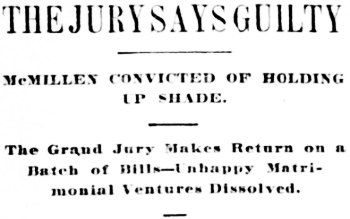
H. W. McMillen was tried and convicted yesterday in the state circuit
court, Judge Stephens presiding, on an indictment charging him with assault with intent to rob Theodore Shade, January 19, 1896. Shade says McMillen held him up at the point of a six-shooter, on the steel bridge, and searched his pockets, taking all of his money, about $12. The testimony for the prosecution disclosed that McMillen and Ed S. Bradbury arrived in Portland from Merced, Cal., January 16, per steamer State of California from the Bay city. They put up at the New Grand Central hotel, and there became acquainted with Shade, who had just come from Alaska, where he was engaged in mining. Shade, McMillen, Bradbury
and one Sargent took in the sights together for several nights, visiting numerous saloons and dance halls, drinking and making merry. During the course of their acquaintanceship, Shade confided to McMillen and Bradbury that he had made some money in Alaska, and had $500 ready to invest in some profitable enterprise. The bulk of Shade's possessions were in notes and valuable papers, on which he could readily realize $500, but this was not
made known to MeMillen and Bradbury, who, it is believed, were of the opinion that Shade had $500 in cash, and they determined to relieve him of it.
Early in the morning of the 19th, Shade, who had been drinking somewhat and as usual having a gay time in the dance halls, was induced by Bradbury to walk over the steel bridge, where he was told he could continue the festivities, all the places on this side having been closed up for the night. McMillen followed, and, in the middle of the bridge, drew his revolver and told Shade and Bradbury to hold up their hands, which they did. McMillen went through their pockets, and then told them to move on, which they lost no time in doing. Instead of the $500 which he doubtless expected to get, McMillen obtained from Shade, according to Shade's statement, $12, all the money he had. The
object in McMillen also robbing his friend Bradbury was a ruse to throw Shade off his guard, and not cause him to suspect that Bradbury was in the scheme with him (McMillen), and that in the darkness and excitement Shade would not recognize him, or for a moment think he was the offender, as Shade also presumed he had gone to bed long before, as he had parted with Shade and Bradbury in a dance hall ostensibly for that purpose.
This idea worked capitally for a while. Shade and Bradbury hurried back to town, going to Bradbury and McMillen's room, where McMillen was encountered. Shade here discovered that McMillen, instead of being in bed, as he supposed, was up and dressed. Shade accused McMillen of having a hat on like the man who had just stood them up, and insinuated that
McMillen was the highwayman. McMillen went to throw off his coat, and said he would thrash Shade if he dared to state that he was the robber, and this demonstration on the part of McMillen was the occasion of an immediate apolory by Shade.
McMillen and Bradbury endeavored to convince Shade that they had better retire for the night, and talk over the adventure the next day, but Shade would not be persuaded, but instead proceeded to the police station and related his experience to Captain Cox. He was told to return the next day, and he then went back to the hotel and informed Bradbury and McMillen of the result of his visit. McMillen thereupon acknowledged to Shade that he was the culprit, and explained that it was all a joke, and he wanted to settle the matter. Shade, however, made a second call to the police station, as he had agreed to do, and Bradbury and McMillen were arrested and charged with the crime.
McMillen tn his own behalf yesterday stated that he and Bradbury were particular friends and traveling companions, and were engaged in business together in
Merced, Cal. McMillen also said he had been a saloon-keeper. He and Bradbury came here together, and he (McMillen) had expended all of his money but 15 cents, and Bradbury was fast getting rid of what cash he had. Bradbury, so McMillen said, was a high-flyer when he got started, who treated everybody, and he was fearful, at the rate Bradbury was going on, that they would both soon be without a cent in a strange place.
Bradbury was drinking freely, and had refused several times to go with him to his room and go to bed. MoMillen stated that he finally resolved to take the money from Bradbury by force, so he followed Bradbury and Shade over the steel bridge, unknown to them, and robbed Bradbury, but did not take anything from Shade or make any attempt to do so. The revolver, McMillen said, he had taken out of Bradbury's pocket several hours previous to the hold-up, in a Japanese restaurant. Bradbury was having some words with
the Japanese over the payment of his bill. Bradbury was intoxicated, and he was afraid he might use his pistol, so he slipped it out of his pocket. McMillen explained that if Shade lost $12 he must have lost it during his spree or around town, or have had it stolen from him then. He did not take it.
McMillen, in answer to a question by District Attorney Hume, admitted that he was known by the name of Schop, in Merced and Madera, Cal., but that the people
there also knew him by the name of McMillen. He denied that he left Merced
clandestinely.
Bradbury has been jointly indicted with McMillen, and is to have his trial today. McMillen and Bradbury are both young men, and of quite decent appearance.
Shade ts also a young man.
The Morning Oregonian (Portland, Oregon) - Saturday, February 15, 1896

The jury in the case of Edward S. Bradbury, who was jointly indicted with H. W. McMillen for assault with intent to rob Theodore Shade, returned a verdict yesterday, after a brief deliberation, finding Bradbury guilty of simple assault. Shade
was held-up on the steel bridge by McMillen, and Bradbury, who accompanied Shade, was also at the same time robbed by McMillen.
As Bradbury and McMillen came here together and are old friends and former business partners, the robbery of Bradbury by McMillen was, of course, believed to be only a part of the scheme arranged for the robbery of Shade, and to throw him off the scent. This was very difficult of proof, and was evidently not established to the satisfaction of the jury. There was no direct evidence that such a plan was laid. It could only be conjectured. Judge Stephens was displeased with the verdict, and so expressed himself to the jury concerning it. He said:
"Gentlemen, I am astonished at your verdict. It is a farce upon its face. Bradbury is either guilty as charged in the indictment, or he is not guilty, and is entitled to an acquittal. There is no middle road."
McMillen was convicted Wednesday, according to indictment. As the case now stands, McMillen has to go to the penitentiary and Bradbury gets off with a county jail sentence. If this is not even-handed justice it is not the fault of the court, but
of the evidence.
Bradbury was sentenced to pay a fine of $500 or to serve 250 days in the county jail. The present outlook is that he will stay in jail.
|
