
|





|
|
Adelbert David "Bert" Stickney (1870-1897)
Klondike Gold Rush, 1896-1899
The "Third Avenue Typhoid Cemetery at Find a Grave.
Dateline: October 24, 2024.
Adelbert David "Bert" Stickney was born in Illinois in 1870. His parents were Calvin W. Stickney (1828-1902) and Aurilla Mabie Stickney (1832-1921). He was one of 9 children. In 1880 the family was living at Fredericksburg, Chickasaw County, Iowa.
There are various versions of what happened to Bert while en route tom the Klondike gold fields in 1897, and we have posted a few. What we do know for certain is that he was the first burial at Dawson City, and photos of his grave as we saw it in 2003 and 2007 can be seen at the bottom of the page.
The most complete report is the one published in The Forreston Herald on August 21st.
The cemetery where Bert was buried goes by three names - the Klondike Visitors Association calls it the St. Mary's Cemetery, Yukon Heritage calls it the Third Avenue Cemetery, and Find a Grave calls it the Third Avenue Typhoid Cemetery (the least accurate of the three).
San Francisco Chronicle (San Francisco, California) - Sunday, July 11, 1897
Mr. A. E. Carr, who took the American mail to the Yukon, tells a story which illustrated the manner in which a miner sticks to his friends. While on his way to the mines, Bert Stickney died and his partner, putting his body in a canoe, paddled mournfully toward Circle City. He offered as much as $300 to any man who would accompany him, but no one being willing to go, he played a lone hand and, taking his partner to Circle City, he buried him there with all the honors he could bestow upon him.
Anderson Daily Bulletin (Anderson, Illinois) - Wednesday, August 4, 1897
DIED ON THE WAY.
The most touching incident which has so far been brought to our attention is the death of Bert Stickney, who in company with a friend was on his way to the gold fields. When at Lake LeBarge he was stricken and died. His friend would not leave him in that solitary yet beautiful place, but was anxious to have him buried near civilization. Being alone he was compelled to travel with the body of his friend a distance of 400 miles before he could obtain a decent burial. Upon arriving at Dawson willing hands helped to dig a grave and all that remains of Bert Stickney now reposes beside the granite hills which border the golden Klondyke.
The Boston Daily Globe (Boston, Massachusetts) - Friday, August 6, 1897
From Joseph Ladue: "We have a graveyard started and two graves in it. One is that of Bert Stickney, who died a natural death on lake Labarge, and the other is that of C. G. Felch, who died of heart disease in the room over my office. We had service over these men, conducted by a church of England man. I do not know his name. Bishop Bumpers [sic - Bompas] is the head of the English church, and this was one of the clergymen under him. The bishop is at Forty-Mile, but will move to Dawson."
The Evening Journal (Ottawa, Ontario) - Saturday, August 7, 1897
From Joseph Ladue: "It was reported by the Montana man, Moss, that there were 2,000 graves in the place. I don’t see how that could be, as we never had more than
1,500 men there. The first to die was Bert Stickney, who died on Lake Labarge while on his way in. The second death was C. G. Felch, of Oregon, who died of heart disease. They found him dead in bed In the morning. He had sold out and had his money in three sacks under his pillow, which amounted to $12,340.
"These are the only two graves in Dawson.
He was buried by the people there and his money was turned over to the
gold commissioner. The commissioner settled his funeral expenses and I suppose the rest of his money will go to his people in Oregon. When a man dies there his effects are turned over to the gold commissioner. This commissioner records claims and settles all mining disputes."
The Forreston Herald (Forreston, Illinois) - Saturday, August 21, 1897
Died Near Klondike
Mrs. S. W. Baker, who lives on the Killbuck, in Ogle county, has just received the sad news of the death of her brother, Bert Stickney, in Alaska. Bert went there three years ago and was joined by his brother, Frank, the following year, and together they engaged in mining. Last fall Bert came to Chicago, leaving Frank in charge of the mine. Bert started from Chicago to return to Alaska by way of Montana, stopping at Craig to visit his brother Roscome. He left early in January for Juneau, reaching there
in February. There he received a letter from Frank stating that the mine had proved a winner, and that there was a new rich discovery at Klondike, which wae 500 miles from
Circle City, where he was located; also that the supply boats had failed to get up the Yukon last year, on account of ice,and that the supplies were running low. Flour was $50 a
sack and still going higher. Bert and his partner loaded up twenty-four sacks of flour and 1,500 pounds of provisions and started over the trail of snow and ice, a distance of eight
hundred miles with the thermometer ranging from 40 to 75 degrees below zero. After they had traveled a dozen days they met a mail messenger and wrote they were well and hearty but traveling slow. They reached Salmon river where Bert was taken sick with pneumonia and died seven hundred miles from his destination with no one but his faithful partner, who took his body with him four hundred miles to Dawson City, the metroplis of the Klondike, where he buried the remains. It is thought he went on to Circle City with the supplies as no word was ever sen to the contrary. - [Rockford Republic]
The Kansas City Journal (Kansas City, Missouri) - Wednesday, September 8, 1897
Even in the Klondike Kansas was first and foremost. The first grave in the settlement was that of Bert Stickney, son of C.. W. Stickney, of Logan county. He went to the Yukon region three years ago.
Helena Evening Herald (Helena, Montana) - Friday, September 10, 1897
DIES EN ROUTE TO THE YUKON.
Bert Stickney Passes Away on the
Trail Between Juneau and Circle City.
The life of one Montanian has been sacrificed in the chase for wealth in Alaska. The privations that the struggle for wealth in the frozen north encounter have proved too severe for a resident of this state, and he has succumbed fon the trail while en route to the new Eldorado. The details of the sad affair are not obtainable. Little
beyond the fact that he died while on the way to Circle City and the gold fields is known. Whether he fell a victim to the disease that is said to be rampant in that distant country or perished from an accident is not known. No one seems to know whether his remains were given civilized sepulcher. All that can be learned is that he is dead and that his relatives are seeking to establish the extent of his property holdings in Montana. A local
banker today received a request from R. M. Stickney, a well known citizen of Craig, asking if Bert Stickney, his brother, had money on deposit in the bank. Mr. Stickney wrote that his brother died on the trail between Juneau and Circle City a few months ago and his relatives are seeking to have his property administered. The banker will reply in the negative. The deceased at one time transacted business with the bank, but at the time of his death he has no deposits. This is all that can be learned of the affair. It will probably be several months before the circumstances leading up to the death are known.
Great Falls Daily Tribune (Great Falls, Montana) - Saturday, September 11, 1897
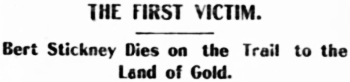
HELENA, Sept. 10. - Relatives of Bert Stickney, a brother of R. M. Stickney of Craig, are endeavoring to ascertain if he had any property here. They have
recently learned that he lost his life on the Clondyke trail between Dyea and Dawson City. This is the first Montanian sacrificed in the mad chase for gold in the land under the arctic circle. No particulars of his death are available.
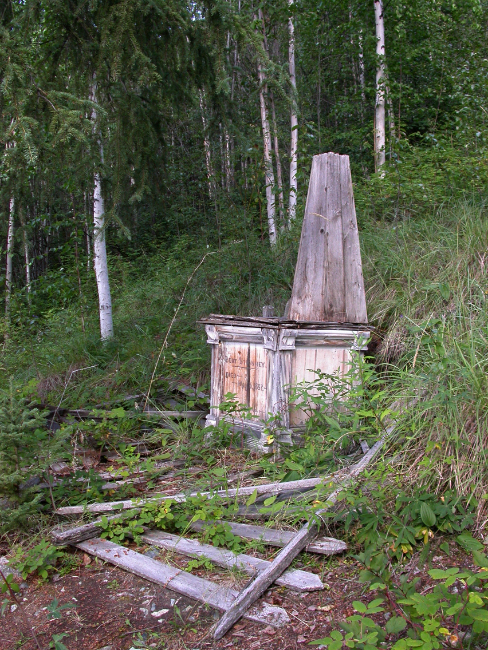
August 4, 2003.
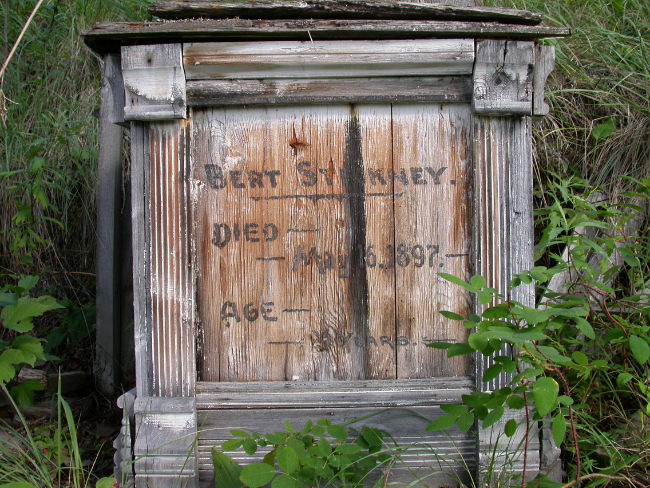
August 4, 2003.
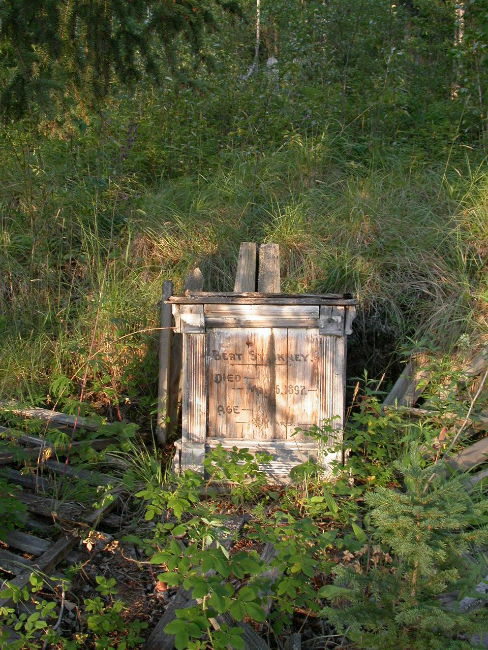
August 4, 2007.
|

|
