Arctic & Northern Biographies
Dateline: March 4, 2025.
The centennial of Stefansson's birth was commemorated in the December 1979 issue of Arctic: Journal of the Arctic Institute of North America.
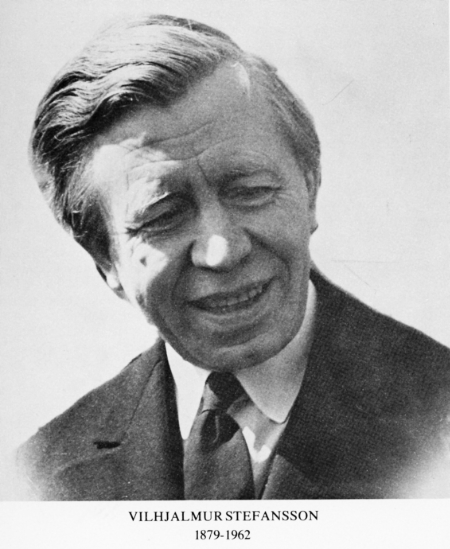
One hundred years ago, on 3 November 1879, Vilhjalmur Stefansson was born
in Arnes, Manitoba. Shortly thereafter his Icelandic parents moved to North Dakota, and Stefansson spent the next years in the United States. After attending college, he spent two summers doing field work in Iceland, and then spent almost all of the period from 1906 to 1918 in the Canadian Arctic. From 1914 to 1918 he covered over 30,000 km by dogsled, exploring 250,000 square km and discovering Brock, Borden, Meighen and Lougheed Islands.
On the centennial of his birth he is remembered for this period of Arctic
discovery and for his subsequent career as an author, lecturer, consultant, and collector of polar literature and knowledge. His life was spent in exploring the Arctic, intellectually as well as geographically, and in striving to convince his contemporaries that the region was not perpetually bleak and frozen but had a habitable climate. His experience and observations led him to conclude that there was a tremendous potential for northern development. His words in The Northward Course of Empire in 1922 were far ahead of his time: "There is no northern boundary beyond which productive activity cannot go until North meets North on the opposite shores of the Arctic Ocean as East has met West on
the Pacific."
He is remembered by the Eskimo, not only because he proved false the myth
of a lifeless polar sea, but also because he was one of the few white men to come among them who could speak their language fluently. Further, he had nothing to sell or teach them and came only to learn, adopting their techniques and excelling in their ways.
Stefansson is to be remembered by all who follow him to the Arctic for his unending quest for scholarly knowledge about the region, and for the breadth of his scope and vision which led him to adapt many contemporary notions to form a complete and rational theory for Arctic development. His centenary is being marked by gatherings in Canada, the Soviet Union, and the United States. In the United States, a commemorative publication will be issued by the Stefansson Collection, Baker Library, Dartmouth College, which houses his historical acquisitions and correspondence.
J. E. Sater







