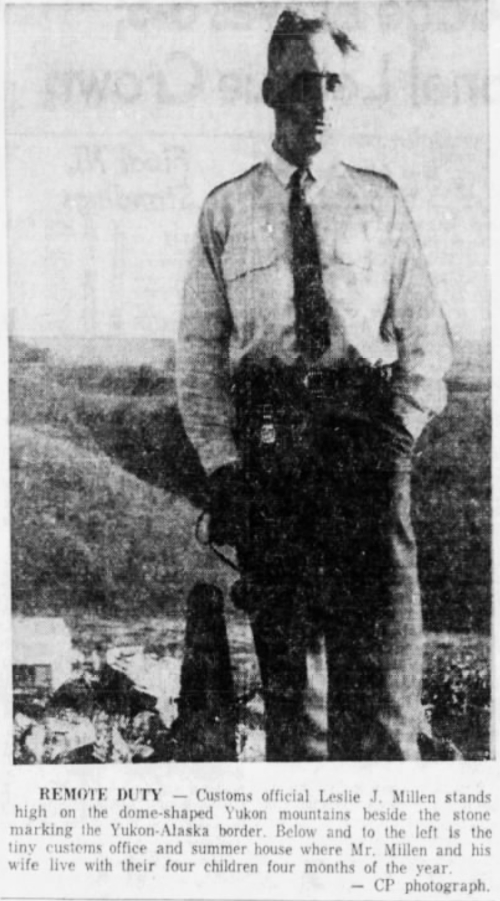
LITTLE GOLD CREEK, Y.T. (CP) - For four months of the year Leslie J. Millen sits high above the gold-bearing creeks of the Yukon manning a remote customs office.
His post, on the Alaska-Yukon border about 60 miles northwest of Dawson, Y.T., is the most westerly and northerly highway customs station in Canada.
The United States customs offices are located at Tok Junction, Alaska, on the Alaska Highway another 125 miles to the northwest. His nearest neighbor is at a roadhouse two miles in- side Alaska. Dawson is the nearest community.
"It is about as remote as you can get," Mr. Millen, 44-year-old native of Vancouver who has been in the Yukon since 1927, said in an interview.
SUMMER HOLIDAY
"However, it is like summer holiday for me. The scenery is good and I meet a lot of interesting people."
The tiny white station is perched at the 4,200-foot level on the barren, dome-shaped mountains of the central Yukon, high above the tree line where cariboo make their annual migration. It contains the customs office and_ fully-equipped living quarters for himself and his family.
Mr. Millen joined the customs department in 1953 when someone familiar with the country was sought to handle the duties at Little Gold Creek. The road had just been opened. He spends the other eight months of the year at Dawson customs office.
Early in June, Mr. Millen climbs into his truck and follows the first snowplow along the "60-mile" road from Dawson. He stays at the customs station until snow threatens to block the road.
"Last year a couple of Alaskans with two pick-up trucks got as far as the boundary from Dawson during the first week of October," he said. "Then they got stuck and were forced to leave their trucks there until this June."
FAMILY AT STATION
Mr. Millen's Quebec-born wife, Alberte, and their four children, ranging from nine to 13 years, live at the station during July and August.
At the start of the season Mr. Millen brings out supplies for his stay.
"My wife makes trips back and forth for whatever we forget. We also can radio Dawson for other supplies and mail. We have them sent out with a tourist heading this way."
During July and August, the customs officer checks from 10 to 15 cars daily. The cars travel the route that leads from Dawson to the Alaska Highway at Tetlin Junction, Alaska.
Most of the tourists come from California, Texas and Alaska, but this year there were cars bearing Hawaiian, Mexican and German licence plates. This year traffic was double that in 1958.
NEW ROAD HELPED
Traffic started to increase following the completion in 1954 of the highway between Dawson and Whitehorse, 350 miles to the south. This allowed tourists to
make a loop through Dawson from the Alaska Highway, adding 150 miles to the Whitehorse-Alaska trip over the Alaska Highway.
Residents and hunters make up most of the June and September traffic along the narrow road bulldozed along the ridge of the mounains.
"The 60-mile road dates back to the gold rush days of 1898-1905 and ran to a point in Alaska about 20 miles northwest of here," Mr. Millen said. "All the supplies for the gold camps were brought along the valleys on pack and wagon trains."
Today, the tracks, cut deep into the moss of the river valleys, still are visible.
Between 1937 and 1942 Mr. Millen worked on gold dredges in the creeks around Dawson. At other times he has been a rural mail driver, a department store employee and a photographic processor.
PHOTOGRAPHY HOBBY
The job that gave him most satisfaction was connected with photography, now his hobby.
A group of old glass contact plates from the estates of E. C. Adams and E. A. Hegg, two early Yukon photographers, were brought to him for processing because he had equipment to handle the negatives.
Mr. Millen processed 400, the Dominion Archives in Ottawa and the National Film Board each getting a full set. He has some 250 of the best mounted, which he shows to tourists. The pictures are of gold seekers entering the Yukon in 1898 over the Chilcoot Pass, and of Dawson and the Yukon during the hectic gold rush days.
The NFB used many of the prints he processed for its production City of Gold. Tourists carry away thousands of postcards and slides made from these prints.