




|
|
The death of Fitzpatrick Joseph 'Fitz' Horrigan (1861-1920)
Arctic & Northern Biographies
Highlights of History from The Whitehorse Star
Dateline: March 19, 2024.
Fitzpatrick Joseph Horrigan was born in Hallowell, Picton, Prince Edward County, Ontario, on October 13, 1861. He joined the North West Mounted Police in November 1899, with the rank of Inspector due to previous military experience. He served in the Force until the time of his death in Hawaii, March 3, 1920, when he was in charge of the British Columbia division of the Royal Canadian Mounted Police.
On April 5, 1920, he was buried in the family plot at the Mount Olivet Cemetery in Picton.
The side-by-side layout of the newspaper article made formatting this first one awkward - the text to the left of the photo is repeated below.
The Daily Province (Vancouver, B.C.), Thursday, March 4, 1920
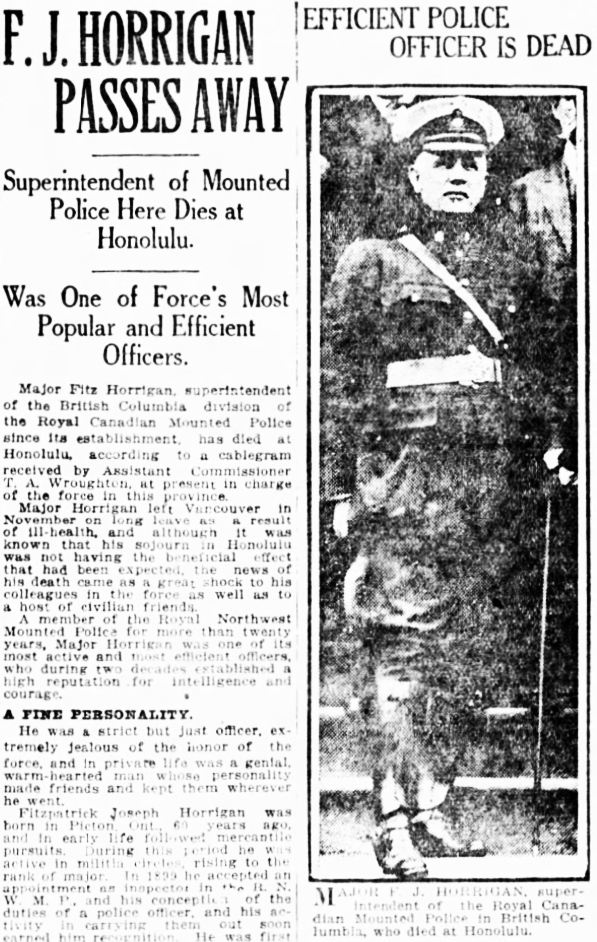
Major Fitz Horrigan, superintendent of the British Columbia division of the Royal Canadian Mounted Police since its establishment, has died at Honolulu, according to a cablegram received by Assistant Commissioner T. A. Wroughton, at present in charge of the force in this province.
Major Horrigan left Vancouver in November on long leave as a result of ill-health, and although it was known that his sojourn in Honolulu was not having the beneficial effect that had been expected, the news of his death came as a great shock to his colleagues in the force as well as to a host of civilian friends.
A member of the Royal Northwest Mounted Police for more than twenty years, Major Horrigan was one of its most active and most efficient officers, who during two decades established a high reputation for intelligence and courage.
A FINE PERSONALITY.
He was a strict but just officer, extremely jealous of the honor of the force, and !n private life was a genial, warm-hearted man whose personality made friends and kept them wherever he went.
Fitzpatrick Joseph Horrigan was born in Picton, Ont. 60 years ago, and in early life followed mercantile pursuits. During this period he was active in militia circles, rising to the rank of major. In 1899 he accepted an appointment as inspector in the R. N. W. M. P., and his conception of the duties of a police officer, and his activity in carrying them out soon earned him recognition. He was first stationed at Regina, but later was transferred to the Yukon, arriving there in 1901. He remained in the North until 1912 or 1913, when he was recalled to Regina, then transferred to Maple Creek, Sask., as superintendent, and finally to Calgary and Vancouver in similar capacities.
At Calgary he undertook to break up a powerful gang of organized horse and cattle thieves whose depredations extended from the international boundary to Edmonton and the Peace River, and from British Columbia into Saskatchewan. After a year's hard work he succeeded and sent many of the culprits to jail, scattering the others so far that they never came back. As a recognition of this work the ranchers and stockmen of Alberta at an annual meeting made him the recipient of a very handsome appreciation.
MERCY AND JUSTICE.
An example of his humanity is the fact that after he had prosecuted the ringleaders of this gang, and seen them sent to jail, he used his influence with the authorities to have their sentences shortened when he was convinced the ends of justice had been served. Several of them were young farmers with families, who had fallen gradually into criminal ways. One of these he afterwards invited to dine with him at his quarters In Calgary, and had the supreme satisfaction of being thanked by his guest for
having put him on the "straight road."
When the government decided to establish the R. N. W. M. P. here Major Horrigan was placed in charge, arriving early last year. His chief duties here consisted of checking up and controlling the activities of suspected alien propagandists, and the result of his campaign was the round-up last spring of forty-seven aliens, most of whom were ordered deported by an immigration board.
Early last summer, while inspecting the basement of the new barracks on
Hornby street, Superintendent Horrigan was the victim of an accident which may have brought on his later illness. He was walking through the building in the dark and struck his head on the angle of a heavy iron pipe. The blow rendered him unconscious, and he was taken to St. Paul's Hospital where he was laid up for some days.
LEAVES FOR SOUTH.
The roundup of suspects occurred about this time, and it is thought the combination of the accident and the nervous strain of his police activities brought on the breakdown that finally resulted in his leaving for Honolulu after a lengthy sojourn in the hospital last fall.
Superintendent Horrigan was a Catholic and the only relative whose address is known is a sister who is a nun in an eastern convent. There is also belleved to be a brother somewhere in Eastern Canada. He was unmarried.
For several months after being transferred to British Columbia Major Horrigan lived at the Hotel Vancouver. Later he established quarters in the residence of Mr. F. C. Wade, Seaton street.
The body will be brought to Vancouver on the R. M. S. Niagara, leaving Honolulu on March 16, and arriving here on March 24. It is not yet known where the burial will take place.
The much shorter article in The Vancouver Daily Sun on this date adds some information of interest:
...when it was decided to establish a force of R.N.W.M.P. at the coast, Major Fitz Horrigan was detailed to assume command of the detachment with headquarters at Vancouver. Shortly after his arrival here he was busily engaged in checking up the activities of a number of the aliens in this city suspected of being paid agents engaged
in spreading Bolshevist doctrines and working in favor of social revolution by violent methods.
The activities of the agents employed by Major Fitz Horrigan resulted in 47 of the suspects being arrested and brought before an immigration board for deportation to their native country.
During the progress of the trials of these cases Major Fitz Horrigan
suffered from a severe nervous breakdown and after several weeks, during which he was confined to his bed, his medical advisers thought that a trip to the Southern Pacific isles would result in him regaining his normal health. The details received by cable last night were meagre and told little beyond the mere fact that he had succumbed to his illness.
The Weekly Star (Whitehorse, Y.T.), Friday, March 19, 1920

Major Fitz Horrigan, superintendent of R. C. M. P. for British Columbia, with headquarters in Vancouver, B. C., died at Honolulu, H. I., on March 3. Deceased was about 60 years of age and for some time had been in poor health. Early last winter he went to Honolulu with the hope that the mild climate there would benefit him, but as it now appears, without avail. His remains were forwarded to Vancouver for burial. Of his relatives nothing is known here.
For several years previous to 1907 Major Fitz Horrigan, then an inspector, was stationed at Whitehorse, at first serving under Major Snyder, officer in command, whom he afterward succeeded both here and at Dawson. After being stationed at Dawson for some time Major Fitz Horrigan was transferred to Regina, from there to Calgary and afterward to Vancouver, B. C.
He was one of those genial, whole-souled Irishmen whom it is always a pleasure to meet, and made warm friends wherever he went. It was with a feeling of sadness that the news of his death was received here by those with whom he formerly associated.
The Pacific Commercial Advertiser (Honolulu, Hawaii), Friday, March 19, 1920

Two companies of United States troops will escort the body of Col. Fitzpatrick J. Horrigan, superintendent of the British Columbia division of the Royal Canadian Mounted Police, who died here March 3, from the Williams funeral parlors to the steamer Niagara at 10 o'clock tomorrow morning. The body will be carried on a gun caisson
and the pallbearers will be eight British officers. The military escort has been provided by Major General Charles G. Morton as a fitting tribute to the man who for more than 20 years was a member of the famous North-west Mounted Police of Canada. The action of General Morton was taken after he had been conferred with by George K. French, well known Honolulu attorney, who had known Colonel Horrigan intimately for many years,
Death Occurs Here
The death of the famous officer occurred here while he was on a trip in
the hope of recovering his health. He left Vancouver last November on a long leave of absence from active service, and the news of his death was received with a great shock to his colleagues in the force in Canada and his many intimate friends there. He held the rank of Major when he left Vancouver, but while here he was elevated to that of colonel.
The Daily Province of Vancouver said of him in the article announcing the news of his death here, "he was a strict but just officer, extremely jealous of the honor of the force, and in private life was a genial and warm hearted man whose personality made
friends and kept them wherever he went."
Rose To High Rank
"Colonel Horrigan was born in Picton, Ontario, 60 years ago, and in early
life followed mercantile pursuits. During this period he was active in military circles, rising to the rank of major. In 1899 he accepted appointment in the Royal Northwest Mounted Police, and his conception of the duties of a police officer, and his activity in carrying them out, soon earned him recognition. He was first stationed at Regina, but later was transferred to the Yukon, arriving there in 1901. He remained in the north until 1912, when he was recalled to Regina, then transferred to Maple Creek, Saskatchewan,
as superintendent, and finally to Calgary und Vancouver in similar capacities."
He was unmarried and his only known relative is a sister who is a nun in an eastern convent.
He became a fast friend of Attorney French when the latter was chief of
Scouts in the United States army at Fort Egbert, Alaska, across the border from where Colonel Horrigan was stationed in a similar capacity for the Canadian government.
The Vancouver Daily Province (Vancouver, B.C.), Monday, March 29, 1920

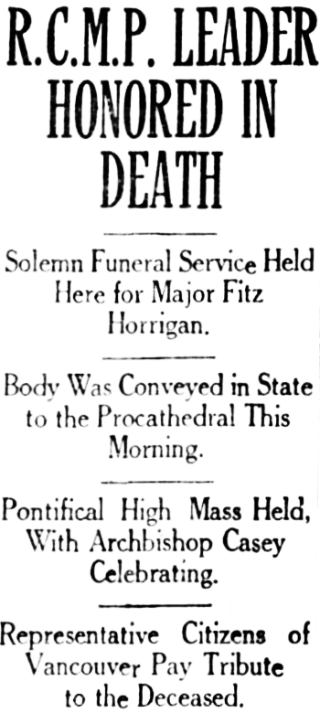
Surrounded by red-coated officers, N. C. O.'s and men of the force which
in life he loved so well, the body of Major Fitzpatrick Joseph Horrigan, superintendent in British Columbia of the Royal Canadian Mounted Police, who died recently in Honolulu, was
this morning borne in solemn state to the Procathedral of Our Lady of the Holy Rosary, where funeral services were held.
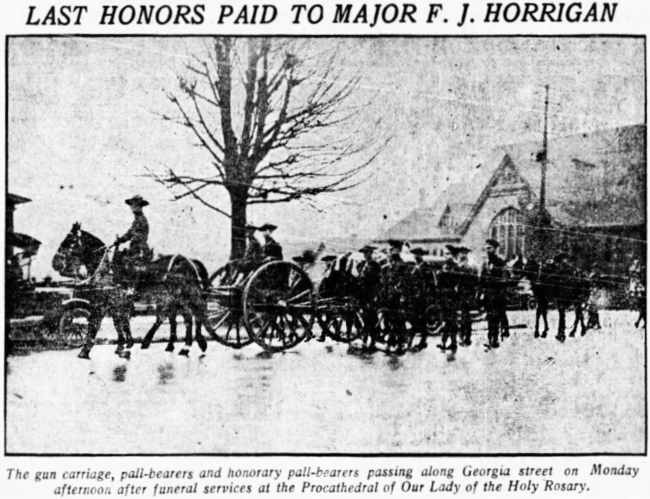
It was one of the most impressive military funerals ever held in Vancouver and hundreds of spectators lined the route and bared their heads as the four-horse gun carriage bearing the coffin, enveloped in the Union Jack and surmounted by the helmet and sword of the deceased officer, passed along Georgia street from the undertaking establishment of Center & Hanna to the cathedral, The entire strength of "E" and "H" divisions of the mounted police, except the few men detailed for duty in barracks,
turned out for the ceremony and the band of the Great War Veterans furnished music.
OLD-TIMERS ATTEND.
Local military units were represented by several officers, while Chief McRae of the city police force and a large number of old-time members of the Royal Northwest Mounted Police, including a number of ex-Yukoners also attended in tribute to the many fine qualities of the late Major Horrigan.
Colonel A. Bowen Perry of Ottawa, commissioner of the Royal Canadian
Mounted Police, and Major T. A. Wroughton, assistant commissioner and acting commandant of the force in British Columbia, acted as chief mourners, following the gun carriage, which was preceded by a firing party with arms reversed.
Immediately in rear of the gun carriage two constables led the horse of
the deceased officer, the saddle and bridle draped in black and the riding boots reversed in the stirrups.
FLORAL TRIBUTES MANY.
The pallbearers were six N.C.O's from the two British Columbia divisions and the honorary pallbearers Inspectors Hill, Tupper, Vernon, Fletcher and Bell, all of Vancouver. Other red-coated N.C.O's and constables carried a number of beautiful floral
tributes, some of which came from Honolulu, where the late superintendent died while on sick leave.
In rear of Col. Perry and Major Wroughton were about a hundred red-coated troopers, while behind them again marched the Mounted Police veterans and a number of old personal friends of the deceased, who had known him in the Yukon and on the prairies. As the procession crossed Granville street all traffic was halted. At the cathedral there was a large congregation and the steps of the edifice were crowded as the cortege drew up, the band playing "Nearer My God, to Thee."
AT THE PROCATHEDERAL.
The Mass, Solemn Pontifical, was carried through with all the solemnity
of the Catholic Church. The cortege was met at the Procathedral doors by Rev. Dr. W. P. O'Boyle, O. M. I., rector, who, preceded the bearers to the front of the Sanctuary, where the casket was placed.
His Grace, Most Reverend T. Casey, D.D. archbishop of Vancouver, pontificated, with Rev. Dr. O'Boyle as arch-priest, Rev. J. P. O'Neill, O. M. I., as
deacon, Rev. H. P. Bessette, O. M. I., as sub-deacon and Rev. H. Thayer, O. M. I., as master of ceremonies.
The Gregorian music of the Mass was rendered by male voices of the Procathedral choir, with Miss Heritage at the organ. The hymn "Dies Irae" was sung at the Epistle, while the Offertory piece was Rossina's "Stabat Mater." At the close of the Mass Miss Dorris Wilbers, the choir leader, gave a fine rendering of "Nearer My God to Thee."
At the termination of the Mass His Grace, divesting himself of his chasuble, and vested in black cope and white mitre, gave the Last Absolutions and afterwards preached the panegyric on the dead officer.
TRIBUTE TO DECEASED.
After recalling how Judas Maccabaeus had prayers and sacrifices offered up for the dead, the archbishop said they had met this morning to offer up the Holy Sacrifice of the church for the late Major Fitz Horrigan, and explained, for the benefit of non-Catholics present, why the church conducted its services in Latin.
Referring to the late officer's devotion to duty and his ideal Christian life His Grace said Major Fitz Horrigan made it a practice of beginning his day by attending Mass in St. Paul's chapel every morning at 6 o'clock.
The archbishop continued:
"After the war there was a certain element which sought to overthrow
everything from the Tables of Law to the Ten Commandments. They sought to suppress every man, woman and child who did not think as they wished them to think. They assailed the
Christian civilization built up by Christ nearly two thousand years ago on the ruins of paganism. They claimed that, because there might be defects, the whole fabric should be
destroyed. Against such men the officer whose body lies here, was our defender."
This morning, added the preacher, the Holy Sacrifice had been offered up
for the deceased officer, and they had met to do him, who was worthy, the last marks of respect and honor. He (the speaker) had hoped to have seen the major back with them again, but God had called him and he had obeyed.
They could only pray" "Eterna! rest give unto him, O Lord, let perpetual
light shine upon him; may he rest in peace."
As the body wae carried out shoulder high by the bearers the March Funebre was played by Miss Heritage.
Among the representative citizens present were: Lieut.-Col. H. D. Hulme,
Lieut.-Col. C. A. Worsnop, Col. Donald McGregor of the Yukon Pioneers, and the R. N. W. M. P. Veterans. Rev. H. C. Lewis Hooper, Rev. R. G. McBeth, Col. Markham, Major C. C. Owen, Major A. E. Snyder (late R. N. W. M. P.), Mr. Fred Buscombe and Mr. N. G. Neill.
Representing the authorities of Military District No. 11 were Capt M. M.
Marsden of the 11th Irish and Lieut. J. H. Johnson, adjutant of the 1st B. C. Regiment
HONOLULU CEREMONY.
According to advices received from Honolulu by the R. M. S. Niagara, on
which vessel the body of Major Horrigan was also brought home to Canada, impressive funeral services were held in the Hawalian city. The following is an account of the ceremony in honor of the deceased officer which appeared in the Honolulu Advertiser:
Draped with the Union Jack and partially concealed by beautiful floral wreaths, the casket containing the body of Major F. J. Horrigan, Royal Canadian Mounted Police, was escorted with full military honors to the British steamship Niagara to be
sent to Canada for burial.
Two companies of United States coast artillery troops, commanded by Major Abbott, C. A. C., U. S. A, with a color guard, and the coast artillery band, preceded the funeral cortege down Nuuanu and Fort streets and thence along Allen street to pier 6, where the casket was placed aboard.
It was an impressive military funeral in which the flags of America and Britain were united in the common purpose of honoring a brave man and a leader of one of the world's most noted police-military organizations.
MARCH THROUGH STREETS.
With measure step, to the strains of the Dead March in Saul and other
funeral airs, the soldiers with their colors flying passed through the streets. Spectators everywhere stopped and uncovered, first to the Stars and Stripes and then to the Union Jack.
The casket, which was of solid oak, had a true military aspect with the
flag of Great Britain covering it. The wreaths were from the Canadian G. W. V. A., the British Club of Honolulu, and from Attorney George K. French, who knew Major Horrigan in Alaska, and who arranged for the military funeral.
The honorary pallbearers were all men of Hawaii who had served in the Canadian armies during the Great War and who had returned to civilian pursuits, including Maj. Curzon Osborne, Capt. Harvey V. Murray, Lieut. Watson Ballentyne, Lieut. Cullen, Sergt. Brown, Corp. Potter, Ptes. Schofield and Fitzgerald.
The wreaths were placed tn the care of the purser and chief steward of the Niagara to be kept during the voyage and replaced on the casket when it reached Vancouver. The pallbearers walked beside the army caisson and with them were George K. French, Fred Harrison, president of ths British Club, and British Consul W. Massey Royds.
The body will leave on tonight's train for Major Horrigan's old home at Picton, Ont., where interment will take place.
The Vancouver Daily Province (Vancouver, B.C.), Tuesday, March 30, 1920
The burial at Picton on April 5th passed almost unnoticed, with just a brief comment in The Weekly British Whig (Kingston): "FUNERAL AT PICTON. Remains of the Late Major Fitz Horrigan Brought From Honolulu. Picton, April 8. - The funeral of the late Major Fitz Horrigan, who died at Honolulu, was held on Monday morning from St. Mary's church, here."
The Vancouver Sun (Vancouver, B.C.), Thursday, April 22, 1920
Several hundred dollars of the estate of the late Superintendent Fitzpatrick Joseph Horrigan. of the Mounted Police, are left to Catholic institutions, including $200 "to have Masses offered up for poor suffering souls in purgatory."
His estate, according to papers filed in court yesterday, was valued at $9006, of which he left $4500 to his sister, Miss Elizabeth Horrigan, of Syracuse, N. Y., $1500 to his sister, Mrs. George Burke; $500 to Thomas H. Horrigam, his brother, and $500 to a niece, all of Syracuse. He leaves $200 to the parish priest at Picton, Ont., his original home, $100 to the Bishop of Caigary "for college that I owe him" and $100 to the Mother Superior of the Ursuline convent at Edmonton.
The residue is bequethed to his sister, Elizabeth, who, with his brother Thomas, is named as executor. The bulk of the estate was in Victory bonds and insurance. The will was typed on a Mounted Police form.
|


