
|





|
|
William Henry Beer Hoare, 1890-1948
This page is under construction
Arctic & Northern Biographies
William Henry Beer Hoare was born at Ottawa, Ontario, on June 28, 1890. He was the second of 5 children born to John Hoare and Jenny Gowan Hoare.
On March 16, 1919, 29-year-old missionary William Hoare married 31-year-old nurse Catherine Alicia Cowan at St. Matthias Church in Ottawa.
William and Catherine had four children: William (1921-2013), Sheila (1923), Beverley (M) (1924), and Alicia (1927).
Aklavik (interactive map
The Evening Citizen (Ottawa, Ontario) - April 30, 1914
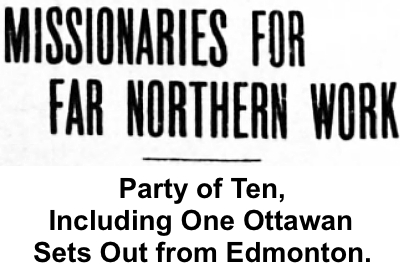
Edmonton, April 30. - Headed by Bishop Lucas, who has had 23 years' experience in the Anglican mission fields of the North, and Archdeacon Whitaker, a close second, with 19 years in the same field, a party of ten left Edmonton today for the North. The personnel of the party and the places at which they will be stationed are:
Bishop Lucas at Fort Chippewyan, Archdeacon and Mrs. Whitaker at Fort McPherson, Rev. G. H. Quarterman of Wycliffe College, Toronto, at Fort Chippewyan and Smith's Landing, Rev. Bowering, Emmanuel College, Saskatoon, at Fort Simpson, Rev. H. Girling, Emmanuel College, Saskatoon, for Eskimo work; W. Spencer Tremain and wife, Lloydminster, at Fort Norman; E. Merritt, St. John, N.B, and W. H. B. Hoare, Ottawa, for Eskimo work.
With the exception of Bishop Lucas and Archdeacon and Mrs. Whitaker, all the members of the party are new to Northern mission work.
While in Ottawa Mr. Hoare followed the occupation of steamfitting. He was an active church worker, and was connected with St. Matthias' Anglican church. He left the city about three weeks ago to accompany C. E. Whitaker, who left to establish an Anglican mission at the head of the Mackenzie river at a point known as the Athabasca Landing.
The Calgary Daily Herald, Tuesday, August 12, 1924
By T. M. FRASER
(Special Dispatch to The Herald)
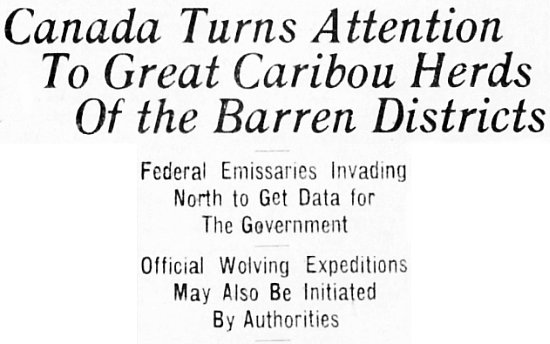
OTTAWA, Aug. 12. - In order to obtain data upon the migration of the
great caribou herd in the barren lands of Northern Canada, the federal government has appointed a commissioner to spend several years in the north country.
The Work is to be done by W. H. B. Hoare, who has considerable experience there. A patty has been organized and is now proceeding north from Edmonton. The radio apparatus now being installed at Edmonton, Herschel Island and Fort Simpson will permit him to keep in touch with headquarters at Ottawa.
At the same time the federal department here has changed the policy in connection with the extermination of timber wolves, which have menaced the caribou and butfalo. Hitherto the government has paid $20 per pelt for the wolf skins and permitted the trapper to keep his furs. This year, as an experiment, a party with provisions to last several years has gone into the Arctic under an agreement whereby they will get $30 per pelt and give the skin to the government. Should this policy prove successful the department may organize hunting expeditions on a large scale next year, recruiting from Winnipeg and elsewhere.
Mr. Hoare returned to his home in Ottawa from this expedition in late September 1926. Mrs. Hoare went to Victoria to meet him and accompany him home.
The Winnipeg Tribune - September 9, 1927

[By Canadian Press]
OTTAWA, Ont., Sept. 9 - Six Husky dogs of the famous Eskimo breed have arrived in Ottawa, completing nearly 4,000 miles of their 6,500-mile journey from Baffin Island in the eastern Arctic to the east of Great Slave lake in the North-west Territories. These dogs, which are the property of the North-west Territories and Yukon branch of the Department of the Interior, will be used as a sled team by W. H. B. Hoare, an officer of the department, during an exploratory survey of the 15,000 square miles of Musk-Ox Sanctuary recently set aside in the valleys of the Hanbury and Thelon rivers, Mackenzie district.
The dogs were bought at Pond Inlet by George P. Mackenzie, officer in charge of the 1927 Canadian Arctic expedition, during this summer's patrol of the Dominion's northern islands, and when the ss. Beothic docked at North Sydney, Nova Scotia, on Monday evening, the dogs were immediately placed board the train for Ottawa. The dogs will remain here until the early part of January, when Mr. Hoare will start for Edmonton en route to the far northern sanctuary.
Edmonton Journal, Tuesday, November 29, 1927
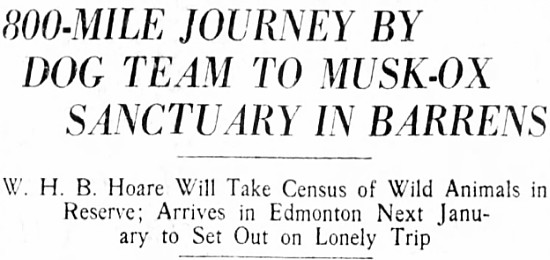
To make an intensive examination and patrol of the area east of Great Slave lake recently set aside as a sanctuary for musk-ox and other wild life, the department of the interior is sending out an experienced explorer having an intimate knowledge of the animal life of the region.
Early in January, W. H. B. Hoare of the North West territories and Yukon branch, will leave Ottawa for Edmonton on the first leg of his journey to the 15,000 square mile reserve lying on the Thelon and Hanbury rivers in the North West territories.
From Edmonton, Mr. Hoare will continue by rail to Waterways, the end of steel, and there he will begin an 800-mile journey by dog team to the proposed location of his base camp on the site of Fort Reliance, about 35 miles southwest of the westermost corner of the sanctuary. About a month will be occupied in the trip to Fort Reliance, and it is not expected that Mr. Hoare will return south before the end of 1928 or the spring of 1929.
Conserving Resources
Accurate information has long been recognized as the basis of efficient and economical administration, and it is for this reason that the department of the interior is having careful examinations made of this part of Canada's vast northland before undertaking the expenditures necessary to conserve and develop the resources therein.
During his patrol Mr. Hoare will take a census of the wild animals in the reserve, indicating as far as possible the inroads being made by wolves and other predatory animals. He will also report on what measures should be taken to protect the big game therein, particularly the musk-ox and the caribou; on the number of wardens that
will be required to properly patrol the area; and on the best locations for wardens' cabins. There are no permanent residents, either native or white, in the sanctuary, and the area is seldom visited. Observations will be made of the number, if any, of Eskimos and Indians visiting the area and the seasons at which they appear.
Eskimo Sieigh Dogs
For the purpose of equipping this patrol six Eskimo sled dogs were
brought from Pond Inlet, Baffin Land, by the 1927 Canadian Arctic expedition. Sled dogs from the eastern Arctic are noted for their strength and endurance and on that account are rated highly by travelers in the Far North. A thick growth of fur close to the skin protects the Eskimo dog from the cold winds of the Arctic regions and makes him most suitable for work in the open expanses of the great northern plains.
Warden Makes Trip
On the journey in Mr. Hoare will be joined by a game warden at Fort
Smith, the local administrative headquarters of the Northwest Territories. The warden will accompany Mr. Hoare during the patrol and if it is necessary will bring a team of dogs to help in moving the equipment to Fort Reliance. Should the return trip, late in 1928 or early in 1929, be made via Fort Smith the Eskimo dogs will be left there for the use of the wardens on patrol work.
The Ottawa Evening Citizen, Tuesday, December 27, 1927
"Mush, Mush, you huskies!" was the cry that rang out from a fur clad "Eskimon-esque" figure guiding a dog team along the thoroughfares of the Capital yesterday afternoon. Pedestrians put away for the moment all thoughts of turkey dinners while they watched open-mouthed at what appeared to be a belated section of the entourage of Santa-Claus, on its way back to the frozen fastness of the north pole.
As a matter of fact, the dog driver was Mr. W. H. B. Hoare of the Northwest Territories and Yukon branch, department of the Interior, who will start in the course of a few days on an exploratory expedition to carry him into obscure sections of the vast MacKenzie country, over a period of many months.
When he was seen yesterday in characteristic northern regalia he was on his way, from his home on the New Island Driveway, to the Chaudiere golf club to participate in the making of motion pictures apropos of the contemplated expedition. Awaiting his arrival at the golf club were various prominent officials of the Interior Department, as well as cameramen of the Paramount and Fox screen news companies and of the Dominion government motion picture bureau.
For a time members of the party at the Chaudiere club were somewhat exercised over the non-appearance of the dog team, fearing that the canine denizens of the north had possibly become involved in a traffic jam en route and had come out second best in the fracas. However, at about 4 o'clock the cry went up, "Here they are!" And when everyone ran outdoors to see for himself, sure enough, the picturesque team were observed prancing along an avenue branching from the Aylmer road. They were travelling at top
speed and seemed to rival in performance the much talked of new conveyance of Mr. Ford.
Minister on Sledge.
Mr. Hoare was greeted by the Hon. Charles Stewart, Minister of the Interior. Then, while movie machines purred, Mr. Stewart climbed onto the be-robed komatik, or sledge, and was taken for a drive over the crisp and coruscating snow.
The going was fine and smooth for a time until the sledge struck a hidden snag and the Minister of the Interior narrowly escaped being precipitated unceremoniously from the sledge. Spectators gasped. But the capable driver soon had the team in hand, and with the cry of "Gee!" then "Mush!" the dogs were again tugging at the traces and dragging their load back to the starting point.
Later, other interested officials and guests were introduced in a practical way to a mode of transport which hitherto had been a much greater novelty to them than even that of the aeroplane. Mr. O. S. Finnie, director of the Northwest Territories and Yukon, in company with Mr. Norman Smith, was given an exhilarating drive, and upon the return two others were invited to hop off, a la Eskimo. These latter were Col. Maynard Rogers, special representative of the Parks branch to the United States, and Mr. Norman Smith. Some observing wag called attention to what was no doubt an anachronism - that effected by the derby hat worn by Colonel Rogers during the drive.
The dogs used by Mr. Hoare were a half-dozen brought from Baffin Island last summer on the S. S. Beothic of the Northwest Territories branch. These animals are to
be taken north, to the Western Arctic, by Mr. Hoare when he leaves here during the first week in January.
The use of these dogs in that part of the Arctic will be a unique experiment, as never before have the huskies of the Eastern Archipelago - which are of a distinctive type - been harnessed and driven in the Mackenzie district.
Edmonton Journal, Monday, January 16, 1928
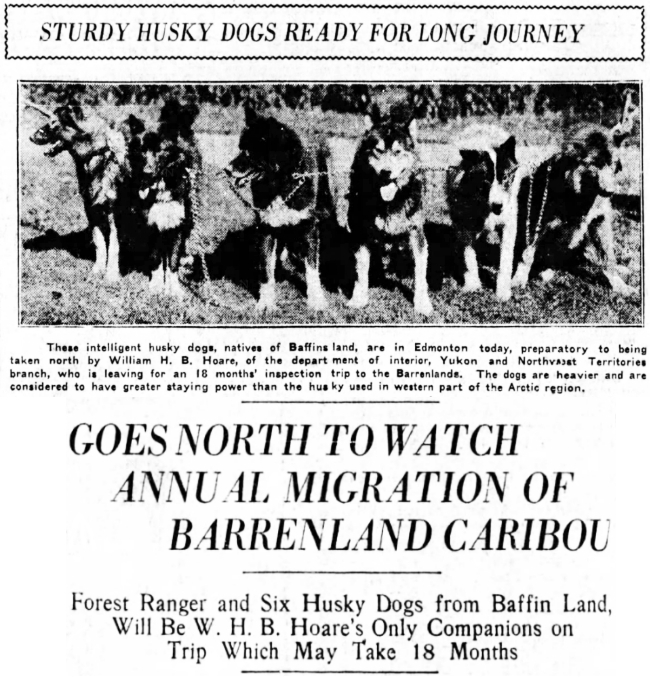
"All set" for his 18 months' expedition through the heart of the Barren Lands, William H. B. Hoare, of the department of the interior, Yukon and North-West Territories branch, leaves Edmonton on Tuesday's train for McMurray, on the first leg of a journey that may take him eventually to Churchill on Hudson Bay, or to some point on
the Arctic coast.
With him go six husky dogs that have come all the way from Baffin Land, and all across Canada, to act as his beasts of burden on the long and hazardous trip.
Baffin Land dogs, explains Mr. Hoare, are heavier and more sturdy than the dogs of the western Arctic. They are no larger, nor are they any faster, but their extra sturdiness and weight make them more dependable for the hauling of their load, day
after day, and the explorer depends for a large measure of his safety on these companions of the lone trail.
Thelon Game Sanctuary
Mr. Hoare has the task of reporting on the recently created Thelon River game sanctuary, and on the wild animals and possible wandering tribes of Indians or Eskimo he may meet in his travels across the Barren Lands.
He will watch the caribou in their annual migration and will keep an
especially careful lookout for musk-ox, an animal which, many naturalists claim, is pretty well extinct in the western Arctic region.
At McMurray the explorer and his dogs take to the long trail that is
to lead them over many miles of white wilderness. A buffalo ranger from the preserve at Fort Smith will be Mr. Hoare's sole companion, and this man will take along his own
team of dogs to help in transportation of the supplies which the expedition will require for its long stay in the far north.
Returns in 1929
The explorer does not expect to see civilization again for 18 months,
coming out in the fall of 1929. He cannot say just which way he may return, as everything depends on the outlet for which he finally heads on the completion of his task.
If he is nearer to Hudson Bay than any other outet, he will make his
exit from that point. If his long trip ends somewhere on the shores of the western Arctic, he will take some trading schooner or whaler and sail west through Behring Strait down the Pacific to Vancouver. He may, as a possible third alternative, return via Edmonton.
Victoria Daily Times, Friday, June 15, 1928
The 1928 Summer season will be one of great activity in the Northwest
territories of Canada, says the publication Natural Resources of Canada. In the vast regions "North of Sixty," administered by the Department of the Interior exploratory and investigatory surveys will be carried on by officials of the Northwest Territories and Yukon branch, and the annual patrol will be made by the Ss. Beothic. The members of the Royal Canadian Mounted Police stationed in the North will carry on overland patrols in their work of maintaining law and order.
Preparations are now under way in the Northwest territories and Yukon
branch for the annual trip of the Ss. Beothic to the police posts in the Arctic archipelago. The ship will sail from North Sydney, Nova Scotia, on July 18. It is expected that the ports of call during the northward trip will be Godhavn, Greenland; Pond Inlet,
Baffin Island; Dundas Harbor, Devon Island and Craig Harbor and Bache Peninsula, Ellesmere Island. The return trip from Bache Peninsula, the farthest north post, will begin sometime during the first week in August. Circumstances will determine whether or not the expedition will sail to points in Hudson Strait farther west than Lake Harbor.
WORK AMONG NATIVES
George P. Mackenzie will be the officer in charge and the chief navigating officer will be Captain E. Falk Captain Morin will be ice pilot. Dr.
Livingstone will go north this year to Pangnirtung, where he will remain for a year carrying out medical patrols among the natives on Baffin Island. Inspector A. H. Joy and a number of members of the Royal Canadian Mounted Police will also accompany the expedition.
In the districts of Mackenzie and Keewatin many important investigations will be conducted. Major L. T. Burwash, exploratory engineer of the Northwest Territories and Yukon branch, left Ottawa early this month for Edmonton en route to Aklavik in the mouth of the Mackenzie River. From the latter point he will begin his patrol eastward along the Arctic Coast. The principal investigations to be carried on by Major Burwash will be a further search in and around King William Island for records and relics of Sir John Franklin's ill-fated expedition of 1845; a survey of navigating conditions in Franklin Strait and Peel Sound; an examination of a proposed tractor train route from Wager Bay on the west coast of Hudson Bay to Cockburn Bay south of King William Island; and a visit to the magnetic pole on Boothia Peninsula. It is expected that Major Burwash will complete his work in the Autumn of 1929.
MUSK-OX SANCTUARY
A patrol of the musk-ox sanctuary lying on the Hanbury and Thelon Rivers east of Great Slave Lake, was undertaken early in the year, and this work will be continued during the Summer. W. H. B. Hoare left Ottawa in January for Edmonton. From that city he traveled by train to the end of steel at Waterways, where he began an 800-mile journey by dog team to
his base camp on the site of Fort Reliance, at the east end of Great Slave Lake and about thirty-five miles southwest of the westernmost corner of the 15,000-square mile game sanctuary. He is accompanied by a warden from Fort Smith and his investigations will not
be completed until the Summer or Fall of 1929.
Investigations to determine what areas in the Northwest Territories are
most suited for grazing of herds of reindeer will be continued this Summer in the area north of Great Bear Lake. A. E. and R. T. Porsild, who have been engaged in this work since 1926, have reported on their biological investigations in the area lying east of
the Mackenzie River delta and inland from the Arctic Coast, and the results appear to be very satisfactory.
Edmonton Journal, Wednesday, March 13, 1929

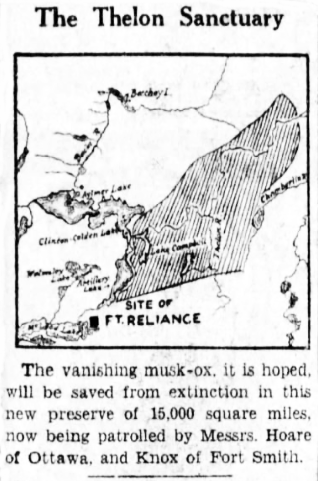
Word has been received in the city that W. H. B. Hoare, explorer of the Northwest Territories and Yukon branch, and Warden A. J. Knox, of Fort Smith, N.W.T., have completed an examination and patrol of the southern portion of the Thelon game sactuary east of Great Slave lake.
After a survey by dog team and canoe covering eight months they returned to their base near the site of old Fort Reliance on December 13, and began preparations for the immediate resumption of the work so as to complete it this year.
The survey of the 15,000-square-mile game preserve was begun in April last year and from that time until the receipt of the report on January 11, no word had been received from the investigators.
 Police patrols and other parties passing through the areas were asked to keep watch for the departmental party but without results, the wireless message dated January 10 from Fort Smith being the first intimation officials at Ottawa had of the movements of Messrs. Hoare and Knox.
Valuable Information
Much valuable information was obtained by Mr. Hoare and his companion during their survey of the southern part of the Thelon sactuary. Musk-ox were seen along the Hanbury river and tracks of these rapidly disappearing big game animals were noted in the vicinity of the Thelon river. Large herds of caribou were reported south of the sactuary. Wolves were also numerous but they proved wary of both trap and gun.
Mr. Hoare left Ottawa for the North early in January, 1928, taking with
him six Baffin Island huskies to form his dog-team during the patrol.
He began his overland trip to Fort Smith from the end of steel at McMurray, on January 23 and covered the 300 miles to Fort Smith by February 3. Here the equipment was completely overhauled and supplies secured.
Then, accompanied by Warden A. J. Knox, Mr. Hoare entered upon one of
the most arduous stages of the trip namely, the 500-mile journey via Resolution to the east end of Great Slave lake, where the base camp was established. About the middle of
April the party began their patrol of the sanctuary.
Visit Baker Lake
It had been arranged that the investigators were to visit the post of Baker Lake to receive and dispatch mail and to secure supplies. This post is situated at the western end of the lake of the same name which empties into Chesterfield inlet, thus forming a navigable waterway to Hudson bay.
The route Messrs. Hoare and Knox were to follow was through the Ford-Campbell-Smart chain of lakes to the Thelon and down that river to Baker lake. However, the investigators report that these lakes are not connected as shown on the map and since they were unable to reach Baker Lake during the open season it was decided to explore the southern part of the park and later return to their base at Fort Reliance.
They reached that point in mid-December and shortly afterwards a Royal Canadian Mounted Police patrol brought Mr. Hoare's report to Fort Smith from which post it was telegraphed to Ottawa.
The report received also stated that early in February of this year Hoare and Knox would resume their detailed examination of the Thelon preserve, working over the northern portion during the coming summer.
They will travel eastward and pick up at Baker Lake the supplies and letters left there for them last year, and it is expected that their survey will be concluded early next autumn.
The Edmonton Journal of March 13, 1929, published a very lengthy and detailed report on Hoare's investigations into caribou during the previous two years. Because of its length and specific focus, we have posted it in a separate page - see "Caribou Conservation in the Canadian Arctic, 1929" (opens in a new window).
Brief articles in several newspapers in August 1929 reported that W. H. B. Hoare reached Baker Lake, North Territories on August 6th, having concluded his survey of the Thelon Musk-Ox Sanctuary.
The Gazette (Montreal), Saturday, August 31, 1929
(By Canadian Press.)
Ottawa, August 30. - The steamer Beothic, with the Department of the
Interior's 1929 Arctic Expedition on board, has made its final call on this year's patrol and is now steaming down the Labrador coast for the home-port of North Sydney, N.S.,
which with fair weather conditions should be reached on September 3.
The patrol ship arrived off Port Burwell at the entrance to Hudson Strait on August 28, but owing to heavy fog was unable to enter the harbor until the morning of the 29th. At seven o'clock the same evening she headed for home.
With the arrival of the Beothic at North Sydney early next week the ship will have completed a voyage of 8,500 miles during which the posts on Baffin, Devon and Ellesmere Islands were reprovisioned and changes in police personnel effected. A new
medical station was established at Chesterfield and calls made at numerous other native settlements and trading stations.
Quite a number of Government officials, who have been engaged for varying periods in the north on work for their respective departments, are on board the ship. In addition to George P. MacKenzie of the Northwest Territories and Yukon branch, the officer in charge of this year's patrol, and the members of the 1929 expedition, there are Dr. Livingstone, chief medical officer of the Northwest Territories and Yukon branch, returning from the year's work among the natives of Baffin Island; J. Dewey Soper and
W. H. B. Hoare, special investigators of the same branch, who have been making surveys and patrols in northern Canada and Baffin Island respectively; six members of the Royal Canadian Mounted Police who have completed their period of voluntary northern service, namely, Inspector A. H. Joy, Sergt. E. F. Wight, Corp. E. Anstead and Constables S. H. G. Margetts, P. Dersch and J. Jones; and two members of the staff of the Radio Telegraph Branch of the Department of Marine, Messrs. St. Armaud, of Hope's Advance, and Baker, from Port Burwell.
 Hoare's journals from his in 1928 and 1930 expeditions provide some exciting reading. Here is part of his entry for Friday November 2nd, 1928: [At Hanbury Lake] I had to make a two mile portage to get around the rapids. At the foot of the rapids I tried to stop the dogs on the crest of the 50 foot slope but the sled bumped into the wheel dogs and started the whole team racing down hill to the very treacherous looking ice at the foot of the rapids. At the edge they broke through shell ice . . went into water but there was another thickness of ice 8 inches below, so the dogs kept on until they reached solid ice in the centre. There I stopped them and went to test the ice along the opposite shore as there was open water 500 yards below us. Along that shore also two thicknesses of ice with a layer of water between them, but the top layer of ice seemed a bit stronger than the other side. I stepped to the edge of the sandwich ice to test its strength with the ax, my both feet slipped at the same instant and shot forward and lit on my back about the center of the sandwich ice with such impact that the top layer was broken and I found myself in a foot of ice cold water with only my head & chest unsubmerged. Scrambling out with all speed I returned to the dogs and drove them rapidly across the sandwich ice about half way between my swimming hole and the open water. The dogs got across alright but the sled broke through right at the shore. It was the work of an instant to get it out and I proceeded with all speed a mile up a hill until I found suitable building snow near the crest. I immediately set to work to build a small snow house. By this time my clothing from the waist down and on my whole back was frozen stiffly so that I was much impeded in my movements and it took me more than an hour to complete the snow house. I kept from freezing by eating raw deer tallow every few minutes. Soon I was rolled up in my sleeping sack and the sled cover and got warmed up by eating tallow and sipping hot Stew from my thermos bottle from time to time . . The heat of my body during the night dried out my clothing somewhat but my outer foot wear was still frozen so that I could not get it off. About 7 miles today with dogs.
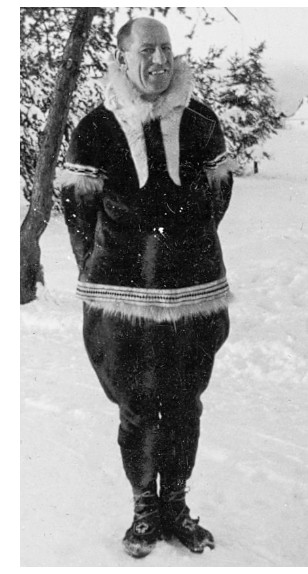
The photo of W.H.B. Hoare above was taken in 1929 at St. Peter's Indian Residential School at Lesser Slave Lake, Alberta. It is from the Arthur Henry Sovereign fonds at the archives of The General Synod of the Anglican Church of Canada. See other material about Mr. Hoare at that archives here.
|
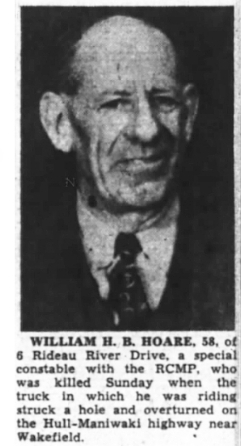
The brief notice to the right, from The Journal (Ottawa, Ontario) of Monday, August 16, 1948, was the entire news about Mr. Hoare's death. A private funeral was held, and he was buried at Merivale Cemetery, according to a photo of a Cowan family headstone at Ancestry. However, neither he nor Catherine is listed at FindaGrave in any of the 3 cemeteries at Merivale in Ottawa.
In July 1949, daughter Alicia J. S. Hoare married Richard Brown in Whitehorse, Yukon. See the wedding announcement and photo from The Ottawa Citizen of August 3, 1949 here.
Catherine Alicia Cowan Hoare, R.N., died in Ottawa on May 8, 1982, at the age of 94. She was buried at Merivale Cemetery according to the death notice in The Ottawa Citizen.
|
Books and Reports by W. H. B. Hoare
- "Report of investigations affecting Eskimo and wild life, District of Mackenzie, 1924-1925-1926" by W. H. B. Hoare (Dept. of the Interior, Northwest Territories and Yukon Branch, Ottawa, 1926).
- "Conserving Canada's musk-oxen, being an account of an investigation of Thelon game sanctuary 1928-29 with a brief history of the area and an outline of known facts regarding the musk-ox" by William H. B. Hoare; Rudolph Martin Anderson (King's Printer, Ottawa, 1930).
- Sanctuary (musk oxen) by W. H. B. Hoare (The Beaver, June 1939)
- "Journal of a Barrenlander: W.H.B. Hoare, 1928-1929" by W. H. B. Hoare (Sheila C. Thomson, Ottawa, 1990).
- "A Thelon odyssey: Journal of a Barrenlander and Return to the Barrens" by W. H. B. Hoare (McGahern Stewart Publishing, Ottawa, 2014).
Books and articles related to W. H. B. Hoare
|

|
