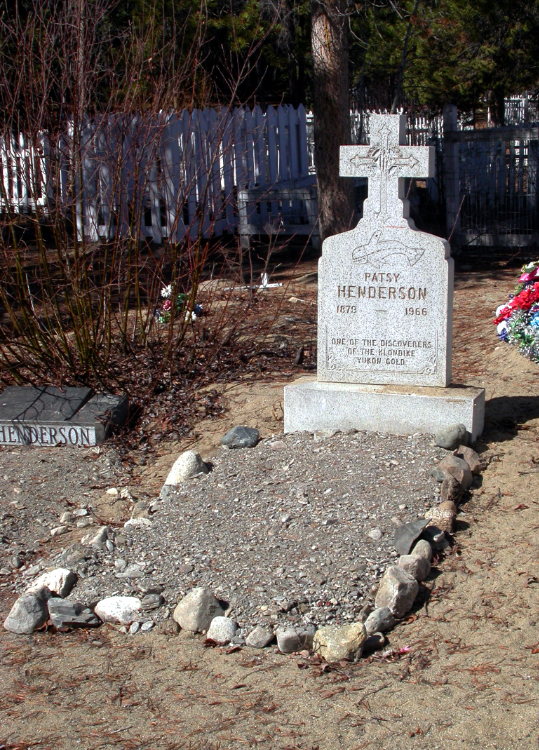
Patsy Henderson is dead. The last surviving member of the group which sparked the gold rush to the Klondike in 1896, died Friday at the Whitehorse General Hospital.
He suffered a stroke some months ago and had been in hospital ever since.
 The funeral service was conducted Monday by Archdeacon Arthur Privett, at Carcross St. Savior's Church, and Patsy was buried at the cemetery alongside Dawson Charlie, Skookum Jim and Kate Carmack.
Patsy Henderson was born around Tagish, Yukon, 84 years ago, and his Indian name was Kulsin, The name Patsy Henderson was given to him by George Carmack.
Though Patsy was a young boy at the time of the Klondike gold giscovery, he remembered the event all his life, and would relate the story to tourists he met at the
Carcross railway station.
He said that Dawson Charlie, his brother, was the man who found the first gold. Dawson Charlie's partner was Skookum Jim, Patsy's uncle. He said that George Carmack had come into the country in about 1888 over the Chilkoot Pass, and lived with the Indians for about five years, during which time he married Skookum Jim's sister Kate.
After a while George Carmack and his wife went down river, where they stayed for two years. Patsy then told how he, Dawson Charlie and Skookum Jim went to find Carmack. When they got to the Klondike, they found George and set up fish traps to catch fish for the winter and for the dogs.
George Carmack told them that he had met a man called Bob Henderson who had found some gold, so they decided to go look for him, while Patsy stayed at the camp on the Klondike and looked after the traps and the dogs. Dawson Charlie spotted the first gold, a ten cent nugget, about eight miles from camp.
The three found Bob Henderson's camp, stayed one night, then came back of another creek,.They panned for gold at various spots, and half way down the creek, they rested at the top of a bank while Skookum Jim went to get a drink of water. He saw some gold in the steam, and told George to bring down a shovel and gold pan. George Carmack
panned the stream, found about fifty cents worth, then tried again above and below the spot, where he then found $5.00's worth of coarse gold. George said that he thought they had a good place, and staked for three people, calling the creek "Bonanza".
When they got back to the Klondike camp, Patsy Henderson said he didn't pay much attention to the gold, because he didn't understand. The next day they went down to Forty Mile to record the claims.
They returned to the Klondike, moved the camp to Bonanza and built a sluice box. They started work in September and in three weeks, took out $1450. It became very cold so they returned to Forty Mile for the winter. They told people of the discovery, and the rush started.
Patsy Henderson said he remembered that the big rush went on for two years steady, and that at one time, there were 20,000 people around Bennett and Tagish Lakes.
WIDOW ALONE
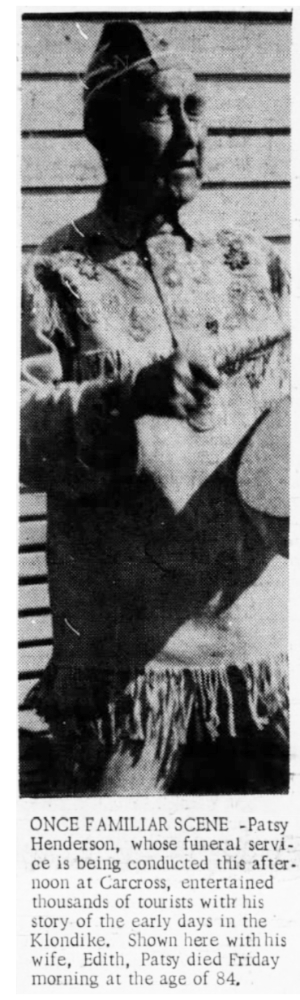
Patsy's widow, Edith Henderson, lives at Carcross, surrounded by grandchildren and other family, including her sister, Mrs. Frank Williams. She and Patsy had two children, Irene, who died in her teens, and Lily, who married Buck Dickson. Both are now dead and buried in the Carcross Cemetery.