"You can't work with people properly unless you make their sorrows your own," and Deaconess Hilda A. Hellaby has followed this maxim throughout fifty years as a church worker.
Born in England, Miss Hellaby came to Canada with her mother and sister as a small girl. She joined the staff of the Anglican Chinese Mission on Georgia Street, East, on January 1, 1920 learning first-hand that "missionaries don't keep holidays!"
Not only did she teach English in night school and at a kindergarten class but also learned the Cantonese dialect from a returned missionary who was, at that time, Superintendent of Chinese Missions in B.C.
Miss Hellaby lived at first with her mother in the Kerrisdale district of Vancouver, but later moved close to the Chinese Mission. In 1927 she attended Anglican Theological College but kept on with the kindergarten and added home visiting to her agenda.
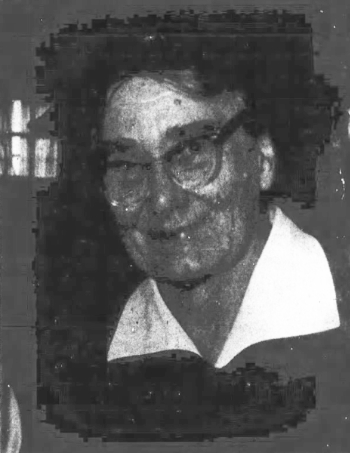
DR. HILDA HELLABY: She's a Doctor of Divinity, a Deaconess in the Anglican Church of Canada, friend to hundreds of northerners and "Mum" to many native prisoners. Next Sunday Hilda Hellaby observes her 50th anniversary of service to the church, and the Diocese of Yukon is holding an Open House in the Anglican Parish Hall in Whitehorse when all her friends are invited to come and share the happy occasion with her.
"It was not all jam by any means, but I liked it," Miss Hellaby recalls, "It was always interesting."
Educated at home by her mother, she nevertheless excelled in Greek and Latin, became a Deaconness in July, 1928, got her L. Th. (Licentiate in Theology) in 1930 and was honored by the awarding of a D.D. (Doctor of Divinity) in 1964 from Vancouver's Anglican Theological College.
The Depression, in 1929 brought people down from the clouds of rich and riotous living, with a bang. It was so sudden, in fact, that the government was in no way ready to act, to offer aid, or ways and means of providing jobs. Church agencies and volunteer groups first took over Relief Work. With people unemployed, drifting, sleeping under bridges and in parks and doorways, the need was great.
Even the ever-provident Chinese were stricken and the government asked the people of the Chinese Mission to take over Chinese Relief. This was, at first, "a mere nothing" but in the depth of Depression the Mission looked after as many as 1200 needy souls.
A system evolved whereby the government provided meals and bed-tickets so that men who did have a chance to work were physically capable of doing the job.
As Miss Hellaby was fluent in Cantonese, the brunt of the work fell on her - to interpret when people in need went to register at the Welfare Department, to keep track of meals and medical bills etc., which would then be paid by the government. She was assisted in all this work by white boys at the Mission and the Chinese cooks.
Financial assistance and guidance was provided first by civic authority, then provincial and then federal. The terms of unemployment-assistance have changed through the years, from Relief to Social Assistance to Welfare, but the picture of people in need is the same today, Miss Hellaby feels. It is a sub-culture of a single, drifting working force with no place in society.
OUTSIDE - LOOKING IN.
In 1929, the men in this drifting tide gave no names, had no identification. They had no money, not even to buy a postage stamp for a letter home. They had no food, and often no place to stay. They were "peop-
le on the outside, looking in."
And it still goes on, the faceless, nameless drifters, living in lonely rooms with only the comforts of beer parlours open to them, the shallow acquaintance of bar-flies for company. When the beer parlours close these men have no place to go - a sense of being "outside" that grows particularly painful at Christmas.
At the Mission, relief work lasted until World War Two was well underway. Only then, about 1943, were jobs found for all the employable people. However, many Chinese had been brought to Canada to work on railway and were, by then, old and destitute. The Chinees Mission wound up its relief work by giving direct assistance to the old and sick.
During the War, Miss Hellaby went back to ordinary parish duties in the Chinese Mission, excepting for short periods when she was on loan to Vernon, B.C. helping there during the rector's illness.
TIME FOR CHANGE
About then she felt the need to make a change. When an emergency arose in the Yukon she went to Dawson City. Accompanied by her adopted daughter (who is married and living in Keno) she worked at the old Hostel for a two-month stint that became a year, from summer 1950 - 1952.
When the clergyman at Mayo drowned while out fishing, Miss Hellaby was asked by Bishop Greenwood to take over until a man was found. He requested also, that she re-open the Indian Day School, in 1952, at the village which was then three miles from Mayo. when it was decided to integrate the children of the Day School into the Mayo School, the village was moved inside the townsite. Miss Hellaby stayed on until a vacancy appeared in the parish of Carmacks and Pelly, where she lived and worked until the summer of 1967.
BUILT NEW CHURCH
The Pelly Church was built while she was there, by local Indian men under the direction of "a good log man," Irvine Armstrong. With every tree grown in the parish, and every log squared with a broad axe, the Pelly Church is a good example of old time log-work. The church furniture was brought over from Fort Selkirk where the people who are now located at Pelly, used to live.
Miss Hellaby also bought a cabin for herself at Mayo, where she hoped to retire, but sold it after moving to Whitehorse.
Bishop Marsh left Yukon in 1967 and suggested then that she come to Whitehorse and look after the office until the arrival of a new Bishop. Her work was endorsed by Bishop John T. Frame, who asked her to stay on as his Secretary.
Miss Hellaby helps with church services, continues her work in the parish and visits the Whitehorse Correctional Institute. She also corresponds with and visits Yukoners in institutions outside , at present numbering about twenty, both Indian and
white. Miss Hellaby reminds us, "These people don't like feeling that everyone has forgotten them. In particular, they want the Whitehorse Star, so they know what is going on in their town and territory."
Transportation has brought about the biggest change over the years, Miss Hellaby feels. Opening up new roads, the increase in trucking and air routes and services all have opened up the villages to outside influences. Although many of these outside influcences have not been good, the educational opportunities are to the good, opening many doors to those people who take advantage of them.
Eighteen years ago, when she first came to the Yukon, almost everyone lived in log cabins, burned wood and enjoyed a complete and self-sufficient community life. Now most live in houses, burn oil, and enjoy running water and inside plumbing. They can also leave their villages more readily, for White- horse or outside, making for
increased knowledge of places and people.
AGE IS NO BARRIER
"I was well over fifty years before I even saw the north," Miss Hellaby says. "This is a very good place to grow old in because there is so much to do, and age is no barrier. For instance, when my sister came to visit me, she was over seventy and was immediately offered two jobs.
Her own activities today include Family Counselling, the Operating Committee at Skookum Jim Hall and the Yukon Social Service Society, along with her church work, These organizations and others, could just as easily involye anyone interested in
Yukon.
As well, the government sees the value of keeping its older people in the territory, as their knowledge and past experience can contribute largely to the advancement of Yukon and tries make it easy for them to stay.
Miss Hellaby is most grateful for a long and purposeful life. She has found her years in Yukon most satisfying - so much so, in fact, that when the time comes, she says she will be happy to be "Planted in the perma-frost."
Deaconness Hilda Hellaby's half-century of church work will be recognized at an Open House on Sunday, January 4, the Sunday nearest her fifty years anniversary. It is hoped that everyone will come by the Anglican Parish Hall to wish her another long term of good health and work in the service of the church, and the people of the Yukon.
Iris Warner
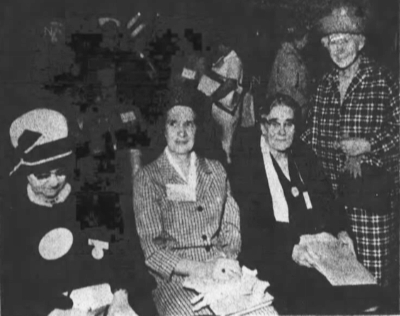
IN DEMAND AS A SPEAKER; Dr. Hilda Hellaby is always a popular speaker at church gatherings outside, as well as in the Yukon, and she never fails to bring something sincere and practical to her listeners, who number in the thousands over the years. This picture was taken at meetings of the Dominion Board of the the Anglican Women's Auxiliary in Victoria in 1966, when the Yukon worker was one of the speakers, On her right is Mrs. H. J. Taylor, delegate from the Diocese of Yukon.
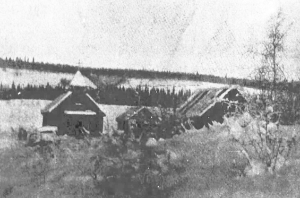
THE PELLY CHURCH: This little log church at Pelly Crossing was built when Hilda Hellaby was in charge of the mission which serves the people who from Selkirk when the highway
replaced the river as the main transportation route, It is called the church of St. James, the Brother of Jesus.







